
Why Is Crypto Going Up? Clarity Act Pushes XRP Price to 2-Month High as Bitcoin, Dogecoin and Ethereum Follow

Friday, 15/05/2026 | 07:36 GMT by Damian Chmiel
  • Senate Banking advanced the Clarity Act 15-9 Thursday. BTC, XRP, ETH and DOGE all sit below their 200 EMAs on Friday, May 15.
  • Bitcoin at $79.6K, XRP $1.42, ETH $2.25K, DOGE $0.114. Every major sits inside tight consolidation despite the bullish vote.
  • Polymarket prices 62-73% odds of 2026 passage. Citi targets $143K BTC and Standard Chartered $8 XRP if the bill becomes law.
Smartphone screen with different cryptos icons like apps
Why is crypto going up today? Let's check current Bitcoin, Ethereum, XRP and Dogecoin prices

Bitcoin, XRP, Ethereum and Dogecoin all trade lower on Friday, May 15, 2026, the morning after the US Senate Banking Committee voted 15-9 to advance the Digital Asset Market Clarity Act. BTC sits at $79,611, down 1.48%, after closing above $81,000 on Thursday. XRP changes hands at $1.42, down 1.55%, after intraday strength to $1.55.

ETH trades at $2,256, down 1.28%. DOGE holds near $0.1145. Every major asset remains locked inside the tight consolidation ranges that defined the week.

The bipartisan committee vote was the bullish catalyst the market had been waiting on for months. The price reaction is not the breakout that catalyst implied. My chart work shows all four assets pinned below their respective 200-day exponential moving averages, with Thursday's rally rejected at every relevant overhead level.

Follow me on X for real-time crypto market analysis: @ChmielDk

Why Crypto Rallied? The Clarity Act Unblocking

The Senate Banking Committee cleared the 309-page Digital Asset Market Clarity Act on Thursday, May 14, in a 15-9 bipartisan vote at 10:30 AM EST. Democrats Ruben Gallego and Angela Alsobrooks crossed over to join all 13 Republicans, on a markup that the FinanceMagnates.com breaking coverage detailed in full. The bill now moves to a full Senate floor vote requiring 60 votes, then House reconciliation with H.R. 3633 passed in July 2025.

What the bill does for digital assets, the FinanceMagnates.com Clarity Act explainer breaks down. It codifies the SEC and CFTC March 17 joint commodity classification of XRP, Bitcoin and Ethereum into federal law, removing the legal overhang that has kept institutional capital sidelined.

"The upcoming legislation is likely to have three key effects," said Paul Howard, Senior Director at Wincent. Howard expects regulatory clarity to act as a "net positive for Bitcoin over the medium to long term," with allowing yield-bearing stablecoins potentially driving a bullish second half.

Bitcoin (BTC) Technical Analysis: Cage Breaks at $82K or Returns to the 50 EMA

In 15 years analyzing crypto and CFD markets, I've rarely seen four majors simultaneously frozen this tight under their 200 EMAs on a bullish regulatory catalyst. As I wrote in my Wednesday analysis on Bitcoin stuck below the 200 EMA at $82,000, the volatility cage is the dominant feature of this tape, not the Clarity Act headline.

Thursday's session delivered a 2%+ gain that closed BTC above $81,000. Friday's 0.6% pullback leaves price inside the same consolidation range that has defined trading since early May. The 200 EMA continues to act as the lid.
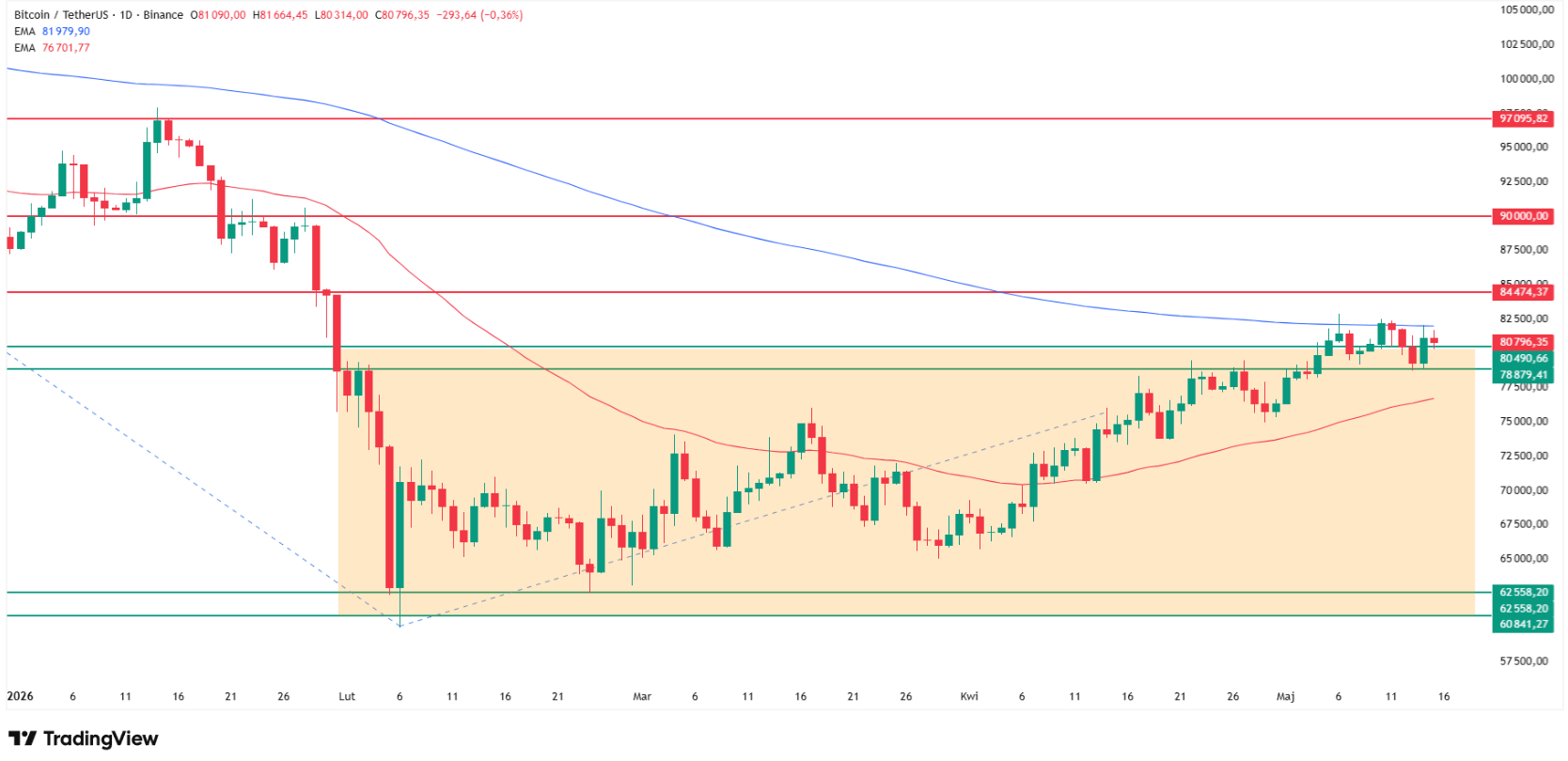
Why Bitcoin is going up? Source: Tradingview.com

A daily close above opens the corridor to $85,000, which marked the November and December 2024 lows. Below the current range, the 50 EMA at $77,000 is the next test.

"We are watching $82,000 most closely this week," said Adam Haeems, Head of Asset Management at Tesseract Group. He flagged it as the 200-day moving average and the top of the recent range. A daily close above opens a corridor to $85,000 and then $90,000 in his framework, while failure brings $76,000, $73,000 and $70,000 back into the frame.

Howard pegged technical support around $79,000 and resistance near $82,500, consistent with my chart and with where the 200 EMA cluster sits.

XRP Technical Analysis: Biggest Reaction, Most Familiar Rejection

XRP was the strongest reactor to Thursday's vote. The token climbed as much as 8% intraday and tested $1.55, the highest print since March 17, before closing the session with a 4% gain. Friday brings a 1% pullback to below $1.47.

That intraday spike ran straight into the same supply zone that has rejected XRP four times since February.

As I documented in my analysis published this Monday before the markup vote, the $1.51 to $1.57 ceiling has held in mid-February, mid-March, mid-April, and now mid-May. Every prior contact with this level was followed by a return to the lower boundary of the range near $1.30.
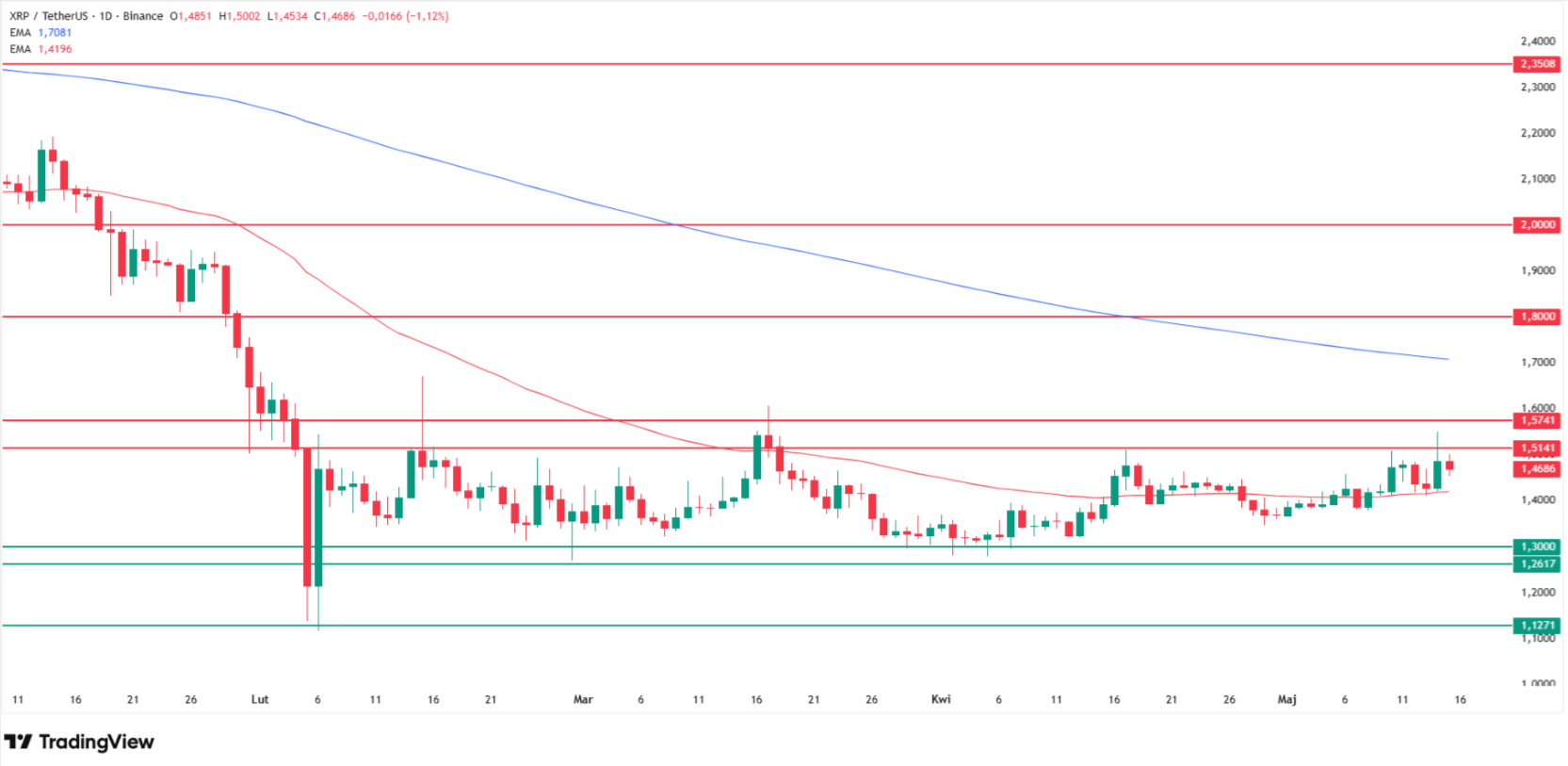
Why XRP is going up? Source: Tradingview.com

The chart structure is unchanged by the headline. My downside reference remains the $1.30 floor, with the deeper $0.53 scenario active only on a clean break below it and a stalled bill. The structural bull case still requires a clean daily close above $1.57 to unlock the $1.70 short-term target cited by 24/7 Wall Street, with $3 to $5 conditional on full Senate passage and ETF inflows scaling.

Ethereum (ETH) Technical Analysis: Balancing on the 50 MA at One-Year Lows

Ethereum took the Clarity Act vote with the smallest reaction of the four majors. ETH climbed 3% intraday Thursday before closing with a 1% gain. Friday brings a 1.2% pullback to $2,255, balancing on the 50-day moving average.

The structure is consolidation at the lowest levels in a year, not a base-building setup. As my February analysis of the ETH break below $2,000 detailed, the range between $1,760 support (February lows) and $2,380 resistance (March highs) has held intact through repeated tests in April and May. The bears have rejected every upside attempt at $2,380.
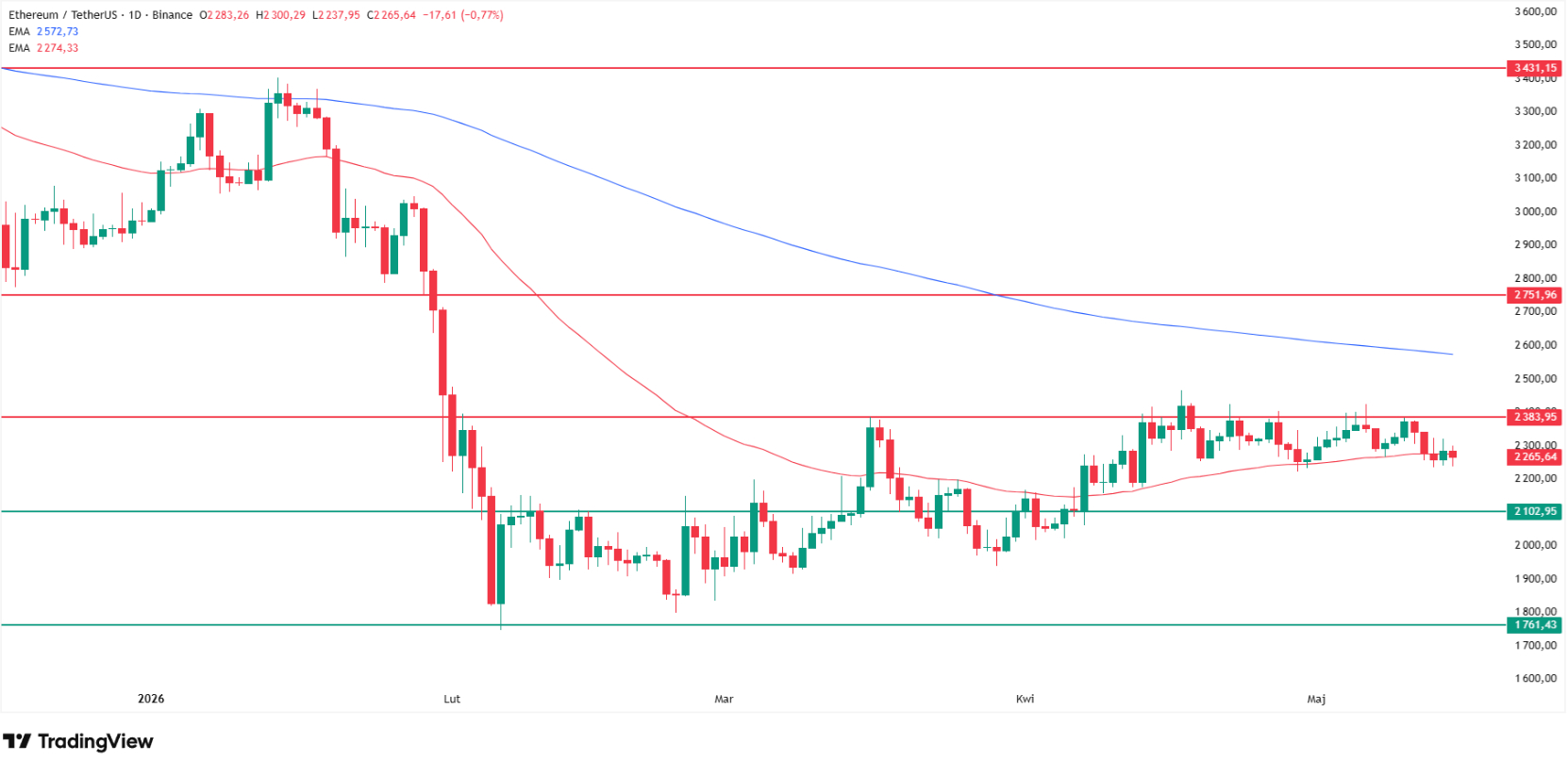
Why Ethereum is going up? Source: Tradingview.com

Even a clean break of $2,380 does not unlock a directional move. The 200 EMA sits at $2,600 as the next ceiling, and the $2,750 area, which marked the November and December 2024 lows, becomes the structural resistance above that. The trend remains down.

Standard Chartered's $7,500 end-2026 target requires this entire ladder to be cleared, and the chart shows no evidence that capacity yet exists.

Dogecoin (DOGE) Technical Analysis: Narrowest Range, Weakest Structure

Dogecoin briefly tested $0.12 on Thursday, the highest level since January, before giving back 2.5% into the close. Friday brings further modest losses, with DOGE trading near $0.1145. As my prior multi-asset crypto coverage flagged, the upper boundary of the current range has now been tested twice in May.

The main support sits just below $0.09, marking the February, March and April lows. The chart structure is unambiguous: tight range, lowest levels of 2024, no break of the downtrend. Of the four majors, DOGE has the least technical room for any directional move in either direction.
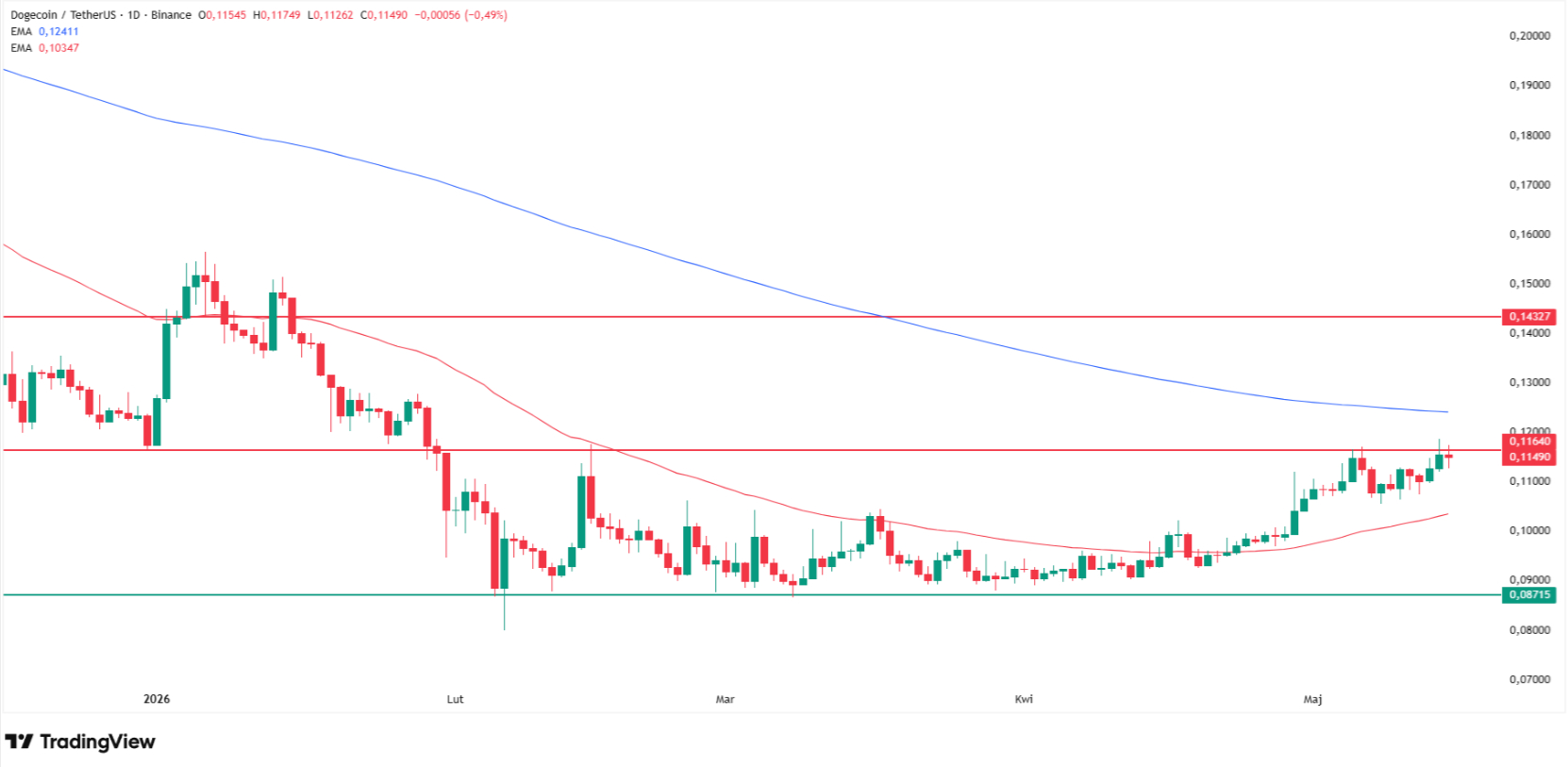
Why Dogecoin is going up? Source: Tradingview.com

That structural weakness fits Haeems' point about ETF flow durability rather than retail momentum being the marginal price setter in 2026. Meme tokens depend on the retail bid that 2026 has not delivered. Without it, DOGE keeps grinding inside this cage.

FAQ

Why did Bitcoin not break out after the Clarity Act vote?

Bitcoin closed Thursday above $81,000 but the 200 EMA at roughly $82,000 has acted as a ceiling since early May. The committee vote moves the bill forward, but full Senate passage requires 60 votes including at least seven Democrats. Citi's $143,000 BTC target is conditional on the law actually being signed, not just clearing committee.

What is the next resistance for XRP?

XRP's primary overhead supply sits between $1.51 and $1.57. That band has rejected price in mid-February, mid-March, mid-April, and again on May 14 after the Thursday vote. A daily close above $1.57 would activate the $1.70 target cited by 24/7 Wall Street, with Standard Chartered's $8.00 contingent on full Senate passage and $10 billion in ETF inflows.

Will Ethereum recover above $2,380 in 2026?

The $2,380 level marks the March highs and has been tested unsuccessfully in April and May. Above it, the 200 EMA at $2,600 is the next ceiling, then the $2,750 area from November and December 2024 lows. Standard Chartered's $7,500 end-2026 target requires this entire ladder to clear. The chart structure does not yet show momentum for it.

What is the main support for Dogecoin?

DOGE's main support sits just below $0.09, which marked the February, March and April lows. The current $0.1145 keeps price inside a narrow consolidation that has formed at the lowest levels of 2024. The upper boundary near $0.12 has been tested twice in May without a clean break. The structure remains a downtrend with no upside resolution yet.

Bitcoin, XRP, Ethereum and Dogecoin all trade lower on Friday, May 15, 2026, the morning after the US Senate Banking Committee voted 15-9 to advance the Digital Asset Market Clarity Act. BTC sits at $79,611, down 1.48%, after closing above $81,000 on Thursday. XRP changes hands at $1.42, down 1.55%, after intraday strength to $1.55.

ETH trades at $2,256, down 1.28%. DOGE holds near $0.1145. Every major asset remains locked inside the tight consolidation ranges that defined the week.

The bipartisan committee vote was the bullish catalyst the market had been waiting on for months. The price reaction is not the breakout that catalyst implied. My chart work shows all four assets pinned below their respective 200-day exponential moving averages, with Thursday's rally rejected at every relevant overhead level.

Follow me on X for real-time crypto market analysis: @ChmielDk

Why Crypto Rallied? The Clarity Act Unblocking

The Senate Banking Committee cleared the 309-page Digital Asset Market Clarity Act on Thursday, May 14, in a 15-9 bipartisan vote at 10:30 AM EST. Democrats Ruben Gallego and Angela Alsobrooks crossed over to join all 13 Republicans, on a markup that the FinanceMagnates.com breaking coverage detailed in full. The bill now moves to a full Senate floor vote requiring 60 votes, then House reconciliation with H.R. 3633 passed in July 2025.

What the bill does for digital assets, the FinanceMagnates.com Clarity Act explainer breaks down. It codifies the SEC and CFTC March 17 joint commodity classification of XRP, Bitcoin and Ethereum into federal law, removing the legal overhang that has kept institutional capital sidelined.

"The upcoming legislation is likely to have three key effects," said Paul Howard, Senior Director at Wincent. Howard expects regulatory clarity to act as a "net positive for Bitcoin over the medium to long term," with allowing yield-bearing stablecoins potentially driving a bullish second half.

Bitcoin (BTC) Technical Analysis: Cage Breaks at $82K or Returns to the 50 EMA

In 15 years analyzing crypto and CFD markets, I've rarely seen four majors simultaneously frozen this tight under their 200 EMAs on a bullish regulatory catalyst. As I wrote in my Wednesday analysis on Bitcoin stuck below the 200 EMA at $82,000, the volatility cage is the dominant feature of this tape, not the Clarity Act headline.

Thursday's session delivered a 2%+ gain that closed BTC above $81,000. Friday's 0.6% pullback leaves price inside the same consolidation range that has defined trading since early May. The 200 EMA continues to act as the lid.

Why Bitcoin is going up? Source: Tradingview.com

A daily close above opens the corridor to $85,000, which marked the November and December 2024 lows. Below the current range, the 50 EMA at $77,000 is the next test.

"We are watching $82,000 most closely this week," said Adam Haeems, Head of Asset Management at Tesseract Group. He flagged it as the 200-day moving average and the top of the recent range. A daily close above opens a corridor to $85,000 and then $90,000 in his framework, while failure brings $76,000, $73,000 and $70,000 back into the frame.

Howard pegged technical support around $79,000 and resistance near $82,500, consistent with my chart and with where the 200 EMA cluster sits.

XRP Technical Analysis: Biggest Reaction, Most Familiar Rejection

XRP was the strongest reactor to Thursday's vote. The token climbed as much as 8% intraday and tested $1.55, the highest print since March 17, before closing the session with a 4% gain. Friday brings a 1% pullback to below $1.47.

That intraday spike ran straight into the same supply zone that has rejected XRP four times since February.

As I documented in my analysis published this Monday before the markup vote, the $1.51 to $1.57 ceiling has held in mid-February, mid-March, mid-April, and now mid-May. Every prior contact with this level was followed by a return to the lower boundary of the range near $1.30.

Why XRP is going up? Source: Tradingview.com

The chart structure is unchanged by the headline. My downside reference remains the $1.30 floor, with the deeper $0.53 scenario active only on a clean break below it and a stalled bill. The structural bull case still requires a clean daily close above $1.57 to unlock the $1.70 short-term target cited by 24/7 Wall Street, with $3 to $5 conditional on full Senate passage and ETF inflows scaling.

Ethereum (ETH) Technical Analysis: Balancing on the 50 MA at One-Year Lows

Ethereum took the Clarity Act vote with the smallest reaction of the four majors. ETH climbed 3% intraday Thursday before closing with a 1% gain. Friday brings a 1.2% pullback to $2,255, balancing on the 50-day moving average.

The structure is consolidation at the lowest levels in a year, not a base-building setup. As my February analysis of the ETH break below $2,000 detailed, the range between $1,760 support (February lows) and $2,380 resistance (March highs) has held intact through repeated tests in April and May. The bears have rejected every upside attempt at $2,380.

Why Ethereum is going up? Source: Tradingview.com

Even a clean break of $2,380 does not unlock a directional move. The 200 EMA sits at $2,600 as the next ceiling, and the $2,750 area, which marked the November and December 2024 lows, becomes the structural resistance above that. The trend remains down.

Standard Chartered's $7,500 end-2026 target requires this entire ladder to be cleared, and the chart shows no evidence that capacity yet exists.

Dogecoin (DOGE) Technical Analysis: Narrowest Range, Weakest Structure

Dogecoin briefly tested $0.12 on Thursday, the highest level since January, before giving back 2.5% into the close. Friday brings further modest losses, with DOGE trading near $0.1145. As my prior multi-asset crypto coverage flagged, the upper boundary of the current range has now been tested twice in May.

The main support sits just below $0.09, marking the February, March and April lows. The chart structure is unambiguous: tight range, lowest levels of 2024, no break of the downtrend. Of the four majors, DOGE has the least technical room for any directional move in either direction.

Why Dogecoin is going up? Source: Tradingview.com

That structural weakness fits Haeems' point about ETF flow durability rather than retail momentum being the marginal price setter in 2026. Meme tokens depend on the retail bid that 2026 has not delivered. Without it, DOGE keeps grinding inside this cage.

FAQ

Why did Bitcoin not break out after the Clarity Act vote?

Bitcoin closed Thursday above $81,000 but the 200 EMA at roughly $82,000 has acted as a ceiling since early May. The committee vote moves the bill forward, but full Senate passage requires 60 votes including at least seven Democrats. Citi's $143,000 BTC target is conditional on the law actually being signed, not just clearing committee.

What is the next resistance for XRP?

XRP's primary overhead supply sits between $1.51 and $1.57. That band has rejected price in mid-February, mid-March, mid-April, and again on May 14 after the Thursday vote. A daily close above $1.57 would activate the $1.70 target cited by 24/7 Wall Street, with Standard Chartered's $8.00 contingent on full Senate passage and $10 billion in ETF inflows.

Will Ethereum recover above $2,380 in 2026?

The $2,380 level marks the March highs and has been tested unsuccessfully in April and May. Above it, the 200 EMA at $2,600 is the next ceiling, then the $2,750 area from November and December 2024 lows. Standard Chartered's $7,500 end-2026 target requires this entire ladder to clear. The chart structure does not yet show momentum for it.

What is the main support for Dogecoin?

DOGE's main support sits just below $0.09, which marked the February, March and April lows. The current $0.1145 keeps price inside a narrow consolidation that has formed at the lowest levels of 2024. The upper boundary near $0.12 has been tested twice in May without a clean break. The structure remains a downtrend with no upside resolution yet.

About the Author: Damian Chmiel
Damian Chmiel
  • 3549 Articles
  • 110 Followers
About the Author: Damian Chmiel
Damian Chmiel is a Senior Analyst & Editor at Finance Magnates with more than 15 years of experience in the CFD and online trading industry. Active as both a trader and journalist since 2010, he focuses on broker coverage, fintech innovation, and regulatory developments across Europe, the Middle East, and Asia. His work includes interviews with C-level leaders at major brokerages and fintech platforms, as well as co-authoring Finance Magnates’ quarterly industry benchmarking reports. Damian’s reporting is data-driven, market-aware, and grounded in direct industry engagement. His analysis and commentary have also been cited by external media outlets, including Investing.com, Binance, The Asset, Stockhead, and Dispatch. Education: MA in Finance and Accounting, Cracow University of Economics
  • 3549 Articles
  • 110 Followers

More from the Author

Trending

!"#$%&'()*+,-./0123456789:;<=>?@ABCDEFGHIJKLMNOPQRSTUVWXYZ[\]^_`abcdefghijklmnopqrstuvwxyz{|} !"#$%&'()*+,-./0123456789:;<=>?@ABCDEFGHIJKLMNOPQRSTUVWXYZ[\]^_`abcdefghijklmnopqrstuvwxyz{|}