
BTC Risks 40% Drop to $45K According to This Bitcoin Price Prediction

Monday, 01/06/2026 | 08:43 GMT by Damian Chmiel
  • Bitcoin traded below $73,000 on Monday, June 1, 2026, down more than 1% and holding near its weakest level since mid-April's swing low.
  • My Fibonacci extension targets the $45,000 area, almost 40% below current prices and the 100% extension level, while the downtrend holds.
Bitcoin crypto
Let's check the current Bitcoin price predictions

Bitcoin (BTC) traded below $73,000 on Monday, June 1, 2026, down more than 1% as it opened the week near its lowest level since mid-April, roughly a month and a half of price erosion. The move keeps BTC under both the 50 and 200 exponential moving averages and back inside the consolidation that has capped the market since February.

My read has not changed: the primary trend points lower, and the next measured objective sits near $45,000, almost 40% below current levels.

Bitcoin spot ETFs closed May with $2.30 billion in net outflows, the largest monthly exit of 2026, putting Fed policy and Treasury yields at the center of this week's catalysts.

Follow me on X for real-time market analysis: @ChmielDk

Bitcoin Technical Analysis: The BTC/USD Trend Stays Down

Bitcoin slipped back below the 50-day exponential moving average at $76,088 and remains well under the 200 EMA at $80,993, a configuration that has defined the tape since the February breakdown.

On my chart I marked the local resistance with a dashed line drawn across the lows of recent sessions. That ceiling rarely survives in the medium term, and my analysis points to BTC drifting toward the $63,000-$65,000 support zone, the February-to-April floor.

In 15 years covering crypto and metals, I have learned that the 200 EMA rarely lies about trend regime, and right now it sits above price as resistance rather than support. You can follow my full archive on my analyst page, Damian Chmiel.
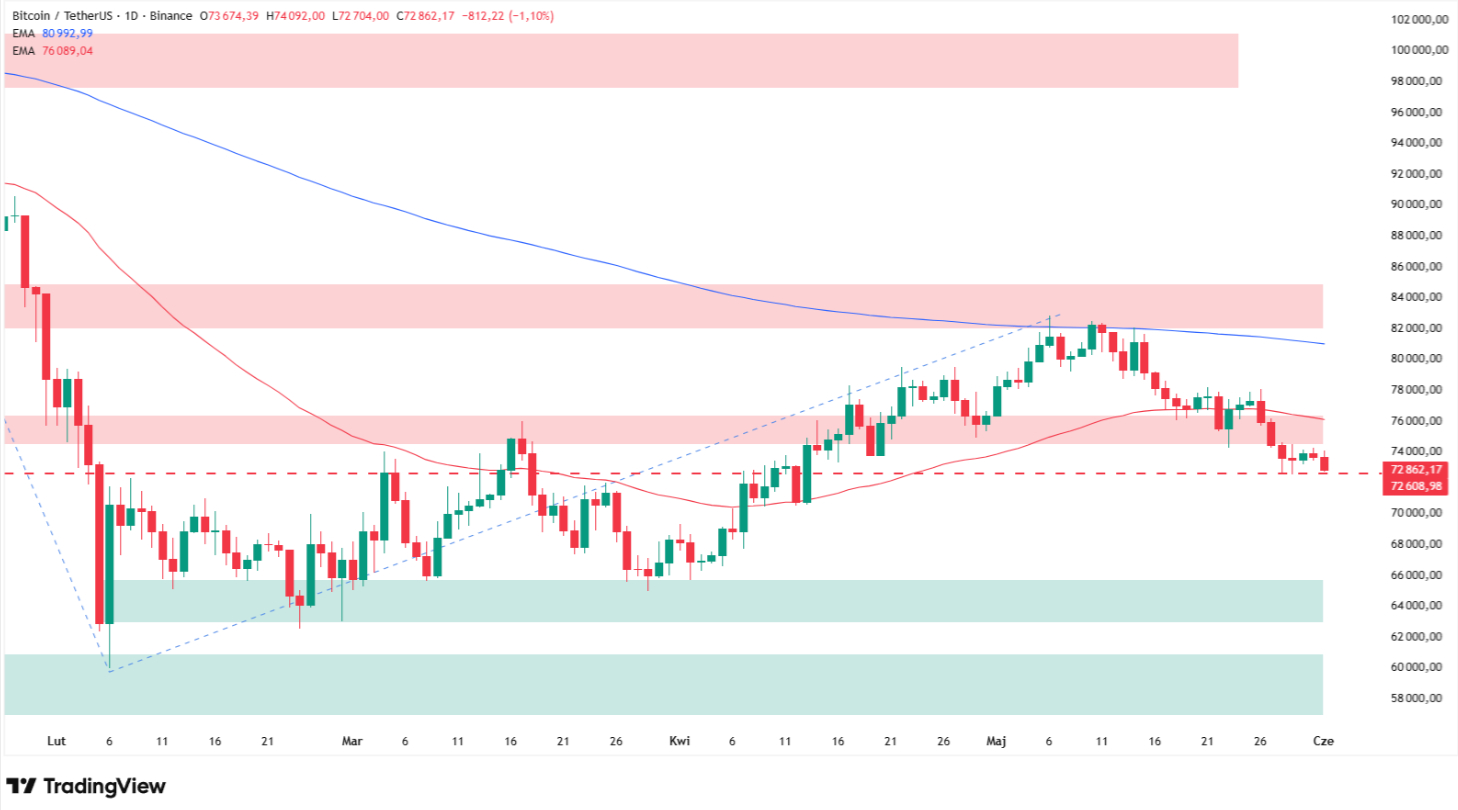
BTC/USDT daily, consolidation since February with price pinned under the 50 EMA. Source: TradingView

To pull pressure off the bulls, price needs to reclaim the $74,000-$76,000 band, reinforced by that same 50 EMA. Even then, a heavier wall arrives fast at the $81,000-$85,000 zone, built by the 200 EMA together with the November-December 2025 lows.

That band is the real divider between the broken uptrend and the active downtrend, and until it gives way, every rally is a sell candidate in my framework. As I argued in my March analysis, the burden of proof stays with the bears while these levels cap the market.

Level

Type

Notes

$45,000

Target / 100% Fib extension

Measured downside objective, 2024 structure

$63,000-$65,000

Support

February-April floor, next downside stop

$74,000-$76,000

Resistance / 50 EMA

Reclaim needed to ease pressure

$81,000-$85,000

Resistance / 200 EMA

November-December 2025 lows, trend divider

How Low Can Bitcoin Go? Fibonacci Extension to $45,000

Stretching a Fibonacci extension grid across the bearish impulse from January and then over the correction that ran from February to early May, the 100% extension lands near $45,000.

That zone overlaps the structure built in 2024, where the $50,000 area first acted as a local top and later as a floor. From current prices, that leaves Bitcoin almost 40% of room to fall, and it stays my long-term bearish bet while the primary trend points lower.
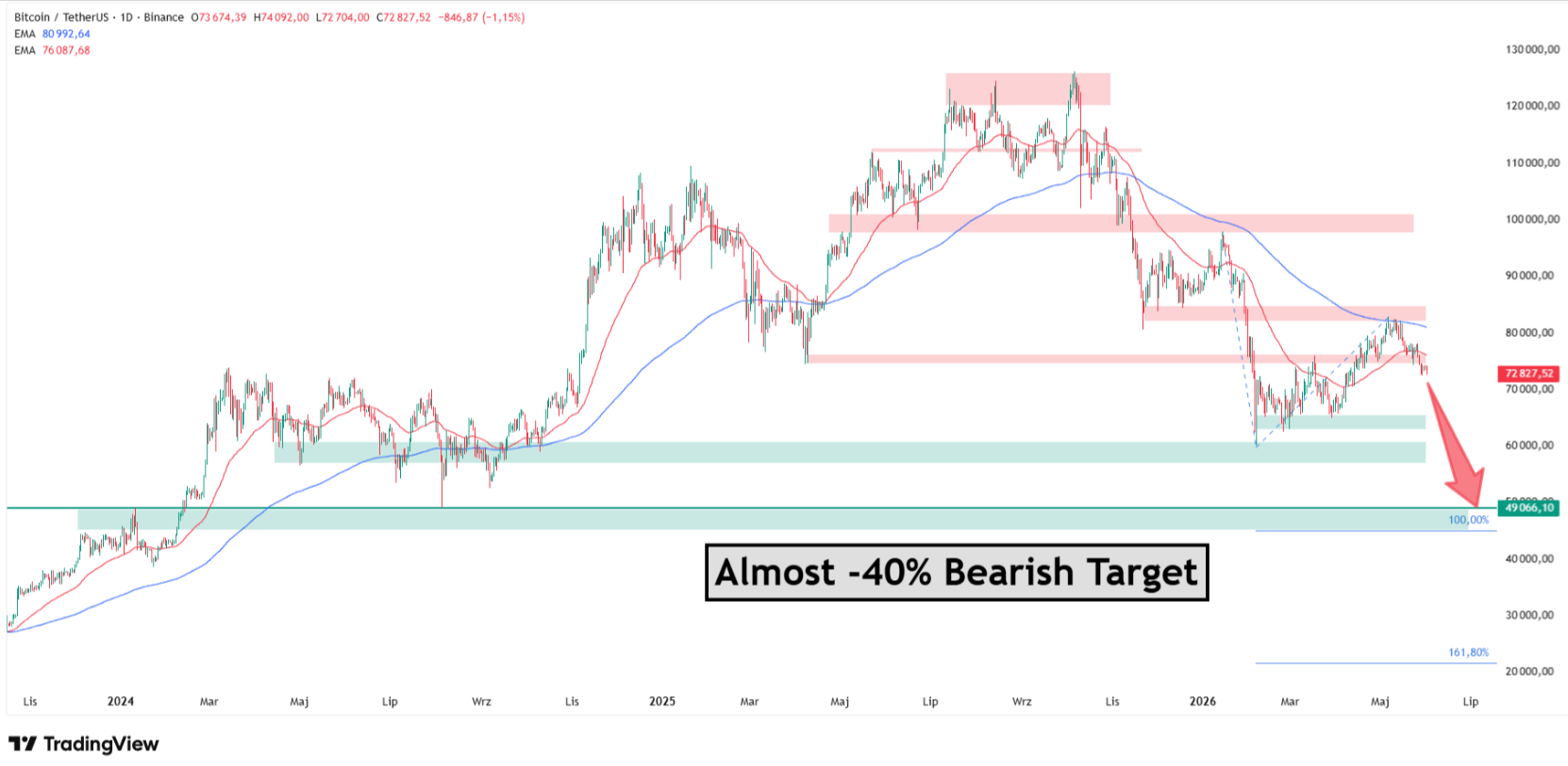
BTC/USDT daily, Fibonacci extension projecting a bear target toward the $45-50K. Source: TradingView

I am not ruling out a deeper slide if conditions allow, since the 161.8% extension projects toward the low-$20,000s on the same grid. As my earlier Fibonacci extension work mapped the upside targets, the same tool inverted now points down, and a full 100% retracement of the year's move reads as the base case for the bears, not a tail risk.

Why It Is Happening

The selling has a clear macro spine. Bitcoin spot ETFs shed $2.30 billion in May, the biggest monthly outflow of 2026 and the steepest since November 2025, as April CPI hit 3.8% and PPI jumped to 6%, the kind of prints that knocked Fed rate-cut bets off the table.

The 10-year Treasury yield near 4.7% and a firmer dollar have pulled capital toward income-producing assets, with BlackRock's IBIT alone losing $448 million in a single session during the May exodus. Bitcoin still trades with a high Nasdaq correlation when oil spikes, as I detailed in my April coverage of the Strait of Hormuz shock.

Joel Kruger, cryptocurrency strategist at LMAX Group, offers the counter-case. "May delivered a healthy reality check for crypto markets," Kruger said. He noted Bitcoin fell 3.58% in May and Ethereum dropped 11.17%, yet the weakness arrived while US equities held near record highs, pointing to a crypto-specific capital problem rather than broad risk-off.

The pullback triggered no mass liquidation, and Kruger argues much of the leverage that amplified past selloffs has already cleared, leaving positioning healthier and the asset class more mature.

Key drivers behind the move:

  • May ETF outflows of $2.30 billion, the largest monthly exit of 2026
  • April CPI at 3.8% and PPI at 6%, erasing 2026 rate-cut expectations
  • 10-year Treasury yield near 4.7%, strengthening the dollar
  • Kevin Warsh confirmed as Fed chair, keeping the policy outlook hawkish
  • US-Iran tensions and volatile oil prices reinforcing inflation fears

Bitcoin Price Predictions: Where I Stand Against the Street

External forecasts span a wide gap, and most assume a macro turn I do not yet see on the chart. Standard Chartered cut its target to $100,000 for year-end 2026 from $300,000, a downgrade that still requires a recovery my levels do not support while price sits under the 200 EMA.

Carol Alexander projects a $75,000-$150,000 range centered on $110,000, credible only if BTC first reclaims the $81,000-$85,000 band. On the bearish side, Benjamin Cowen places a new cycle low as his base case for October 2026, which aligns cleanly with my $45,000 objective.

Peter Brandt flags one more investable low in September-October 2026 that may break the $63,000 swing, and as my coverage of his forecast noted, that timing fits the seasonal weakness. The $200,000-plus bull cases from Bit Mining and Nexo stay parked until ETF flows turn positive, a point the January institutional roundup framed and the later report on cut targets confirmed when Goldman Sachs and Standard Chartered trimmed their numbers.

Source

Target

Notes

Damian Chmiel

$45,000

100% Fib extension, almost 40% downside while trend is down

Benjamin Cowen

New cycle low

Base case around October 2026

Peter Brandt

Low in Sep-Oct 2026

May break the $63,000 swing

Standard Chartered

$100,000 (YE 2026)

Cut from $300,000

Carol Alexander

$75,000-$150,000

$110,000 center

Bit Mining / Nexo

$200,000-$225,000

Bull case, conditional on Fed cuts and ETF inflows

Bitcoin Price Analysis, FAQ

Why is Bitcoin falling in June 2026?

Bitcoin trades below $73,000 after spot ETFs lost $2.30 billion in May, the worst month of 2026. April CPI at 3.8% and PPI at 6% erased Fed rate-cut bets, while the 10-year yield near 4.7% strengthened the dollar. Price sits under both the 50 and 200 EMAs, keeping the primary trend pointed lower.

How low can Bitcoin go in 2026?

My Fibonacci extension across the January impulse and the February-to-May correction projects a 100% target near $45,000, almost 40% below current prices and inside the structure built in 2024. The first downside stop is the $63,000-$65,000 support, the February-to-April floor. A deeper 161.8% extension points toward the low-$20,000s if selling accelerates.

What is the key resistance level for Bitcoin now?

The first hurdle is the $74,000-$76,000 band, reinforced by the 50 EMA at $76,088. The decisive level is the $81,000-$85,000 zone, built by the 200 EMA at $80,993 and the November-December 2025 lows. In my framework, that band separates the broken uptrend from the active downtrend, and rallies stay sells until it breaks.

Will Bitcoin recover in 2026?

A recovery needs Bitcoin to reclaim the $74,000-$76,000 band and close above the 200 EMA near $81,000, neither of which has happened. Standard Chartered targets $100,000 and Carol Alexander centers $110,000, but both assume a macro turn and positive ETF flows after May's $2.30 billion exit. Until those align, my bias stays lower.

What are analysts predicting for Bitcoin in 2026?

Forecasts span a wide range. Bit Mining and Nexo see $200,000-$225,000 in bull scenarios, Standard Chartered cut to $100,000, and Carol Alexander projects $75,000-$150,000. On the bearish side, Benjamin Cowen expects a new cycle low around October, and Peter Brandt flags another low in September-October that may break $63,000. My target sits at $45,000.

Bitcoin (BTC) traded below $73,000 on Monday, June 1, 2026, down more than 1% as it opened the week near its lowest level since mid-April, roughly a month and a half of price erosion. The move keeps BTC under both the 50 and 200 exponential moving averages and back inside the consolidation that has capped the market since February.

My read has not changed: the primary trend points lower, and the next measured objective sits near $45,000, almost 40% below current levels.

Bitcoin spot ETFs closed May with $2.30 billion in net outflows, the largest monthly exit of 2026, putting Fed policy and Treasury yields at the center of this week's catalysts.

Follow me on X for real-time market analysis: @ChmielDk

Bitcoin Technical Analysis: The BTC/USD Trend Stays Down

Bitcoin slipped back below the 50-day exponential moving average at $76,088 and remains well under the 200 EMA at $80,993, a configuration that has defined the tape since the February breakdown.

On my chart I marked the local resistance with a dashed line drawn across the lows of recent sessions. That ceiling rarely survives in the medium term, and my analysis points to BTC drifting toward the $63,000-$65,000 support zone, the February-to-April floor.

In 15 years covering crypto and metals, I have learned that the 200 EMA rarely lies about trend regime, and right now it sits above price as resistance rather than support. You can follow my full archive on my analyst page, Damian Chmiel.

BTC/USDT daily, consolidation since February with price pinned under the 50 EMA. Source: TradingView

To pull pressure off the bulls, price needs to reclaim the $74,000-$76,000 band, reinforced by that same 50 EMA. Even then, a heavier wall arrives fast at the $81,000-$85,000 zone, built by the 200 EMA together with the November-December 2025 lows.

That band is the real divider between the broken uptrend and the active downtrend, and until it gives way, every rally is a sell candidate in my framework. As I argued in my March analysis, the burden of proof stays with the bears while these levels cap the market.

Level

Type

Notes

$45,000

Target / 100% Fib extension

Measured downside objective, 2024 structure

$63,000-$65,000

Support

February-April floor, next downside stop

$74,000-$76,000

Resistance / 50 EMA

Reclaim needed to ease pressure

$81,000-$85,000

Resistance / 200 EMA

November-December 2025 lows, trend divider

How Low Can Bitcoin Go? Fibonacci Extension to $45,000

Stretching a Fibonacci extension grid across the bearish impulse from January and then over the correction that ran from February to early May, the 100% extension lands near $45,000.

That zone overlaps the structure built in 2024, where the $50,000 area first acted as a local top and later as a floor. From current prices, that leaves Bitcoin almost 40% of room to fall, and it stays my long-term bearish bet while the primary trend points lower.

BTC/USDT daily, Fibonacci extension projecting a bear target toward the $45-50K. Source: TradingView

I am not ruling out a deeper slide if conditions allow, since the 161.8% extension projects toward the low-$20,000s on the same grid. As my earlier Fibonacci extension work mapped the upside targets, the same tool inverted now points down, and a full 100% retracement of the year's move reads as the base case for the bears, not a tail risk.

Why It Is Happening

The selling has a clear macro spine. Bitcoin spot ETFs shed $2.30 billion in May, the biggest monthly outflow of 2026 and the steepest since November 2025, as April CPI hit 3.8% and PPI jumped to 6%, the kind of prints that knocked Fed rate-cut bets off the table.

The 10-year Treasury yield near 4.7% and a firmer dollar have pulled capital toward income-producing assets, with BlackRock's IBIT alone losing $448 million in a single session during the May exodus. Bitcoin still trades with a high Nasdaq correlation when oil spikes, as I detailed in my April coverage of the Strait of Hormuz shock.

Joel Kruger, cryptocurrency strategist at LMAX Group, offers the counter-case. "May delivered a healthy reality check for crypto markets," Kruger said. He noted Bitcoin fell 3.58% in May and Ethereum dropped 11.17%, yet the weakness arrived while US equities held near record highs, pointing to a crypto-specific capital problem rather than broad risk-off.

The pullback triggered no mass liquidation, and Kruger argues much of the leverage that amplified past selloffs has already cleared, leaving positioning healthier and the asset class more mature.

Key drivers behind the move:

  • May ETF outflows of $2.30 billion, the largest monthly exit of 2026
  • April CPI at 3.8% and PPI at 6%, erasing 2026 rate-cut expectations
  • 10-year Treasury yield near 4.7%, strengthening the dollar
  • Kevin Warsh confirmed as Fed chair, keeping the policy outlook hawkish
  • US-Iran tensions and volatile oil prices reinforcing inflation fears

Bitcoin Price Predictions: Where I Stand Against the Street

External forecasts span a wide gap, and most assume a macro turn I do not yet see on the chart. Standard Chartered cut its target to $100,000 for year-end 2026 from $300,000, a downgrade that still requires a recovery my levels do not support while price sits under the 200 EMA.

Carol Alexander projects a $75,000-$150,000 range centered on $110,000, credible only if BTC first reclaims the $81,000-$85,000 band. On the bearish side, Benjamin Cowen places a new cycle low as his base case for October 2026, which aligns cleanly with my $45,000 objective.

Peter Brandt flags one more investable low in September-October 2026 that may break the $63,000 swing, and as my coverage of his forecast noted, that timing fits the seasonal weakness. The $200,000-plus bull cases from Bit Mining and Nexo stay parked until ETF flows turn positive, a point the January institutional roundup framed and the later report on cut targets confirmed when Goldman Sachs and Standard Chartered trimmed their numbers.

Source

Target

Notes

Damian Chmiel

$45,000

100% Fib extension, almost 40% downside while trend is down

Benjamin Cowen

New cycle low

Base case around October 2026

Peter Brandt

Low in Sep-Oct 2026

May break the $63,000 swing

Standard Chartered

$100,000 (YE 2026)

Cut from $300,000

Carol Alexander

$75,000-$150,000

$110,000 center

Bit Mining / Nexo

$200,000-$225,000

Bull case, conditional on Fed cuts and ETF inflows

Bitcoin Price Analysis, FAQ

Why is Bitcoin falling in June 2026?

Bitcoin trades below $73,000 after spot ETFs lost $2.30 billion in May, the worst month of 2026. April CPI at 3.8% and PPI at 6% erased Fed rate-cut bets, while the 10-year yield near 4.7% strengthened the dollar. Price sits under both the 50 and 200 EMAs, keeping the primary trend pointed lower.

How low can Bitcoin go in 2026?

My Fibonacci extension across the January impulse and the February-to-May correction projects a 100% target near $45,000, almost 40% below current prices and inside the structure built in 2024. The first downside stop is the $63,000-$65,000 support, the February-to-April floor. A deeper 161.8% extension points toward the low-$20,000s if selling accelerates.

What is the key resistance level for Bitcoin now?

The first hurdle is the $74,000-$76,000 band, reinforced by the 50 EMA at $76,088. The decisive level is the $81,000-$85,000 zone, built by the 200 EMA at $80,993 and the November-December 2025 lows. In my framework, that band separates the broken uptrend from the active downtrend, and rallies stay sells until it breaks.

Will Bitcoin recover in 2026?

A recovery needs Bitcoin to reclaim the $74,000-$76,000 band and close above the 200 EMA near $81,000, neither of which has happened. Standard Chartered targets $100,000 and Carol Alexander centers $110,000, but both assume a macro turn and positive ETF flows after May's $2.30 billion exit. Until those align, my bias stays lower.

What are analysts predicting for Bitcoin in 2026?

Forecasts span a wide range. Bit Mining and Nexo see $200,000-$225,000 in bull scenarios, Standard Chartered cut to $100,000, and Carol Alexander projects $75,000-$150,000. On the bearish side, Benjamin Cowen expects a new cycle low around October, and Peter Brandt flags another low in September-October that may break $63,000. My target sits at $45,000.

About the Author: Damian Chmiel
Damian Chmiel
  • 3589 Articles
  • 112 Followers
About the Author: Damian Chmiel
Damian Chmiel is a Senior Analyst & Editor at Finance Magnates with more than 15 years of experience in the CFD and online trading industry. Active as both a trader and journalist since 2010, he focuses on broker coverage, fintech innovation, and regulatory developments across Europe, the Middle East, and Asia. His work includes interviews with C-level leaders at major brokerages and fintech platforms, as well as co-authoring Finance Magnates’ quarterly industry benchmarking reports. Damian’s reporting is data-driven, market-aware, and grounded in direct industry engagement. His analysis and commentary have also been cited by external media outlets, including Investing.com, Binance, The Asset, Stockhead, and Dispatch. Education: MA in Finance and Accounting, Cracow University of Economics
  • 3589 Articles
  • 112 Followers

More from the Author

Trending

!"#$%&'()*+,-./0123456789:;<=>?@ABCDEFGHIJKLMNOPQRSTUVWXYZ[\]^_`abcdefghijklmnopqrstuvwxyz{|} !"#$%&'()*+,-./0123456789:;<=>?@ABCDEFGHIJKLMNOPQRSTUVWXYZ[\]^_`abcdefghijklmnopqrstuvwxyz{|}