
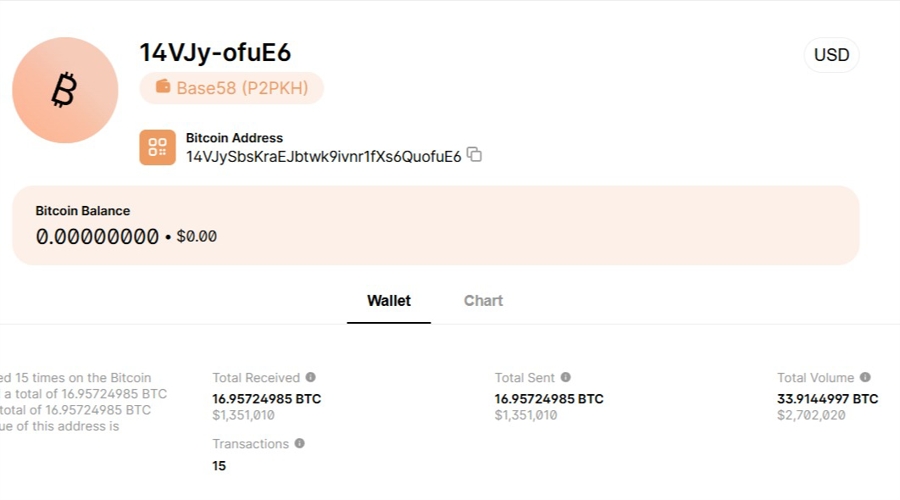
A Bitcoin wallet that had not moved in more than 11 years sent out roughly 5 BTC worth about $400,000 yesterday (Wednesday), after its pseudonymous owner uploaded the contents of an old college computer into Anthropic's Claude and let the AI sift through more than a gigabyte of files.
The address 14VJySbsKraEJbtwk9ivnr1fXs6QuofuE6 distributed the coins across five transactions on May 13, according to public blockchain records.
The recovery, posted on X by an account called Cprkrn, drew more than 11 million views within hours and prompted reactions from prominent crypto figures including Castle Island Ventures partner Nic Carter and Base creator Jesse Pollak.
HOLY FUCKING SHIT OMG CLAUDE JUST CRACKED THIS SHIT, THANK YOU @AnthropicAI THANK YOU @DarioAmodei NAMING MY KID AFTER YOU 😍https://t.co/gObNirRDpS https://t.co/ByTdIM4d20 pic.twitter.com/xB5LUJb6Pe
— 🍜 (@cprkrn) May 13, 2026
The case sits inside a broader trend of large language model deployment across crypto infrastructure, following work by Revolut engineers who built an AI-driven trading workflow with Claude in 30 minutes earlier this year.
What Claude Actually Did
Despite the "OMG Claude just cracked this shit" framing in the original tweet, the AI did not break Bitcoin's encryption. Cprkrn told Cointelegraph in a follow-up interview that he had already located a handwritten mnemonic in an old notebook before turning to Claude.
The AI then searched two Macs, two external hard drives, an Apple Notes export, an iCloud Mail inbox, a Gmail inbox and X direct messages, totaling more than a gigabyte of unstructured data, according to the user's account.
I tried like 7 trillion passwords lmfao
— 🍜 (@cprkrn) May 13, 2026
Found this old pneumonic a few weeks ago that ended up being the old password before I changed it
Thought I was screwed
Last ditch effort dumped my whole college computer into Claude
It found an OLD wallet file that the pneumonic…
On the college computer, Claude located a wallet backup file from December 2019 that predated a password change Cprkrn had made on blockchain.info, and the mnemonic decrypted that older file.
Claude also identified a logic detail in the open-source recovery tool BTCRecover, which concatenates a sharedKey value with the user password during decryption.
Total compute spend came to roughly $15, according to a summary the model produced. The recovered password, Cprkrn later disclosed publicly, was "lol420fuckthePOLICE!*:)".
Wallet Recovery Industry Faces a New Cost Curve
Commercial recovery services have for years charged premium prices for the technical expertise needed to handle legacy Bitcoin Core wallets. Cprkrn said he had spent roughly $250 per failed attempt at such services before turning to AI.
Firms including Wallet Recovery Services and KeychainX market brute-force password recovery and typically take percentage cuts of recovered funds.
- Is Crypto Becoming a Must-Have for Retail FX Brokers? | Free Webinar
- Coinbase Cuts 14% of Staff as AI and Crypto Downturn Reshape Its Operating Model
- DeFi’s Next Chapter: Breaking the Loop of Speculation, Leverage, and Inflated Yields
The case fits a wider thread of AI deployment across crypto-adjacent functions. ATFX partnered with data firm KX in late 2025 to deploy an AI-driven MCP server for real-time trading data, while LSEG connected its market data feeds to ChatGPT in December 2025.
Bitget Wallet launched its Smart Money feature earlier, tracking high-performing addresses with AI to surface trading signals.
In this case, the user worked through Claude's consumer interface with standard file uploads and tool use, not a purpose-built API integration or agent-ready exchange architecture.
If the account is accurate, the same workflow could in principle be replicated by any holder of a legacy wallet with surviving file backups.
The Dormant Supply Question Returns
Industry estimates of inaccessible Bitcoin vary widely. Cointelegraph cited reports putting between 2.3 million and 4 million BTC as unrecoverable, or roughly 11% to 19% of the 21 million maximum supply.
Glassnode data shows about 34% of circulating supply, more than 7 million coins, sits in wallets that have not transacted in years. A 2020 Chainalysis estimate put confirmed lost coins at approximately 3.7 million.
Fidelity Digital Assets, citing Glassnode, reported in 2025 that more than 566 BTC per day were aging into the "ancient" category of coins untouched for 10 years or more. Miners produce only 450 BTC per day following the April 2024 halving.
The differential between dormant accumulation and new issuance has been cited as structural support for Bitcoin prices, on the assumption ancient coins represent lost supply.
There is no evidence the Cprkrn case meaningfully shifts those estimates. But the demonstration that consumer AI tools can compress recovery costs from professional service rates to $15 changes the cost-benefit math for holders of forgotten wallets.
Forensics or Cracking? Experts Push Back
Wallet recovery experts told Decrypt the screenshots posted by Cprkrn showed file forensics, not cryptographic work.
"Claude's likely role was sorting through large amounts of historical data and identifying clues tied to older wallet credentials or password formats," one expert told the outlet, adding that the case is "not so much a password cracking thing as it is a forensics sorting."
The skepticism extended to Reddit. "Claude didn't do anything other than search his files," user MeteorSwarmGallifrey wrote in the technology subreddit, arguing the model had not done anything "groundbreaking."
Other commenters defended the use of AI for forensic triage across years of unstructured personal data, noting that knowledge of how older Bitcoin Core wallet files persist as .bak backups is non-obvious to non-specialists.
Anthropic has not commented publicly on the case.


