

CMC, Binance launch SpaceX retail trades same day
CMC Markets introduced grey market trading on SpaceX, allowing clients to take long or short positions on the private company ahead of any potential public listing.
The FTSE 250-listed broker said the product, which uses spread bets and contracts for difference (CFDs), will convert into standard listed share trading once SpaceX goes public. Clients retain control over when to close their positions.
- Weekly Focus: CLARITY Act Clears Key Senate Vote; IBKR Bundles Kalshi, CME Event Contracts
- Weekly Report: Smarter Copy Trading Challenges Prop Firm Controls; CFD Volumes Soar 96%
- Weekly Recap: Plus500’s Double Exposure in Prediction Markets; iFOREX IPO Costs Hit Profit
The rollout coincided with a similar move by Binance, which launched its own SpaceX-linked product on the same day. Binance’s SPCXUSDT Pre-IPO perpetual futures are USDT-margined and designed to track pricing signals during the IPO process before switching to the live share price after listing.
#Revolut's CFD trading feature offering 2x leverage just showed up in the Revolut app for EU based user. In June 2024 Revolut entered into partnership with CMC Markets for access to various markets including CFDs for its customers. pic.twitter.com/ij37GdDWgh
— Max Karpis (@maxkarpis) January 24, 2025
At the same time, CMC Markets is focusing on the B2B segment, with UK Head Chris Cheverall highlighting the broker’s early push into the neobank space. Cheverall told Finance Magnates that the CFD broker identified growing demand in the sector a few years ago, which led to the launch of its prime brokerage business and underpinned its partnership with Revolut.
IG lifts forecast on positive Q1 results
Amid strong financials, IG raised its full-year revenue guidance and medium-term outlook its first-quarter. The FTSE 100 broker posted organic total revenue of £331.2 million, up 19% year-on-year. It was driven by growth in OTC derivatives, an expanded crypto offering, and momentum from its recently acquired platform, Freetrade.
Net trading revenue reached £306.5 million, marking a 25% increase compared to the same period last year and a 17% rise from the previous quarter. On a reported basis, which includes contributions from Freetrade and Australia-based crypto exchange Independent Reserve, total revenue climbed 21% to £339.9 million.
IG Group shares closed at a record 1,742 pence on Tuesday, rising nearly 11% in a single session after the broker raised its full-year revenue guidance and reported 19% growth in first-quarter organic revenue. The surge marks one of the stock’s strongest daily gains outside the pandemic period and pushes its year-to-date increase to over 30%, roughly matching its total gains for all of 2025.
Swissquote 1:10 split set for next week
Meanwhile, Swissquote confirmed that its 1:10 share split will take effect in public trading on 28 May. It follows shareholder approval earlier this month. Under the split, each existing share has been divided into ten new shares, with the share price adjusted proportionally.
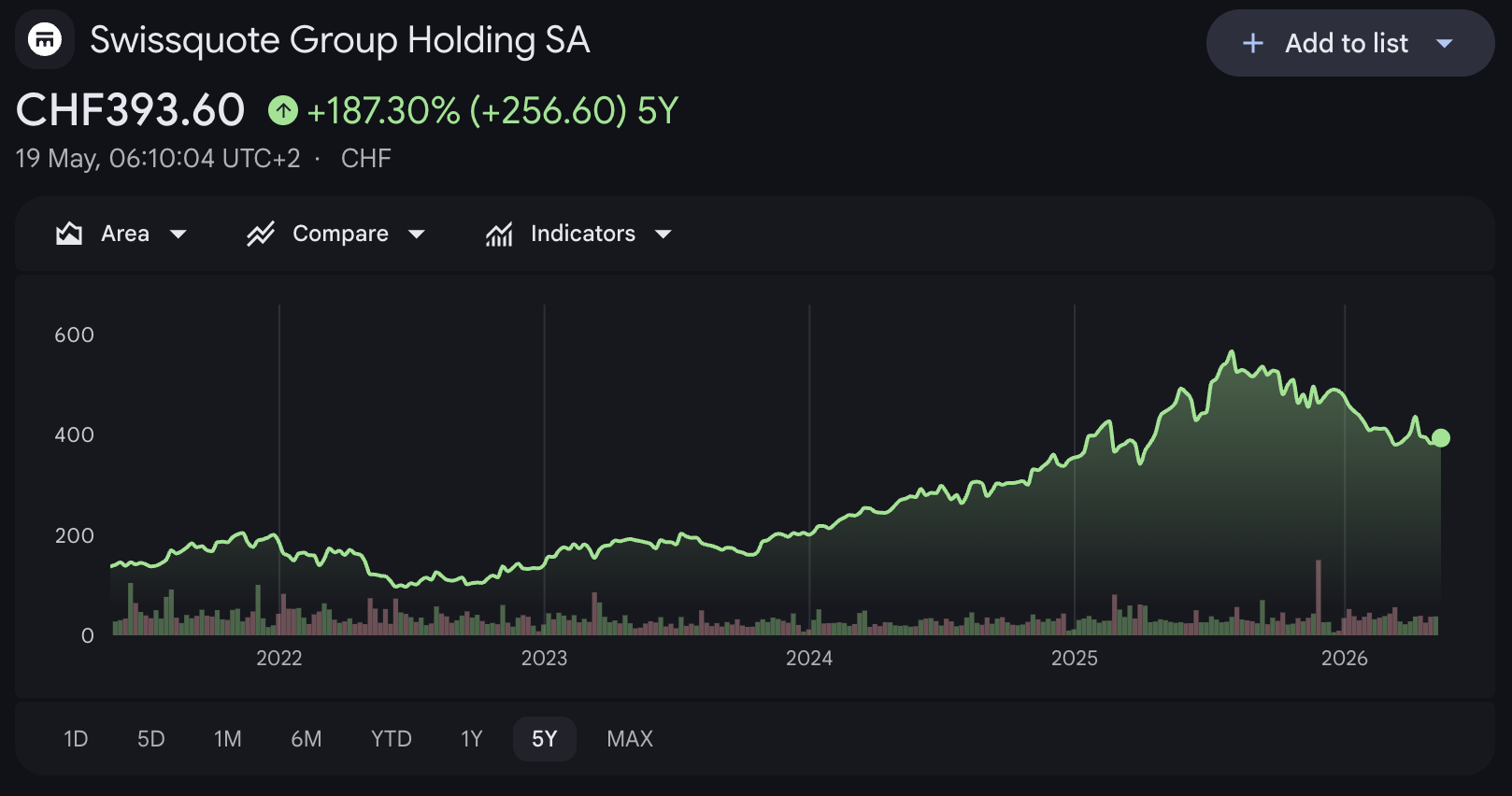
The split shares will trade on the SIX Swiss Exchange, with the opening price based on the closing price recorded on 27 May 2026. As a result, the total number of Swissquote shares will increase from 15,328,170 to 153,281,700, while the par value per share will decrease from CHF 0.20 to CHF 0.02.
XTB’s PLN 1B quarter driven by Europe
Still with this week's numbers, XTB’s full first-quarter report confirmed the headline figures released in late April but adds a detailed regional breakdown. The broker generated PLN 1.09 billion in operating revenue between January and March, with PLN 780.2 million, or 71%, coming from Central and Eastern Europe (CEE). Western Europe contributed PLN 232.8 million.
Other regions remained smaller contributors, with Latin America generating PLN 35.4 million, the Middle East PLN 45.7 million, and Asia just PLN 4,000. Growth Concentrated in Europe Nearly all year-on-year growth came from Europe. Revenue from CEE rose 99% from PLN 391.7 million in the same period last year, with Poland alone contributing PLN 568.8 million, or 52% of total revenue, up from PLN 314.4 million. Western Europe also saw strong growth, with revenue increasing 114% from PLN 108.9 million.
Is MT4 losing ground to rivals?
The CFD industry continued its strong growth into early 2026, with both trading volumes and user numbers reaching record levels. Monthly retail trading volumes rose to $33.6 trillion in Q1 2026, up from $29.8 trillion in the previous quarter and significantly higher than the $18.2 trillion recorded in the same period of 2024.
At the same time, the number of active retail FX/CFD accounts outside Japan exceeded 7.4 million, reflecting steady growth in global participation. Platform Landscape Largely Unchanged Despite this expansion, the competitive balance among trading platforms has remained largely unchanged. Broker data shows that only 16% of retail trading volume in Q1 2026 was generated on platforms outside the MetaQuotes ecosystem.
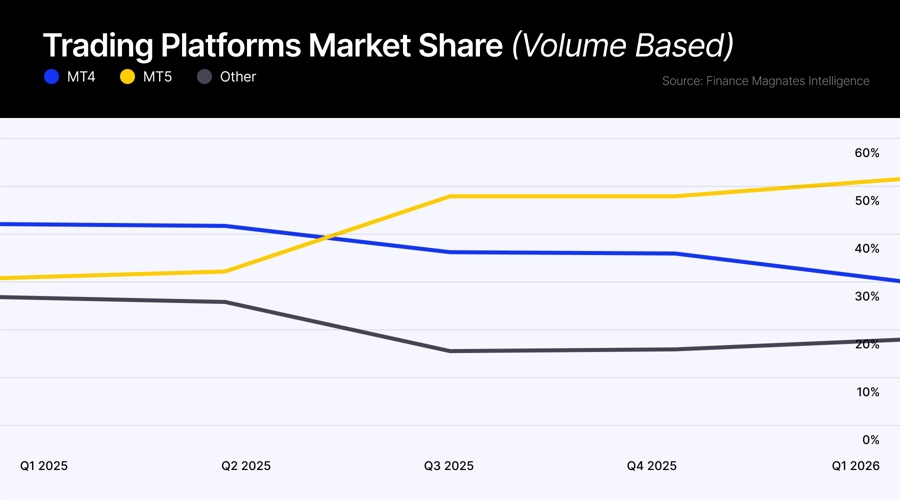
This is below the recent peak of 27% recorded in Q1 2025. The data suggests that while alternative platforms are attracting users, they are growing at a slower pace than MetaQuotes platforms, including MT4 and MT5.
Europe looks weak, but is it?
In Paul Golden's column, Europe is facing a range of ongoing challenges, both at home and abroad. The war between Ukraine and Russia has entered its fifth year with no clear resolution, while energy prices remain affected by disruptions in the Strait of Hormuz. Political uncertainty is also elevated, with eight of the 27 EU member states set to hold parliamentary elections this year.
In addition, countries such as the UK and Germany are seeing opposition parties gain ground in national polls. Focus Beyond Immediate Risks Despite these pressures, investors are being urged to look beyond short-term geopolitical and macroeconomic concerns and focus on the broader picture. While current developments highlight instability, they do not necessarily reflect Europe’s longer-term outlook.
Futures prop firm Tradeify launches retail broker
In the prop trading space, Tradeify launched a new retail brokerage as the US-based proprietary trading firm expands beyond its core evaluation business. The futures prop firm has signed a clearing and technology agreement with NinjaTrader, which was acquired by Kraken, and will rely on it for all trade execution and handling of client funds.
The brokerage will operate through Tradeify Brokerage, a registered introducing broker with the Commodity Futures Trading Commission and a member of the National Futures Association. Under the agreement, NinjaTrader Clearing LLC will act as the exclusive futures commission merchant for Slay Markets, the new trading platform.
US prop firms move inside CFTC perimeter: opportunity or survival?
Prop trading remains largely unregulated worldwide, but several US-based firms are now choosing to come under the oversight of the Commodity Futures Trading Commission (CFTC). FTMO has already moved into the regulated space through its acquisition by OANDA, while recent steps by Topstep and Tradeify highlight a shift in priorities among proprietary trading firms.
When I was working in brokerages, I had big volumes of affiliates and introducing brokers. Some were refering 30+ depositing customers every day. Whilst I appreciate their business at that time of my career, I have never used an affiliate link to register a brokerage account and…
— Josh Dentrinos - Founder of Trader Fights (@PropJoshD) May 15, 2026
Many prop firms have shown interest in obtaining brokerage licenses, often from offshore regulators, mainly to secure access to widely used trading platforms such as MetaTrader. The push toward a US CFTC license appears to reflect a different strategic motive, tied to the attractiveness of the US retail trading market and its strict regulatory environment.
CFTC is a “rogue agency” on prediction markets
In the prediction markets, the battle over U.S. prediction markets is intensifying, with growing focus on federal preemption and the Commodity Futures Trading Commission’s (CFTC) authority over event contracts. Speaking before a Senate subcommittee on Wednesday, American Gaming Association CEO Bill Miller sharply criticized the regulator, calling it a “rogue agency” and accusing it of undermining congressional intent by allowing financial exchanges to offer what he described as “backdoor sports betting.”
At the core of the dispute is a key legal issue: whether firms licensed by the CFTC as designated contract markets (DCMs) or derivatives clearing organizations can bypass state-level gambling laws under federal preemption. This framework is already influencing business strategy. For example, Sporttrade recently shut down its sportsbook operations to focus on obtaining CFTC exchange and clearinghouse status, signaling a shift toward operating under federal oversight rather than state-by-state regulation.
Jon Light warns prediction markets may need gambling licenses
Prediction markets and binary options may appear similar, but they differ in their underlying references and typical structure, according to Jon Light, Senior Director of Product Management at Devexperts. He also highlighted the concentration of risk in event contracts and noted that, in many jurisdictions, such products are more likely to fall under gambling or betting regulations rather than traditional financial market rules.
While Kalshi and Polymarket remain the leading platforms, mainstream brokers are increasingly entering the space. Plus500 has moved in as an event contracts clearing partner, and IG Group’s CEO has confirmed internal discussions on the topic, signaling growing engagement from major CFD brokerage firms.
Prediction markets are a vital customer insight tool
Interactive Brokers is positioning prediction markets as a source of actionable intelligence rather than purely speculative products, as it expands access to multiple platforms and targets more sophisticated investors seeking market signals.
Speaking to CNBC, founder and chairman Thomas Peterffy dismissed the idea that the firm’s push into the space is driven by competition from platforms like Kalshi and Polymarket. Instead, he said prediction markets are often misunderstood, noting that clients use them to track economic trends across regions and sectors, anticipate demand shifts, and inform their investment decisions.
EU to review MiCA as 80% of crypto firms vanish
Lastly, the European Commission launched a formal consultation to assess how the Markets in Crypto-Assets (MiCA) regulation is functioning. This continues its practice of reviewing major frameworks after implementation. The process invites feedback from exchanges, issuers, and industry associations, effectively reopening debate among key stakeholders as the regulation takes hold.
EURC wallet share grew more than 6x from January 2025 to March 2026.
— Circle (@circle) May 15, 2026
As adoption expands, euro-denominated stablecoin usage is reaching a broader set of users and applications onchain. pic.twitter.com/VsKTZlNKuU
This review comes as MiCA’s grandfathering period nears its July 1 deadline, with early signs pointing to a sharp drop in market participants. Before MiCA, an estimated 1,100 to 1,300 crypto asset service providers (CASPs) operated across the EU under fragmented national rules. As of May, only around 200 firms have secured authorization under the new unified regime, highlighting the scale of the compliance-driven contraction.


