
Weekly Report: Smarter Copy Trading Challenges Prop Firm Controls; CFD Volumes Soar 96%

Friday, 08/05/2026 | 22:08 GMT by Jared Kirui
  • The UK’s investment campaign is missing beginners by ignoring low-cost platforms and real user behaviour.
  • Two brokers, XTB and CMC Markets, IPO’d months apart, but their returns have diverged sharply.
CFI Opens Bogotá Office
CFI opens new office in Colombia

Finfluencer reach doesn’t mean trust

Finfluencer marketing has become a standard play in the trading industry, but its effectiveness is increasingly under scrutiny. Many trading influencers build large followings using trading-related content. Yet, their primary revenue often comes from selling courses, memberships, or monetizing attention, frequently with low conversion and retention rates.

Singapore Summit: Meet the largest APAC brokers you know (and those you still don't!)

While brokers continue to pay premium rates to access these audiences, questions remain about the real value delivered, especially as client retention declines.

Creator TypeTypical FollowingCommunity Depth90-Day RetentionBrand RiskRecommended Use
Lifestyle / Flexer100k–2MLow/Instagram only25–35%HighAwareness only
Multi-sponsor generalist50k–500kLow/Medium30–40%Medium –HighShort-term CPA only
Signal / alert seller10k–200kMedium (Telegram-heavy)30–40%Very HighAvoid entirely
Niche educational creator5k–80kHigh/Discord, email, Telegram55–70%LowCore long-term partner
Founder / operator contentVariesOwned — brand community60–75%Very LowHighest LTV, compounds

From inside the industry, a clearer picture emerges. Most creators on platforms like Instagram, TikTok, and YouTube operate as content businesses rather than active traders, using trading visuals such as charts and profit screenshots to drive engagement.

Kudotrade secures UAE CMA approval

Meanwhile, the industry is expanding fast. Kudotrade received initial approval from the UAE’s Capital Market Authority (CMA) and opened a new office in Dubai. The broker, which is currently licensed in Mauritius, also confirmed it has acquired the Kudo.com domain and plans to use it as its main brand going forward.

The CMA, recently rebranded from the Securities and Commodities Authority, has become a key regulatory target for retail brokers. Competition for licenses has intensified in 2026, with firms increasingly moving into the UAE market.

oneZero to Launch Dubai Office

Technology provider oneZero is also expanding. Lochlan White joined the firm as Director of Sales and Relationship Management (EMEA) and will lead the launch of the company’s first Middle East office in Dubai.

oneZero, which provides execution and liquidity hub technology to retail brokers and institutional clients, is expanding into Dubai as the city continues to attract CFD brokers. Many firms have already established local operations and secured licenses, making the UAE a key hub for the industry.

CFI opens Bogotá office, names Colombia Head

At the same time, CFI Financial Group officially launched its Colombian operations, opening a Bogotá office and appointing Simon Knudson as country manager nearly nine months after receiving approval from Colombia’s Financial Superintendence.

The move converts last August’s regulatory clearance into a live, on-the-ground presence in one of Latin America’s increasingly competitive brokerage markets. CFI enters a space that has rapidly attracted international players.

The SFC approved Plus500’s first Latin American office on August 19, 2025, followed by CFI on August 28. Within the same week, Australia’s ACY Securities and Libertex Group’s offshore brand LBX also secured approvals, highlighting a coordinated wave of broker expansion into Colombia.

Retail FX/CFD volume outpaces accounts

Retail FX and CFD trading growth is not only being driven by more accounts but also by higher activity per trader. FM Intelligence data shows active accounts surpassed 7.4 million for the first time in Q1 2026, while the average trading volume per account also climbed, pushing the combined per-account metric for tracked brokers to a record high.
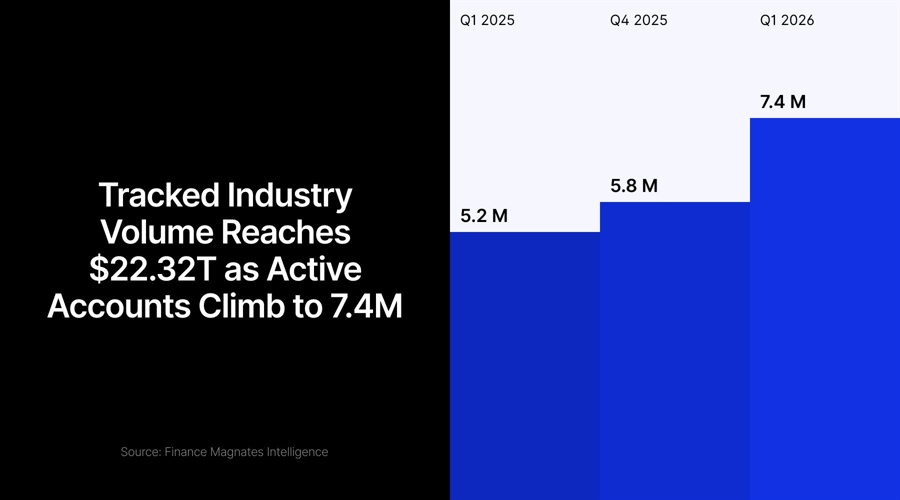
Average monthly trading volume per 1,000 active accounts rose to $4.30 billion in Q1 2026, up 27% from $3.38 billion a year earlier. This builds on a longer trend: the same metric increased from $3.0 billion in Q4 2021 to $4.2 billion in Q4 2025, a 38% rise over four years, with the latest quarterly figure continuing to outpace that growth trajectory.

Two CFD IPOs, one big divergence

XTB marked ten years since its listing on the Warsaw Stock Exchange (WSE: XTB), with shares trading at around 102 zlotys—an increase of roughly 800% from the 11.50 zloty IPO price set on May 6, 2016. The stock recently hit a record high of 114 zlotys on April 16, giving the company a market capitalization of approximately 12.1 billion zlotys ($3.2 billion).

The company’s debut was the largest IPO on the Warsaw exchange in 2016, raising 189 million zlotys at a valuation of 1.35 billion zlotys. Founder Jakub Zablocki sold 16.4 million shares at 11.50 zlotys, near the lower end of the 11.50–13 zloty price range, with the stock closing its first trading day slightly higher at 12.05 zlotys.

CMC Markets, which also went public in 2016 at 240 pence, saw its stock fall by about half within months after the UK’s Financial Conduct Authority introduced restrictions on retail CFD providers. Since then, CMC has recorded the weakest performance among its peers, with gains of just over 50% from its IPO level.

Plus500: 2026 performance beats forecasts

Among the publicly -listed brokers, Plus500 (LSE: PLUS) used its annual general meeting in London this week to confirm the upgraded full-year 2026 guidance it gave two weeks ago. The broker told shareholders that its first-quarter performance was ahead of market expectations and that the board is still confident about the rest of 2026.

Metric

Q1 2026

Q1 2025

YoY change

Revenue

$242.1m

$205.8m

+18%

EBITDA

$95.7m

$93.8m

+2%

Customer Income

$270.6m

$176.3m

+53%

New Customers

39,867

26,897

+48%

Active Customers

157,703

30,000

+21%

This mirrors the Q1 trading update from April 20, when Plus500 first said it expects revenue and EBITDA to come in above analyst consensus. The Israeli firm added that it entered 2026 with solid momentum in both its OTC and non-OTC operations, highlighting growth in its B2B futures offering and its newer prediction markets ecosystem.

The numbers behind this message were already disclosed in the Q1 update. Revenue rose 18% year-on-year to 242.1 million dollars in the first quarter, which was also 24% higher than in the fourth quarter of 2025. EBITDA came in at 95.7 million dollars, representing a 40% margin.

UK’s new investment campaign misses the mark

Elsewhere, the UK government’s new ‘Invest for the Future’campaign, launched late last month, is intended to be the first coordinated, industry-wide effort to change how investing is understood, discussed and adopted among first-time investors.

The initiative is backed by HM Treasury, the Financial Conduct Authority and the Money and Pensions Service, but it is funded by financial services firms including Aviva, Fidelity International, Jupiter, L&G, Quilter, Schroders, St James's Place, Barclays, NatWest, Hargreaves Lansdown and Vanguard.

Criticism has focused on the absence of lower-cost platforms aimed at smaller or beginner investors. One concern raised is that firms backing the campaign have little incentive to promote platforms better suited to absolute beginners, and that providers such as AJ Bell and Trading 212 are not involved, reportedly because they viewed the cost of taking part as too high.

SaaS is the escape from the zero-commission trap

For decades, brokerage was straightforward: companies earned money mainly from clients executing trades, and the more deals clients made, the more revenue brokers generated. That model worked when investors were satisfied with basic market access and simple execution.

Today, clients expect much more, including analytics , AI-powered insights, leverage, and a wide range of complex products. If a broker cannot provide these, users can quickly switch to a rival. This has made it harder to rely on transaction-based revenue alone, so many brokers are exploring new ways to make money and are increasingly adopting a SaaS model.

AI’s power is hyped, its impact on financial decisions isn’t

Meanwhile, discussions about AI in finance tend to follow a script: people talk about faster trade execution, smarter signals, hyper-personalisation, and frictionless user journeys. None of this is inaccurate, but it skips over the most important part of the story.

The real questions about any new technology in financial services are not just about what it can do in theory, but what happens when real people start using it. Those people have very different levels of experience and are making decisions in situations where the outcome is uncertain. That is the conversation we should be having about AI in finance, and we are not quite having it yet.

How copy trading is hurting prop firms

In proprietary trading, some of the most important risks are not immediately obvious. Copy trading has become one of these risks, moving from a niche practice to a widespread and increasingly sophisticated behavior that challenges how firms measure performance and manage risk.

Detection systems were once built on a simple idea: copy trading would be easy to spot because it would show identical entries, synchronized execution, and uniform position sizing, all of which could be flagged by rule-based monitoring.

Flutter is profiting from prediction markets as a market maker

Flutter Entertainment confirmed it is already earning revenue from prediction markets by acting as a market maker rather than operating its own retail-facing platform. This approach distinguishes it from consumer exchanges that compete directly for end users. During a recent earnings call, CEO Peter Jackson responded to questions about whether platforms such as Kalshi and Polymarket are taking share from the roughly 14 billion dollar U.S. sports betting market.

Jackson said he sees the expansion of event-based trading as an opportunity for companies that already have risk-pricing infrastructure in place. He noted that market making in these products is expected to be a meaningful contributor to Flutter’s revenues and stated that the company is already making money from this activity after an initial trial period.

Executive moves of the week: CMC, MAS Markets, Blueberry Markets

Lastly, in this week’s executive moves, CMC Markets appointed Angela Hayward as Head of Corporate Distribution for New Zealand, marking an expansion of its capital markets operations beyond the UK. The move reflects the company’s push to strengthen its presence in the region as capital raising conditions continue to evolve.

Additionally, MAS Markets, an FCA-regulated multi-asset liquidity provider, named Saul Knapp as the Chief Risk Officer. Knapp joins from Rostro Group’s institutional arm, Scope Prime, where he served as Managing Director of Futures and Options and also held the role of Group CRO since early 2025.

Mario Saudino also joined Blueberry Markets as LATAM Regional Manager after leaving STARTRADER earlier this year, continuing his career in regional leadership within the forex and derivatives sector.

Finfluencer reach doesn’t mean trust

Finfluencer marketing has become a standard play in the trading industry, but its effectiveness is increasingly under scrutiny. Many trading influencers build large followings using trading-related content. Yet, their primary revenue often comes from selling courses, memberships, or monetizing attention, frequently with low conversion and retention rates.

Singapore Summit: Meet the largest APAC brokers you know (and those you still don't!)

While brokers continue to pay premium rates to access these audiences, questions remain about the real value delivered, especially as client retention declines.

Creator TypeTypical FollowingCommunity Depth90-Day RetentionBrand RiskRecommended Use
Lifestyle / Flexer100k–2MLow/Instagram only25–35%HighAwareness only
Multi-sponsor generalist50k–500kLow/Medium30–40%Medium –HighShort-term CPA only
Signal / alert seller10k–200kMedium (Telegram-heavy)30–40%Very HighAvoid entirely
Niche educational creator5k–80kHigh/Discord, email, Telegram55–70%LowCore long-term partner
Founder / operator contentVariesOwned — brand community60–75%Very LowHighest LTV, compounds

From inside the industry, a clearer picture emerges. Most creators on platforms like Instagram, TikTok, and YouTube operate as content businesses rather than active traders, using trading visuals such as charts and profit screenshots to drive engagement.

Kudotrade secures UAE CMA approval

Meanwhile, the industry is expanding fast. Kudotrade received initial approval from the UAE’s Capital Market Authority (CMA) and opened a new office in Dubai. The broker, which is currently licensed in Mauritius, also confirmed it has acquired the Kudo.com domain and plans to use it as its main brand going forward.

The CMA, recently rebranded from the Securities and Commodities Authority, has become a key regulatory target for retail brokers. Competition for licenses has intensified in 2026, with firms increasingly moving into the UAE market.

oneZero to Launch Dubai Office

Technology provider oneZero is also expanding. Lochlan White joined the firm as Director of Sales and Relationship Management (EMEA) and will lead the launch of the company’s first Middle East office in Dubai.

oneZero, which provides execution and liquidity hub technology to retail brokers and institutional clients, is expanding into Dubai as the city continues to attract CFD brokers. Many firms have already established local operations and secured licenses, making the UAE a key hub for the industry.

CFI opens Bogotá office, names Colombia Head

At the same time, CFI Financial Group officially launched its Colombian operations, opening a Bogotá office and appointing Simon Knudson as country manager nearly nine months after receiving approval from Colombia’s Financial Superintendence.

The move converts last August’s regulatory clearance into a live, on-the-ground presence in one of Latin America’s increasingly competitive brokerage markets. CFI enters a space that has rapidly attracted international players.

The SFC approved Plus500’s first Latin American office on August 19, 2025, followed by CFI on August 28. Within the same week, Australia’s ACY Securities and Libertex Group’s offshore brand LBX also secured approvals, highlighting a coordinated wave of broker expansion into Colombia.

Retail FX/CFD volume outpaces accounts

Retail FX and CFD trading growth is not only being driven by more accounts but also by higher activity per trader. FM Intelligence data shows active accounts surpassed 7.4 million for the first time in Q1 2026, while the average trading volume per account also climbed, pushing the combined per-account metric for tracked brokers to a record high.

Average monthly trading volume per 1,000 active accounts rose to $4.30 billion in Q1 2026, up 27% from $3.38 billion a year earlier. This builds on a longer trend: the same metric increased from $3.0 billion in Q4 2021 to $4.2 billion in Q4 2025, a 38% rise over four years, with the latest quarterly figure continuing to outpace that growth trajectory.

Two CFD IPOs, one big divergence

XTB marked ten years since its listing on the Warsaw Stock Exchange (WSE: XTB), with shares trading at around 102 zlotys—an increase of roughly 800% from the 11.50 zloty IPO price set on May 6, 2016. The stock recently hit a record high of 114 zlotys on April 16, giving the company a market capitalization of approximately 12.1 billion zlotys ($3.2 billion).

The company’s debut was the largest IPO on the Warsaw exchange in 2016, raising 189 million zlotys at a valuation of 1.35 billion zlotys. Founder Jakub Zablocki sold 16.4 million shares at 11.50 zlotys, near the lower end of the 11.50–13 zloty price range, with the stock closing its first trading day slightly higher at 12.05 zlotys.

CMC Markets, which also went public in 2016 at 240 pence, saw its stock fall by about half within months after the UK’s Financial Conduct Authority introduced restrictions on retail CFD providers. Since then, CMC has recorded the weakest performance among its peers, with gains of just over 50% from its IPO level.

Plus500: 2026 performance beats forecasts

Among the publicly -listed brokers, Plus500 (LSE: PLUS) used its annual general meeting in London this week to confirm the upgraded full-year 2026 guidance it gave two weeks ago. The broker told shareholders that its first-quarter performance was ahead of market expectations and that the board is still confident about the rest of 2026.

Metric

Q1 2026

Q1 2025

YoY change

Revenue

$242.1m

$205.8m

+18%

EBITDA

$95.7m

$93.8m

+2%

Customer Income

$270.6m

$176.3m

+53%

New Customers

39,867

26,897

+48%

Active Customers

157,703

30,000

+21%

This mirrors the Q1 trading update from April 20, when Plus500 first said it expects revenue and EBITDA to come in above analyst consensus. The Israeli firm added that it entered 2026 with solid momentum in both its OTC and non-OTC operations, highlighting growth in its B2B futures offering and its newer prediction markets ecosystem.

The numbers behind this message were already disclosed in the Q1 update. Revenue rose 18% year-on-year to 242.1 million dollars in the first quarter, which was also 24% higher than in the fourth quarter of 2025. EBITDA came in at 95.7 million dollars, representing a 40% margin.

UK’s new investment campaign misses the mark

Elsewhere, the UK government’s new ‘Invest for the Future’campaign, launched late last month, is intended to be the first coordinated, industry-wide effort to change how investing is understood, discussed and adopted among first-time investors.

The initiative is backed by HM Treasury, the Financial Conduct Authority and the Money and Pensions Service, but it is funded by financial services firms including Aviva, Fidelity International, Jupiter, L&G, Quilter, Schroders, St James's Place, Barclays, NatWest, Hargreaves Lansdown and Vanguard.

Criticism has focused on the absence of lower-cost platforms aimed at smaller or beginner investors. One concern raised is that firms backing the campaign have little incentive to promote platforms better suited to absolute beginners, and that providers such as AJ Bell and Trading 212 are not involved, reportedly because they viewed the cost of taking part as too high.

SaaS is the escape from the zero-commission trap

For decades, brokerage was straightforward: companies earned money mainly from clients executing trades, and the more deals clients made, the more revenue brokers generated. That model worked when investors were satisfied with basic market access and simple execution.

Today, clients expect much more, including analytics , AI-powered insights, leverage, and a wide range of complex products. If a broker cannot provide these, users can quickly switch to a rival. This has made it harder to rely on transaction-based revenue alone, so many brokers are exploring new ways to make money and are increasingly adopting a SaaS model.

AI’s power is hyped, its impact on financial decisions isn’t

Meanwhile, discussions about AI in finance tend to follow a script: people talk about faster trade execution, smarter signals, hyper-personalisation, and frictionless user journeys. None of this is inaccurate, but it skips over the most important part of the story.

The real questions about any new technology in financial services are not just about what it can do in theory, but what happens when real people start using it. Those people have very different levels of experience and are making decisions in situations where the outcome is uncertain. That is the conversation we should be having about AI in finance, and we are not quite having it yet.

How copy trading is hurting prop firms

In proprietary trading, some of the most important risks are not immediately obvious. Copy trading has become one of these risks, moving from a niche practice to a widespread and increasingly sophisticated behavior that challenges how firms measure performance and manage risk.

Detection systems were once built on a simple idea: copy trading would be easy to spot because it would show identical entries, synchronized execution, and uniform position sizing, all of which could be flagged by rule-based monitoring.

Flutter is profiting from prediction markets as a market maker

Flutter Entertainment confirmed it is already earning revenue from prediction markets by acting as a market maker rather than operating its own retail-facing platform. This approach distinguishes it from consumer exchanges that compete directly for end users. During a recent earnings call, CEO Peter Jackson responded to questions about whether platforms such as Kalshi and Polymarket are taking share from the roughly 14 billion dollar U.S. sports betting market.

Jackson said he sees the expansion of event-based trading as an opportunity for companies that already have risk-pricing infrastructure in place. He noted that market making in these products is expected to be a meaningful contributor to Flutter’s revenues and stated that the company is already making money from this activity after an initial trial period.

Executive moves of the week: CMC, MAS Markets, Blueberry Markets

Lastly, in this week’s executive moves, CMC Markets appointed Angela Hayward as Head of Corporate Distribution for New Zealand, marking an expansion of its capital markets operations beyond the UK. The move reflects the company’s push to strengthen its presence in the region as capital raising conditions continue to evolve.

Additionally, MAS Markets, an FCA-regulated multi-asset liquidity provider, named Saul Knapp as the Chief Risk Officer. Knapp joins from Rostro Group’s institutional arm, Scope Prime, where he served as Managing Director of Futures and Options and also held the role of Group CRO since early 2025.

Mario Saudino also joined Blueberry Markets as LATAM Regional Manager after leaving STARTRADER earlier this year, continuing his career in regional leadership within the forex and derivatives sector.

About the Author: Jared Kirui
Jared Kirui
  • 2787 Articles
  • 54 Followers
About the Author: Jared Kirui
Jared Kirui is an Editor at Finance Magnates with more than five years of experience in financial journalism. He covers online trading, fintech, payments, and crypto industries with a focus on companies, regulation and compliance, executive moves, trading technology, and market analysis. His work has been featured in other media outlets, including Benzinga, ZyCrypto, The Distributed, and The Daily Hodl. Education: Bachelor of Commerce degree (Finance option), University of Nairobi
  • 2787 Articles
  • 54 Followers

More from the Author

Retail FX

!"#$%&'()*+,-./0123456789:;<=>?@ABCDEFGHIJKLMNOPQRSTUVWXYZ[\]^_`abcdefghijklmnopqrstuvwxyz{|} !"#$%&'()*+,-./0123456789:;<=>?@ABCDEFGHIJKLMNOPQRSTUVWXYZ[\]^_`abcdefghijklmnopqrstuvwxyz{|}