Three AI Shifts and a $40 Billion Fraud Problem: Inside the FCA's First Horizon Scan

Thursday, 11/06/2026 | 19:01 GMT by Damian Chmiel
  • The UK regulator's first external horizon scan sets out how AI, synthetic crime and programmable finance could reshape financial services by 2030.
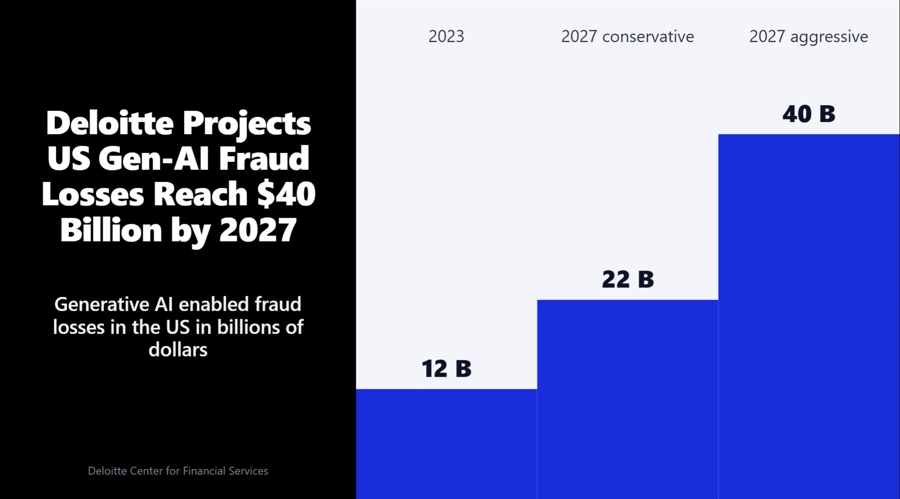
  • It lands as Deloitte projects gen-AI-enabled fraud in the US could reach $40 billion by 2027, up from $12.3 billion in 2023.
Deloitte

The Financial Conduct Authority (FCA) has published its first public Technology Horizon Scan, a foresight document that groups emerging risks under three headings: personalized intelligence, synthetic crime and programmable finance.

The regulator was careful about what the document is. The FCA said it is "not a set of predictions or regulatory guidance," but a map of plausible ways technologies could combine for consumers, firms and markets by 2030.

Read the full FM Intelligence analysis on the DataLab portal: Three AI Shifts and a $40 Billion Fraud Forecast: Reading the FCA's First Horizon Scan.

Synthetic Crime Could Push Gen-AI Fraud to $40 Billion

The report describes AI lowering the barrier to large-scale fraud and making fabricated evidence harder to detect. It points to a move from manipulating what people see and hear, through deepfake audio and video, to manipulating how they judge what is true.

Deloitte's Center for Financial Services estimates gen-AI-enabled fraud losses in the US could rise from $12.3 billion in 2023 to $40 billion by 2027.

UK fraud losses passed £1.17 billion in 2024, according to UK Finance, with authorized push payment fraud at £450.7 million.

The detection problem is already visible. Account takeover scams tied to AI rose 250% in 2024, and regulators including South Africa's FSCA have warned that AI voice cloning undermines voiceprint authentication.

When the Next Customer Is an AI Agent

The second theme, personalized intelligence, describes AI agents becoming the main interface between consumers and firms. The FCA sketches a "proxy economy" in which an agent searches, compares and transacts for a customer.

It lays out three steps: assistive tools that compare and pre-fill, advisory agents that recommend, and a do-it-for-me mode that acts within set limits.

This is not hypothetical. eToro now lets investors delegate trades to AI agents within a set budget, and Mastercard and Santander have run a live payment executed by an AI agent inside a regulated framework.

The open question for compliance is who consents when software acts on a person's behalf.

Tokenized Assets Reach $18.6 Billion as the Plumbing Changes

The third theme, programmable finance, covers tokenization, stablecoins and smart contracts moving from pilots to national strategies.

On-chain tokenized real-world assets rose to about $18.6 billion across 2025, according to industry trackers, and the FCA frames the destination as "TradFi with protocol capabilities" rather than a full shift to decentralized finance.

The direction is already in motion in the UK. The FCA has picked four firms for stablecoin sandbox trials ahead of its 2027 crypto regime, work that sits alongside the Digital Securities Sandbox it runs with the Bank of England.

Detection Shifts Toward Spotting Suspicious Perfection

For compliance and financial-crime teams, the through-line is detection. The report suggests the signal of fraud may move from obvious error toward what it calls "suspicious perfection," which complicates controls built to flag anomalies.

The scan also notes a concentration risk, with many firms leaning on the same AI platforms and cloud providers, so a single shared flaw could reach several at once.

FM Intelligence's full breakdown, including the data behind each theme, the scenario ranges, and the limits of the forecasts, is on the DataLab portal: read the analysis here.

The Financial Conduct Authority (FCA) has published its first public Technology Horizon Scan, a foresight document that groups emerging risks under three headings: personalized intelligence, synthetic crime and programmable finance.

The regulator was careful about what the document is. The FCA said it is "not a set of predictions or regulatory guidance," but a map of plausible ways technologies could combine for consumers, firms and markets by 2030.

Read the full FM Intelligence analysis on the DataLab portal: Three AI Shifts and a $40 Billion Fraud Forecast: Reading the FCA's First Horizon Scan.

Synthetic Crime Could Push Gen-AI Fraud to $40 Billion

The report describes AI lowering the barrier to large-scale fraud and making fabricated evidence harder to detect. It points to a move from manipulating what people see and hear, through deepfake audio and video, to manipulating how they judge what is true.

Deloitte's Center for Financial Services estimates gen-AI-enabled fraud losses in the US could rise from $12.3 billion in 2023 to $40 billion by 2027.

UK fraud losses passed £1.17 billion in 2024, according to UK Finance, with authorized push payment fraud at £450.7 million.

The detection problem is already visible. Account takeover scams tied to AI rose 250% in 2024, and regulators including South Africa's FSCA have warned that AI voice cloning undermines voiceprint authentication.

When the Next Customer Is an AI Agent

The second theme, personalized intelligence, describes AI agents becoming the main interface between consumers and firms. The FCA sketches a "proxy economy" in which an agent searches, compares and transacts for a customer.

It lays out three steps: assistive tools that compare and pre-fill, advisory agents that recommend, and a do-it-for-me mode that acts within set limits.

This is not hypothetical. eToro now lets investors delegate trades to AI agents within a set budget, and Mastercard and Santander have run a live payment executed by an AI agent inside a regulated framework.

The open question for compliance is who consents when software acts on a person's behalf.

Tokenized Assets Reach $18.6 Billion as the Plumbing Changes

The third theme, programmable finance, covers tokenization, stablecoins and smart contracts moving from pilots to national strategies.

On-chain tokenized real-world assets rose to about $18.6 billion across 2025, according to industry trackers, and the FCA frames the destination as "TradFi with protocol capabilities" rather than a full shift to decentralized finance.

The direction is already in motion in the UK. The FCA has picked four firms for stablecoin sandbox trials ahead of its 2027 crypto regime, work that sits alongside the Digital Securities Sandbox it runs with the Bank of England.

Detection Shifts Toward Spotting Suspicious Perfection

For compliance and financial-crime teams, the through-line is detection. The report suggests the signal of fraud may move from obvious error toward what it calls "suspicious perfection," which complicates controls built to flag anomalies.

The scan also notes a concentration risk, with many firms leaning on the same AI platforms and cloud providers, so a single shared flaw could reach several at once.

FM Intelligence's full breakdown, including the data behind each theme, the scenario ranges, and the limits of the forecasts, is on the DataLab portal: read the analysis here.

About the Author: Damian Chmiel
Damian Chmiel
  • 3636 Articles
  • 113 Followers
About the Author: Damian Chmiel
Damian Chmiel is a Senior Analyst & Editor at Finance Magnates with more than 15 years of experience in the CFD and online trading industry. Active as both a trader and journalist since 2010, he focuses on broker coverage, fintech innovation, and regulatory developments across Europe, the Middle East, and Asia. His work includes interviews with C-level leaders at major brokerages and fintech platforms, as well as co-authoring Finance Magnates’ quarterly industry benchmarking reports. Damian’s reporting is data-driven, market-aware, and grounded in direct industry engagement. His analysis and commentary have also been cited by external media outlets, including Investing.com, Binance, The Asset, Stockhead, and Dispatch. Education: MA in Finance and Accounting, Cracow University of Economics
  • 3636 Articles
  • 113 Followers

More from the Author

Retail FX

!"#$%&'()*+,-./0123456789:;<=>?@ABCDEFGHIJKLMNOPQRSTUVWXYZ[\]^_`abcdefghijklmnopqrstuvwxyz{|} !"#$%&'()*+,-./0123456789:;<=>?@ABCDEFGHIJKLMNOPQRSTUVWXYZ[\]^_`abcdefghijklmnopqrstuvwxyz{|}