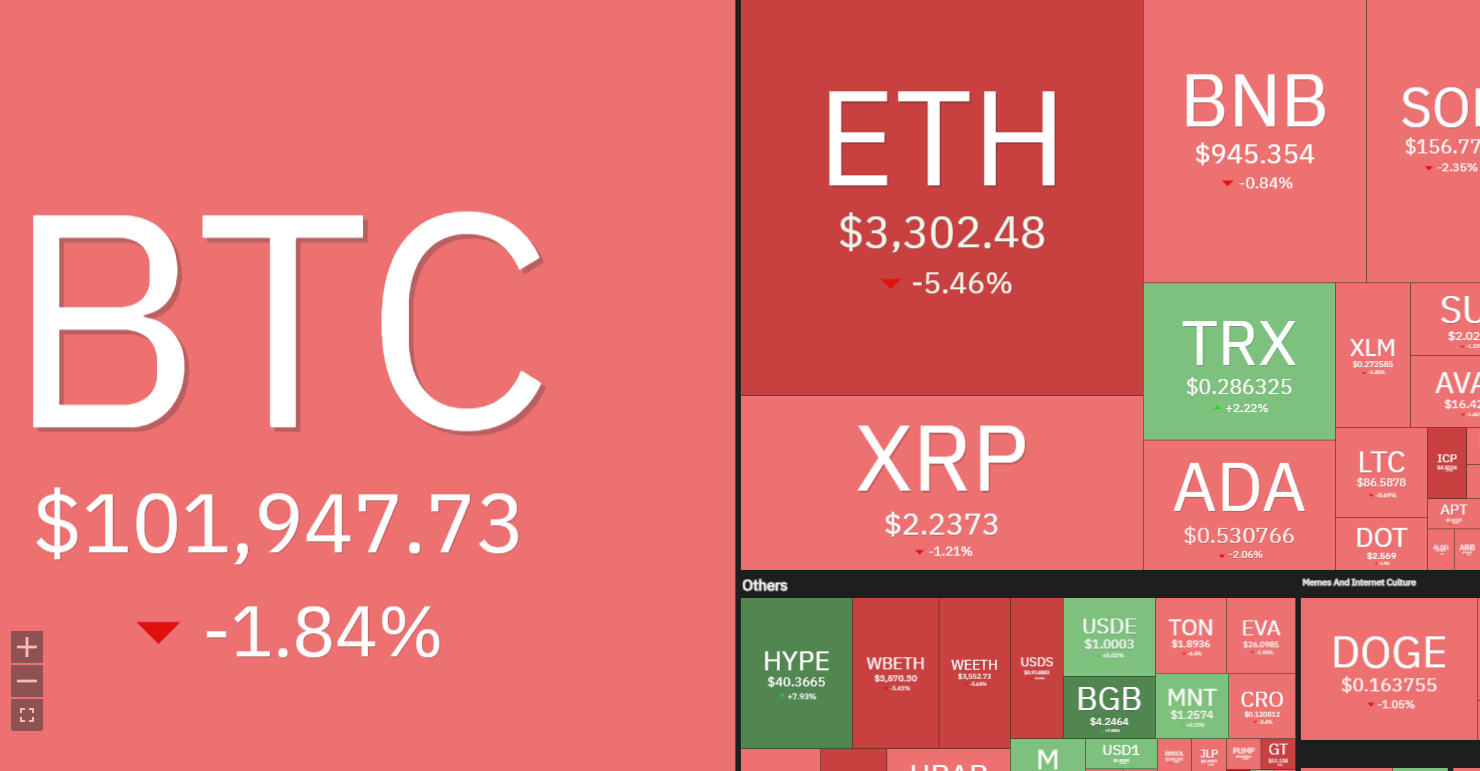
The cryptocurrency market crashed on Wednesday, with Bitcoin breaking below $100,000 psychological support for the first time since June.
Ethereum plunges 16% over 48 hours, followed by strong selloffs on the XRP and DOGE charts.
The AI bubble contagion, institutional outflows from bitcoin ETFs and a leverage cascade are among the main drivers behind the sell-off in the crypto market.
Why crypto is falling today? Check the newest technical analysis of BTC, ETH, DOGE and XRP charts
The
cryptocurrency market crashed for a second consecutive day today (Wednesday), 5
November 2025, losing over $1 trillion in market capitalization since early
October as Bitcoin, Ethereum, XRP and Dogecoin prices led a broad-based
selloff.
The entire
crypto ecosystem is experiencing dynamic declines with Ethereum at $3,303 (after
-16% two-day crash), Bitcoin testing $100,000 psychological support, and major
altcoins extending losses as institutional investors rotate out of digital
assets.
In this
article, I examine why crypto is going down and conduct a technical analysis of
the BTC/USDT, XRP/USDT, ETH/USDT and DOGE/USDT charts, based on more than 10
years of experience as a cryptocurrency investor and analyst.
Why Crypto Is Going Down Today?
Fed, AI Bubble, and Whale Selling
Federal
Reserve Chairman Jerome Powell's hawkish remarks downplaying December rate cuts
created the initial catalyst for crypto's collapse. The probability of a
December cut collapsed from 96% before Powell's press conference to just 69.3%
afterward, dampening expectations for looser financial conditions that
typically support cryptocurrency prices.
The
cryptocurrency collapse coincides with a broader tech selloff. Palantir dropped
8% despite beating earnings on valuation concerns, while Nvidia shed 4% losing
$200 billion in market capitalization. The Nasdaq fell 2% and the S&P 500
declined 1.2%, reflecting growing worries about AI-driven stock valuations.
Institutional
investors pulled $1.15 billion from Bitcoin ETFs last week, led by BlackRock,
ARK Invest, and Fidelity. This exodus signals a significant shift in sentiment
as traditional financial institutions that drove Bitcoin's rally to $126,000 in
early October are now reducing exposure amid Federal Reserve uncertainty and AI
bubble concerns.
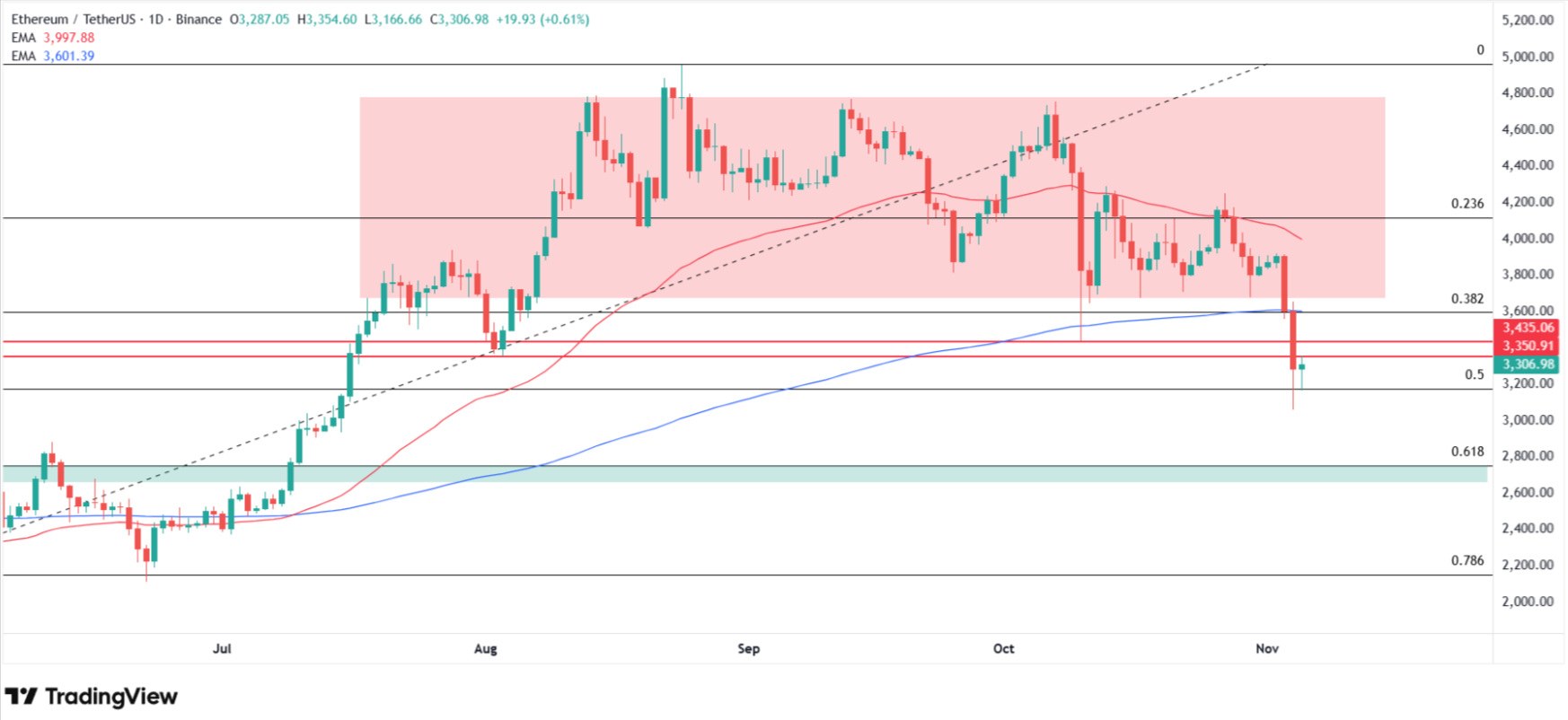
Ethereum 16% Two-Day Crash
Breaks 200-Day EMA
According
to my technical analysis, the price of Ethereum (ETH) has experienced two days
of dynamic declines in a row, losing approximately 16% within 48 hours. For the
chart situation, this is a very large change, and from my technical analysis,
these declines from the first part of the week fully hand power to the bears,
changing the trend currently to downward.
Most
significantly, we went below the 200-day exponential moving average (200 EMA),
simultaneously breaking out of the consolidation range drawn since July, and
also went below the zone of August lows, leaving behind a series of very
important supports which are now resistance.
Why Ethereum price is going down today? Source: Tradingview.com
At this
moment, bears have the advantage in the market, so further depreciation cannot
be ruled out either, and the target level or range, according to my forecasts,
is the April minimums at the $2,380 level. This means ETH could fall from
current levels by as much as 60%.
Bitcoin Price Tests $100K
After 8% Two-Day Plunge
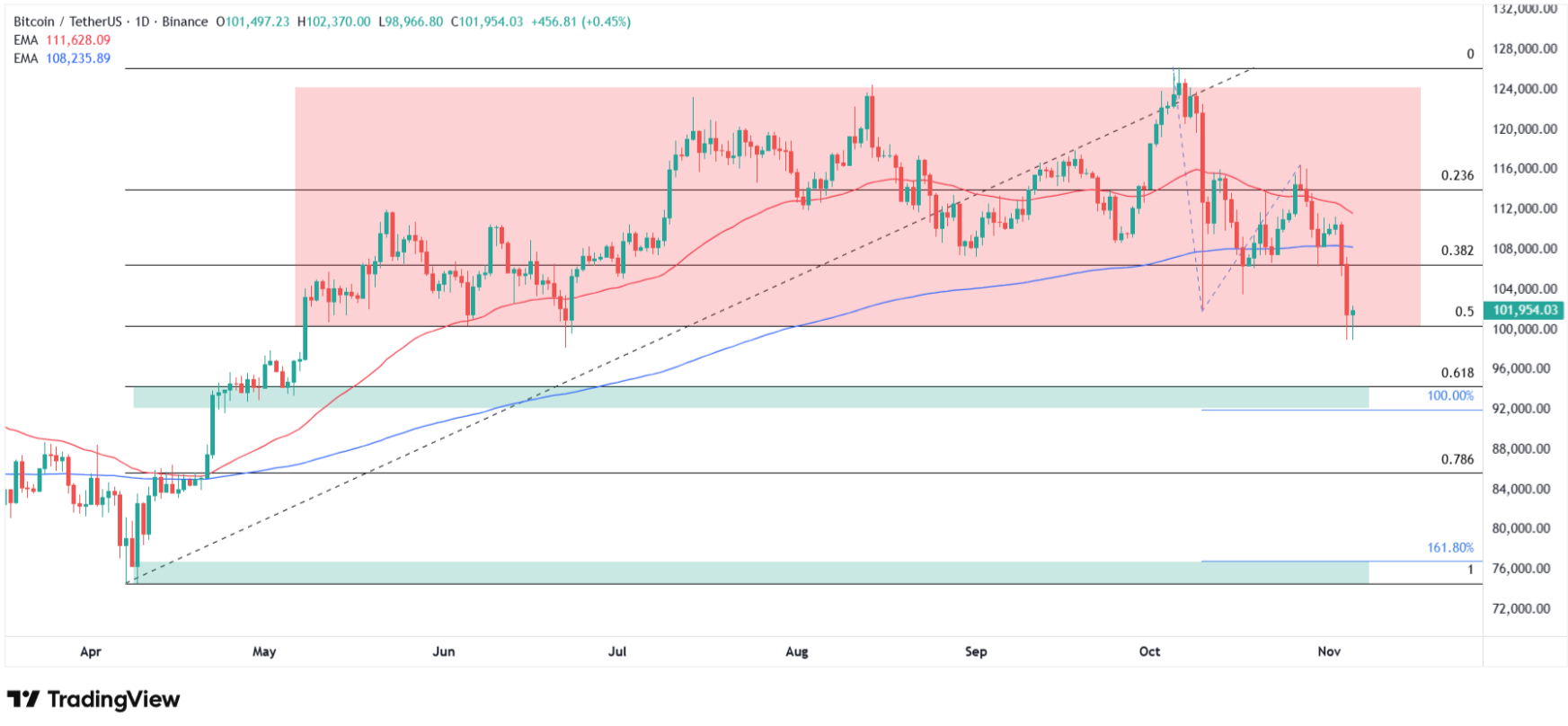
The price
of Bitcoin (BTC), like other major cryptocurrencies discussed by me in this
analysis, has two days of dynamic declines behind it, during which it lost a
total of 8% in value, and prices stopped only at the height of the
psychological $100,000 level last tested in June. Today Bitcoin is trying to
violate this level for the second day in a row.
Bulls are
trying to defend for now. If it is broken, however, it opens the road to a much
stronger downward correction. We will officially exit the consolidation range
drawn from May, and moving below the 200-day exponential moving average (200
EMA) only confirms that now bears are in the lead.
I identify
the first zone of declines around the levels of $92,000 and $94,000, where
Fibonacci extension and retracement levels coincide, with the target zone of
declines around $74,000 and $76,000, the April lows where the 161.8% Fibonacci
extension also falls.
Why Bitcoin price is going down today? Source: Tradingview.com
Joel
Kruger, strategist at LMAX, also provided important context: "A sustained
move under the 50-week could extend the pullback toward the top of the cloud
near $95,000, where we would expect strong support and the formation of a
higher low before the next leg higher to fresh record highs. The key takeaway:
this remains a healthy correction within an ongoing bull market, not a bearish
shift."
XRP’s Death Cross Looms at
$2.30 Support
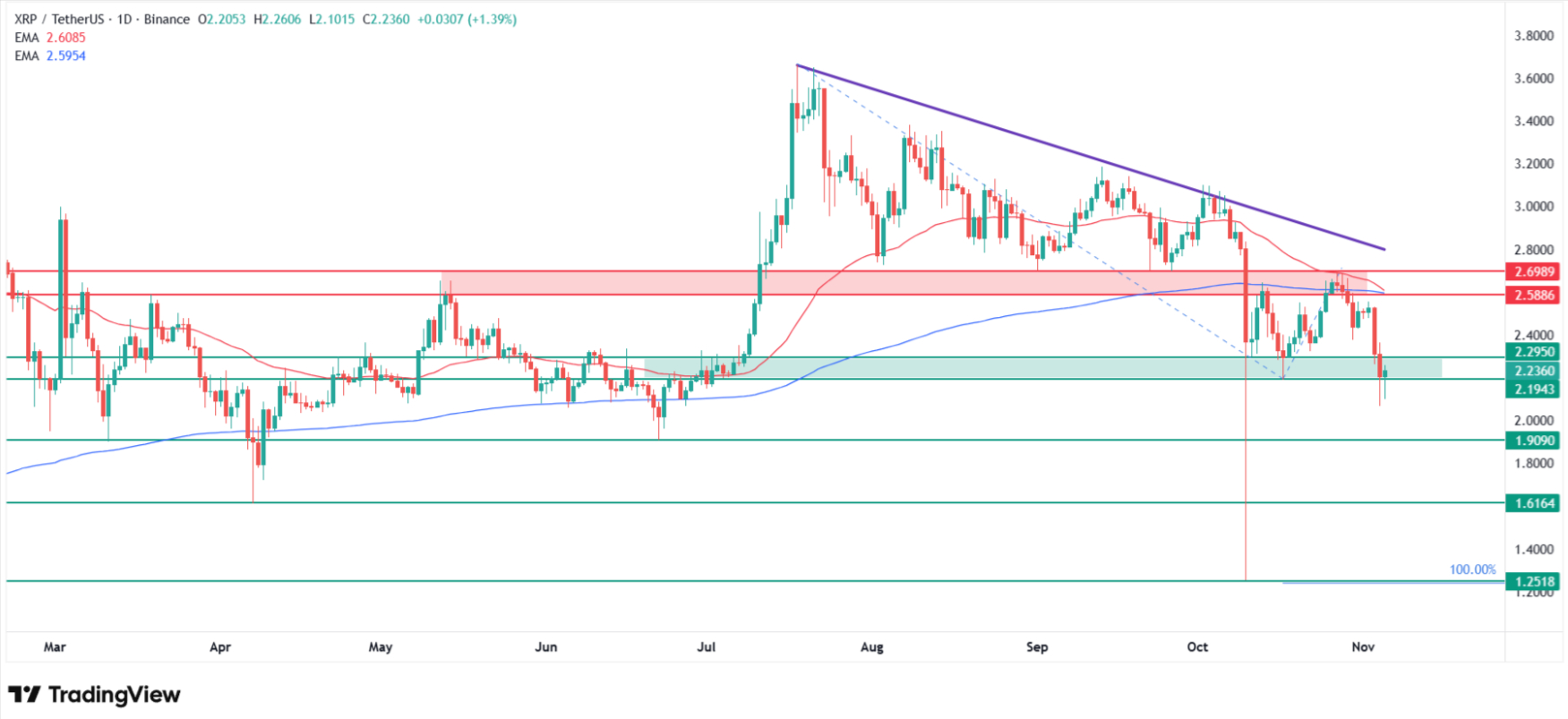
The XRP is
managing best for now compared to other leading cryptocurrencies, maintaining
local support levels and trading still in the $2.20-$2.30 zone coinciding with
July lows.
This
doesn't change the fact, however, that prices broke out at the beginning of
October from a wedge or triangle formation and are currently consolidating at
lower levels below the 50 and 200 EMA which are very close to drawing a death
cross, a crossover which, according to technical analysis enthusiasts like me,
is a strong sell signal.
If the
current support doesn't hold, we face a decline below the round $2.00 level,
including toward $1.90, June lows. The next target decline level is $1.61 at
April minimums, and the ultimate level is $1.25, the level last observed in
November 2024 coinciding with intraday lows from October 10 when the market
briefly collapsed, as well as my XRP price decline forecast based on Fibonacci
extensions.
Why XRP price is going down today? Source: Tradingview.com
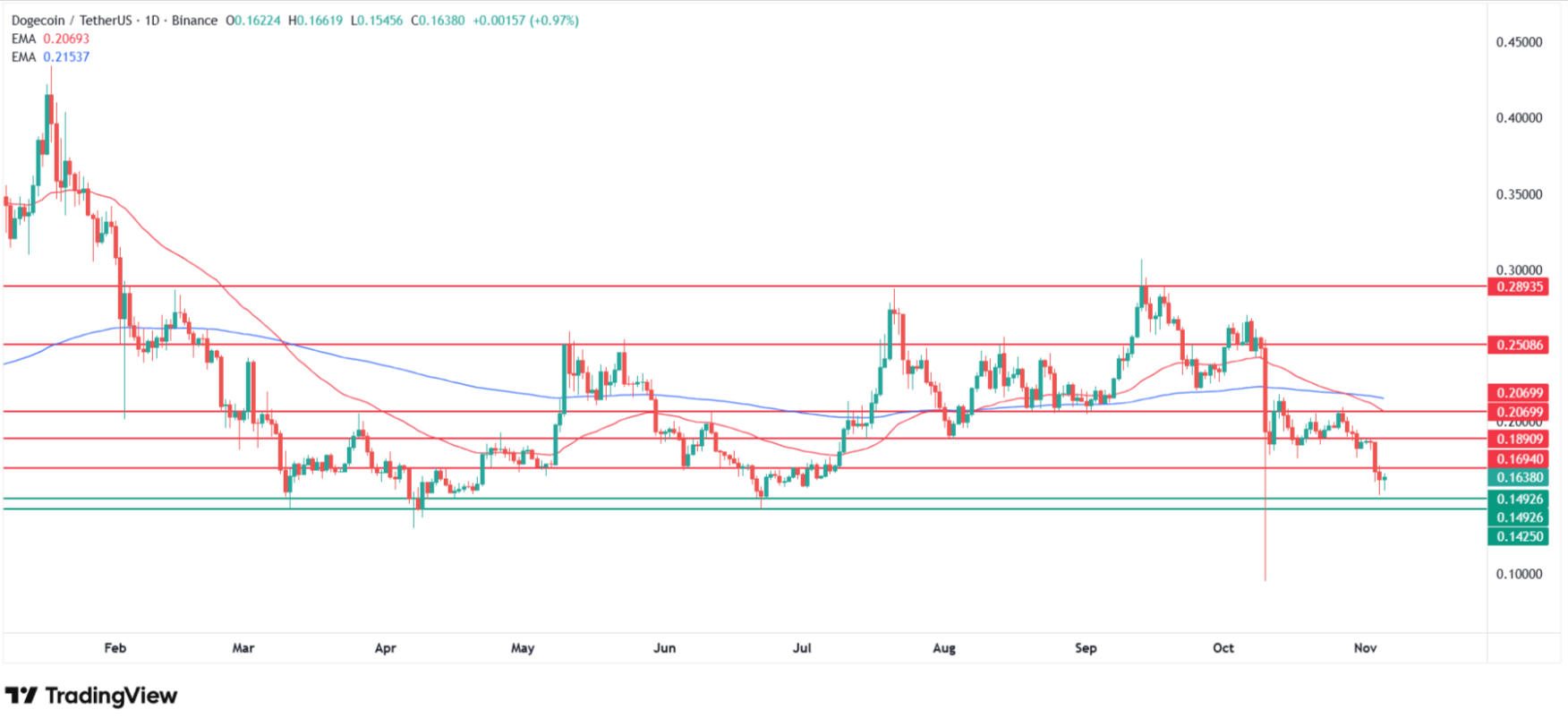
Dogecoin Also Sees Death
Cross, Forms at Channel Bottom
Although
Dogecoin (DOGE) chart clearly shows it has lost and cut itself off from its
September highs by several cents, in broader terms we actually remain in the
same consolidation drawn since February. Its lower limit, which we are
currently witnessing, falls just above the 14-cent level, while the top is at
just under 29 cents.
The last
hours of declines caused some local supports to turn into resistance, and at
this moment, only the lower limit of the sideways channel last tested in June
stands before us. What's more significant, however, is we're moving below the
50 and 200 MA which have already formed a death cross formation, the very
strong sell signal mentioned earlier by me.
If the
current support doesn't hold and we exit this consolidation, Dogecoin could
pave the road to stronger declines and a retest of levels last observed in
August 2024 below the 8-cent level.
Why Dogecoin price is going down today? Source: Tradingview.com
Crypto Price Analysis, FAQ
Why is crypto crashing
today?
Cryptocurrency
market lost over $1 trillion since October 6 peak with Bitcoin breaking
$100,000 for first time since June (-5% daily to $100,893), Ethereum crashing
-16% over 48 hours to $3,303, triggered by Federal Reserve Powell walking back
December cuts (probability 96% to 69.3%), AI bubble concerns spreading from
tech selloff (Nasdaq -2%, Nvidia -4%), institutional exodus (Bitcoin ETF
outflows $1.15B) and. leverage cascade ($1.78B liquidations affecting 441,867
traders).
Will Bitcoin go below
$90,000?
Yes, it may.
According to my technical analysis, Bitcoin breaking $100,000 opens path to
first target $92,000-$94,000 (Fibonacci extension/retracement zone coinciding
with April-May lows), ultimate target $74,000-$76,000 (April minimums + 161.8%
Fibonacci extension).
Why are Ethereum and
altcoins falling harder than Bitcoin?
According
to my analysis, Ethereum down -16% over 48 hours breaking below 200-day EMA and
consolidation range from July, bears now in control with potential 60% decline
to $2,380 April lows if 50% Fibonacci support $3,175 breaks, XRP death cross
forming between 50/200 MA at $2.30 support, Dogecoin death cross completed
testing channel bottom 14 cents, altcoins exhibiting 1.5-2x Bitcoin beta
amplification typical during market weakness.
Is this a crypto bear
market?
In my
opnion, yes. Bears warning Peter Schiff "losses staggering surpassing
dot-com bubble," CredibleCrypto "most severe bear market in Bitcoin's
history," $1 trillion market cap loss, institutional exodus $1.15B ETF
outflows, 2018 parallel (October weak, November brutal preceded -37% crash).
Before you go, please also check my previous (and more bullish) crypto price predictions:
The
cryptocurrency market crashed for a second consecutive day today (Wednesday), 5
November 2025, losing over $1 trillion in market capitalization since early
October as Bitcoin, Ethereum, XRP and Dogecoin prices led a broad-based
selloff.
The entire
crypto ecosystem is experiencing dynamic declines with Ethereum at $3,303 (after
-16% two-day crash), Bitcoin testing $100,000 psychological support, and major
altcoins extending losses as institutional investors rotate out of digital
assets.
In this
article, I examine why crypto is going down and conduct a technical analysis of
the BTC/USDT, XRP/USDT, ETH/USDT and DOGE/USDT charts, based on more than 10
years of experience as a cryptocurrency investor and analyst.
Why Crypto Is Going Down Today?
Fed, AI Bubble, and Whale Selling
Federal
Reserve Chairman Jerome Powell's hawkish remarks downplaying December rate cuts
created the initial catalyst for crypto's collapse. The probability of a
December cut collapsed from 96% before Powell's press conference to just 69.3%
afterward, dampening expectations for looser financial conditions that
typically support cryptocurrency prices.
The
cryptocurrency collapse coincides with a broader tech selloff. Palantir dropped
8% despite beating earnings on valuation concerns, while Nvidia shed 4% losing
$200 billion in market capitalization. The Nasdaq fell 2% and the S&P 500
declined 1.2%, reflecting growing worries about AI-driven stock valuations.
Institutional
investors pulled $1.15 billion from Bitcoin ETFs last week, led by BlackRock,
ARK Invest, and Fidelity. This exodus signals a significant shift in sentiment
as traditional financial institutions that drove Bitcoin's rally to $126,000 in
early October are now reducing exposure amid Federal Reserve uncertainty and AI
bubble concerns.
Ethereum 16% Two-Day Crash
Breaks 200-Day EMA
According
to my technical analysis, the price of Ethereum (ETH) has experienced two days
of dynamic declines in a row, losing approximately 16% within 48 hours. For the
chart situation, this is a very large change, and from my technical analysis,
these declines from the first part of the week fully hand power to the bears,
changing the trend currently to downward.
Most
significantly, we went below the 200-day exponential moving average (200 EMA),
simultaneously breaking out of the consolidation range drawn since July, and
also went below the zone of August lows, leaving behind a series of very
important supports which are now resistance.
Why Ethereum price is going down today? Source: Tradingview.com
At this
moment, bears have the advantage in the market, so further depreciation cannot
be ruled out either, and the target level or range, according to my forecasts,
is the April minimums at the $2,380 level. This means ETH could fall from
current levels by as much as 60%.
Bitcoin Price Tests $100K
After 8% Two-Day Plunge
The price
of Bitcoin (BTC), like other major cryptocurrencies discussed by me in this
analysis, has two days of dynamic declines behind it, during which it lost a
total of 8% in value, and prices stopped only at the height of the
psychological $100,000 level last tested in June. Today Bitcoin is trying to
violate this level for the second day in a row.
Bulls are
trying to defend for now. If it is broken, however, it opens the road to a much
stronger downward correction. We will officially exit the consolidation range
drawn from May, and moving below the 200-day exponential moving average (200
EMA) only confirms that now bears are in the lead.
I identify
the first zone of declines around the levels of $92,000 and $94,000, where
Fibonacci extension and retracement levels coincide, with the target zone of
declines around $74,000 and $76,000, the April lows where the 161.8% Fibonacci
extension also falls.
Why Bitcoin price is going down today? Source: Tradingview.com
Joel
Kruger, strategist at LMAX, also provided important context: "A sustained
move under the 50-week could extend the pullback toward the top of the cloud
near $95,000, where we would expect strong support and the formation of a
higher low before the next leg higher to fresh record highs. The key takeaway:
this remains a healthy correction within an ongoing bull market, not a bearish
shift."
XRP’s Death Cross Looms at
$2.30 Support
The XRP is
managing best for now compared to other leading cryptocurrencies, maintaining
local support levels and trading still in the $2.20-$2.30 zone coinciding with
July lows.
This
doesn't change the fact, however, that prices broke out at the beginning of
October from a wedge or triangle formation and are currently consolidating at
lower levels below the 50 and 200 EMA which are very close to drawing a death
cross, a crossover which, according to technical analysis enthusiasts like me,
is a strong sell signal.
If the
current support doesn't hold, we face a decline below the round $2.00 level,
including toward $1.90, June lows. The next target decline level is $1.61 at
April minimums, and the ultimate level is $1.25, the level last observed in
November 2024 coinciding with intraday lows from October 10 when the market
briefly collapsed, as well as my XRP price decline forecast based on Fibonacci
extensions.
Why XRP price is going down today? Source: Tradingview.com
Dogecoin Also Sees Death
Cross, Forms at Channel Bottom
Although
Dogecoin (DOGE) chart clearly shows it has lost and cut itself off from its
September highs by several cents, in broader terms we actually remain in the
same consolidation drawn since February. Its lower limit, which we are
currently witnessing, falls just above the 14-cent level, while the top is at
just under 29 cents.
The last
hours of declines caused some local supports to turn into resistance, and at
this moment, only the lower limit of the sideways channel last tested in June
stands before us. What's more significant, however, is we're moving below the
50 and 200 MA which have already formed a death cross formation, the very
strong sell signal mentioned earlier by me.
If the
current support doesn't hold and we exit this consolidation, Dogecoin could
pave the road to stronger declines and a retest of levels last observed in
August 2024 below the 8-cent level.
Why Dogecoin price is going down today? Source: Tradingview.com
Crypto Price Analysis, FAQ
Why is crypto crashing
today?
Cryptocurrency
market lost over $1 trillion since October 6 peak with Bitcoin breaking
$100,000 for first time since June (-5% daily to $100,893), Ethereum crashing
-16% over 48 hours to $3,303, triggered by Federal Reserve Powell walking back
December cuts (probability 96% to 69.3%), AI bubble concerns spreading from
tech selloff (Nasdaq -2%, Nvidia -4%), institutional exodus (Bitcoin ETF
outflows $1.15B) and. leverage cascade ($1.78B liquidations affecting 441,867
traders).
Will Bitcoin go below
$90,000?
Yes, it may.
According to my technical analysis, Bitcoin breaking $100,000 opens path to
first target $92,000-$94,000 (Fibonacci extension/retracement zone coinciding
with April-May lows), ultimate target $74,000-$76,000 (April minimums + 161.8%
Fibonacci extension).
Why are Ethereum and
altcoins falling harder than Bitcoin?
According
to my analysis, Ethereum down -16% over 48 hours breaking below 200-day EMA and
consolidation range from July, bears now in control with potential 60% decline
to $2,380 April lows if 50% Fibonacci support $3,175 breaks, XRP death cross
forming between 50/200 MA at $2.30 support, Dogecoin death cross completed
testing channel bottom 14 cents, altcoins exhibiting 1.5-2x Bitcoin beta
amplification typical during market weakness.
Is this a crypto bear
market?
In my
opnion, yes. Bears warning Peter Schiff "losses staggering surpassing
dot-com bubble," CredibleCrypto "most severe bear market in Bitcoin's
history," $1 trillion market cap loss, institutional exodus $1.15B ETF
outflows, 2018 parallel (October weak, November brutal preceded -37% crash).
Before you go, please also check my previous (and more bullish) crypto price predictions:
Damian Chmiel is a Senior Analyst & Editor at Finance Magnates with more than 15 years of experience in the CFD and online trading industry. Active as both a trader and journalist since 2010, he focuses on broker coverage, fintech innovation, and regulatory developments across Europe, the Middle East, and Asia.
His work includes interviews with C-level leaders at major brokerages and fintech platforms, as well as co-authoring Finance Magnates’ quarterly industry benchmarking reports. Damian’s reporting is data-driven, market-aware, and grounded in direct industry engagement. His analysis and commentary have also been cited by external media outlets, including Investing.com, Binance, The Asset, Stockhead, and Dispatch.
Education:
MA in Finance and Accounting, Cracow University of Economics
Gold Price Falls to $4,400 in 2nd 200 EMA Test of 2026
Featured Videos
FM Daily Brief - 5 June 2026
FM Daily Brief - 5 June 2026
FM Daily Brief - 5 June 2026
FM Daily Brief - 5 June 2026
Today’s Friday, the 5th of June 2026, and these are our main stories: The5ers-backed CFD brokerage’s Seychelles licence, Poland–Ukraine forex fraud raids, and China’s offshore broker exit deadline.
Today’s Friday, the 5th of June 2026, and these are our main stories: The5ers-backed CFD brokerage’s Seychelles licence, Poland–Ukraine forex fraud raids, and China’s offshore broker exit deadline.
Today’s Friday, the 5th of June 2026, and these are our main stories: The5ers-backed CFD brokerage’s Seychelles licence, Poland–Ukraine forex fraud raids, and China’s offshore broker exit deadline.
Today’s Friday, the 5th of June 2026, and these are our main stories: The5ers-backed CFD brokerage’s Seychelles licence, Poland–Ukraine forex fraud raids, and China’s offshore broker exit deadline.
Industry Talks | Vinay Trivedi | CEO, SGX CurrencyNode | FM Singapore Summit 2026
Industry Talks | Vinay Trivedi | CEO, SGX CurrencyNode | FM Singapore Summit 2026
Industry Talks | Vinay Trivedi | CEO, SGX CurrencyNode | FM Singapore Summit 2026
Industry Talks | Vinay Trivedi | CEO, SGX CurrencyNode | FM Singapore Summit 2026
Industry Talks | Vinay Trivedi | CEO, SGX CurrencyNode | FM Singapore Summit 2026
Industry Talks | Vinay Trivedi | CEO, SGX CurrencyNode | FM Singapore Summit 2026
Here is our conversation with Vinay Trivedi, CEO of SGX CurrencyNode, on Singapore's growing role in global FX markets, exchange innovation, and the future of institutional liquidity.
We begin with Singapore's rise as one of the world's leading foreign exchange centers and discuss the role SGX plays in an ecosystem traditionally dominated by OTC trading. Vinay explains how SGX has expanded its footprint across exchange-traded and OTC markets, building a comprehensive suite of solutions spanning execution, distribution, risk management, market data, and liquidity provision.
The conversation then turns to innovation and digital assets. Vinay shares how SGX has embraced blockchain initiatives, collaborated on tokenization projects, and launched institutional crypto derivatives to bridge the gap between traditional finance and digital asset markets. We explore how exchanges can adapt to emerging technologies while maintaining the infrastructure, governance, and trust expected by institutional participants.
We also discuss the relationship between SGX and the retail trading ecosystem. Vinay outlines the exchange's efforts to support broker growth through education, technology, and liquidity solutions, while highlighting the importance of retail participation in building vibrant and sustainable capital markets.
Finally, we look ahead to the second half of the year and the challenges facing market participants in an increasingly volatile environment. From geopolitical uncertainty and commodity price swings to shifting macroeconomic trends, Vinay explains why the industry's focus must remain on providing resilient infrastructure, deep liquidity, and efficient risk management tools for every segment of the market.
Here is our conversation with Vinay Trivedi, CEO of SGX CurrencyNode, on Singapore's growing role in global FX markets, exchange innovation, and the future of institutional liquidity.
We begin with Singapore's rise as one of the world's leading foreign exchange centers and discuss the role SGX plays in an ecosystem traditionally dominated by OTC trading. Vinay explains how SGX has expanded its footprint across exchange-traded and OTC markets, building a comprehensive suite of solutions spanning execution, distribution, risk management, market data, and liquidity provision.
The conversation then turns to innovation and digital assets. Vinay shares how SGX has embraced blockchain initiatives, collaborated on tokenization projects, and launched institutional crypto derivatives to bridge the gap between traditional finance and digital asset markets. We explore how exchanges can adapt to emerging technologies while maintaining the infrastructure, governance, and trust expected by institutional participants.
We also discuss the relationship between SGX and the retail trading ecosystem. Vinay outlines the exchange's efforts to support broker growth through education, technology, and liquidity solutions, while highlighting the importance of retail participation in building vibrant and sustainable capital markets.
Finally, we look ahead to the second half of the year and the challenges facing market participants in an increasingly volatile environment. From geopolitical uncertainty and commodity price swings to shifting macroeconomic trends, Vinay explains why the industry's focus must remain on providing resilient infrastructure, deep liquidity, and efficient risk management tools for every segment of the market.
Here is our conversation with Vinay Trivedi, CEO of SGX CurrencyNode, on Singapore's growing role in global FX markets, exchange innovation, and the future of institutional liquidity.
We begin with Singapore's rise as one of the world's leading foreign exchange centers and discuss the role SGX plays in an ecosystem traditionally dominated by OTC trading. Vinay explains how SGX has expanded its footprint across exchange-traded and OTC markets, building a comprehensive suite of solutions spanning execution, distribution, risk management, market data, and liquidity provision.
The conversation then turns to innovation and digital assets. Vinay shares how SGX has embraced blockchain initiatives, collaborated on tokenization projects, and launched institutional crypto derivatives to bridge the gap between traditional finance and digital asset markets. We explore how exchanges can adapt to emerging technologies while maintaining the infrastructure, governance, and trust expected by institutional participants.
We also discuss the relationship between SGX and the retail trading ecosystem. Vinay outlines the exchange's efforts to support broker growth through education, technology, and liquidity solutions, while highlighting the importance of retail participation in building vibrant and sustainable capital markets.
Finally, we look ahead to the second half of the year and the challenges facing market participants in an increasingly volatile environment. From geopolitical uncertainty and commodity price swings to shifting macroeconomic trends, Vinay explains why the industry's focus must remain on providing resilient infrastructure, deep liquidity, and efficient risk management tools for every segment of the market.
Here is our conversation with Vinay Trivedi, CEO of SGX CurrencyNode, on Singapore's growing role in global FX markets, exchange innovation, and the future of institutional liquidity.
We begin with Singapore's rise as one of the world's leading foreign exchange centers and discuss the role SGX plays in an ecosystem traditionally dominated by OTC trading. Vinay explains how SGX has expanded its footprint across exchange-traded and OTC markets, building a comprehensive suite of solutions spanning execution, distribution, risk management, market data, and liquidity provision.
The conversation then turns to innovation and digital assets. Vinay shares how SGX has embraced blockchain initiatives, collaborated on tokenization projects, and launched institutional crypto derivatives to bridge the gap between traditional finance and digital asset markets. We explore how exchanges can adapt to emerging technologies while maintaining the infrastructure, governance, and trust expected by institutional participants.
We also discuss the relationship between SGX and the retail trading ecosystem. Vinay outlines the exchange's efforts to support broker growth through education, technology, and liquidity solutions, while highlighting the importance of retail participation in building vibrant and sustainable capital markets.
Finally, we look ahead to the second half of the year and the challenges facing market participants in an increasingly volatile environment. From geopolitical uncertainty and commodity price swings to shifting macroeconomic trends, Vinay explains why the industry's focus must remain on providing resilient infrastructure, deep liquidity, and efficient risk management tools for every segment of the market.
Here is our conversation with Vinay Trivedi, CEO of SGX CurrencyNode, on Singapore's growing role in global FX markets, exchange innovation, and the future of institutional liquidity.
We begin with Singapore's rise as one of the world's leading foreign exchange centers and discuss the role SGX plays in an ecosystem traditionally dominated by OTC trading. Vinay explains how SGX has expanded its footprint across exchange-traded and OTC markets, building a comprehensive suite of solutions spanning execution, distribution, risk management, market data, and liquidity provision.
The conversation then turns to innovation and digital assets. Vinay shares how SGX has embraced blockchain initiatives, collaborated on tokenization projects, and launched institutional crypto derivatives to bridge the gap between traditional finance and digital asset markets. We explore how exchanges can adapt to emerging technologies while maintaining the infrastructure, governance, and trust expected by institutional participants.
We also discuss the relationship between SGX and the retail trading ecosystem. Vinay outlines the exchange's efforts to support broker growth through education, technology, and liquidity solutions, while highlighting the importance of retail participation in building vibrant and sustainable capital markets.
Finally, we look ahead to the second half of the year and the challenges facing market participants in an increasingly volatile environment. From geopolitical uncertainty and commodity price swings to shifting macroeconomic trends, Vinay explains why the industry's focus must remain on providing resilient infrastructure, deep liquidity, and efficient risk management tools for every segment of the market.
Here is our conversation with Vinay Trivedi, CEO of SGX CurrencyNode, on Singapore's growing role in global FX markets, exchange innovation, and the future of institutional liquidity.
We begin with Singapore's rise as one of the world's leading foreign exchange centers and discuss the role SGX plays in an ecosystem traditionally dominated by OTC trading. Vinay explains how SGX has expanded its footprint across exchange-traded and OTC markets, building a comprehensive suite of solutions spanning execution, distribution, risk management, market data, and liquidity provision.
The conversation then turns to innovation and digital assets. Vinay shares how SGX has embraced blockchain initiatives, collaborated on tokenization projects, and launched institutional crypto derivatives to bridge the gap between traditional finance and digital asset markets. We explore how exchanges can adapt to emerging technologies while maintaining the infrastructure, governance, and trust expected by institutional participants.
We also discuss the relationship between SGX and the retail trading ecosystem. Vinay outlines the exchange's efforts to support broker growth through education, technology, and liquidity solutions, while highlighting the importance of retail participation in building vibrant and sustainable capital markets.
Finally, we look ahead to the second half of the year and the challenges facing market participants in an increasingly volatile environment. From geopolitical uncertainty and commodity price swings to shifting macroeconomic trends, Vinay explains why the industry's focus must remain on providing resilient infrastructure, deep liquidity, and efficient risk management tools for every segment of the market.
Industry Talks | Philip Huang | CRO, Orient Futures Singapore | FM Singapore Summit 2026
Industry Talks | Philip Huang | CRO, Orient Futures Singapore | FM Singapore Summit 2026
Industry Talks | Philip Huang | CRO, Orient Futures Singapore | FM Singapore Summit 2026
Industry Talks | Philip Huang | CRO, Orient Futures Singapore | FM Singapore Summit 2026
Industry Talks | Philip Huang | CRO, Orient Futures Singapore | FM Singapore Summit 2026
Industry Talks | Philip Huang | CRO, Orient Futures Singapore | FM Singapore Summit 2026
Here is our conversation with Philip Huang, Chief Risk Officer at Orient Futures Singapore, on navigating market volatility, modern risk management, and Singapore's growing role as a global liquidity hub.
We begin by reflecting on the heightened volatility seen across commodities and energy markets in recent months. Philip shares how risk frameworks were stress-tested during periods of geopolitical uncertainty, why correlations breaking down is one of the toughest challenges for risk teams, and what stood out most to him was the composure and preparedness displayed by market participants throughout the turbulence.
The discussion then turns to the evolving nature of risk management. Drawing on insights from a private industry roundtable, Philip explains why successful risk functions increasingly require a combination of quantitative expertise, technological understanding, and strong governance. We explore the growing role of AI, automation, and human oversight, and why effective risk management is becoming a multidisciplinary discipline rather than a collection of isolated specializations.
We also examine Singapore's position in the global liquidity landscape. Philip discusses how the city-state has developed a distinct identity compared to other major financial centers, driven by institutional participation, regulatory stability, and a market structure that continues to attract sophisticated participants from across the region.
Finally, we look ahead to the second half of the year and the challenges risk teams are preparing for. Philip shares how simulation exercises, stress-testing programs, and forward-looking risk indicators are becoming increasingly important as firms adapt to an environment where volatility remains the norm and resilience is a competitive advantage.
Here is our conversation with Philip Huang, Chief Risk Officer at Orient Futures Singapore, on navigating market volatility, modern risk management, and Singapore's growing role as a global liquidity hub.
We begin by reflecting on the heightened volatility seen across commodities and energy markets in recent months. Philip shares how risk frameworks were stress-tested during periods of geopolitical uncertainty, why correlations breaking down is one of the toughest challenges for risk teams, and what stood out most to him was the composure and preparedness displayed by market participants throughout the turbulence.
The discussion then turns to the evolving nature of risk management. Drawing on insights from a private industry roundtable, Philip explains why successful risk functions increasingly require a combination of quantitative expertise, technological understanding, and strong governance. We explore the growing role of AI, automation, and human oversight, and why effective risk management is becoming a multidisciplinary discipline rather than a collection of isolated specializations.
We also examine Singapore's position in the global liquidity landscape. Philip discusses how the city-state has developed a distinct identity compared to other major financial centers, driven by institutional participation, regulatory stability, and a market structure that continues to attract sophisticated participants from across the region.
Finally, we look ahead to the second half of the year and the challenges risk teams are preparing for. Philip shares how simulation exercises, stress-testing programs, and forward-looking risk indicators are becoming increasingly important as firms adapt to an environment where volatility remains the norm and resilience is a competitive advantage.
Here is our conversation with Philip Huang, Chief Risk Officer at Orient Futures Singapore, on navigating market volatility, modern risk management, and Singapore's growing role as a global liquidity hub.
We begin by reflecting on the heightened volatility seen across commodities and energy markets in recent months. Philip shares how risk frameworks were stress-tested during periods of geopolitical uncertainty, why correlations breaking down is one of the toughest challenges for risk teams, and what stood out most to him was the composure and preparedness displayed by market participants throughout the turbulence.
The discussion then turns to the evolving nature of risk management. Drawing on insights from a private industry roundtable, Philip explains why successful risk functions increasingly require a combination of quantitative expertise, technological understanding, and strong governance. We explore the growing role of AI, automation, and human oversight, and why effective risk management is becoming a multidisciplinary discipline rather than a collection of isolated specializations.
We also examine Singapore's position in the global liquidity landscape. Philip discusses how the city-state has developed a distinct identity compared to other major financial centers, driven by institutional participation, regulatory stability, and a market structure that continues to attract sophisticated participants from across the region.
Finally, we look ahead to the second half of the year and the challenges risk teams are preparing for. Philip shares how simulation exercises, stress-testing programs, and forward-looking risk indicators are becoming increasingly important as firms adapt to an environment where volatility remains the norm and resilience is a competitive advantage.
Here is our conversation with Philip Huang, Chief Risk Officer at Orient Futures Singapore, on navigating market volatility, modern risk management, and Singapore's growing role as a global liquidity hub.
We begin by reflecting on the heightened volatility seen across commodities and energy markets in recent months. Philip shares how risk frameworks were stress-tested during periods of geopolitical uncertainty, why correlations breaking down is one of the toughest challenges for risk teams, and what stood out most to him was the composure and preparedness displayed by market participants throughout the turbulence.
The discussion then turns to the evolving nature of risk management. Drawing on insights from a private industry roundtable, Philip explains why successful risk functions increasingly require a combination of quantitative expertise, technological understanding, and strong governance. We explore the growing role of AI, automation, and human oversight, and why effective risk management is becoming a multidisciplinary discipline rather than a collection of isolated specializations.
We also examine Singapore's position in the global liquidity landscape. Philip discusses how the city-state has developed a distinct identity compared to other major financial centers, driven by institutional participation, regulatory stability, and a market structure that continues to attract sophisticated participants from across the region.
Finally, we look ahead to the second half of the year and the challenges risk teams are preparing for. Philip shares how simulation exercises, stress-testing programs, and forward-looking risk indicators are becoming increasingly important as firms adapt to an environment where volatility remains the norm and resilience is a competitive advantage.
Here is our conversation with Philip Huang, Chief Risk Officer at Orient Futures Singapore, on navigating market volatility, modern risk management, and Singapore's growing role as a global liquidity hub.
We begin by reflecting on the heightened volatility seen across commodities and energy markets in recent months. Philip shares how risk frameworks were stress-tested during periods of geopolitical uncertainty, why correlations breaking down is one of the toughest challenges for risk teams, and what stood out most to him was the composure and preparedness displayed by market participants throughout the turbulence.
The discussion then turns to the evolving nature of risk management. Drawing on insights from a private industry roundtable, Philip explains why successful risk functions increasingly require a combination of quantitative expertise, technological understanding, and strong governance. We explore the growing role of AI, automation, and human oversight, and why effective risk management is becoming a multidisciplinary discipline rather than a collection of isolated specializations.
We also examine Singapore's position in the global liquidity landscape. Philip discusses how the city-state has developed a distinct identity compared to other major financial centers, driven by institutional participation, regulatory stability, and a market structure that continues to attract sophisticated participants from across the region.
Finally, we look ahead to the second half of the year and the challenges risk teams are preparing for. Philip shares how simulation exercises, stress-testing programs, and forward-looking risk indicators are becoming increasingly important as firms adapt to an environment where volatility remains the norm and resilience is a competitive advantage.
Here is our conversation with Philip Huang, Chief Risk Officer at Orient Futures Singapore, on navigating market volatility, modern risk management, and Singapore's growing role as a global liquidity hub.
We begin by reflecting on the heightened volatility seen across commodities and energy markets in recent months. Philip shares how risk frameworks were stress-tested during periods of geopolitical uncertainty, why correlations breaking down is one of the toughest challenges for risk teams, and what stood out most to him was the composure and preparedness displayed by market participants throughout the turbulence.
The discussion then turns to the evolving nature of risk management. Drawing on insights from a private industry roundtable, Philip explains why successful risk functions increasingly require a combination of quantitative expertise, technological understanding, and strong governance. We explore the growing role of AI, automation, and human oversight, and why effective risk management is becoming a multidisciplinary discipline rather than a collection of isolated specializations.
We also examine Singapore's position in the global liquidity landscape. Philip discusses how the city-state has developed a distinct identity compared to other major financial centers, driven by institutional participation, regulatory stability, and a market structure that continues to attract sophisticated participants from across the region.
Finally, we look ahead to the second half of the year and the challenges risk teams are preparing for. Philip shares how simulation exercises, stress-testing programs, and forward-looking risk indicators are becoming increasingly important as firms adapt to an environment where volatility remains the norm and resilience is a competitive advantage.
Industry Talks | Vidushan Premathiratne | Founder, 8 Circle & TechLabs | FM Singapore Summit 2026
Industry Talks | Vidushan Premathiratne | Founder, 8 Circle & TechLabs | FM Singapore Summit 2026
Industry Talks | Vidushan Premathiratne | Founder, 8 Circle & TechLabs | FM Singapore Summit 2026
Industry Talks | Vidushan Premathiratne | Founder, 8 Circle & TechLabs | FM Singapore Summit 2026
Industry Talks | Vidushan Premathiratne | Founder, 8 Circle & TechLabs | FM Singapore Summit 2026
Industry Talks | Vidushan Premathiratne | Founder, 8 Circle & TechLabs | FM Singapore Summit 2026
Here is our conversation with Vidushan Premathiratne, Founder of 8 Circle and TechLabs, on startup growth, business development, AI opportunities, and the evolving digital asset ecosystem.
We begin with Vidushan's work across both ventures, from participating in the Bank of England's digital securities and digital pound initiatives through TechLabs to helping businesses accelerate growth through curated introductions, investor connections, and strategic networking with Eight Circle.
The discussion then turns to one of the most persistent challenges facing startups: go-to-market execution. Vidushan explains why customer acquisition remains harder than product development in the AI era, how founders can better identify decision-makers within target organizations, and why face-to-face interactions continue to outperform digital channels when it comes to building trust and closing deals.
We also explore the opportunities emerging from AI and agentic workflows. Vidushan shares his perspective on where startups can still create meaningful value, from workflow automation and digital transformation to AI-powered research, customer acquisition, and localized solutions tailored to specific markets across Asia.
Finally, we discuss stablecoins and digital asset adoption in the region. Vidushan outlines why cross-border payments and remittances remain one of the strongest use cases for stablecoin infrastructure, how regulatory and compliance challenges are being addressed, and why Singapore continues to position itself as a leading hub for innovation at the intersection of finance and technology.
Here is our conversation with Vidushan Premathiratne, Founder of 8 Circle and TechLabs, on startup growth, business development, AI opportunities, and the evolving digital asset ecosystem.
We begin with Vidushan's work across both ventures, from participating in the Bank of England's digital securities and digital pound initiatives through TechLabs to helping businesses accelerate growth through curated introductions, investor connections, and strategic networking with Eight Circle.
The discussion then turns to one of the most persistent challenges facing startups: go-to-market execution. Vidushan explains why customer acquisition remains harder than product development in the AI era, how founders can better identify decision-makers within target organizations, and why face-to-face interactions continue to outperform digital channels when it comes to building trust and closing deals.
We also explore the opportunities emerging from AI and agentic workflows. Vidushan shares his perspective on where startups can still create meaningful value, from workflow automation and digital transformation to AI-powered research, customer acquisition, and localized solutions tailored to specific markets across Asia.
Finally, we discuss stablecoins and digital asset adoption in the region. Vidushan outlines why cross-border payments and remittances remain one of the strongest use cases for stablecoin infrastructure, how regulatory and compliance challenges are being addressed, and why Singapore continues to position itself as a leading hub for innovation at the intersection of finance and technology.
Here is our conversation with Vidushan Premathiratne, Founder of 8 Circle and TechLabs, on startup growth, business development, AI opportunities, and the evolving digital asset ecosystem.
We begin with Vidushan's work across both ventures, from participating in the Bank of England's digital securities and digital pound initiatives through TechLabs to helping businesses accelerate growth through curated introductions, investor connections, and strategic networking with Eight Circle.
The discussion then turns to one of the most persistent challenges facing startups: go-to-market execution. Vidushan explains why customer acquisition remains harder than product development in the AI era, how founders can better identify decision-makers within target organizations, and why face-to-face interactions continue to outperform digital channels when it comes to building trust and closing deals.
We also explore the opportunities emerging from AI and agentic workflows. Vidushan shares his perspective on where startups can still create meaningful value, from workflow automation and digital transformation to AI-powered research, customer acquisition, and localized solutions tailored to specific markets across Asia.
Finally, we discuss stablecoins and digital asset adoption in the region. Vidushan outlines why cross-border payments and remittances remain one of the strongest use cases for stablecoin infrastructure, how regulatory and compliance challenges are being addressed, and why Singapore continues to position itself as a leading hub for innovation at the intersection of finance and technology.
Here is our conversation with Vidushan Premathiratne, Founder of 8 Circle and TechLabs, on startup growth, business development, AI opportunities, and the evolving digital asset ecosystem.
We begin with Vidushan's work across both ventures, from participating in the Bank of England's digital securities and digital pound initiatives through TechLabs to helping businesses accelerate growth through curated introductions, investor connections, and strategic networking with Eight Circle.
The discussion then turns to one of the most persistent challenges facing startups: go-to-market execution. Vidushan explains why customer acquisition remains harder than product development in the AI era, how founders can better identify decision-makers within target organizations, and why face-to-face interactions continue to outperform digital channels when it comes to building trust and closing deals.
We also explore the opportunities emerging from AI and agentic workflows. Vidushan shares his perspective on where startups can still create meaningful value, from workflow automation and digital transformation to AI-powered research, customer acquisition, and localized solutions tailored to specific markets across Asia.
Finally, we discuss stablecoins and digital asset adoption in the region. Vidushan outlines why cross-border payments and remittances remain one of the strongest use cases for stablecoin infrastructure, how regulatory and compliance challenges are being addressed, and why Singapore continues to position itself as a leading hub for innovation at the intersection of finance and technology.
Here is our conversation with Vidushan Premathiratne, Founder of 8 Circle and TechLabs, on startup growth, business development, AI opportunities, and the evolving digital asset ecosystem.
We begin with Vidushan's work across both ventures, from participating in the Bank of England's digital securities and digital pound initiatives through TechLabs to helping businesses accelerate growth through curated introductions, investor connections, and strategic networking with Eight Circle.
The discussion then turns to one of the most persistent challenges facing startups: go-to-market execution. Vidushan explains why customer acquisition remains harder than product development in the AI era, how founders can better identify decision-makers within target organizations, and why face-to-face interactions continue to outperform digital channels when it comes to building trust and closing deals.
We also explore the opportunities emerging from AI and agentic workflows. Vidushan shares his perspective on where startups can still create meaningful value, from workflow automation and digital transformation to AI-powered research, customer acquisition, and localized solutions tailored to specific markets across Asia.
Finally, we discuss stablecoins and digital asset adoption in the region. Vidushan outlines why cross-border payments and remittances remain one of the strongest use cases for stablecoin infrastructure, how regulatory and compliance challenges are being addressed, and why Singapore continues to position itself as a leading hub for innovation at the intersection of finance and technology.
Here is our conversation with Vidushan Premathiratne, Founder of 8 Circle and TechLabs, on startup growth, business development, AI opportunities, and the evolving digital asset ecosystem.
We begin with Vidushan's work across both ventures, from participating in the Bank of England's digital securities and digital pound initiatives through TechLabs to helping businesses accelerate growth through curated introductions, investor connections, and strategic networking with Eight Circle.
The discussion then turns to one of the most persistent challenges facing startups: go-to-market execution. Vidushan explains why customer acquisition remains harder than product development in the AI era, how founders can better identify decision-makers within target organizations, and why face-to-face interactions continue to outperform digital channels when it comes to building trust and closing deals.
We also explore the opportunities emerging from AI and agentic workflows. Vidushan shares his perspective on where startups can still create meaningful value, from workflow automation and digital transformation to AI-powered research, customer acquisition, and localized solutions tailored to specific markets across Asia.
Finally, we discuss stablecoins and digital asset adoption in the region. Vidushan outlines why cross-border payments and remittances remain one of the strongest use cases for stablecoin infrastructure, how regulatory and compliance challenges are being addressed, and why Singapore continues to position itself as a leading hub for innovation at the intersection of finance and technology.
Industry Talks | Luke Boland | Head of Fintech Coverage, Standard Chartered | FM Singapore Summit 26
Industry Talks | Luke Boland | Head of Fintech Coverage, Standard Chartered | FM Singapore Summit 26
Industry Talks | Luke Boland | Head of Fintech Coverage, Standard Chartered | FM Singapore Summit 26
Industry Talks | Luke Boland | Head of Fintech Coverage, Standard Chartered | FM Singapore Summit 26
Industry Talks | Luke Boland | Head of Fintech Coverage, Standard Chartered | FM Singapore Summit 26
Industry Talks | Luke Boland | Head of Fintech Coverage, Standard Chartered | FM Singapore Summit 26
Here is our conversation with Luke Boland, Global Head of Fintech Coverage at Standard Chartered, on the evolving relationship between traditional banking and digital assets.
We begin by discussing how banks' attitudes toward crypto and digital assets have changed over the past few years. Luke explains Standard Chartered's journey from banking the ecosystem to actively building infrastructure across key markets, and how the bank sees itself as a bridge between traditional finance and the crypto-native world.
The conversation then explores the challenges and opportunities facing banks as digital asset adoption accelerates. Luke shares why stablecoins have emerged as one of the most compelling use cases, how client demand continues to shape the bank's strategy, and what lessons the wider banking sector can learn from the rapid evolution of blockchain-based financial services.
We also dive into real-world applications beyond the hype cycle, including digital asset custody, collateral management, and partnerships between global financial institutions and crypto exchanges. Luke discusses how Standard Chartered is helping institutional clients access digital asset markets while maintaining the security, governance, and trust expected from a global bank.
Finally, we look ahead to the next phase of financial innovation, with a focus on stablecoins, on-chain financial infrastructure, and the future of payments. Luke shares insights into Standard Chartered's recent Hong Kong stablecoin initiative and explains why the bank believes that a growing share of financial services will ultimately move on-chain.
Here is our conversation with Luke Boland, Global Head of Fintech Coverage at Standard Chartered, on the evolving relationship between traditional banking and digital assets.
We begin by discussing how banks' attitudes toward crypto and digital assets have changed over the past few years. Luke explains Standard Chartered's journey from banking the ecosystem to actively building infrastructure across key markets, and how the bank sees itself as a bridge between traditional finance and the crypto-native world.
The conversation then explores the challenges and opportunities facing banks as digital asset adoption accelerates. Luke shares why stablecoins have emerged as one of the most compelling use cases, how client demand continues to shape the bank's strategy, and what lessons the wider banking sector can learn from the rapid evolution of blockchain-based financial services.
We also dive into real-world applications beyond the hype cycle, including digital asset custody, collateral management, and partnerships between global financial institutions and crypto exchanges. Luke discusses how Standard Chartered is helping institutional clients access digital asset markets while maintaining the security, governance, and trust expected from a global bank.
Finally, we look ahead to the next phase of financial innovation, with a focus on stablecoins, on-chain financial infrastructure, and the future of payments. Luke shares insights into Standard Chartered's recent Hong Kong stablecoin initiative and explains why the bank believes that a growing share of financial services will ultimately move on-chain.
Here is our conversation with Luke Boland, Global Head of Fintech Coverage at Standard Chartered, on the evolving relationship between traditional banking and digital assets.
We begin by discussing how banks' attitudes toward crypto and digital assets have changed over the past few years. Luke explains Standard Chartered's journey from banking the ecosystem to actively building infrastructure across key markets, and how the bank sees itself as a bridge between traditional finance and the crypto-native world.
The conversation then explores the challenges and opportunities facing banks as digital asset adoption accelerates. Luke shares why stablecoins have emerged as one of the most compelling use cases, how client demand continues to shape the bank's strategy, and what lessons the wider banking sector can learn from the rapid evolution of blockchain-based financial services.
We also dive into real-world applications beyond the hype cycle, including digital asset custody, collateral management, and partnerships between global financial institutions and crypto exchanges. Luke discusses how Standard Chartered is helping institutional clients access digital asset markets while maintaining the security, governance, and trust expected from a global bank.
Finally, we look ahead to the next phase of financial innovation, with a focus on stablecoins, on-chain financial infrastructure, and the future of payments. Luke shares insights into Standard Chartered's recent Hong Kong stablecoin initiative and explains why the bank believes that a growing share of financial services will ultimately move on-chain.
Here is our conversation with Luke Boland, Global Head of Fintech Coverage at Standard Chartered, on the evolving relationship between traditional banking and digital assets.
We begin by discussing how banks' attitudes toward crypto and digital assets have changed over the past few years. Luke explains Standard Chartered's journey from banking the ecosystem to actively building infrastructure across key markets, and how the bank sees itself as a bridge between traditional finance and the crypto-native world.
The conversation then explores the challenges and opportunities facing banks as digital asset adoption accelerates. Luke shares why stablecoins have emerged as one of the most compelling use cases, how client demand continues to shape the bank's strategy, and what lessons the wider banking sector can learn from the rapid evolution of blockchain-based financial services.
We also dive into real-world applications beyond the hype cycle, including digital asset custody, collateral management, and partnerships between global financial institutions and crypto exchanges. Luke discusses how Standard Chartered is helping institutional clients access digital asset markets while maintaining the security, governance, and trust expected from a global bank.
Finally, we look ahead to the next phase of financial innovation, with a focus on stablecoins, on-chain financial infrastructure, and the future of payments. Luke shares insights into Standard Chartered's recent Hong Kong stablecoin initiative and explains why the bank believes that a growing share of financial services will ultimately move on-chain.
Here is our conversation with Luke Boland, Global Head of Fintech Coverage at Standard Chartered, on the evolving relationship between traditional banking and digital assets.
We begin by discussing how banks' attitudes toward crypto and digital assets have changed over the past few years. Luke explains Standard Chartered's journey from banking the ecosystem to actively building infrastructure across key markets, and how the bank sees itself as a bridge between traditional finance and the crypto-native world.
The conversation then explores the challenges and opportunities facing banks as digital asset adoption accelerates. Luke shares why stablecoins have emerged as one of the most compelling use cases, how client demand continues to shape the bank's strategy, and what lessons the wider banking sector can learn from the rapid evolution of blockchain-based financial services.
We also dive into real-world applications beyond the hype cycle, including digital asset custody, collateral management, and partnerships between global financial institutions and crypto exchanges. Luke discusses how Standard Chartered is helping institutional clients access digital asset markets while maintaining the security, governance, and trust expected from a global bank.
Finally, we look ahead to the next phase of financial innovation, with a focus on stablecoins, on-chain financial infrastructure, and the future of payments. Luke shares insights into Standard Chartered's recent Hong Kong stablecoin initiative and explains why the bank believes that a growing share of financial services will ultimately move on-chain.
Here is our conversation with Luke Boland, Global Head of Fintech Coverage at Standard Chartered, on the evolving relationship between traditional banking and digital assets.
We begin by discussing how banks' attitudes toward crypto and digital assets have changed over the past few years. Luke explains Standard Chartered's journey from banking the ecosystem to actively building infrastructure across key markets, and how the bank sees itself as a bridge between traditional finance and the crypto-native world.
The conversation then explores the challenges and opportunities facing banks as digital asset adoption accelerates. Luke shares why stablecoins have emerged as one of the most compelling use cases, how client demand continues to shape the bank's strategy, and what lessons the wider banking sector can learn from the rapid evolution of blockchain-based financial services.
We also dive into real-world applications beyond the hype cycle, including digital asset custody, collateral management, and partnerships between global financial institutions and crypto exchanges. Luke discusses how Standard Chartered is helping institutional clients access digital asset markets while maintaining the security, governance, and trust expected from a global bank.
Finally, we look ahead to the next phase of financial innovation, with a focus on stablecoins, on-chain financial infrastructure, and the future of payments. Luke shares insights into Standard Chartered's recent Hong Kong stablecoin initiative and explains why the bank believes that a growing share of financial services will ultimately move on-chain.