Major cryptocurrencies declined sharply Monday, with Bitcoin breaking $115K support and Ethereum testing $4,100.
Moreover, XRP is hitting its two-month lows, while Dogecoin suffers the steepest 10% decline.
Technical levels are under pressure as profit-taking accelerates after Bitcoin September's rally.
How low Can Bitcoin price go? Let's check the current price and BTC forecasts
Digital
asset prices tumbled across the board today (Monday), with Bitcoin (BTC) and
Ethereum (ETH) leading a broad-based selloff that sent major cryptocurrencies
toward multi-week lows as technical levels crumbled and profit-taking
accelerated.
The
cryptocurrency market's total capitalization fell by $77 billion during
Monday's session, with more than 400,000 traders facing liquidations worth $1.7
billion combined. Market sentiment has turned decidedly cautious as traders
reassess positioning ahead of month-end.
Why are
cryptocurrencies falling? In this article, I address that question by analyzing
technical charts for XRP/USDT, BTC/USDT, DOGE/USDT, and ETH/USDT.
Why Is Crypto Going Down
Today?
Several
macro factors have contributed to the selloff. While last week's Federal
Reserve rate cut to 4.00-4.25% initially supported risk assets, Chair Powell's
cautious stance on inflation has tempered expectations for rapid easing.
"As a result, traders have been reluctant to extend crypto's recent rally
without fresh macro catalysts," explained Joel Kruger, FX and crypto
strategist at LMAX Group.
"Despite downside pressure from a stronger U.S. dollar, driven by concern the Fed may stay less accommodative than markets hope, we also see profit-taking on bitcoin longs after an unusually strong September," Kruger commented for FinanceMagnates.com. "Still, we believe the Fed will ultimately align with market expectations and that crypto remains well-positioned for a historically robust Q4. Any near-term dips should be well-supported, setting the stage for potential new record highs in bitcoin and ETH into year-end."
As a
result, cryptocurrency prices have fallen to their lowest levels in more than a
month, extending declines for four and in some cases five consecutive sessions.
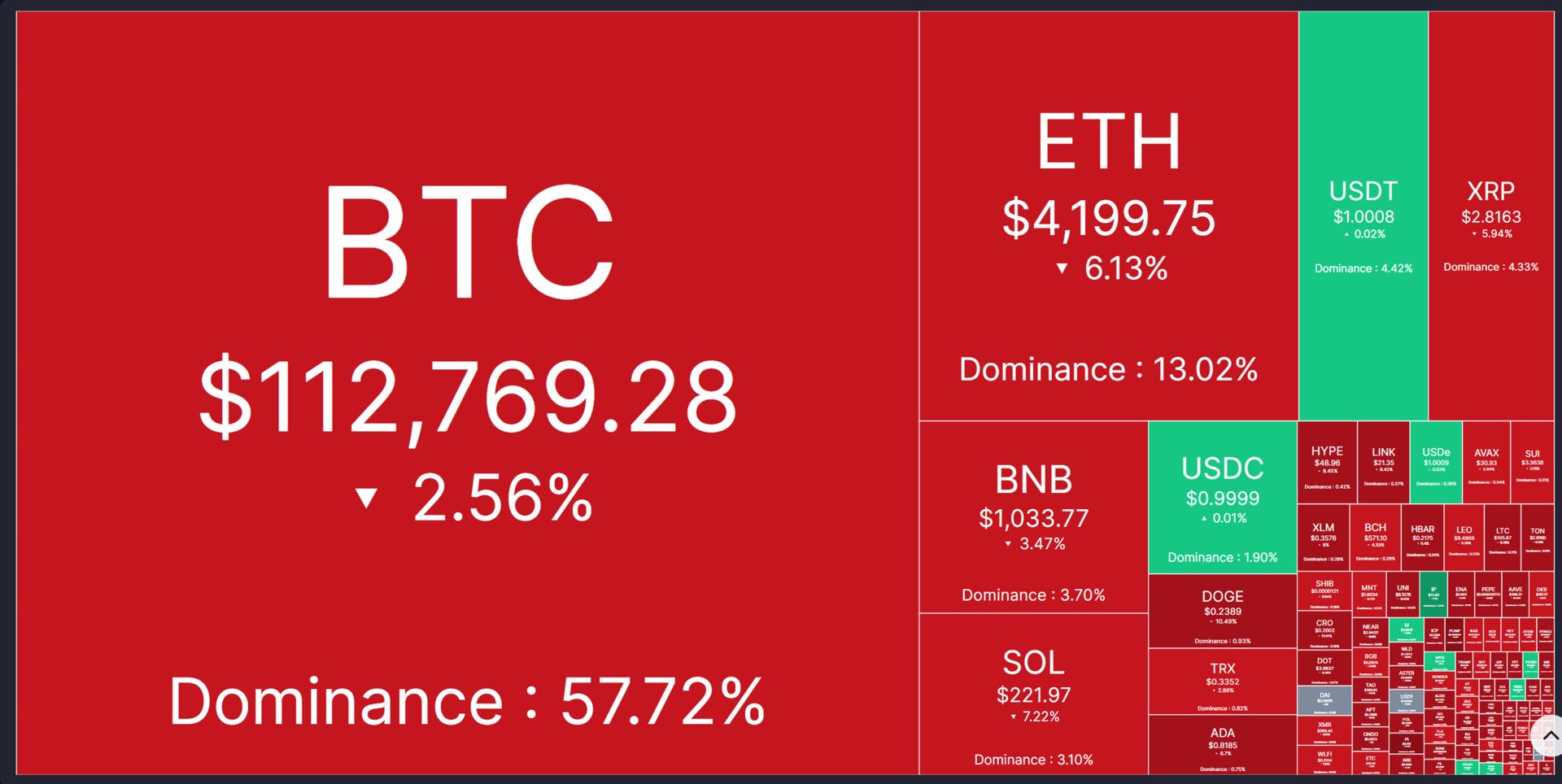
Red dominates the market, as shown on the cryptocurrency heatmap from
CoinMarketCap:
Source: CoinMarketCap
"Speculation is swirling that a BTC whale offloaded
a large position during thin liquidity and muted trading activity, sparking
forced liquidations," commented Paul Howard from Wincent. "This type of impact could have been reduced by executing
through OTC channels with a trusted counterparty, where sizable transactions
are absorbed more efficiently within market depth and demand."
"Altcoins bore the brunt of the spillover today, though it’s worth remembering
that a 3% dip in BTC is relatively minor compared to historical drawdowns. In
my view, the broader outlook for the asset still points to further upside from
here," he added.
Bitcoin Price Tests
Critical Support Boundaries
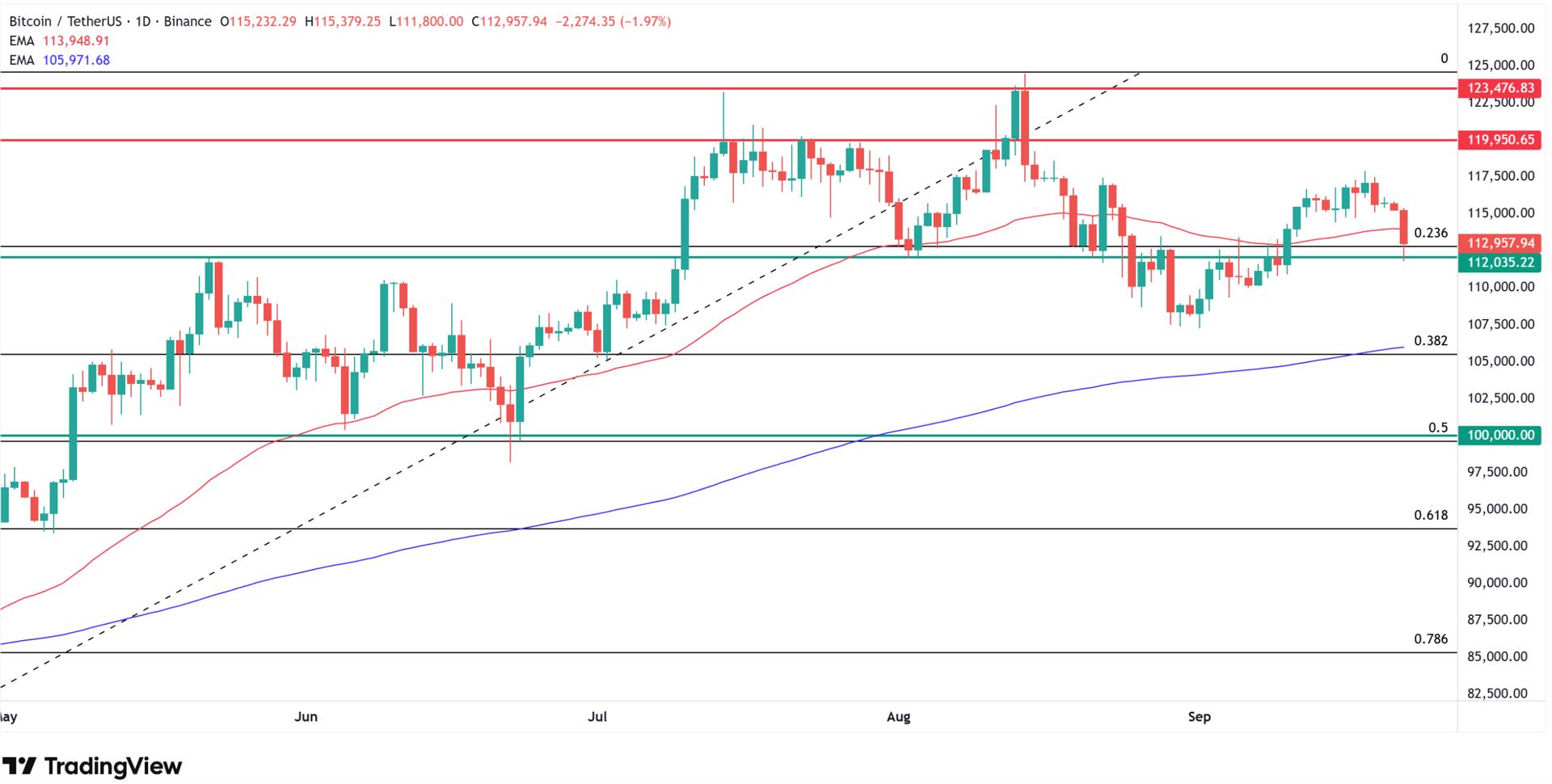
Bitcoin
slipped below the psychologically important $115,000 level, trading at $112,840
after touching session lows near $111,760. The world's largest cryptocurrency
retreated from September highs above $117,000, testing the lower boundary of
its consolidation range that has defined trading since July.
From my
technical analysis, Bitcoin's break below its 50-day moving average at $115,000
signals potential further declines toward the $105,000 support zone, which
coincides with a 38.2% Fibonacci retracement and the 200-day exponential moving
average. According to my technical view, even if Bitcoin exits its current
consolidation, this level represents very strong support.
Why Bitcoin price is going down today? Source: Tradingview.com
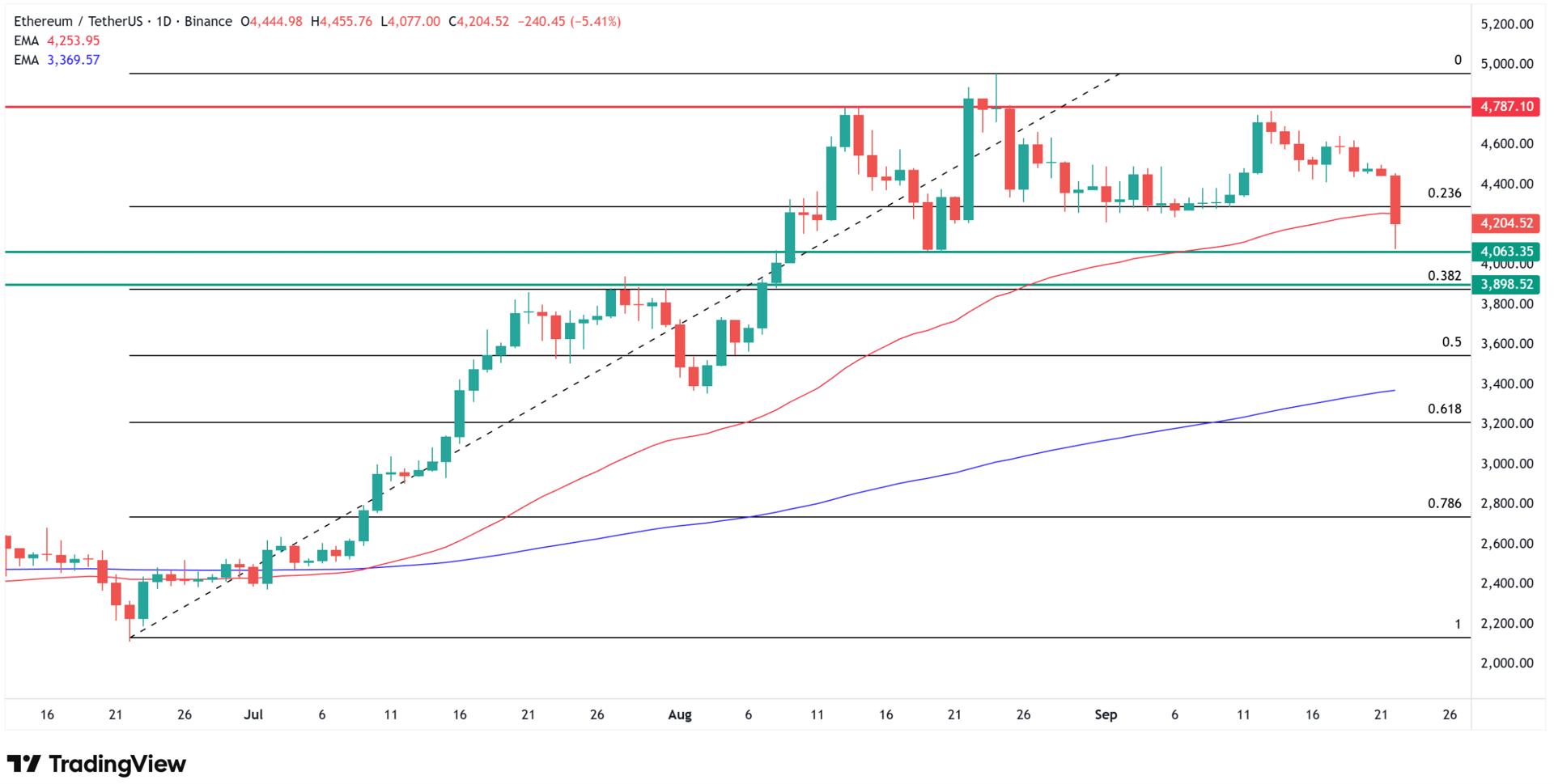
Ethereum
faced more severe pressure, with the second-largest digital asset by market
capitalization dropping to around $4,100 during Monday's session, its lowest
level in over a month. The sharp decline violated Ethereum's 50-day exponential
moving average and September lows, though some of the selling was corrected as
ETH recovered to trade near $4,200, still down more than 5% on the day.
According
to my technical analysis, the cryptocurrency has pulled significantly away from
August highs tested on August 13 near $4,800. Despite Monday's weakness, from
my technical view, Ethereum remains within the same consolidation channel
observed since early August, trading between support at $4,060 and resistance
at $4,800—a range representing approximately 17% volatility spread.
Why Ethereum price is going down today? Source: Tradingview.com
The current
price action suggests Ethereum is testing the lower boundary of this
established range, with the next critical support level sitting at the $4,060
zone that has been defended multiple times since August.
XRP Approaches Multi-Month
Support Zone
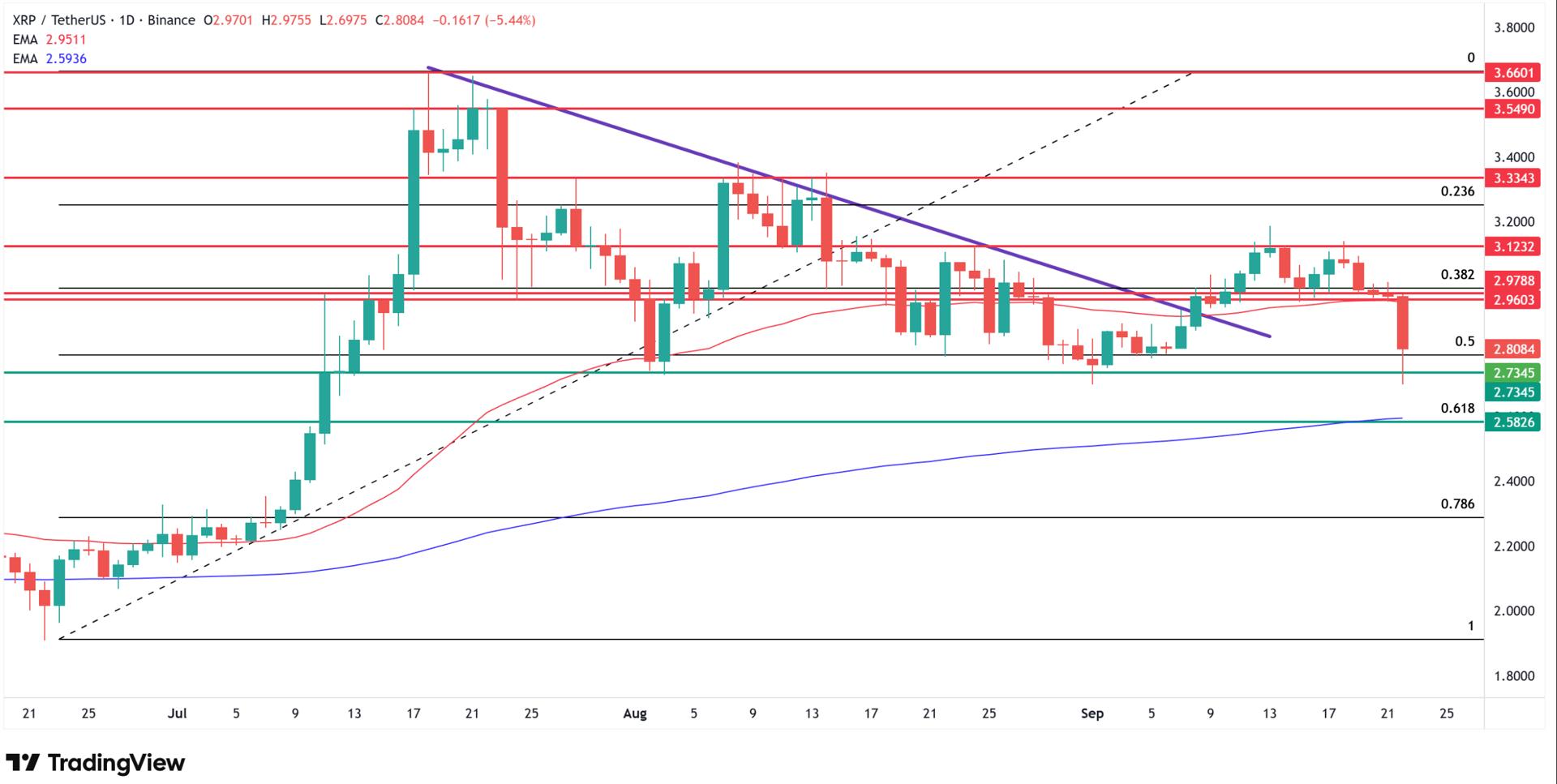
XRP price emerged
as one of Monday's worst performers among major cryptocurrencies, sliding for
the fifth consecutive session to test levels below $2.70. The decline marked
XRP's lowest point since early September and coincided with levels last seen in
early July, representing a two-month low.
Over less
than a week, XRP has declined from local resistance at $3.12 and September
highs to the lower boundary of its consolidation range that has been tested
three times since early August. From my technical analysis, this
support zone aligns with a 50% Fibonacci retracement and local highs from the
2024-2025 transition period, typically functioning as strong support.
According
to my technical view, just below this level lies the 200-day exponential moving
average combined with the $2.58 level and 61.8% Fibonacci retracement, creating
a broader support zone that should help defend XRP against stronger
depreciation. This confluence of technical indicators suggests a critical
juncture for the token.
Why XRP price is going down today? Source: Tradingview.com
Dogecoin Suffers Steepest
Decline Among Major Cryptos
Among the
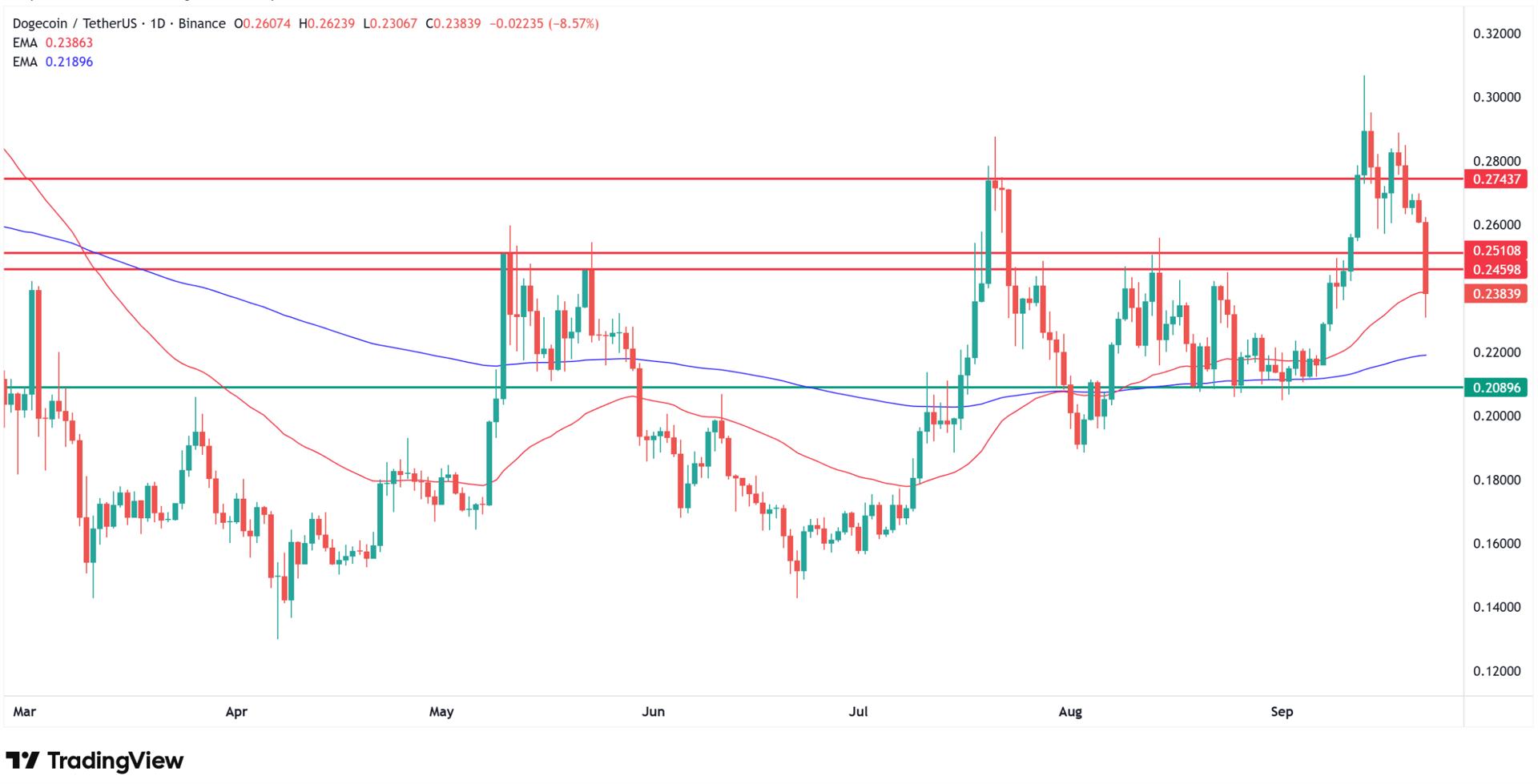
four major cryptocurrencies analyzed, Dogecoin posted the largest losses. The
meme token fell more than 10% at one point during Monday's session to just 23
cents, though it found support at the 50-day exponential moving average.
Currently trading down 8.6% near 24 cents, with an exact valuation of $0.2384.
Dogecoin
had surged strongly in September, briefly reaching 31 cents—the highest level
since the beginning of the year. However, it has sharply corrected and according
to my technical analysis, is now returning to the consolidation range
observed throughout most of August, which spans between 21 cents and a
resistance zone around 25 cents.
From my
technical view, the current price action suggests significant risk that
Dogecoin could approach the lower boundary of this consolidation range. The
50-day exponential moving average provided temporary support during Monday's
decline, but sustained selling pressure could push the token toward the 21-cent
floor established in August.
Why Dogecoin price is going down today? Source: Tradingview.com
Seasonal Patterns Offer
Hope
Despite
near-term weakness, from my technical analysis, historical patterns
suggest potential for recovery. "While near-term weakness is possible
between now and month-end, the market is also entering what is historically the
strongest quarter of the year for crypto," Kruger observed.
According
to market analysis, seasonally favorable flows and positioning have often set
the stage for powerful year-end rallies. "Fresh record highs in both Bitcoin and ether remain in view if the macro backdrop cooperates," the
LMAX strategist added.
However,
Kruger cautioned that "sustained dollar strength or geopolitical
developments—ranging from U.S. regulatory moves to broader global political
tensions—could further test crypto's resilience."
From my
technical analysis, the key levels to watch include Bitcoin's $105,000 support
zone, Ethereum's $4,060 consolidation floor, XRP's $2.58-$2.70 support band,
and Dogecoin's 21-cent August low. These technical boundaries will likely
determine whether the current correction represents healthy consolidation or
the beginning of a deeper bear phase.
"For
now, however, the balance of risks leans toward consolidation or modest
downside unless Bitcoin can decisively clear overhead resistance," Kruger
concluded.
Read my other posts and analysis related to the cryptocurrency market:
The crypto
market declines due to multiple interconnected factors. Macroeconomic
conditions play a crucial role: when central banks raise interest rates,
borrowing becomes more expensive and reduces liquidity in financial markets,
leading to lower investment in risky assets like crypto. Market sentiment and
speculation also drive volatility, as prices are often influenced more by
investor emotions than intrinsic value. Regulatory developments create
uncertainty, with crackdowns or proposed regulations often triggering panic
selling.
Will crypto rise again?
Historical
patterns suggest crypto markets tend to recover from downturns, particularly
during the fourth quarter which has traditionally been the strongest period for
digital assets. Seasonally favorable flows and institutional positioning often
set the stage for year-end rallies, with fresh record highs remaining possible
if macroeconomic conditions cooperate. However, recovery depends on factors
including Federal Reserve policy clarity, regulatory developments, and overall
market sentiment toward risk assets.
What is the 30 day rule in
crypto?
The 30-day
rule, also known as the wash sale rule, prevents investors from claiming tax
losses while immediately repurchasing the same asset. However, most
cryptocurrencies are currently exempt from this rule since they're not legally
defined as securities by tax authorities. In traditional markets, investors
must wait 30 days after selling an asset at a loss before buying it back to
claim the tax deduction.
What does Warren Buffett
say about crypto?
Warren
Buffett has been consistently critical of cryptocurrency, famously calling
Bitcoin "rat poison squared" at Berkshire Hathaway's 2018 annual
meeting. At the 2022 shareholder meeting, he stated: "If you told me you
owned all of the bitcoin in the world and you offered it to me for $25, I
wouldn't take it because what would I do with it? I'd have to sell it back to
you one way or another. It isn't going to do anything". Buffett believes
cryptocurrencies lack intrinsic value and don't produce concrete returns like
traditional investments.
Digital
asset prices tumbled across the board today (Monday), with Bitcoin (BTC) and
Ethereum (ETH) leading a broad-based selloff that sent major cryptocurrencies
toward multi-week lows as technical levels crumbled and profit-taking
accelerated.
The
cryptocurrency market's total capitalization fell by $77 billion during
Monday's session, with more than 400,000 traders facing liquidations worth $1.7
billion combined. Market sentiment has turned decidedly cautious as traders
reassess positioning ahead of month-end.
Why are
cryptocurrencies falling? In this article, I address that question by analyzing
technical charts for XRP/USDT, BTC/USDT, DOGE/USDT, and ETH/USDT.
Why Is Crypto Going Down
Today?
Several
macro factors have contributed to the selloff. While last week's Federal
Reserve rate cut to 4.00-4.25% initially supported risk assets, Chair Powell's
cautious stance on inflation has tempered expectations for rapid easing.
"As a result, traders have been reluctant to extend crypto's recent rally
without fresh macro catalysts," explained Joel Kruger, FX and crypto
strategist at LMAX Group.
"Despite downside pressure from a stronger U.S. dollar, driven by concern the Fed may stay less accommodative than markets hope, we also see profit-taking on bitcoin longs after an unusually strong September," Kruger commented for FinanceMagnates.com. "Still, we believe the Fed will ultimately align with market expectations and that crypto remains well-positioned for a historically robust Q4. Any near-term dips should be well-supported, setting the stage for potential new record highs in bitcoin and ETH into year-end."
As a
result, cryptocurrency prices have fallen to their lowest levels in more than a
month, extending declines for four and in some cases five consecutive sessions.
Red dominates the market, as shown on the cryptocurrency heatmap from
CoinMarketCap:
Source: CoinMarketCap
"Speculation is swirling that a BTC whale offloaded
a large position during thin liquidity and muted trading activity, sparking
forced liquidations," commented Paul Howard from Wincent. "This type of impact could have been reduced by executing
through OTC channels with a trusted counterparty, where sizable transactions
are absorbed more efficiently within market depth and demand."
"Altcoins bore the brunt of the spillover today, though it’s worth remembering
that a 3% dip in BTC is relatively minor compared to historical drawdowns. In
my view, the broader outlook for the asset still points to further upside from
here," he added.
Bitcoin Price Tests
Critical Support Boundaries
Bitcoin
slipped below the psychologically important $115,000 level, trading at $112,840
after touching session lows near $111,760. The world's largest cryptocurrency
retreated from September highs above $117,000, testing the lower boundary of
its consolidation range that has defined trading since July.
From my
technical analysis, Bitcoin's break below its 50-day moving average at $115,000
signals potential further declines toward the $105,000 support zone, which
coincides with a 38.2% Fibonacci retracement and the 200-day exponential moving
average. According to my technical view, even if Bitcoin exits its current
consolidation, this level represents very strong support.
Why Bitcoin price is going down today? Source: Tradingview.com
Ethereum
faced more severe pressure, with the second-largest digital asset by market
capitalization dropping to around $4,100 during Monday's session, its lowest
level in over a month. The sharp decline violated Ethereum's 50-day exponential
moving average and September lows, though some of the selling was corrected as
ETH recovered to trade near $4,200, still down more than 5% on the day.
According
to my technical analysis, the cryptocurrency has pulled significantly away from
August highs tested on August 13 near $4,800. Despite Monday's weakness, from
my technical view, Ethereum remains within the same consolidation channel
observed since early August, trading between support at $4,060 and resistance
at $4,800—a range representing approximately 17% volatility spread.
Why Ethereum price is going down today? Source: Tradingview.com
The current
price action suggests Ethereum is testing the lower boundary of this
established range, with the next critical support level sitting at the $4,060
zone that has been defended multiple times since August.
XRP Approaches Multi-Month
Support Zone
XRP price emerged
as one of Monday's worst performers among major cryptocurrencies, sliding for
the fifth consecutive session to test levels below $2.70. The decline marked
XRP's lowest point since early September and coincided with levels last seen in
early July, representing a two-month low.
Over less
than a week, XRP has declined from local resistance at $3.12 and September
highs to the lower boundary of its consolidation range that has been tested
three times since early August. From my technical analysis, this
support zone aligns with a 50% Fibonacci retracement and local highs from the
2024-2025 transition period, typically functioning as strong support.
According
to my technical view, just below this level lies the 200-day exponential moving
average combined with the $2.58 level and 61.8% Fibonacci retracement, creating
a broader support zone that should help defend XRP against stronger
depreciation. This confluence of technical indicators suggests a critical
juncture for the token.
Why XRP price is going down today? Source: Tradingview.com
Dogecoin Suffers Steepest
Decline Among Major Cryptos
Among the
four major cryptocurrencies analyzed, Dogecoin posted the largest losses. The
meme token fell more than 10% at one point during Monday's session to just 23
cents, though it found support at the 50-day exponential moving average.
Currently trading down 8.6% near 24 cents, with an exact valuation of $0.2384.
Dogecoin
had surged strongly in September, briefly reaching 31 cents—the highest level
since the beginning of the year. However, it has sharply corrected and according
to my technical analysis, is now returning to the consolidation range
observed throughout most of August, which spans between 21 cents and a
resistance zone around 25 cents.
From my
technical view, the current price action suggests significant risk that
Dogecoin could approach the lower boundary of this consolidation range. The
50-day exponential moving average provided temporary support during Monday's
decline, but sustained selling pressure could push the token toward the 21-cent
floor established in August.
Why Dogecoin price is going down today? Source: Tradingview.com
Seasonal Patterns Offer
Hope
Despite
near-term weakness, from my technical analysis, historical patterns
suggest potential for recovery. "While near-term weakness is possible
between now and month-end, the market is also entering what is historically the
strongest quarter of the year for crypto," Kruger observed.
According
to market analysis, seasonally favorable flows and positioning have often set
the stage for powerful year-end rallies. "Fresh record highs in both Bitcoin and ether remain in view if the macro backdrop cooperates," the
LMAX strategist added.
However,
Kruger cautioned that "sustained dollar strength or geopolitical
developments—ranging from U.S. regulatory moves to broader global political
tensions—could further test crypto's resilience."
From my
technical analysis, the key levels to watch include Bitcoin's $105,000 support
zone, Ethereum's $4,060 consolidation floor, XRP's $2.58-$2.70 support band,
and Dogecoin's 21-cent August low. These technical boundaries will likely
determine whether the current correction represents healthy consolidation or
the beginning of a deeper bear phase.
"For
now, however, the balance of risks leans toward consolidation or modest
downside unless Bitcoin can decisively clear overhead resistance," Kruger
concluded.
Read my other posts and analysis related to the cryptocurrency market:
The crypto
market declines due to multiple interconnected factors. Macroeconomic
conditions play a crucial role: when central banks raise interest rates,
borrowing becomes more expensive and reduces liquidity in financial markets,
leading to lower investment in risky assets like crypto. Market sentiment and
speculation also drive volatility, as prices are often influenced more by
investor emotions than intrinsic value. Regulatory developments create
uncertainty, with crackdowns or proposed regulations often triggering panic
selling.
Will crypto rise again?
Historical
patterns suggest crypto markets tend to recover from downturns, particularly
during the fourth quarter which has traditionally been the strongest period for
digital assets. Seasonally favorable flows and institutional positioning often
set the stage for year-end rallies, with fresh record highs remaining possible
if macroeconomic conditions cooperate. However, recovery depends on factors
including Federal Reserve policy clarity, regulatory developments, and overall
market sentiment toward risk assets.
What is the 30 day rule in
crypto?
The 30-day
rule, also known as the wash sale rule, prevents investors from claiming tax
losses while immediately repurchasing the same asset. However, most
cryptocurrencies are currently exempt from this rule since they're not legally
defined as securities by tax authorities. In traditional markets, investors
must wait 30 days after selling an asset at a loss before buying it back to
claim the tax deduction.
What does Warren Buffett
say about crypto?
Warren
Buffett has been consistently critical of cryptocurrency, famously calling
Bitcoin "rat poison squared" at Berkshire Hathaway's 2018 annual
meeting. At the 2022 shareholder meeting, he stated: "If you told me you
owned all of the bitcoin in the world and you offered it to me for $25, I
wouldn't take it because what would I do with it? I'd have to sell it back to
you one way or another. It isn't going to do anything". Buffett believes
cryptocurrencies lack intrinsic value and don't produce concrete returns like
traditional investments.
Damian Chmiel is a Senior Analyst & Editor at Finance Magnates with more than 15 years of experience in the CFD and online trading industry. Active as both a trader and journalist since 2010, he focuses on broker coverage, fintech innovation, and regulatory developments across Europe, the Middle East, and Asia.
His work includes interviews with C-level leaders at major brokerages and fintech platforms, as well as co-authoring Finance Magnates’ quarterly industry benchmarking reports. Damian’s reporting is data-driven, market-aware, and grounded in direct industry engagement. His analysis and commentary have also been cited by external media outlets, including Investing.com, Binance, The Asset, Stockhead, and Dispatch.
Education:
MA in Finance and Accounting, Cracow University of Economics
Why Is Dogecoin Going Up Today? DOGE Price Prediction Shows 25% Upside Potential
Featured Videos
AvaTrade to Acquire Most of FXCM; NAGA Raises $8M
AvaTrade to Acquire Most of FXCM; NAGA Raises $8M
AvaTrade to Acquire Most of FXCM; NAGA Raises $8M
AvaTrade to Acquire Most of FXCM; NAGA Raises $8M
Today’s financial news recap covers AvaTrade agrees to acquire most of FXCM, NAGA secures eight million dollars in new financing, and Wise seeks a tax settlement in the UK.
Finance Magnates Daily Recap brings you the latest news from forex and CFD brokers, fintech, payments, cryptocurrency, digital assets, trading platforms, financial regulation and global markets.
Get the key company news, executive moves, deals, regulatory updates and market developments of the day, in just a few minutes. New episodes published every weekday.
Read more: https://www.financemagnates.com
#FinanceMagnates #ForexNews #FintechNews
Today’s financial news recap covers AvaTrade agrees to acquire most of FXCM, NAGA secures eight million dollars in new financing, and Wise seeks a tax settlement in the UK.
Finance Magnates Daily Recap brings you the latest news from forex and CFD brokers, fintech, payments, cryptocurrency, digital assets, trading platforms, financial regulation and global markets.
Get the key company news, executive moves, deals, regulatory updates and market developments of the day, in just a few minutes. New episodes published every weekday.
Read more: https://www.financemagnates.com
#FinanceMagnates #ForexNews #FintechNews
Today’s financial news recap covers AvaTrade agrees to acquire most of FXCM, NAGA secures eight million dollars in new financing, and Wise seeks a tax settlement in the UK.
Finance Magnates Daily Recap brings you the latest news from forex and CFD brokers, fintech, payments, cryptocurrency, digital assets, trading platforms, financial regulation and global markets.
Get the key company news, executive moves, deals, regulatory updates and market developments of the day, in just a few minutes. New episodes published every weekday.
Read more: https://www.financemagnates.com
#FinanceMagnates #ForexNews #FintechNews
Today’s financial news recap covers AvaTrade agrees to acquire most of FXCM, NAGA secures eight million dollars in new financing, and Wise seeks a tax settlement in the UK.
Finance Magnates Daily Recap brings you the latest news from forex and CFD brokers, fintech, payments, cryptocurrency, digital assets, trading platforms, financial regulation and global markets.
Get the key company news, executive moves, deals, regulatory updates and market developments of the day, in just a few minutes. New episodes published every weekday.
Read more: https://www.financemagnates.com
#FinanceMagnates #ForexNews #FintechNews
XTB Adds Overnight US Stock Trading; Nasdaq Ventures Invests in One Trading
XTB Adds Overnight US Stock Trading; Nasdaq Ventures Invests in One Trading
XTB Adds Overnight US Stock Trading; Nasdaq Ventures Invests in One Trading
XTB Adds Overnight US Stock Trading; Nasdaq Ventures Invests in One Trading
XTB Adds Overnight US Stock Trading; Nasdaq Ventures Invests in One Trading
XTB Adds Overnight US Stock Trading; Nasdaq Ventures Invests in One Trading
Today’s financial news recap covers XTB expands overnight US stock trading, Fortrade reports higher revenue, Nasdaq backs One Trading, and Vest Labs raises 13 million dollars.
Finance Magnates Daily Recap brings you the latest news from forex and CFD brokers, fintech, payments, cryptocurrency, digital assets, trading platforms, financial regulation and global markets.
Get the key company news, executive moves, deals, regulatory updates and market developments of the day, in just a few minutes. New episodes published every weekday.
Read more: https://www.financemagnates.com
#FinanceMagnates #ForexNews #FintechNews
Today’s financial news recap covers XTB expands overnight US stock trading, Fortrade reports higher revenue, Nasdaq backs One Trading, and Vest Labs raises 13 million dollars.
Finance Magnates Daily Recap brings you the latest news from forex and CFD brokers, fintech, payments, cryptocurrency, digital assets, trading platforms, financial regulation and global markets.
Get the key company news, executive moves, deals, regulatory updates and market developments of the day, in just a few minutes. New episodes published every weekday.
Read more: https://www.financemagnates.com
#FinanceMagnates #ForexNews #FintechNews
Today’s financial news recap covers XTB expands overnight US stock trading, Fortrade reports higher revenue, Nasdaq backs One Trading, and Vest Labs raises 13 million dollars.
Finance Magnates Daily Recap brings you the latest news from forex and CFD brokers, fintech, payments, cryptocurrency, digital assets, trading platforms, financial regulation and global markets.
Get the key company news, executive moves, deals, regulatory updates and market developments of the day, in just a few minutes. New episodes published every weekday.
Read more: https://www.financemagnates.com
#FinanceMagnates #ForexNews #FintechNews
Today’s financial news recap covers XTB expands overnight US stock trading, Fortrade reports higher revenue, Nasdaq backs One Trading, and Vest Labs raises 13 million dollars.
Finance Magnates Daily Recap brings you the latest news from forex and CFD brokers, fintech, payments, cryptocurrency, digital assets, trading platforms, financial regulation and global markets.
Get the key company news, executive moves, deals, regulatory updates and market developments of the day, in just a few minutes. New episodes published every weekday.
Read more: https://www.financemagnates.com
#FinanceMagnates #ForexNews #FintechNews
Today’s financial news recap covers XTB expands overnight US stock trading, Fortrade reports higher revenue, Nasdaq backs One Trading, and Vest Labs raises 13 million dollars.
Finance Magnates Daily Recap brings you the latest news from forex and CFD brokers, fintech, payments, cryptocurrency, digital assets, trading platforms, financial regulation and global markets.
Get the key company news, executive moves, deals, regulatory updates and market developments of the day, in just a few minutes. New episodes published every weekday.
Read more: https://www.financemagnates.com
#FinanceMagnates #ForexNews #FintechNews
Today’s financial news recap covers XTB expands overnight US stock trading, Fortrade reports higher revenue, Nasdaq backs One Trading, and Vest Labs raises 13 million dollars.
Finance Magnates Daily Recap brings you the latest news from forex and CFD brokers, fintech, payments, cryptocurrency, digital assets, trading platforms, financial regulation and global markets.
Get the key company news, executive moves, deals, regulatory updates and market developments of the day, in just a few minutes. New episodes published every weekday.
Read more: https://www.financemagnates.com
#FinanceMagnates #ForexNews #FintechNews
CMC Founder Downplays Volatility Hit; Devexperts Names CEO
CMC Founder Downplays Volatility Hit; Devexperts Names CEO
CMC Founder Downplays Volatility Hit; Devexperts Names CEO
CMC Founder Downplays Volatility Hit; Devexperts Names CEO
CMC Founder Downplays Volatility Hit; Devexperts Names CEO
CMC Founder Downplays Volatility Hit; Devexperts Names CEO
Today’s financial news recap covers low volatility pressures brokers, Devexperts names a new CEO, Saxo cuts onboarding time, and OKX reaches a 25 billion dollar valuation.
Finance Magnates Daily Recap brings you the latest news from forex and CFD brokers, fintech, payments, cryptocurrency, digital assets, trading platforms, financial regulation and global markets.
Get the key company news, executive moves, deals, regulatory updates and market developments of the day, in just a few minutes. New episodes published every weekday.
Read more: https://www.financemagnates.com
#FinanceMagnates #ForexNews #FintechNews
Today’s financial news recap covers low volatility pressures brokers, Devexperts names a new CEO, Saxo cuts onboarding time, and OKX reaches a 25 billion dollar valuation.
Finance Magnates Daily Recap brings you the latest news from forex and CFD brokers, fintech, payments, cryptocurrency, digital assets, trading platforms, financial regulation and global markets.
Get the key company news, executive moves, deals, regulatory updates and market developments of the day, in just a few minutes. New episodes published every weekday.
Read more: https://www.financemagnates.com
#FinanceMagnates #ForexNews #FintechNews
Today’s financial news recap covers low volatility pressures brokers, Devexperts names a new CEO, Saxo cuts onboarding time, and OKX reaches a 25 billion dollar valuation.
Finance Magnates Daily Recap brings you the latest news from forex and CFD brokers, fintech, payments, cryptocurrency, digital assets, trading platforms, financial regulation and global markets.
Get the key company news, executive moves, deals, regulatory updates and market developments of the day, in just a few minutes. New episodes published every weekday.
Read more: https://www.financemagnates.com
#FinanceMagnates #ForexNews #FintechNews
Today’s financial news recap covers low volatility pressures brokers, Devexperts names a new CEO, Saxo cuts onboarding time, and OKX reaches a 25 billion dollar valuation.
Finance Magnates Daily Recap brings you the latest news from forex and CFD brokers, fintech, payments, cryptocurrency, digital assets, trading platforms, financial regulation and global markets.
Get the key company news, executive moves, deals, regulatory updates and market developments of the day, in just a few minutes. New episodes published every weekday.
Read more: https://www.financemagnates.com
#FinanceMagnates #ForexNews #FintechNews
Today’s financial news recap covers low volatility pressures brokers, Devexperts names a new CEO, Saxo cuts onboarding time, and OKX reaches a 25 billion dollar valuation.
Finance Magnates Daily Recap brings you the latest news from forex and CFD brokers, fintech, payments, cryptocurrency, digital assets, trading platforms, financial regulation and global markets.
Get the key company news, executive moves, deals, regulatory updates and market developments of the day, in just a few minutes. New episodes published every weekday.
Read more: https://www.financemagnates.com
#FinanceMagnates #ForexNews #FintechNews
Today’s financial news recap covers low volatility pressures brokers, Devexperts names a new CEO, Saxo cuts onboarding time, and OKX reaches a 25 billion dollar valuation.
Finance Magnates Daily Recap brings you the latest news from forex and CFD brokers, fintech, payments, cryptocurrency, digital assets, trading platforms, financial regulation and global markets.
Get the key company news, executive moves, deals, regulatory updates and market developments of the day, in just a few minutes. New episodes published every weekday.
Read more: https://www.financemagnates.com
#FinanceMagnates #ForexNews #FintechNews
Today’s financial news recap covers Trade Nation buys FXCM's UK client book, Trading 212 reports higher revenue, the CFTC's move to allow perpetual index futures.
Finance Magnates Daily Recap brings you the latest news from forex and CFD brokers, fintech, payments, cryptocurrency, digital assets, trading platforms, financial regulation and global markets.
Get the key company news, executive moves, deals, regulatory updates and market developments of the day, in just a few minutes. New episodes published every weekday.
Read more: https://www.financemagnates.com
#FinanceMagnates #ForexNews #FintechNews
Today’s financial news recap covers Trade Nation buys FXCM's UK client book, Trading 212 reports higher revenue, the CFTC's move to allow perpetual index futures.
Finance Magnates Daily Recap brings you the latest news from forex and CFD brokers, fintech, payments, cryptocurrency, digital assets, trading platforms, financial regulation and global markets.
Get the key company news, executive moves, deals, regulatory updates and market developments of the day, in just a few minutes. New episodes published every weekday.
Read more: https://www.financemagnates.com
#FinanceMagnates #ForexNews #FintechNews
Today’s financial news recap covers Trade Nation buys FXCM's UK client book, Trading 212 reports higher revenue, the CFTC's move to allow perpetual index futures.
Finance Magnates Daily Recap brings you the latest news from forex and CFD brokers, fintech, payments, cryptocurrency, digital assets, trading platforms, financial regulation and global markets.
Get the key company news, executive moves, deals, regulatory updates and market developments of the day, in just a few minutes. New episodes published every weekday.
Read more: https://www.financemagnates.com
#FinanceMagnates #ForexNews #FintechNews
Today’s financial news recap covers Trade Nation buys FXCM's UK client book, Trading 212 reports higher revenue, the CFTC's move to allow perpetual index futures.
Finance Magnates Daily Recap brings you the latest news from forex and CFD brokers, fintech, payments, cryptocurrency, digital assets, trading platforms, financial regulation and global markets.
Get the key company news, executive moves, deals, regulatory updates and market developments of the day, in just a few minutes. New episodes published every weekday.
Read more: https://www.financemagnates.com
#FinanceMagnates #ForexNews #FintechNews
Today’s financial news recap covers Trade Nation buys FXCM's UK client book, Trading 212 reports higher revenue, the CFTC's move to allow perpetual index futures.
Finance Magnates Daily Recap brings you the latest news from forex and CFD brokers, fintech, payments, cryptocurrency, digital assets, trading platforms, financial regulation and global markets.
Get the key company news, executive moves, deals, regulatory updates and market developments of the day, in just a few minutes. New episodes published every weekday.
Read more: https://www.financemagnates.com
#FinanceMagnates #ForexNews #FintechNews
Today’s financial news recap covers Trade Nation buys FXCM's UK client book, Trading 212 reports higher revenue, the CFTC's move to allow perpetual index futures.
Finance Magnates Daily Recap brings you the latest news from forex and CFD brokers, fintech, payments, cryptocurrency, digital assets, trading platforms, financial regulation and global markets.
Get the key company news, executive moves, deals, regulatory updates and market developments of the day, in just a few minutes. New episodes published every weekday.
Read more: https://www.financemagnates.com
#FinanceMagnates #ForexNews #FintechNews
Your career isn’t a linear path.
Your career isn’t a linear path.
Your career isn’t a linear path.
Your career isn’t a linear path.
Your career isn’t a linear path.
Your career isn’t a linear path.
Roles change. Career goals change. Sometimes you want a completely new challenge.
But the skills and knowledge you build along the way can stay with you and give you something to build on.
For Jeff Patterson, that continued growth is key to long-term career development.
You bring the skills. FM Academy helps you build the knowledge.
#FMAcademy #FinanceMagnates #FinanceCareers #ProfessionalDevelopment #Fintech
Roles change. Career goals change. Sometimes you want a completely new challenge.
But the skills and knowledge you build along the way can stay with you and give you something to build on.
For Jeff Patterson, that continued growth is key to long-term career development.
You bring the skills. FM Academy helps you build the knowledge.
#FMAcademy #FinanceMagnates #FinanceCareers #ProfessionalDevelopment #Fintech
Roles change. Career goals change. Sometimes you want a completely new challenge.
But the skills and knowledge you build along the way can stay with you and give you something to build on.
For Jeff Patterson, that continued growth is key to long-term career development.
You bring the skills. FM Academy helps you build the knowledge.
#FMAcademy #FinanceMagnates #FinanceCareers #ProfessionalDevelopment #Fintech
Roles change. Career goals change. Sometimes you want a completely new challenge.
But the skills and knowledge you build along the way can stay with you and give you something to build on.
For Jeff Patterson, that continued growth is key to long-term career development.
You bring the skills. FM Academy helps you build the knowledge.
#FMAcademy #FinanceMagnates #FinanceCareers #ProfessionalDevelopment #Fintech
Roles change. Career goals change. Sometimes you want a completely new challenge.
But the skills and knowledge you build along the way can stay with you and give you something to build on.
For Jeff Patterson, that continued growth is key to long-term career development.
You bring the skills. FM Academy helps you build the knowledge.
#FMAcademy #FinanceMagnates #FinanceCareers #ProfessionalDevelopment #Fintech
Roles change. Career goals change. Sometimes you want a completely new challenge.
But the skills and knowledge you build along the way can stay with you and give you something to build on.
For Jeff Patterson, that continued growth is key to long-term career development.
You bring the skills. FM Academy helps you build the knowledge.
#FMAcademy #FinanceMagnates #FinanceCareers #ProfessionalDevelopment #Fintech