
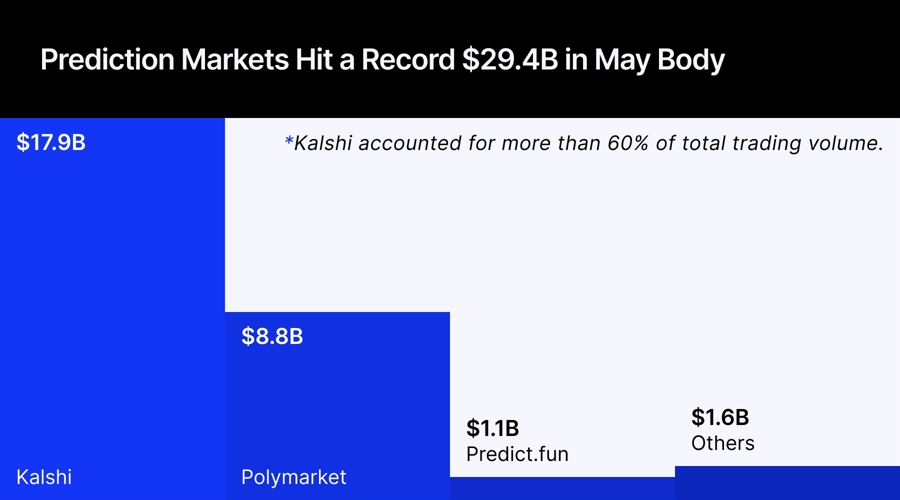
With a record-breaking $29.4 billion in trading volume in May, prediction markets are expanding faster than the infrastructure supporting them. But the gap is closing.
Retail brokers like Moomoo are rushing to onboard mass-market traders, while heavyweight market makers and OTC desks are stepping in to provide the institutional-grade liquidity and privacy that these soaring volumes demand.
The developments span different parts of the market, but they point to the same trend: more firms are finding reasons to engage with prediction markets, whether as distributors, liquidity providers, or trading counterparties.
Here’s what mattered this week.
Brokers Keep Adding Prediction Markets
Moomoo has partnered with Kalshi to bring prediction markets to its users, becoming the latest broker to add event contracts alongside traditional trading products.
The integration gives eligible customers access to contracts tied to economic data, elections, Federal Reserve decisions, and other real-world events directly from the broker’s existing platform.
The move continues a broader trend across the industry. Robinhood has already launched a prediction markets hub powered by Kalshi, while Interactive Brokers recently integrated contracts from Kalshi, CME Group, and ForecastEx into a single trading interface. Tradeweb has also taken a stake in Kalshi and entered a strategic partnership focused on institutional distribution.
Institutional Traders Build Around Prediction Markets
Wintermute and Galaxy Digital expanded their prediction market activities this week, but in very different ways. Wintermute has begun providing liquidity on Kalshi and Polymarket, joining firms such as Jump Trading and Susquehanna in supporting trading activity on public platforms.
The firm processes more than $3.5 trillion in annual trading volume across digital asset markets. Its arrival comes as prediction market volumes have grown beyond $20 billion per month, while liquidity has often lagged behind that growth.
Galaxy, meanwhile, is taking a different approach. The firm launched an OTC swap business for event-driven contracts and executed a $10 million trade tied to the passage of a U.S. crypto bill - nearly five times the size of the comparable contract available on Kalshi.
The contrast highlights a growing divide in market structure. Some firms are working to deepen liquidity on exchanges. Others are building off-exchange infrastructure for institutions that need larger trade sizes, privacy, and familiar derivatives documentation.
Sportsbooks Adjust Their World Cup Playbook
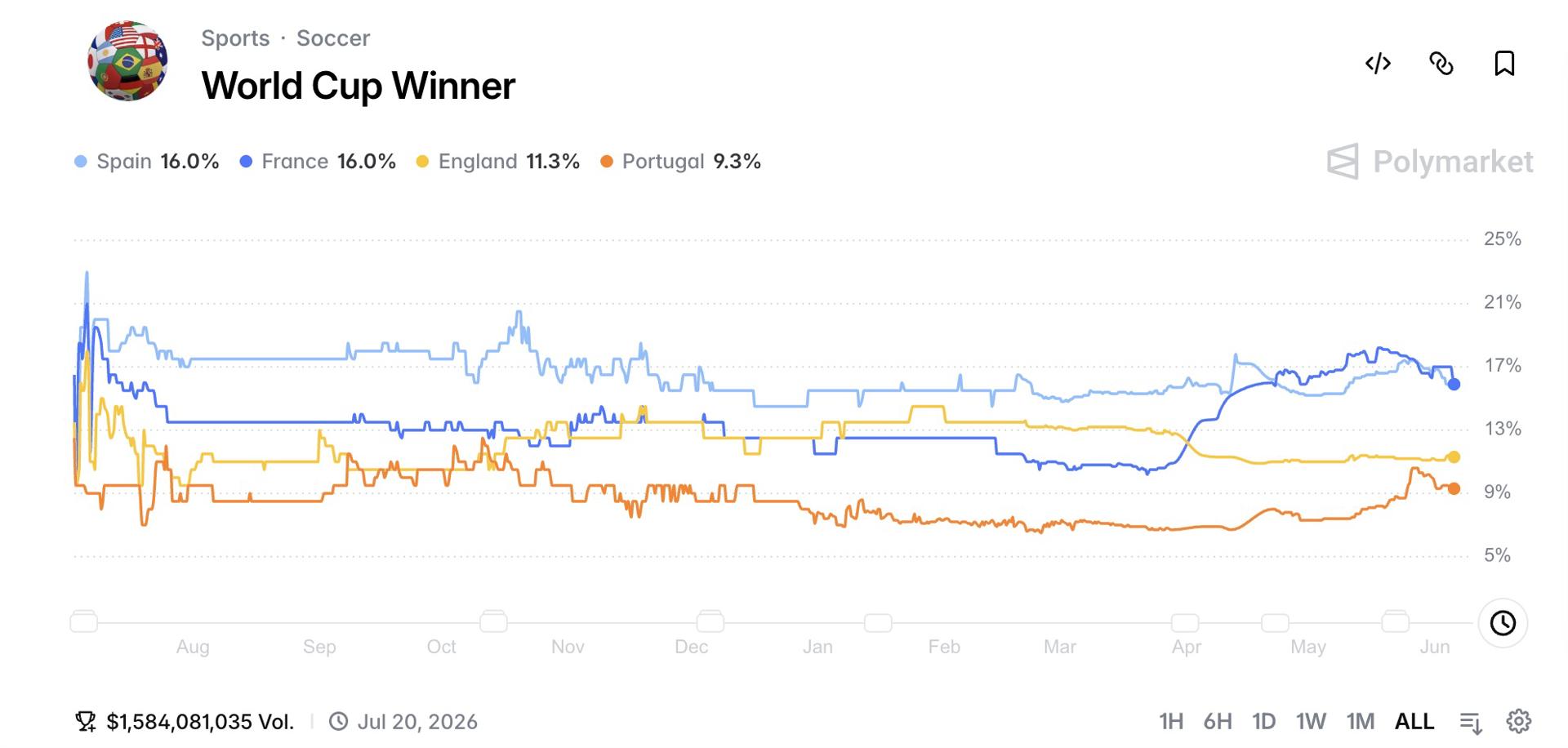
Prediction markets are beginning to influence how sportsbooks prepare for major sporting events. World Cup winner contracts on Polymarket have already generated roughly $1.5 billion in trading volume, giving traditional operators a new competitor during one of the industry’s biggest customer-acquisition periods.
Sportsbooks are responding by expanding product offerings and promotions. Flutter plans to introduce additional in-play markets and micro-betting options during the tournament, while operators continue to emphasise rewards programs and free bets as differentiators.
At the same time, the gap between the two models is narrowing. Polymarket has introduced combination contracts, while DraftKings and FanDuel have both expanded their involvement in prediction markets through separate initiatives.
- George Santos Probe Adds to Growing Insider-Trading Pressure on Prediction Markets
- Prediction Markets Force Sportsbooks to Rethink Their World Cup Strategy
- Prediction Markets Go Institutional as Galaxy Digital Moves Event Trading to the OTC Swap Market
Number of the Week
$29.4 billion is the total prediction market trading volume in May, according to data compiled by Artemis. The figure marks a new monthly record for the industry and extends a streak of four consecutive months of growth.
Kalshi accounted for $17.3 billion of that volume, while Polymarket processed $8.4 billion. The record comes as brokers, market makers, and sportsbooks increasingly adjust their strategies around a market that is growing well beyond its niche origins.
Use Case of the Week
A New York bar offered customers free drinks if the Knicks won — and hedged the promotion through Kalshi. The trade effectively offset the cost of the giveaway, turning a customer-acquisition campaign into a manageable risk rather than an open-ended expense.
The example is small, but it highlights a broader idea prediction market operators have been pushing for years: event contracts can be used for hedging by ordinary businesses, not just traders and hedge funds.
An NYC bar offered free drinks if the Knicks won and hedged it on @Kalshi so the promo paid for itself
— Lauris (@lzminsky) June 4, 2026
Shipped Bizhedge: tell it your business, and it finds live @kalshi markets you can use to cover a risk or run a promotion.
Link below
Not a product, company or investment… pic.twitter.com/QCZgtD1ELH
Bottom Line
The common thread running through this week’s developments is infrastructure. Brokers are adding prediction markets alongside stocks and options. Market makers are improving liquidity.
OTC desks are building institutional trading channels. Even sportsbooks are adapting products and promotions in response to growing competition. The debate over regulation remains unresolved, but firms are increasingly acting as though prediction markets are a permanent part of the financial landscape.


