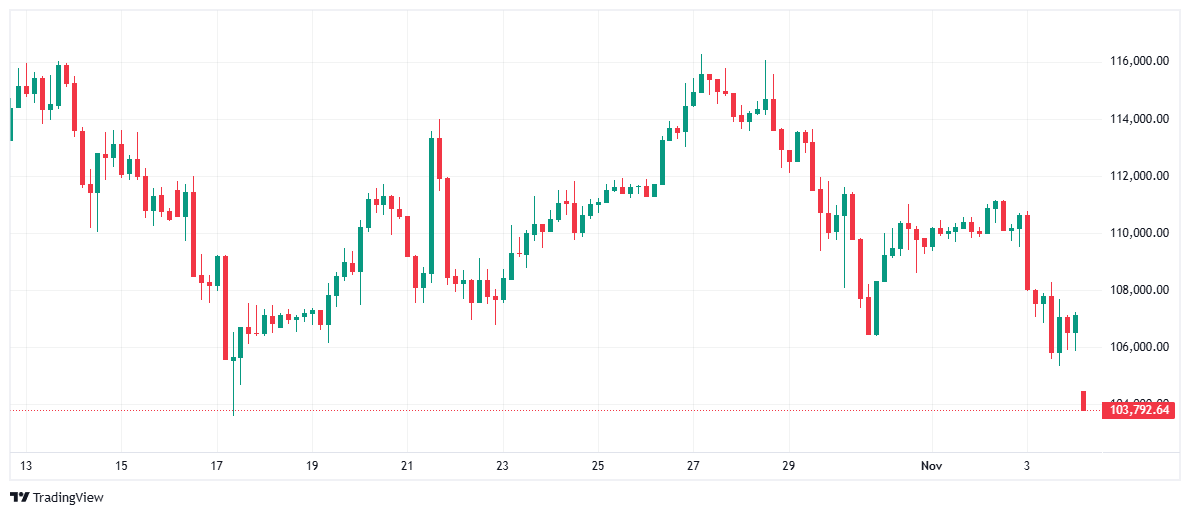
Bitcoin plunged to $104,288 on Tuesday, breaking below the critical 200-day moving average after the worst October in a decade.
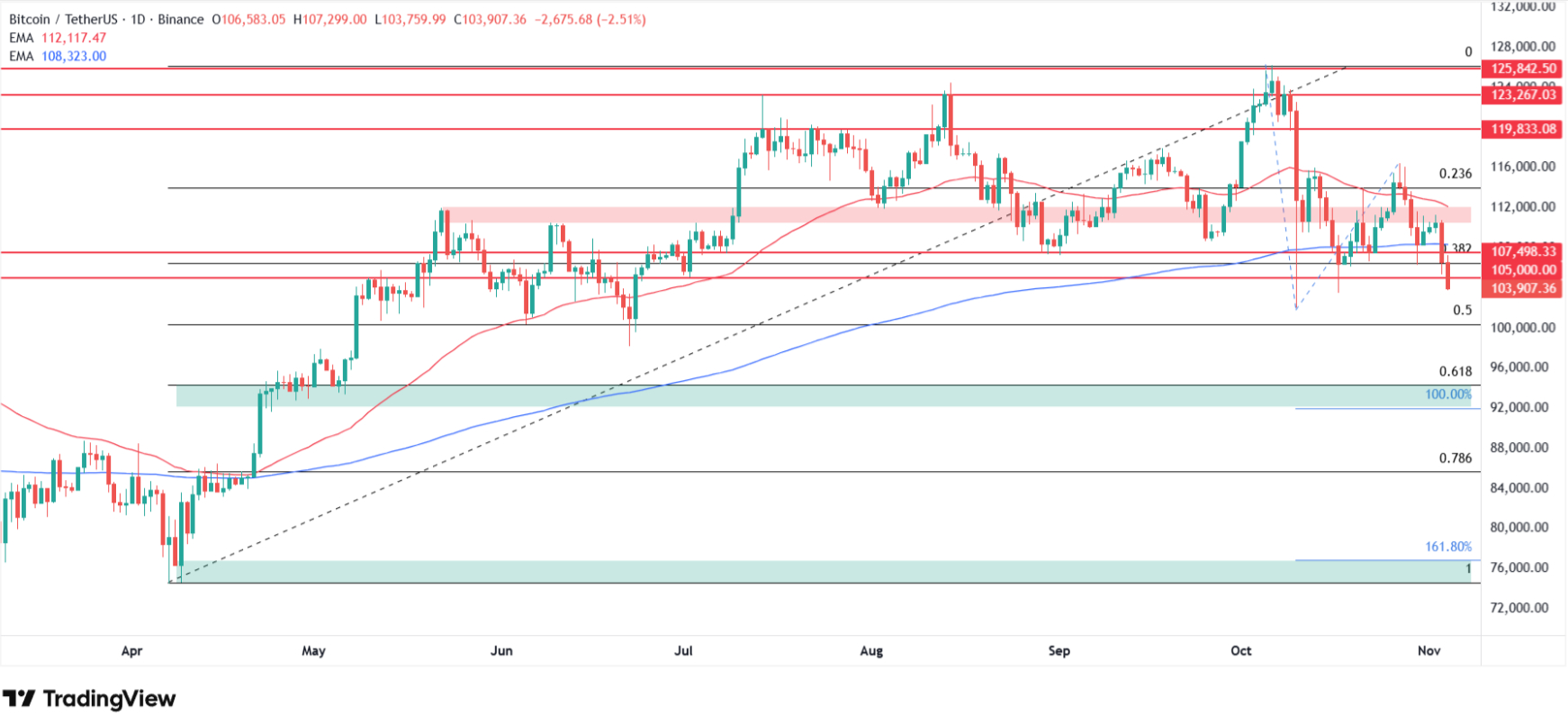
My Bitcoin price prediction suggests that if the $100,000 level does not hold, BTC could fall by 30% to the April lows, around $74,000.
Federal Reserve Chairman Powell's walkback of December rate cut expectations is fueling the US dollar, while simultaneously weakening risk assets, including crypto.
Why Bitcoin price is going down today?
Bitcoin (BTC) price is
falling very dynamically for the second consecutive session, losing a total of
over 5% and violating the important support zone marked by July and August
minimums.
Today (Tuesday)
November 4 2025, Bitcoin costs $104,288, a lower price than the October 17
crash, and we previously observed such low values at the end of June.
Is this the
end of the decline, or does Bitcoin still have room for further depreciation?
And if so, why Bitcoin price it going down and how low BTC can go? I explore
these questions in this article, drawing on more than ten years of experience
as a cryptocurrency analyst and investor. My latest Bitcoin price predictions,
however, are rather bearish.
Why Bitcoin Price Is Going
Down? Worst October in Decade Ends Rally Streak
On average,
October has historically delivered gains of 19.92%, while 2025 recorded a loss
of 3.69%, representing a 23.61 percentage point underperformance relative to
historical patterns.
Bitcoin price today. Source: CoinMarketCap.com
The
broad-based decline shaved another $100 billion off total crypto market
capitalization, now hovering near $3.56 trillion, with Bitcoin falling 2.8% in
24 hours while Ethereum dropped 6% to around $3,630, Solana led losses with a
10% slide to below $160 (extending its seven-day drop to more than 20%), BNB
lost 6.4%, and XRP shed 5%.
Bitcoin Decline Metrics
November 4, 2025
Current Price
$104,287.93
Daily Change
-$2,270.05 (-2.13%)
Intraday Low
$104,139.52
Session Range
$104,139.52-$107,269.85
October Performance
-3.69% (worst in decade)
From ATH Decline
-17.4%
Market Cap
$2.06 trillion
Technical Breakdown Below
200-Day Moving Average
According
to my technical analysis, Bitcoin has fallen below the support grid marked by
the 38.2% Fibonacci retracement, the 200-day exponential moving average (200
EMA), and horizontal levels. The terrain officially changes to bearish. With
the 200 EMA breakdown, Bitcoin has an open road to retesting the psychological
$100,000 level—representing June lows which combine with the 50% Fibonacci
retracement.
If this
level doesn't hold and Bitcoin fails its ultimate test, I would expect further
and stronger Bitcoin depreciation. How low can the cryptocurrency fall,
however? At this moment, I would point to three potential levels or target
ranges.
How Low Can Bitcoin Go? BTC
Price Prediction Targets $94K, Then $77K, Ultimately $74K
My first
target is the area of the 61.8% Fibonacci retracement combined with the 100%
Fibonacci extension, stretching from $92,000 to $94,000, which coincides with
lows from late April and early May. The ultimate range of declines, however, is
this year's April lows in the area of the $74,000-$77,000 zone, where Fibonacci
extensions again align with us, and at this moment the 161.8% level.
This would
mean that Bitcoin, according to my forecasts, could slide from current levels
by almost 30% and erase the entire upward rally observed over the last six
months when it gained a total of 70%.
Bitcoin Downside Targets
Level
Decline from Current
Technical Significance
Current Price
$104,288
—
Breaking 200-day MA
Immediate Test
$100,000
-4.1%
Psychological + 50% Fibonacci + June lows
First Target
$92,000-$94,000
-11.8% to -9.9%
61.8% Fib
+ 100% Extension (Apr-May lows)
Second Target
$77,000
-26.2%
April 2025 lows + 161.8% Extension
Ultimate Target
$74,000
-29.0%
April
lows + Complete rally erasure
Lacie
Zhang, Research Analyst at Bitget Wallet, provided a more moderate outlook:
"Market data and technical signals suggest Bitcoin may trade within a
$94,000–$118,000 range in the near term. The lower bound represents a healthy
retracement zone consistent with subdued ETF inflows, while the upper range
reflects a measured recovery below the October high near $125K."
You may also like to check my previous Bitcoin and crypto analyses:
He noted
that "Bitcoin has been in a sustained uptrend since 2023. Each pullback
since that breakout has found strong support near the 50-week SMA, which also
roughly aligns with the top of the Ichimoku cloud. On two occasions since 2023,
bitcoin briefly slipped below this level, but in both cases, weekly closes
recovered swiftly back above it."
Why Bitcoin Is Falling?
Federal Reserve
Uncertainty Dampens Risk Appetite
The Federal
Reserve's recent actions and cautious messaging have contributed to broader
risk aversion across markets. The Fed delivered a 25-basis-point cut last week
as widely expected, but Chair Jerome Powell's restrained tone dampened risk
appetite after he hinted that December's cut isn't guaranteed.
This shift
in expectations proved dramatic, the market's probability of a cut at
December's FOMC meeting stood as high as 96% leading up to last Wednesday's
decision, but after Powell's press conference, this dropped drastically to less
than 70% chance. The collapse in rate cut expectations created headwinds for
risk assets like Bitcoin that benefited from assumptions of continuous monetary
easing.
On-Chain Data Suggests
Further Weakness Ahead
BeInCrypto's
analysis of the Net Unrealized Profit/Loss (NUPL) metric shows how much profit
or loss Bitcoin investors are holding. Currently, Bitcoin's NUPL sits at 0.47, the
lowest level since April 8 when it fell to 0.42.
During that
earlier cycle, Bitcoin's NUPL declined in three stages: 0.48 on February 26,
0.44 on March 10, and 0.42 on April 8, before Bitcoin rallied from $76,000 to
above $125,000.
Critical Test at Bitcoin $100,000
Psychological Level
If Bitcoin
doesn't hold the psychological $100,000 level and fails its ultimate test, I
would expect further and stronger Bitcoin depreciation toward my identified
targets. The convergence of the 50% Fibonacci retracement, June 2025 lows, and
the major psychological threshold creates a powerful support confluence that
will likely attract significant buying interest.
However, a
sustained break below $100,000 would open the path to my first target zone at
$92,000-$94,000 (61.8% Fibonacci retracement combined with 100% Fibonacci
extension), representing late April and early May lows. From there, the
ultimate downside targets sit at $74,000-$77,000, this year's April lows where
the 161.8% Fibonacci extension falls.
This would
mean Bitcoin could slide from current $104,288 levels by almost 30%, erasing
the entire upward rally observed over the last six months when it gained a
total of 70%.
While this
represents a severe correction, it would align with historical Bitcoin drawdown
patterns during consolidation phases within longer-term bull markets.
Bitcoin Price Analysis, FAQ
Why is Bitcoin falling
today?
Bitcoin
dropped 2.13% to $104,288 Tuesday extending second consecutive session decline
totaling over 5%, breaking below critical 200-day moving average $109,840 (now
-5.1% below fragile support), after worst October in decade (-3.69% ending
seven-year "Uptober" streak), triggered by Federal Reserve Powell
walking back December rate cut expectations (probability collapsed 96% to below
70%), $100 billion crypto market cap loss, broader altcoin crash (Ethereum -6%,
Solana -10%, XRP -5%), NUPL metric at 0.47 (lowest since April suggesting
further weakness).
How low can Bitcoin price
go?
According
to my technical analysis, Bitcoin could decline 30% from current $104,288 to
ultimate target $74,000-$77,000 (April 2025 lows + 161.8% Fibonacci extension
erasing entire six-month 70% rally), staged breakdown: immediate test $100,000
psychological level (-4.1% combining 50% Fib + June lows), first target
$92,000-$94,000 (-11.8% to -9.9% representing 61.8% Fib + 100% extension).
Will Bitcoin drop below
$100,000?
Yes, it is
possible. Bitfinex analysts warn "sustained break below $106,000-$107,000
range could send BTC back under $100,000," while my analysis shows
breaking $100,000 (50% Fibonacci + June lows) opens path to $92,000-$94,000,
though Kruger emphasizes "$103,000 50-week SMA leaving bitcoin still
firmly in uptrend despite softness, additional weakness should be viewed as
corrective not structural," with NUPL at 0.47 suggesting possible decline
toward 0.42-0.44 by early-mid December before accumulation phase.
Is Bitcoin a sell now?
Yes. Trading
below both 50-day EMA $113,549 (-8.9% overhead resistance) and 200-day EMA
$109,840 (broken -5.1% bearish), my analysis forecasting potential 30% decline
to $74,000-$77,000, volume 55.5% of average indicating distribution.
Bitcoin (BTC) price is
falling very dynamically for the second consecutive session, losing a total of
over 5% and violating the important support zone marked by July and August
minimums.
Today (Tuesday)
November 4 2025, Bitcoin costs $104,288, a lower price than the October 17
crash, and we previously observed such low values at the end of June.
Is this the
end of the decline, or does Bitcoin still have room for further depreciation?
And if so, why Bitcoin price it going down and how low BTC can go? I explore
these questions in this article, drawing on more than ten years of experience
as a cryptocurrency analyst and investor. My latest Bitcoin price predictions,
however, are rather bearish.
Why Bitcoin Price Is Going
Down? Worst October in Decade Ends Rally Streak
On average,
October has historically delivered gains of 19.92%, while 2025 recorded a loss
of 3.69%, representing a 23.61 percentage point underperformance relative to
historical patterns.
Bitcoin price today. Source: CoinMarketCap.com
The
broad-based decline shaved another $100 billion off total crypto market
capitalization, now hovering near $3.56 trillion, with Bitcoin falling 2.8% in
24 hours while Ethereum dropped 6% to around $3,630, Solana led losses with a
10% slide to below $160 (extending its seven-day drop to more than 20%), BNB
lost 6.4%, and XRP shed 5%.
Bitcoin Decline Metrics
November 4, 2025
Current Price
$104,287.93
Daily Change
-$2,270.05 (-2.13%)
Intraday Low
$104,139.52
Session Range
$104,139.52-$107,269.85
October Performance
-3.69% (worst in decade)
From ATH Decline
-17.4%
Market Cap
$2.06 trillion
Technical Breakdown Below
200-Day Moving Average
According
to my technical analysis, Bitcoin has fallen below the support grid marked by
the 38.2% Fibonacci retracement, the 200-day exponential moving average (200
EMA), and horizontal levels. The terrain officially changes to bearish. With
the 200 EMA breakdown, Bitcoin has an open road to retesting the psychological
$100,000 level—representing June lows which combine with the 50% Fibonacci
retracement.
If this
level doesn't hold and Bitcoin fails its ultimate test, I would expect further
and stronger Bitcoin depreciation. How low can the cryptocurrency fall,
however? At this moment, I would point to three potential levels or target
ranges.
How Low Can Bitcoin Go? BTC
Price Prediction Targets $94K, Then $77K, Ultimately $74K
My first
target is the area of the 61.8% Fibonacci retracement combined with the 100%
Fibonacci extension, stretching from $92,000 to $94,000, which coincides with
lows from late April and early May. The ultimate range of declines, however, is
this year's April lows in the area of the $74,000-$77,000 zone, where Fibonacci
extensions again align with us, and at this moment the 161.8% level.
This would
mean that Bitcoin, according to my forecasts, could slide from current levels
by almost 30% and erase the entire upward rally observed over the last six
months when it gained a total of 70%.
Bitcoin Downside Targets
Level
Decline from Current
Technical Significance
Current Price
$104,288
—
Breaking 200-day MA
Immediate Test
$100,000
-4.1%
Psychological + 50% Fibonacci + June lows
First Target
$92,000-$94,000
-11.8% to -9.9%
61.8% Fib
+ 100% Extension (Apr-May lows)
Second Target
$77,000
-26.2%
April 2025 lows + 161.8% Extension
Ultimate Target
$74,000
-29.0%
April
lows + Complete rally erasure
Lacie
Zhang, Research Analyst at Bitget Wallet, provided a more moderate outlook:
"Market data and technical signals suggest Bitcoin may trade within a
$94,000–$118,000 range in the near term. The lower bound represents a healthy
retracement zone consistent with subdued ETF inflows, while the upper range
reflects a measured recovery below the October high near $125K."
You may also like to check my previous Bitcoin and crypto analyses:
He noted
that "Bitcoin has been in a sustained uptrend since 2023. Each pullback
since that breakout has found strong support near the 50-week SMA, which also
roughly aligns with the top of the Ichimoku cloud. On two occasions since 2023,
bitcoin briefly slipped below this level, but in both cases, weekly closes
recovered swiftly back above it."
Why Bitcoin Is Falling?
Federal Reserve
Uncertainty Dampens Risk Appetite
The Federal
Reserve's recent actions and cautious messaging have contributed to broader
risk aversion across markets. The Fed delivered a 25-basis-point cut last week
as widely expected, but Chair Jerome Powell's restrained tone dampened risk
appetite after he hinted that December's cut isn't guaranteed.
This shift
in expectations proved dramatic, the market's probability of a cut at
December's FOMC meeting stood as high as 96% leading up to last Wednesday's
decision, but after Powell's press conference, this dropped drastically to less
than 70% chance. The collapse in rate cut expectations created headwinds for
risk assets like Bitcoin that benefited from assumptions of continuous monetary
easing.
On-Chain Data Suggests
Further Weakness Ahead
BeInCrypto's
analysis of the Net Unrealized Profit/Loss (NUPL) metric shows how much profit
or loss Bitcoin investors are holding. Currently, Bitcoin's NUPL sits at 0.47, the
lowest level since April 8 when it fell to 0.42.
During that
earlier cycle, Bitcoin's NUPL declined in three stages: 0.48 on February 26,
0.44 on March 10, and 0.42 on April 8, before Bitcoin rallied from $76,000 to
above $125,000.
Critical Test at Bitcoin $100,000
Psychological Level
If Bitcoin
doesn't hold the psychological $100,000 level and fails its ultimate test, I
would expect further and stronger Bitcoin depreciation toward my identified
targets. The convergence of the 50% Fibonacci retracement, June 2025 lows, and
the major psychological threshold creates a powerful support confluence that
will likely attract significant buying interest.
However, a
sustained break below $100,000 would open the path to my first target zone at
$92,000-$94,000 (61.8% Fibonacci retracement combined with 100% Fibonacci
extension), representing late April and early May lows. From there, the
ultimate downside targets sit at $74,000-$77,000, this year's April lows where
the 161.8% Fibonacci extension falls.
This would
mean Bitcoin could slide from current $104,288 levels by almost 30%, erasing
the entire upward rally observed over the last six months when it gained a
total of 70%.
While this
represents a severe correction, it would align with historical Bitcoin drawdown
patterns during consolidation phases within longer-term bull markets.
Bitcoin Price Analysis, FAQ
Why is Bitcoin falling
today?
Bitcoin
dropped 2.13% to $104,288 Tuesday extending second consecutive session decline
totaling over 5%, breaking below critical 200-day moving average $109,840 (now
-5.1% below fragile support), after worst October in decade (-3.69% ending
seven-year "Uptober" streak), triggered by Federal Reserve Powell
walking back December rate cut expectations (probability collapsed 96% to below
70%), $100 billion crypto market cap loss, broader altcoin crash (Ethereum -6%,
Solana -10%, XRP -5%), NUPL metric at 0.47 (lowest since April suggesting
further weakness).
How low can Bitcoin price
go?
According
to my technical analysis, Bitcoin could decline 30% from current $104,288 to
ultimate target $74,000-$77,000 (April 2025 lows + 161.8% Fibonacci extension
erasing entire six-month 70% rally), staged breakdown: immediate test $100,000
psychological level (-4.1% combining 50% Fib + June lows), first target
$92,000-$94,000 (-11.8% to -9.9% representing 61.8% Fib + 100% extension).
Will Bitcoin drop below
$100,000?
Yes, it is
possible. Bitfinex analysts warn "sustained break below $106,000-$107,000
range could send BTC back under $100,000," while my analysis shows
breaking $100,000 (50% Fibonacci + June lows) opens path to $92,000-$94,000,
though Kruger emphasizes "$103,000 50-week SMA leaving bitcoin still
firmly in uptrend despite softness, additional weakness should be viewed as
corrective not structural," with NUPL at 0.47 suggesting possible decline
toward 0.42-0.44 by early-mid December before accumulation phase.
Is Bitcoin a sell now?
Yes. Trading
below both 50-day EMA $113,549 (-8.9% overhead resistance) and 200-day EMA
$109,840 (broken -5.1% bearish), my analysis forecasting potential 30% decline
to $74,000-$77,000, volume 55.5% of average indicating distribution.
Damian Chmiel is a Senior Analyst & Editor at Finance Magnates with more than 15 years of experience in the CFD and online trading industry. Active as both a trader and journalist since 2010, he focuses on broker coverage, fintech innovation, and regulatory developments across Europe, the Middle East, and Asia.
His work includes interviews with C-level leaders at major brokerages and fintech platforms, as well as co-authoring Finance Magnates’ quarterly industry benchmarking reports. Damian’s reporting is data-driven, market-aware, and grounded in direct industry engagement. His analysis and commentary have also been cited by external media outlets, including Investing.com, Binance, The Asset, Stockhead, and Dispatch.
Education:
MA in Finance and Accounting, Cracow University of Economics
Why Is Dogecoin Going Up Today? DOGE Price Prediction Shows 25% Upside Potential
Featured Videos
AvaTrade to Acquire Most of FXCM; NAGA Raises $8M
AvaTrade to Acquire Most of FXCM; NAGA Raises $8M
AvaTrade to Acquire Most of FXCM; NAGA Raises $8M
AvaTrade to Acquire Most of FXCM; NAGA Raises $8M
Today’s financial news recap covers AvaTrade agrees to acquire most of FXCM, NAGA secures eight million dollars in new financing, and Wise seeks a tax settlement in the UK.
Finance Magnates Daily Recap brings you the latest news from forex and CFD brokers, fintech, payments, cryptocurrency, digital assets, trading platforms, financial regulation and global markets.
Get the key company news, executive moves, deals, regulatory updates and market developments of the day, in just a few minutes. New episodes published every weekday.
Read more: https://www.financemagnates.com
#FinanceMagnates #ForexNews #FintechNews
Today’s financial news recap covers AvaTrade agrees to acquire most of FXCM, NAGA secures eight million dollars in new financing, and Wise seeks a tax settlement in the UK.
Finance Magnates Daily Recap brings you the latest news from forex and CFD brokers, fintech, payments, cryptocurrency, digital assets, trading platforms, financial regulation and global markets.
Get the key company news, executive moves, deals, regulatory updates and market developments of the day, in just a few minutes. New episodes published every weekday.
Read more: https://www.financemagnates.com
#FinanceMagnates #ForexNews #FintechNews
Today’s financial news recap covers AvaTrade agrees to acquire most of FXCM, NAGA secures eight million dollars in new financing, and Wise seeks a tax settlement in the UK.
Finance Magnates Daily Recap brings you the latest news from forex and CFD brokers, fintech, payments, cryptocurrency, digital assets, trading platforms, financial regulation and global markets.
Get the key company news, executive moves, deals, regulatory updates and market developments of the day, in just a few minutes. New episodes published every weekday.
Read more: https://www.financemagnates.com
#FinanceMagnates #ForexNews #FintechNews
Today’s financial news recap covers AvaTrade agrees to acquire most of FXCM, NAGA secures eight million dollars in new financing, and Wise seeks a tax settlement in the UK.
Finance Magnates Daily Recap brings you the latest news from forex and CFD brokers, fintech, payments, cryptocurrency, digital assets, trading platforms, financial regulation and global markets.
Get the key company news, executive moves, deals, regulatory updates and market developments of the day, in just a few minutes. New episodes published every weekday.
Read more: https://www.financemagnates.com
#FinanceMagnates #ForexNews #FintechNews
XTB Adds Overnight US Stock Trading; Nasdaq Ventures Invests in One Trading
XTB Adds Overnight US Stock Trading; Nasdaq Ventures Invests in One Trading
XTB Adds Overnight US Stock Trading; Nasdaq Ventures Invests in One Trading
XTB Adds Overnight US Stock Trading; Nasdaq Ventures Invests in One Trading
XTB Adds Overnight US Stock Trading; Nasdaq Ventures Invests in One Trading
XTB Adds Overnight US Stock Trading; Nasdaq Ventures Invests in One Trading
Today’s financial news recap covers XTB expands overnight US stock trading, Fortrade reports higher revenue, Nasdaq backs One Trading, and Vest Labs raises 13 million dollars.
Finance Magnates Daily Recap brings you the latest news from forex and CFD brokers, fintech, payments, cryptocurrency, digital assets, trading platforms, financial regulation and global markets.
Get the key company news, executive moves, deals, regulatory updates and market developments of the day, in just a few minutes. New episodes published every weekday.
Read more: https://www.financemagnates.com
#FinanceMagnates #ForexNews #FintechNews
Today’s financial news recap covers XTB expands overnight US stock trading, Fortrade reports higher revenue, Nasdaq backs One Trading, and Vest Labs raises 13 million dollars.
Finance Magnates Daily Recap brings you the latest news from forex and CFD brokers, fintech, payments, cryptocurrency, digital assets, trading platforms, financial regulation and global markets.
Get the key company news, executive moves, deals, regulatory updates and market developments of the day, in just a few minutes. New episodes published every weekday.
Read more: https://www.financemagnates.com
#FinanceMagnates #ForexNews #FintechNews
Today’s financial news recap covers XTB expands overnight US stock trading, Fortrade reports higher revenue, Nasdaq backs One Trading, and Vest Labs raises 13 million dollars.
Finance Magnates Daily Recap brings you the latest news from forex and CFD brokers, fintech, payments, cryptocurrency, digital assets, trading platforms, financial regulation and global markets.
Get the key company news, executive moves, deals, regulatory updates and market developments of the day, in just a few minutes. New episodes published every weekday.
Read more: https://www.financemagnates.com
#FinanceMagnates #ForexNews #FintechNews
Today’s financial news recap covers XTB expands overnight US stock trading, Fortrade reports higher revenue, Nasdaq backs One Trading, and Vest Labs raises 13 million dollars.
Finance Magnates Daily Recap brings you the latest news from forex and CFD brokers, fintech, payments, cryptocurrency, digital assets, trading platforms, financial regulation and global markets.
Get the key company news, executive moves, deals, regulatory updates and market developments of the day, in just a few minutes. New episodes published every weekday.
Read more: https://www.financemagnates.com
#FinanceMagnates #ForexNews #FintechNews
Today’s financial news recap covers XTB expands overnight US stock trading, Fortrade reports higher revenue, Nasdaq backs One Trading, and Vest Labs raises 13 million dollars.
Finance Magnates Daily Recap brings you the latest news from forex and CFD brokers, fintech, payments, cryptocurrency, digital assets, trading platforms, financial regulation and global markets.
Get the key company news, executive moves, deals, regulatory updates and market developments of the day, in just a few minutes. New episodes published every weekday.
Read more: https://www.financemagnates.com
#FinanceMagnates #ForexNews #FintechNews
Today’s financial news recap covers XTB expands overnight US stock trading, Fortrade reports higher revenue, Nasdaq backs One Trading, and Vest Labs raises 13 million dollars.
Finance Magnates Daily Recap brings you the latest news from forex and CFD brokers, fintech, payments, cryptocurrency, digital assets, trading platforms, financial regulation and global markets.
Get the key company news, executive moves, deals, regulatory updates and market developments of the day, in just a few minutes. New episodes published every weekday.
Read more: https://www.financemagnates.com
#FinanceMagnates #ForexNews #FintechNews
CMC Founder Downplays Volatility Hit; Devexperts Names CEO
CMC Founder Downplays Volatility Hit; Devexperts Names CEO
CMC Founder Downplays Volatility Hit; Devexperts Names CEO
CMC Founder Downplays Volatility Hit; Devexperts Names CEO
CMC Founder Downplays Volatility Hit; Devexperts Names CEO
CMC Founder Downplays Volatility Hit; Devexperts Names CEO
Today’s financial news recap covers low volatility pressures brokers, Devexperts names a new CEO, Saxo cuts onboarding time, and OKX reaches a 25 billion dollar valuation.
Finance Magnates Daily Recap brings you the latest news from forex and CFD brokers, fintech, payments, cryptocurrency, digital assets, trading platforms, financial regulation and global markets.
Get the key company news, executive moves, deals, regulatory updates and market developments of the day, in just a few minutes. New episodes published every weekday.
Read more: https://www.financemagnates.com
#FinanceMagnates #ForexNews #FintechNews
Today’s financial news recap covers low volatility pressures brokers, Devexperts names a new CEO, Saxo cuts onboarding time, and OKX reaches a 25 billion dollar valuation.
Finance Magnates Daily Recap brings you the latest news from forex and CFD brokers, fintech, payments, cryptocurrency, digital assets, trading platforms, financial regulation and global markets.
Get the key company news, executive moves, deals, regulatory updates and market developments of the day, in just a few minutes. New episodes published every weekday.
Read more: https://www.financemagnates.com
#FinanceMagnates #ForexNews #FintechNews
Today’s financial news recap covers low volatility pressures brokers, Devexperts names a new CEO, Saxo cuts onboarding time, and OKX reaches a 25 billion dollar valuation.
Finance Magnates Daily Recap brings you the latest news from forex and CFD brokers, fintech, payments, cryptocurrency, digital assets, trading platforms, financial regulation and global markets.
Get the key company news, executive moves, deals, regulatory updates and market developments of the day, in just a few minutes. New episodes published every weekday.
Read more: https://www.financemagnates.com
#FinanceMagnates #ForexNews #FintechNews
Today’s financial news recap covers low volatility pressures brokers, Devexperts names a new CEO, Saxo cuts onboarding time, and OKX reaches a 25 billion dollar valuation.
Finance Magnates Daily Recap brings you the latest news from forex and CFD brokers, fintech, payments, cryptocurrency, digital assets, trading platforms, financial regulation and global markets.
Get the key company news, executive moves, deals, regulatory updates and market developments of the day, in just a few minutes. New episodes published every weekday.
Read more: https://www.financemagnates.com
#FinanceMagnates #ForexNews #FintechNews
Today’s financial news recap covers low volatility pressures brokers, Devexperts names a new CEO, Saxo cuts onboarding time, and OKX reaches a 25 billion dollar valuation.
Finance Magnates Daily Recap brings you the latest news from forex and CFD brokers, fintech, payments, cryptocurrency, digital assets, trading platforms, financial regulation and global markets.
Get the key company news, executive moves, deals, regulatory updates and market developments of the day, in just a few minutes. New episodes published every weekday.
Read more: https://www.financemagnates.com
#FinanceMagnates #ForexNews #FintechNews
Today’s financial news recap covers low volatility pressures brokers, Devexperts names a new CEO, Saxo cuts onboarding time, and OKX reaches a 25 billion dollar valuation.
Finance Magnates Daily Recap brings you the latest news from forex and CFD brokers, fintech, payments, cryptocurrency, digital assets, trading platforms, financial regulation and global markets.
Get the key company news, executive moves, deals, regulatory updates and market developments of the day, in just a few minutes. New episodes published every weekday.
Read more: https://www.financemagnates.com
#FinanceMagnates #ForexNews #FintechNews
Today’s financial news recap covers Trade Nation buys FXCM's UK client book, Trading 212 reports higher revenue, the CFTC's move to allow perpetual index futures.
Finance Magnates Daily Recap brings you the latest news from forex and CFD brokers, fintech, payments, cryptocurrency, digital assets, trading platforms, financial regulation and global markets.
Get the key company news, executive moves, deals, regulatory updates and market developments of the day, in just a few minutes. New episodes published every weekday.
Read more: https://www.financemagnates.com
#FinanceMagnates #ForexNews #FintechNews
Today’s financial news recap covers Trade Nation buys FXCM's UK client book, Trading 212 reports higher revenue, the CFTC's move to allow perpetual index futures.
Finance Magnates Daily Recap brings you the latest news from forex and CFD brokers, fintech, payments, cryptocurrency, digital assets, trading platforms, financial regulation and global markets.
Get the key company news, executive moves, deals, regulatory updates and market developments of the day, in just a few minutes. New episodes published every weekday.
Read more: https://www.financemagnates.com
#FinanceMagnates #ForexNews #FintechNews
Today’s financial news recap covers Trade Nation buys FXCM's UK client book, Trading 212 reports higher revenue, the CFTC's move to allow perpetual index futures.
Finance Magnates Daily Recap brings you the latest news from forex and CFD brokers, fintech, payments, cryptocurrency, digital assets, trading platforms, financial regulation and global markets.
Get the key company news, executive moves, deals, regulatory updates and market developments of the day, in just a few minutes. New episodes published every weekday.
Read more: https://www.financemagnates.com
#FinanceMagnates #ForexNews #FintechNews
Today’s financial news recap covers Trade Nation buys FXCM's UK client book, Trading 212 reports higher revenue, the CFTC's move to allow perpetual index futures.
Finance Magnates Daily Recap brings you the latest news from forex and CFD brokers, fintech, payments, cryptocurrency, digital assets, trading platforms, financial regulation and global markets.
Get the key company news, executive moves, deals, regulatory updates and market developments of the day, in just a few minutes. New episodes published every weekday.
Read more: https://www.financemagnates.com
#FinanceMagnates #ForexNews #FintechNews
Today’s financial news recap covers Trade Nation buys FXCM's UK client book, Trading 212 reports higher revenue, the CFTC's move to allow perpetual index futures.
Finance Magnates Daily Recap brings you the latest news from forex and CFD brokers, fintech, payments, cryptocurrency, digital assets, trading platforms, financial regulation and global markets.
Get the key company news, executive moves, deals, regulatory updates and market developments of the day, in just a few minutes. New episodes published every weekday.
Read more: https://www.financemagnates.com
#FinanceMagnates #ForexNews #FintechNews
Today’s financial news recap covers Trade Nation buys FXCM's UK client book, Trading 212 reports higher revenue, the CFTC's move to allow perpetual index futures.
Finance Magnates Daily Recap brings you the latest news from forex and CFD brokers, fintech, payments, cryptocurrency, digital assets, trading platforms, financial regulation and global markets.
Get the key company news, executive moves, deals, regulatory updates and market developments of the day, in just a few minutes. New episodes published every weekday.
Read more: https://www.financemagnates.com
#FinanceMagnates #ForexNews #FintechNews
Your career isn’t a linear path.
Your career isn’t a linear path.
Your career isn’t a linear path.
Your career isn’t a linear path.
Your career isn’t a linear path.
Your career isn’t a linear path.
Roles change. Career goals change. Sometimes you want a completely new challenge.
But the skills and knowledge you build along the way can stay with you and give you something to build on.
For Jeff Patterson, that continued growth is key to long-term career development.
You bring the skills. FM Academy helps you build the knowledge.
#FMAcademy #FinanceMagnates #FinanceCareers #ProfessionalDevelopment #Fintech
Roles change. Career goals change. Sometimes you want a completely new challenge.
But the skills and knowledge you build along the way can stay with you and give you something to build on.
For Jeff Patterson, that continued growth is key to long-term career development.
You bring the skills. FM Academy helps you build the knowledge.
#FMAcademy #FinanceMagnates #FinanceCareers #ProfessionalDevelopment #Fintech
Roles change. Career goals change. Sometimes you want a completely new challenge.
But the skills and knowledge you build along the way can stay with you and give you something to build on.
For Jeff Patterson, that continued growth is key to long-term career development.
You bring the skills. FM Academy helps you build the knowledge.
#FMAcademy #FinanceMagnates #FinanceCareers #ProfessionalDevelopment #Fintech
Roles change. Career goals change. Sometimes you want a completely new challenge.
But the skills and knowledge you build along the way can stay with you and give you something to build on.
For Jeff Patterson, that continued growth is key to long-term career development.
You bring the skills. FM Academy helps you build the knowledge.
#FMAcademy #FinanceMagnates #FinanceCareers #ProfessionalDevelopment #Fintech
Roles change. Career goals change. Sometimes you want a completely new challenge.
But the skills and knowledge you build along the way can stay with you and give you something to build on.
For Jeff Patterson, that continued growth is key to long-term career development.
You bring the skills. FM Academy helps you build the knowledge.
#FMAcademy #FinanceMagnates #FinanceCareers #ProfessionalDevelopment #Fintech
Roles change. Career goals change. Sometimes you want a completely new challenge.
But the skills and knowledge you build along the way can stay with you and give you something to build on.
For Jeff Patterson, that continued growth is key to long-term career development.
You bring the skills. FM Academy helps you build the knowledge.
#FMAcademy #FinanceMagnates #FinanceCareers #ProfessionalDevelopment #Fintech