

Two courts, one regulator, one week — the jurisdictional battle over who controls these markets moved to the center.
On Wednesday, CFTC Chairman Michael Selig sat before the House Agriculture Committee and explained that the agency has a “zero tolerance policy” toward fraud, manipulation, and insider trading across all prediction markets.
Singapore Summit: Meet the largest APAC brokers you know (and those you still don't!)
The same day, the Ninth Circuit heard consolidated oral arguments from Kalshi, Robinhood, and Crypto.com challenging state enforcement actions.
The legal fight is intensifying as the market itself continues to grow. Open interest crossed $1 billion for the first time since the November 2024 election, while weekly trading volume reached $6.5 billion.
Here’s what mattered this week.
What Moved the Prediction Markets
The Jurisdiction Fight Goes Federal
On April 16, CFTC Chairman Michael Selig testified before the House Agriculture Committee, stating that prediction market contracts fall under the agency’s exclusive jurisdiction as derivatives.
As Chairman of the @CFTC, I am committed to policing and prohibiting manipulation in our markets. Whether the underlying is sports, politics, or grains, we take our role as the federal regulator seriously. Under my leadership, there is no tolerance for bad actors in our markets.… pic.twitter.com/RRMgAErkip
— Mike Selig (@ChairmanSelig) April 13, 2026
He reiterated that insider trading, fraud, and manipulation are enforcement priorities and defended the CFTC’s ongoing rulemaking process, which remains open for public comment until April 30.
The discussion focused in particular on contracts tied to war, death, and commodities such as oil — categories that lawmakers have flagged as raising consumer protection and market integrity concerns.
The same day, the Ninth Circuit heard consolidated arguments from Kalshi, Robinhood, and Crypto.com challenging state-level enforcement. This follows an April 6 Third Circuit ruling that Kalshi’s sports contracts are federally regulated swaps, not gambling, blocking New Jersey’s enforcement action.
The CFTC has separately filed lawsuits to assert federal preemption, while more than 30 states have filed amicus briefs arguing for state authority.
- Prediction Markets Build Washington Presence as Legislative Pressure Mounts
- Prediction Market Open Interest Hits $1B as Capital Stays Locked in Long-Dated Bets
- Inside the Prediction Markets: Who Controls the Trade
$1 Billion in Open Interest, $6.5 Billion in Weekly Volume
On April 15, open interest on prediction markets crossed $1 billion for the first time since the November 2024 presidential election. Weekly notional volume reached $6.5 billion, up roughly 25% week-over-week.
Activity was spread across multiple categories — sports, geopolitical events, and midterm election positions — rather than driven by a single market.
Prediction market open interest just hit $1B for the first time since Nov 2024.
— Stacy Muur (@stacy_muur) April 15, 2026
Four events are driving it simultaneously:
• Masters Golf Tournament
• NBA Playoffs (sports notional volume is ~$4B on all PMs)
• U.S.-Iran geopolitical events
• 2026 Midterms (open positions… pic.twitter.com/YqaIwNQuTW
Kalshi accounted for $3.54 billion of that volume, while Polymarket handled $2.48 billion. Smaller platforms grew faster in percentage terms, but from a much smaller base.
The figures point to sustained activity across the market, even as legal and regulatory pressure continues to build.
Robinhood Limits Its Exposure, Infrastructure Expands
Robinhood confirmed it is deliberately restricting which prediction market contracts it offers. The company is avoiding high-risk categories — war, death, and political outcomes — citing concerns around insider trading and manipulation.
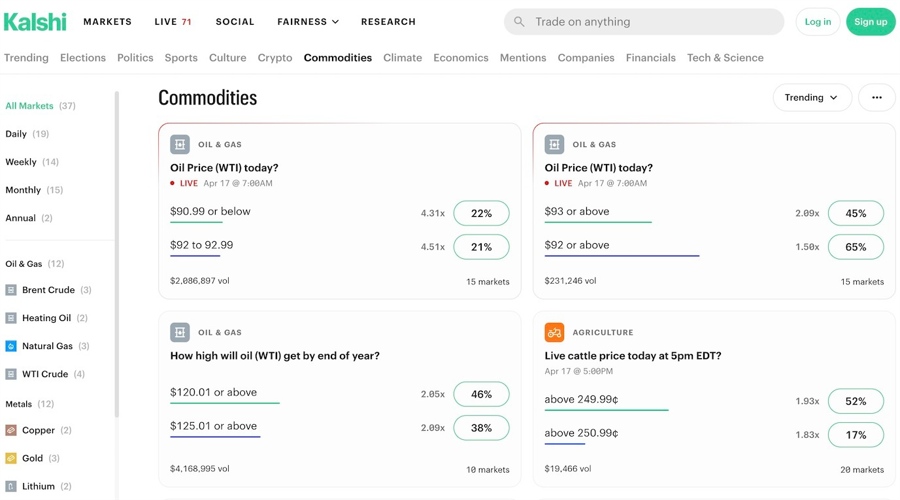
At the same time, platforms are expanding into new product areas. Kalshi announced a new commodities hub, adding event contracts tied to energy, agriculture, and metals markets and positioning prediction markets as a tool for hedging and price discovery in volatile conditions.
Trade on more commodities.
— Kalshi (@Kalshi) April 15, 2026
24/7.
Now on Kalshi. pic.twitter.com/0IugqAk9eD
Infrastructure providers are moving in from the other side of the market. Leverate introduced a hybrid market-making engine for its white-label prediction markets platform, combining an automated pricing model (LMSR) with a central limit order book.
The system is designed to support trading even when liquidity is thin, while allowing traditional order matching once activity picks up. The shift points to a second layer of competition: not just between platforms, but between the systems that power them.
Quote of the Week
Outside the courtroom, the focus is already shifting to how prediction markets could fit into traditional investment products. The next step under discussion is packaging them into ETFs, which would make event contracts accessible within standard portfolio allocations.
"I think prediction markets are one of the most important new financial ideas maybe since crypto and if we can package them in an ETF you will see extensive use of them in various portfolio settings" - @Matt_Hougan on Trillions re prediction market ETFs, which are likely coming… pic.twitter.com/PECCdbNBzE
— Eric Balchunas (@EricBalchunas) April 9, 2026
Number of the Week
$1 trillion.That's the estimated prediction market volume for 2030, according to Bernstein. The projection comes as federal regulators assert control in court, suggesting that both expected growth and legal scrutiny are accelerating.
The Friction of the Week
The week exposed a structural conflict between federal enforcement and state authority. The CFTC is asserting that prediction markets fall under federal derivatives law and is actively suing states to enforce that position.
At the same time, state regulators continue to treat the same contracts as gambling and pursue their own enforcement actions. Kalshi sits at the center of that dispute, defending its ability to offer sports contracts across multiple jurisdictions.
The outcome now depends on how courts interpret federal preemption — and whether that interpretation holds across circuits. The platforms argue they already enforce rules against insider trading and market manipulation.
Regulators are signalling that enforcement does not stop at the platform level. The rules are in place. The question is who enforces them.
Bottom Line
This week centered on one question: Who controls prediction markets?
The CFTC stated its position in Congress and moved to defend it in court. At the same time, states continued to assert their own authority, and the outcome now depends on how federal preemption is interpreted across circuits.
The market itself is not slowing down. Open interest crossed $1 billion, and trading activity remained spread across sports, geopolitics, and elections.
Platforms are already adjusting to that uncertainty. Robinhood is narrowing its offerings, while infrastructure providers are building systems to support trading across different liquidity conditions. The rules are being contested. The market is still operating.


