How Polymarket Users Move From Crypto to Sports And Why It Matters

Tuesday, 28/04/2026 | 13:08 GMT by Tanya Chepkova
  • Most users enter through crypto markets, which offer low entry barriers and familiar trading patterns.
  • Sports drives engagement, accounting for roughly 64% of total market volume and sustaining repeat activity.
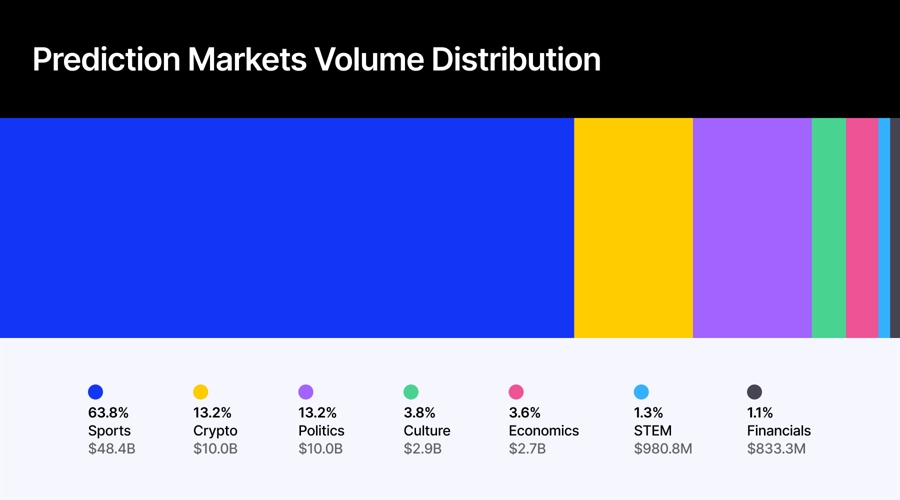
Prediction market volume distribution (Feb25-Feb26). Source: Predictions.paradigm.xyz

A new analysis by Bitget Wallet of 1.29 million Polymarket wallets in Q1 2026 shows how prediction market users actually behave: they arrive via crypto and stay for sports.

Singapore Summit: Meet the largest APAC brokers you know (and those you still don't!).

The finding has practical implications for brokers and fintech platforms building in this space. The data shows a clear user progression, with distinct products driving acquisition and retention at different stages.

The Entry Point: Crypto

Crypto markets are where most new users start. Among the smallest traders on the platform — those with the lowest activity levels — crypto accounts for nearly 40% of all trading volume. These are markets that retail users already know, available around the clock, with median trade sizes for Bitcoin and Ethereum sitting at $2–$3.

The capital commitment is low enough that the platform itself is essentially a test environment. The broader user base is heavily retail in composition. In Q1, 82.3% of all wallets traded under $10,000 — the growth is coming from volume of participants, not concentration at the top.

This retail-driven entry point contrasts with the growing institutional interest in the sector, suggesting that user acquisition and capital deployment are still driven by different segments.

The Retention Driver: Sports

Crypto pulls users in, but sports keep them. As traders move up in activity levels, their share of crypto trading declines and sports picks up — from 22.7% among lower-volume users to 29.2% among mid-tier ones. In aggregate, sports were the single largest category by trading volume in Q1, generating $10.1 billion.

The NBA and English Premier League are cited specifically — leagues with dense, predictable event schedules that give users a recurring reason to return. The mechanic is not complicated: frequent games create frequent markets, which sustain frequent engagement.

Across the broader market, sports dominate prediction market volume, accounting for roughly 64% of the $75.9 billion tracked by Paradigm's data set, compared with about 13% each for crypto and politics.

Politics and Macro as the Third Layer

Political and geopolitical markets are growing into a distinct category. Political markets generated $5 billion in Q1 volume, with geopolitics accounting for close to half of that.

These markets operate differently from sports. They're news-driven and event-dependent rather than calendar-driven, but they add a layer of engagement for users who treat prediction markets as a way to price real-world uncertainty. Total monthly volume on the platform now exceeds $25 billion.

The pattern may reflect product design as much as user preference — particularly the availability of high-frequency sports markets versus more episodic political or macro events.

For brokers, the strategic question the data raises is whether this user journey is platform-specific to Polymarket or whether it generalizes. The onboarding-through-crypto, retention-through-sports pattern suggests product design as much as market demand — and that's worth examining before assuming the playbook transfers.

A new analysis by Bitget Wallet of 1.29 million Polymarket wallets in Q1 2026 shows how prediction market users actually behave: they arrive via crypto and stay for sports.

Singapore Summit: Meet the largest APAC brokers you know (and those you still don't!).

The finding has practical implications for brokers and fintech platforms building in this space. The data shows a clear user progression, with distinct products driving acquisition and retention at different stages.

The Entry Point: Crypto

Crypto markets are where most new users start. Among the smallest traders on the platform — those with the lowest activity levels — crypto accounts for nearly 40% of all trading volume. These are markets that retail users already know, available around the clock, with median trade sizes for Bitcoin and Ethereum sitting at $2–$3.

The capital commitment is low enough that the platform itself is essentially a test environment. The broader user base is heavily retail in composition. In Q1, 82.3% of all wallets traded under $10,000 — the growth is coming from volume of participants, not concentration at the top.

This retail-driven entry point contrasts with the growing institutional interest in the sector, suggesting that user acquisition and capital deployment are still driven by different segments.

The Retention Driver: Sports

Crypto pulls users in, but sports keep them. As traders move up in activity levels, their share of crypto trading declines and sports picks up — from 22.7% among lower-volume users to 29.2% among mid-tier ones. In aggregate, sports were the single largest category by trading volume in Q1, generating $10.1 billion.

The NBA and English Premier League are cited specifically — leagues with dense, predictable event schedules that give users a recurring reason to return. The mechanic is not complicated: frequent games create frequent markets, which sustain frequent engagement.

Across the broader market, sports dominate prediction market volume, accounting for roughly 64% of the $75.9 billion tracked by Paradigm's data set, compared with about 13% each for crypto and politics.

Politics and Macro as the Third Layer

Political and geopolitical markets are growing into a distinct category. Political markets generated $5 billion in Q1 volume, with geopolitics accounting for close to half of that.

These markets operate differently from sports. They're news-driven and event-dependent rather than calendar-driven, but they add a layer of engagement for users who treat prediction markets as a way to price real-world uncertainty. Total monthly volume on the platform now exceeds $25 billion.

The pattern may reflect product design as much as user preference — particularly the availability of high-frequency sports markets versus more episodic political or macro events.

For brokers, the strategic question the data raises is whether this user journey is platform-specific to Polymarket or whether it generalizes. The onboarding-through-crypto, retention-through-sports pattern suggests product design as much as market demand — and that's worth examining before assuming the playbook transfers.

About the Author: Tanya Chepkova
Tanya Chepkova
  • 185 Articles
About the Author: Tanya Chepkova
Tanya Chepkova is a News Editor at Finance Magnates with more than 16 years of experience in financial journalism, covering forex, crypto, and digital asset markets. Her work spans daily industry reporting and data-driven, long-form explainers focused on market structure, trading models, and regulatory shifts. Before joining Finance Magnates, she led the editorial team of a cryptocurrency-focused media outlet for six years. Her reporting combines analytical depth with clear storytelling, with particular attention to how structural changes in trading, stablecoin infrastructure, and emerging products such as prediction markets reshape the broader financial ecosystem. She covers global developments and provides additional insight into CIS markets. Areas of Coverage: Crypto and digital asset markets Prediction markets Stablecoins and cross-border payments Industry analysis and long-form explainers
  • 185 Articles

More from the Author

CryptoCurrency

!"#$%&'()*+,-./0123456789:;<=>?@ABCDEFGHIJKLMNOPQRSTUVWXYZ[\]^_`abcdefghijklmnopqrstuvwxyz{|} !"#$%&'()*+,-./0123456789:;<=>?@ABCDEFGHIJKLMNOPQRSTUVWXYZ[\]^_`abcdefghijklmnopqrstuvwxyz{|}