Trump’s sweeping tariffs, including 10% on all imports and up to 50% on Chinese goods, sparked fears of a global trade war.
It drove the Euro Stoxx 50 to February levels and futures on the S&P 500, and Nasdaq 100 to six-month lows.
The rush to safe-haven assets like gold and Treasuries signals broad risk aversion.
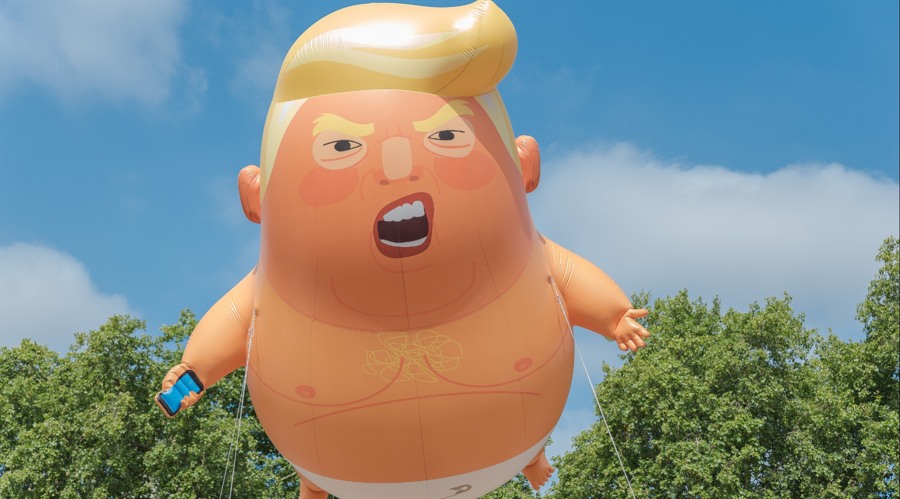
Balloon of baby Donald Trump in air at protest in London
On Thursday,
April 3, 2025, global financial markets are experiencing significant turbulence
following U.S. President Donald Trump’s announcement of sweeping new tariffs,
sparking widespread declines in stock indices across Europe and the United
States.
Investors reacted
swiftly, driving major indices and futures contracts to multi-month lows, including
Euro Stoxx 50, S&P 500, and Nasdaq 100. In this article, we examine how
European stock markets opened on Thursday, the current prices of futures on
Wall Street, and the reasons behind gold reaching new record highs.
This above is an advertisement by Utip
Why Are Stocks in Europe
and the US Falling After Trump’s Tariffs Announcement?
The
announcement, dubbed “Liberation Day” by Trump, introduced tariffs ranging from
10% on imports from numerous countries to as high as 50% on goods from specific
nations like Lesotho, with an effective rate on Chinese imports exceeding 50%
when combined with existing duties. This aggressive trade policy shift sent
shockwaves through global markets, amplifying fears of a potential trade war
and disrupting supply chains.
In Europe,
the Euro Stoxx 50 index opened the day at its lowest levels since February,
though it later rebounded slightly by 0.39% to 5,210. However, the broader Euro
Stoxx 600 index slid 1.2% to 530, testing its weakest point since January.
Germany’s
DAX index also took a hit, dropping 1.3% to 22,104 after earlier touching
two-month lows. These declines reflect growing concerns among European
investors about the impact of U.S. tariffs on export-heavy economies,
particularly in sectors like automotive and manufacturing.
Euro Stoxx 50 index fell during the European session opening. Source: Tradingview.com
Across the
Atlantic, U.S. markets mirrored this pessimism. Futures contracts on the
S&P 500 fell approximately 3% to 5,549 ahead of Thursday’s cash market
opening, though intraday lows hit 5,481—the lowest since September 2024,
marking a six-month trough.
Similarly,
Nasdaq 100 futures shed 3.2% to 19,134, with earlier intraday lows at 18,819,
also a six-month bottom. Since their December peaks, Nasdaq futures have
plummeted 16%, while S&P 500 futures are down roughly 10%, underscoring the
tech-heavy index’s vulnerability to trade disruptions.
“We are in a period of heightened uncertainty—tariff
tensions, conflicting macroeconomic indicators, and ongoing global conflicts,” said Dr. Kirill Kretov from CoinPanel. “Many investors are exiting the stock market, viewing even traditionally
relatively safe assets as too risky, and are reallocating into proven safe
havens like gold.”
“The challenge is that the vast majority of market
participants (myself included) don’t really know where the bottom is,” he added. “And with
someone as powerful and unpredictable as President Trump, things can reverse
course dramatically at any moment.”
S&P 500 and Nasdaq 100 futures test 6-month lows. Source: Tradingview.com
Kathleen Brooks, research director at XTB
“There are many themes that are
playing out in financial markets right now,” said Kathleen Brooks, Research Director at XTB. “The hardest hit sectors in Europe
include industrials, tech, consumer discretionary and financials. The sell-off
in tech, industrials, and consumer discretionary can be explained by their
exposure to global growth and global supply chains, while financials in Europe
are selling off as the prospect of deeper rate cuts by the ECB could knock the
banks’ net interest income in the coming months.”
Why Are Markets Reacting
So Strongly?
The
sharp sell-off can be attributed to several factors tied to Trump’s tariff
policy:
Trade War Fears: Analysts warn that the
tariffs, which Trump described as “reciprocal” but halved from what
trading partners impose on the U.S., could provoke retaliatory measures
from countries like China and the European Union. This tit-for-tat
escalation threatens to derail global trade flows, a critical driver of
economic growth.
Inflation and Cost Pressures: Higher tariffs are expected
to increase the cost of imported goods, potentially reigniting inflation
in the U.S. and beyond. Companies like Nike, Ralph Lauren, and Estée
Lauder saw after-hours declines of 6%, 5%, and 3.5%, respectively, on
April 2, as their reliance on international supply chains and sales came
under scrutiny.
Economic Growth Concerns: The tariffs coincide with
already softening economic data. A Federal Reserve Bank of Atlanta
forecast suggests U.S. GDP could contract at an annual rate of 1.8% in Q1
2025, raising recession risks. Goldman Sachs recently upped its U.S.
recession probability to 35% and slashed its S&P 500 year-end target
to 5,700, reflecting a gloomier outlook.
Sector-Specific Impacts: European firms like Puma
(-9%), Adidas (-8.6%), Volvo Cars (-9%), and Maersk (-7.4%) saw steep
declines, highlighting vulnerabilities in retail, automotive, and shipping
sectors. In the U.S., the Stoxx Autos index dropped over 2% as Trump’s 25%
tariffs on imported vehicles compounded existing duties on steel and
aluminum.
From Wall Street to Main
Street
The
market’s reaction isn’t just a numbers game—it has tangible consequences. For
instance, a U.S. consumer buying a car with 50% foreign-sourced parts could
face price hikes of $3,000 to $8,000, according to S&P Global Mobility.
European exporters, meanwhile, fear losing competitiveness in the U.S. market,
a key revenue source. Maersk, a global trade bellwether, saw its 7.4% drop as a
signal of broader supply chain disruptions ahead.
Investors
are also flocking to safe-haven assets. Gold futures hit a record $3167 today,
with Goldman Sachs raising its year-end forecast to $3,300, driven by central
bank buying and market uncertainty. U.S. 10-year Treasury yields slumped to a
five-month low, and the Japanese yen strengthened as risk-off sentiment took
hold.
“Overall, stocks
are down around the world, but these are not traditional panic moves,
suggesting that there is still some expectation that deals can be cut to reduce
some of the impact from tariffs. The FX market is not moving on the back of
yield differentials today, instead, it is moving on the back of growth outlooks
after the US trade policy threw a grenade into the global economy,” added Brooks.
Sam Stovall, chief investment strategist at CFRA Research
Sam
Stovall, chief investment strategist at CFRA Research, warns that President
Donald Trump’s broad new tariff measures might drive the S&P 500 into
correction territory, with a potential decline of at least 10% from its
February all-time high.
“I think
it’ll probably push the markets lower,” Stovall told CNBC in an interview.
“They will continue lower tomorrow and certainly retest the 10.1% sell-off
threshold, and probably push us into a bit deeper of a correction. People were
hoping for clarity and it added to opaqueness.”
What about
a trade war? Fitch economists note the effective U.S. tariff rate could hit
22%—the highest since 1910—potentially triggering counter-tariffs. Jacob
Pedersen of Sydbank warned that industries like pharmaceuticals could face
long-term investment challenges if trade tensions escalate.
On Thursday,
April 3, 2025, global financial markets are experiencing significant turbulence
following U.S. President Donald Trump’s announcement of sweeping new tariffs,
sparking widespread declines in stock indices across Europe and the United
States.
Investors reacted
swiftly, driving major indices and futures contracts to multi-month lows, including
Euro Stoxx 50, S&P 500, and Nasdaq 100. In this article, we examine how
European stock markets opened on Thursday, the current prices of futures on
Wall Street, and the reasons behind gold reaching new record highs.
This above is an advertisement by Utip
Why Are Stocks in Europe
and the US Falling After Trump’s Tariffs Announcement?
The
announcement, dubbed “Liberation Day” by Trump, introduced tariffs ranging from
10% on imports from numerous countries to as high as 50% on goods from specific
nations like Lesotho, with an effective rate on Chinese imports exceeding 50%
when combined with existing duties. This aggressive trade policy shift sent
shockwaves through global markets, amplifying fears of a potential trade war
and disrupting supply chains.
In Europe,
the Euro Stoxx 50 index opened the day at its lowest levels since February,
though it later rebounded slightly by 0.39% to 5,210. However, the broader Euro
Stoxx 600 index slid 1.2% to 530, testing its weakest point since January.
Germany’s
DAX index also took a hit, dropping 1.3% to 22,104 after earlier touching
two-month lows. These declines reflect growing concerns among European
investors about the impact of U.S. tariffs on export-heavy economies,
particularly in sectors like automotive and manufacturing.
Euro Stoxx 50 index fell during the European session opening. Source: Tradingview.com
Across the
Atlantic, U.S. markets mirrored this pessimism. Futures contracts on the
S&P 500 fell approximately 3% to 5,549 ahead of Thursday’s cash market
opening, though intraday lows hit 5,481—the lowest since September 2024,
marking a six-month trough.
Similarly,
Nasdaq 100 futures shed 3.2% to 19,134, with earlier intraday lows at 18,819,
also a six-month bottom. Since their December peaks, Nasdaq futures have
plummeted 16%, while S&P 500 futures are down roughly 10%, underscoring the
tech-heavy index’s vulnerability to trade disruptions.
“We are in a period of heightened uncertainty—tariff
tensions, conflicting macroeconomic indicators, and ongoing global conflicts,” said Dr. Kirill Kretov from CoinPanel. “Many investors are exiting the stock market, viewing even traditionally
relatively safe assets as too risky, and are reallocating into proven safe
havens like gold.”
“The challenge is that the vast majority of market
participants (myself included) don’t really know where the bottom is,” he added. “And with
someone as powerful and unpredictable as President Trump, things can reverse
course dramatically at any moment.”
S&P 500 and Nasdaq 100 futures test 6-month lows. Source: Tradingview.com
Kathleen Brooks, research director at XTB
“There are many themes that are
playing out in financial markets right now,” said Kathleen Brooks, Research Director at XTB. “The hardest hit sectors in Europe
include industrials, tech, consumer discretionary and financials. The sell-off
in tech, industrials, and consumer discretionary can be explained by their
exposure to global growth and global supply chains, while financials in Europe
are selling off as the prospect of deeper rate cuts by the ECB could knock the
banks’ net interest income in the coming months.”
Why Are Markets Reacting
So Strongly?
The
sharp sell-off can be attributed to several factors tied to Trump’s tariff
policy:
Trade War Fears: Analysts warn that the
tariffs, which Trump described as “reciprocal” but halved from what
trading partners impose on the U.S., could provoke retaliatory measures
from countries like China and the European Union. This tit-for-tat
escalation threatens to derail global trade flows, a critical driver of
economic growth.
Inflation and Cost Pressures: Higher tariffs are expected
to increase the cost of imported goods, potentially reigniting inflation
in the U.S. and beyond. Companies like Nike, Ralph Lauren, and Estée
Lauder saw after-hours declines of 6%, 5%, and 3.5%, respectively, on
April 2, as their reliance on international supply chains and sales came
under scrutiny.
Economic Growth Concerns: The tariffs coincide with
already softening economic data. A Federal Reserve Bank of Atlanta
forecast suggests U.S. GDP could contract at an annual rate of 1.8% in Q1
2025, raising recession risks. Goldman Sachs recently upped its U.S.
recession probability to 35% and slashed its S&P 500 year-end target
to 5,700, reflecting a gloomier outlook.
Sector-Specific Impacts: European firms like Puma
(-9%), Adidas (-8.6%), Volvo Cars (-9%), and Maersk (-7.4%) saw steep
declines, highlighting vulnerabilities in retail, automotive, and shipping
sectors. In the U.S., the Stoxx Autos index dropped over 2% as Trump’s 25%
tariffs on imported vehicles compounded existing duties on steel and
aluminum.
From Wall Street to Main
Street
The
market’s reaction isn’t just a numbers game—it has tangible consequences. For
instance, a U.S. consumer buying a car with 50% foreign-sourced parts could
face price hikes of $3,000 to $8,000, according to S&P Global Mobility.
European exporters, meanwhile, fear losing competitiveness in the U.S. market,
a key revenue source. Maersk, a global trade bellwether, saw its 7.4% drop as a
signal of broader supply chain disruptions ahead.
Investors
are also flocking to safe-haven assets. Gold futures hit a record $3167 today,
with Goldman Sachs raising its year-end forecast to $3,300, driven by central
bank buying and market uncertainty. U.S. 10-year Treasury yields slumped to a
five-month low, and the Japanese yen strengthened as risk-off sentiment took
hold.
“Overall, stocks
are down around the world, but these are not traditional panic moves,
suggesting that there is still some expectation that deals can be cut to reduce
some of the impact from tariffs. The FX market is not moving on the back of
yield differentials today, instead, it is moving on the back of growth outlooks
after the US trade policy threw a grenade into the global economy,” added Brooks.
Sam Stovall, chief investment strategist at CFRA Research
Sam
Stovall, chief investment strategist at CFRA Research, warns that President
Donald Trump’s broad new tariff measures might drive the S&P 500 into
correction territory, with a potential decline of at least 10% from its
February all-time high.
“I think
it’ll probably push the markets lower,” Stovall told CNBC in an interview.
“They will continue lower tomorrow and certainly retest the 10.1% sell-off
threshold, and probably push us into a bit deeper of a correction. People were
hoping for clarity and it added to opaqueness.”
What about
a trade war? Fitch economists note the effective U.S. tariff rate could hit
22%—the highest since 1910—potentially triggering counter-tariffs. Jacob
Pedersen of Sydbank warned that industries like pharmaceuticals could face
long-term investment challenges if trade tensions escalate.
Damian Chmiel is a Senior Analyst & Editor at Finance Magnates with more than 15 years of experience in the CFD and online trading industry. Active as both a trader and journalist since 2010, he focuses on broker coverage, fintech innovation, and regulatory developments across Europe, the Middle East, and Asia.
His work includes interviews with C-level leaders at major brokerages and fintech platforms, as well as co-authoring Finance Magnates’ quarterly industry benchmarking reports. Damian’s reporting is data-driven, market-aware, and grounded in direct industry engagement. His analysis and commentary have also been cited by external media outlets, including Investing.com, Binance, The Asset, Stockhead, and Dispatch.
Education:
MA in Finance and Accounting, Cracow University of Economics
In this video, we review @HolaPrimeMarketsOfficial, a multi-asset forex and CFDs broker offering different account types, trading platforms, and flexible trading conditions.
We cover the broker’s overall offering, including account options, trading environment, platforms like MT4 and MT5, and additional services such as managed accounts and fast withdrawals.
Watch the full video to see if Hola Prime Markets fits your trading needs.
📣 Stay up to date with the latest in finance and trading. Follow Finance Magnates for industry news, insights, and global event coverage.
Connect with us:
🔗 LinkedIn: /financemagnates
👍 Facebook: /financemagnates
📸 Instagram: https://www.instagram.com/financemagnates
🐦 X: https://x.com/financemagnates
🎥 TikTok: https://www.tiktok.com/tag/financemagnates
▶️ YouTube: /@financemagnates_official
#HolaPrime #ForexBroker #CFDTrading #FinanceMagnates #Trading #Forex #BrokerReview
In this video, we review @HolaPrimeMarketsOfficial, a multi-asset forex and CFDs broker offering different account types, trading platforms, and flexible trading conditions.
We cover the broker’s overall offering, including account options, trading environment, platforms like MT4 and MT5, and additional services such as managed accounts and fast withdrawals.
Watch the full video to see if Hola Prime Markets fits your trading needs.
📣 Stay up to date with the latest in finance and trading. Follow Finance Magnates for industry news, insights, and global event coverage.
Connect with us:
🔗 LinkedIn: /financemagnates
👍 Facebook: /financemagnates
📸 Instagram: https://www.instagram.com/financemagnates
🐦 X: https://x.com/financemagnates
🎥 TikTok: https://www.tiktok.com/tag/financemagnates
▶️ YouTube: /@financemagnates_official
#HolaPrime #ForexBroker #CFDTrading #FinanceMagnates #Trading #Forex #BrokerReview
In this video, we review @HolaPrimeMarketsOfficial, a multi-asset forex and CFDs broker offering different account types, trading platforms, and flexible trading conditions.
We cover the broker’s overall offering, including account options, trading environment, platforms like MT4 and MT5, and additional services such as managed accounts and fast withdrawals.
Watch the full video to see if Hola Prime Markets fits your trading needs.
📣 Stay up to date with the latest in finance and trading. Follow Finance Magnates for industry news, insights, and global event coverage.
Connect with us:
🔗 LinkedIn: /financemagnates
👍 Facebook: /financemagnates
📸 Instagram: https://www.instagram.com/financemagnates
🐦 X: https://x.com/financemagnates
🎥 TikTok: https://www.tiktok.com/tag/financemagnates
▶️ YouTube: /@financemagnates_official
#HolaPrime #ForexBroker #CFDTrading #FinanceMagnates #Trading #Forex #BrokerReview
In this video, we review @HolaPrimeMarketsOfficial, a multi-asset forex and CFDs broker offering different account types, trading platforms, and flexible trading conditions.
We cover the broker’s overall offering, including account options, trading environment, platforms like MT4 and MT5, and additional services such as managed accounts and fast withdrawals.
Watch the full video to see if Hola Prime Markets fits your trading needs.
📣 Stay up to date with the latest in finance and trading. Follow Finance Magnates for industry news, insights, and global event coverage.
Connect with us:
🔗 LinkedIn: /financemagnates
👍 Facebook: /financemagnates
📸 Instagram: https://www.instagram.com/financemagnates
🐦 X: https://x.com/financemagnates
🎥 TikTok: https://www.tiktok.com/tag/financemagnates
▶️ YouTube: /@financemagnates_official
#HolaPrime #ForexBroker #CFDTrading #FinanceMagnates #Trading #Forex #BrokerReview
Hola Prime Review: What You Need to Know | Full Breakdown by Finance Magnates
Hola Prime Review: What You Need to Know | Full Breakdown by Finance Magnates
Hola Prime Review: What You Need to Know | Full Breakdown by Finance Magnates
Hola Prime Review: What You Need to Know | Full Breakdown by Finance Magnates
Hola Prime Review: What You Need to Know | Full Breakdown by Finance Magnates
Hola Prime Review: What You Need to Know | Full Breakdown by Finance Magnates
In this video, we review @HolaPrime_Global, a proprietary trading firm offering evaluation programs and performance-based payouts in simulated market environments.
We cover how the challenge model works, including account types, profit splits (up to 95%), trading rules, and what it takes to reach a funded account. You’ll also learn about available platforms like MT4, MT5, cTrader, and more, along with insights into payouts, support, and trading conditions.
Watch the full video to see if Hola Prime fits your trading style.
📣 Stay up to date with the latest in finance and trading. Follow Finance Magnates for industry news, insights, and global event coverage.
Connect with us:
🔗 LinkedIn: /financemagnates
👍 Facebook: /financemagnates
📸 Instagram: https://www.instagram.com/financemagnates
🐦 X: https://x.com/financemagnates
🎥 TikTok: https://www.tiktok.com/tag/financemagnates
▶️ YouTube: /@financemagnates_official
#HolaPrime #PropFirm #Trading #FinanceMagnates #Forex #FuturesTrading #TradingReview #PropFirmReview
In this video, we review @HolaPrime_Global, a proprietary trading firm offering evaluation programs and performance-based payouts in simulated market environments.
We cover how the challenge model works, including account types, profit splits (up to 95%), trading rules, and what it takes to reach a funded account. You’ll also learn about available platforms like MT4, MT5, cTrader, and more, along with insights into payouts, support, and trading conditions.
Watch the full video to see if Hola Prime fits your trading style.
📣 Stay up to date with the latest in finance and trading. Follow Finance Magnates for industry news, insights, and global event coverage.
Connect with us:
🔗 LinkedIn: /financemagnates
👍 Facebook: /financemagnates
📸 Instagram: https://www.instagram.com/financemagnates
🐦 X: https://x.com/financemagnates
🎥 TikTok: https://www.tiktok.com/tag/financemagnates
▶️ YouTube: /@financemagnates_official
#HolaPrime #PropFirm #Trading #FinanceMagnates #Forex #FuturesTrading #TradingReview #PropFirmReview
In this video, we review @HolaPrime_Global, a proprietary trading firm offering evaluation programs and performance-based payouts in simulated market environments.
We cover how the challenge model works, including account types, profit splits (up to 95%), trading rules, and what it takes to reach a funded account. You’ll also learn about available platforms like MT4, MT5, cTrader, and more, along with insights into payouts, support, and trading conditions.
Watch the full video to see if Hola Prime fits your trading style.
📣 Stay up to date with the latest in finance and trading. Follow Finance Magnates for industry news, insights, and global event coverage.
Connect with us:
🔗 LinkedIn: /financemagnates
👍 Facebook: /financemagnates
📸 Instagram: https://www.instagram.com/financemagnates
🐦 X: https://x.com/financemagnates
🎥 TikTok: https://www.tiktok.com/tag/financemagnates
▶️ YouTube: /@financemagnates_official
#HolaPrime #PropFirm #Trading #FinanceMagnates #Forex #FuturesTrading #TradingReview #PropFirmReview
In this video, we review @HolaPrime_Global, a proprietary trading firm offering evaluation programs and performance-based payouts in simulated market environments.
We cover how the challenge model works, including account types, profit splits (up to 95%), trading rules, and what it takes to reach a funded account. You’ll also learn about available platforms like MT4, MT5, cTrader, and more, along with insights into payouts, support, and trading conditions.
Watch the full video to see if Hola Prime fits your trading style.
📣 Stay up to date with the latest in finance and trading. Follow Finance Magnates for industry news, insights, and global event coverage.
Connect with us:
🔗 LinkedIn: /financemagnates
👍 Facebook: /financemagnates
📸 Instagram: https://www.instagram.com/financemagnates
🐦 X: https://x.com/financemagnates
🎥 TikTok: https://www.tiktok.com/tag/financemagnates
▶️ YouTube: /@financemagnates_official
#HolaPrime #PropFirm #Trading #FinanceMagnates #Forex #FuturesTrading #TradingReview #PropFirmReview
In this video, we review @HolaPrime_Global, a proprietary trading firm offering evaluation programs and performance-based payouts in simulated market environments.
We cover how the challenge model works, including account types, profit splits (up to 95%), trading rules, and what it takes to reach a funded account. You’ll also learn about available platforms like MT4, MT5, cTrader, and more, along with insights into payouts, support, and trading conditions.
Watch the full video to see if Hola Prime fits your trading style.
📣 Stay up to date with the latest in finance and trading. Follow Finance Magnates for industry news, insights, and global event coverage.
Connect with us:
🔗 LinkedIn: /financemagnates
👍 Facebook: /financemagnates
📸 Instagram: https://www.instagram.com/financemagnates
🐦 X: https://x.com/financemagnates
🎥 TikTok: https://www.tiktok.com/tag/financemagnates
▶️ YouTube: /@financemagnates_official
#HolaPrime #PropFirm #Trading #FinanceMagnates #Forex #FuturesTrading #TradingReview #PropFirmReview
In this video, we review @HolaPrime_Global, a proprietary trading firm offering evaluation programs and performance-based payouts in simulated market environments.
We cover how the challenge model works, including account types, profit splits (up to 95%), trading rules, and what it takes to reach a funded account. You’ll also learn about available platforms like MT4, MT5, cTrader, and more, along with insights into payouts, support, and trading conditions.
Watch the full video to see if Hola Prime fits your trading style.
📣 Stay up to date with the latest in finance and trading. Follow Finance Magnates for industry news, insights, and global event coverage.
Connect with us:
🔗 LinkedIn: /financemagnates
👍 Facebook: /financemagnates
📸 Instagram: https://www.instagram.com/financemagnates
🐦 X: https://x.com/financemagnates
🎥 TikTok: https://www.tiktok.com/tag/financemagnates
▶️ YouTube: /@financemagnates_official
#HolaPrime #PropFirm #Trading #FinanceMagnates #Forex #FuturesTrading #TradingReview #PropFirmReview
Axi Winner Spotlight 🏆 | Global Most Innovative Broker 2025 #Innovation #Trading #Fintech #Broker
Axi Winner Spotlight 🏆 | Global Most Innovative Broker 2025 #Innovation #Trading #Fintech #Broker
Axi Winner Spotlight 🏆 | Global Most Innovative Broker 2025 #Innovation #Trading #Fintech #Broker
Axi Winner Spotlight 🏆 | Global Most Innovative Broker 2025 #Innovation #Trading #Fintech #Broker
Axi Winner Spotlight 🏆 | Global Most Innovative Broker 2025 #Innovation #Trading #Fintech #Broker
Axi Winner Spotlight 🏆 | Global Most Innovative Broker 2025 #Innovation #Trading #Fintech #Broker
Axi takes the spotlight at the Finance Magnates Awards, winning Global Most Innovative Broker 2025.
Olivia Xenofontos and Ivanna Openko share how the team will feel: proud, motivated, and ready to keep delivering.
They also describe the night as well-organized, focused, and enjoyable for all.
👉 Be part of FM Awards 2026.
Axi takes the spotlight at the Finance Magnates Awards, winning Global Most Innovative Broker 2025.
Olivia Xenofontos and Ivanna Openko share how the team will feel: proud, motivated, and ready to keep delivering.
They also describe the night as well-organized, focused, and enjoyable for all.
👉 Be part of FM Awards 2026.
Axi takes the spotlight at the Finance Magnates Awards, winning Global Most Innovative Broker 2025.
Olivia Xenofontos and Ivanna Openko share how the team will feel: proud, motivated, and ready to keep delivering.
They also describe the night as well-organized, focused, and enjoyable for all.
👉 Be part of FM Awards 2026.
Axi takes the spotlight at the Finance Magnates Awards, winning Global Most Innovative Broker 2025.
Olivia Xenofontos and Ivanna Openko share how the team will feel: proud, motivated, and ready to keep delivering.
They also describe the night as well-organized, focused, and enjoyable for all.
👉 Be part of FM Awards 2026.
Axi takes the spotlight at the Finance Magnates Awards, winning Global Most Innovative Broker 2025.
Olivia Xenofontos and Ivanna Openko share how the team will feel: proud, motivated, and ready to keep delivering.
They also describe the night as well-organized, focused, and enjoyable for all.
👉 Be part of FM Awards 2026.
Axi takes the spotlight at the Finance Magnates Awards, winning Global Most Innovative Broker 2025.
Olivia Xenofontos and Ivanna Openko share how the team will feel: proud, motivated, and ready to keep delivering.
They also describe the night as well-organized, focused, and enjoyable for all.
👉 Be part of FM Awards 2026.
Recognition that matters.
Built on transparency.
Driven by the industry.
The Finance Magnates Awards 2026.
Nominations are now open.
🔗 https://awards.financemagnates.com/?utm_source=SM&utm_medium=social&utm_campaign=recognition-matters
Recognition that matters.
Built on transparency.
Driven by the industry.
The Finance Magnates Awards 2026.
Nominations are now open.
🔗 https://awards.financemagnates.com/?utm_source=SM&utm_medium=social&utm_campaign=recognition-matters
Recognition that matters.
Built on transparency.
Driven by the industry.
The Finance Magnates Awards 2026.
Nominations are now open.
🔗 https://awards.financemagnates.com/?utm_source=SM&utm_medium=social&utm_campaign=recognition-matters
Recognition that matters.
Built on transparency.
Driven by the industry.
The Finance Magnates Awards 2026.
Nominations are now open.
🔗 https://awards.financemagnates.com/?utm_source=SM&utm_medium=social&utm_campaign=recognition-matters
Recognition that matters.
Built on transparency.
Driven by the industry.
The Finance Magnates Awards 2026.
Nominations are now open.
🔗 https://awards.financemagnates.com/?utm_source=SM&utm_medium=social&utm_campaign=recognition-matters
Recognition that matters.
Built on transparency.
Driven by the industry.
The Finance Magnates Awards 2026.
Nominations are now open.
🔗 https://awards.financemagnates.com/?utm_source=SM&utm_medium=social&utm_campaign=recognition-matters
Tickmill Winner Spotlight | Broker of the Year 2025 (LATAM) 🏆 | Finance Magnates Awards #Trading
Tickmill Winner Spotlight | Broker of the Year 2025 (LATAM) 🏆 | Finance Magnates Awards #Trading
Tickmill Winner Spotlight | Broker of the Year 2025 (LATAM) 🏆 | Finance Magnates Awards #Trading
Tickmill Winner Spotlight | Broker of the Year 2025 (LATAM) 🏆 | Finance Magnates Awards #Trading
Tickmill Winner Spotlight | Broker of the Year 2025 (LATAM) 🏆 | Finance Magnates Awards #Trading
Tickmill Winner Spotlight | Broker of the Year 2025 (LATAM) 🏆 | Finance Magnates Awards #Trading
What helped Tickmill stand out this year?
In this Winner Spotlight, Johnny Khalil, Executive Director at Tickmill Europe, shares how listening closely to clients and delivering strong trading conditions made the difference.
A big thank you to the community whose support continues to drive progress every day.
👉 Think your brand has what it takes? Nominate for the 2026 Finance Magnates Awards: https://awards.financemagnates.com/#nominate
What helped Tickmill stand out this year?
In this Winner Spotlight, Johnny Khalil, Executive Director at Tickmill Europe, shares how listening closely to clients and delivering strong trading conditions made the difference.
A big thank you to the community whose support continues to drive progress every day.
👉 Think your brand has what it takes? Nominate for the 2026 Finance Magnates Awards: https://awards.financemagnates.com/#nominate
What helped Tickmill stand out this year?
In this Winner Spotlight, Johnny Khalil, Executive Director at Tickmill Europe, shares how listening closely to clients and delivering strong trading conditions made the difference.
A big thank you to the community whose support continues to drive progress every day.
👉 Think your brand has what it takes? Nominate for the 2026 Finance Magnates Awards: https://awards.financemagnates.com/#nominate
What helped Tickmill stand out this year?
In this Winner Spotlight, Johnny Khalil, Executive Director at Tickmill Europe, shares how listening closely to clients and delivering strong trading conditions made the difference.
A big thank you to the community whose support continues to drive progress every day.
👉 Think your brand has what it takes? Nominate for the 2026 Finance Magnates Awards: https://awards.financemagnates.com/#nominate
What helped Tickmill stand out this year?
In this Winner Spotlight, Johnny Khalil, Executive Director at Tickmill Europe, shares how listening closely to clients and delivering strong trading conditions made the difference.
A big thank you to the community whose support continues to drive progress every day.
👉 Think your brand has what it takes? Nominate for the 2026 Finance Magnates Awards: https://awards.financemagnates.com/#nominate
What helped Tickmill stand out this year?
In this Winner Spotlight, Johnny Khalil, Executive Director at Tickmill Europe, shares how listening closely to clients and delivering strong trading conditions made the difference.
A big thank you to the community whose support continues to drive progress every day.
👉 Think your brand has what it takes? Nominate for the 2026 Finance Magnates Awards: https://awards.financemagnates.com/#nominate