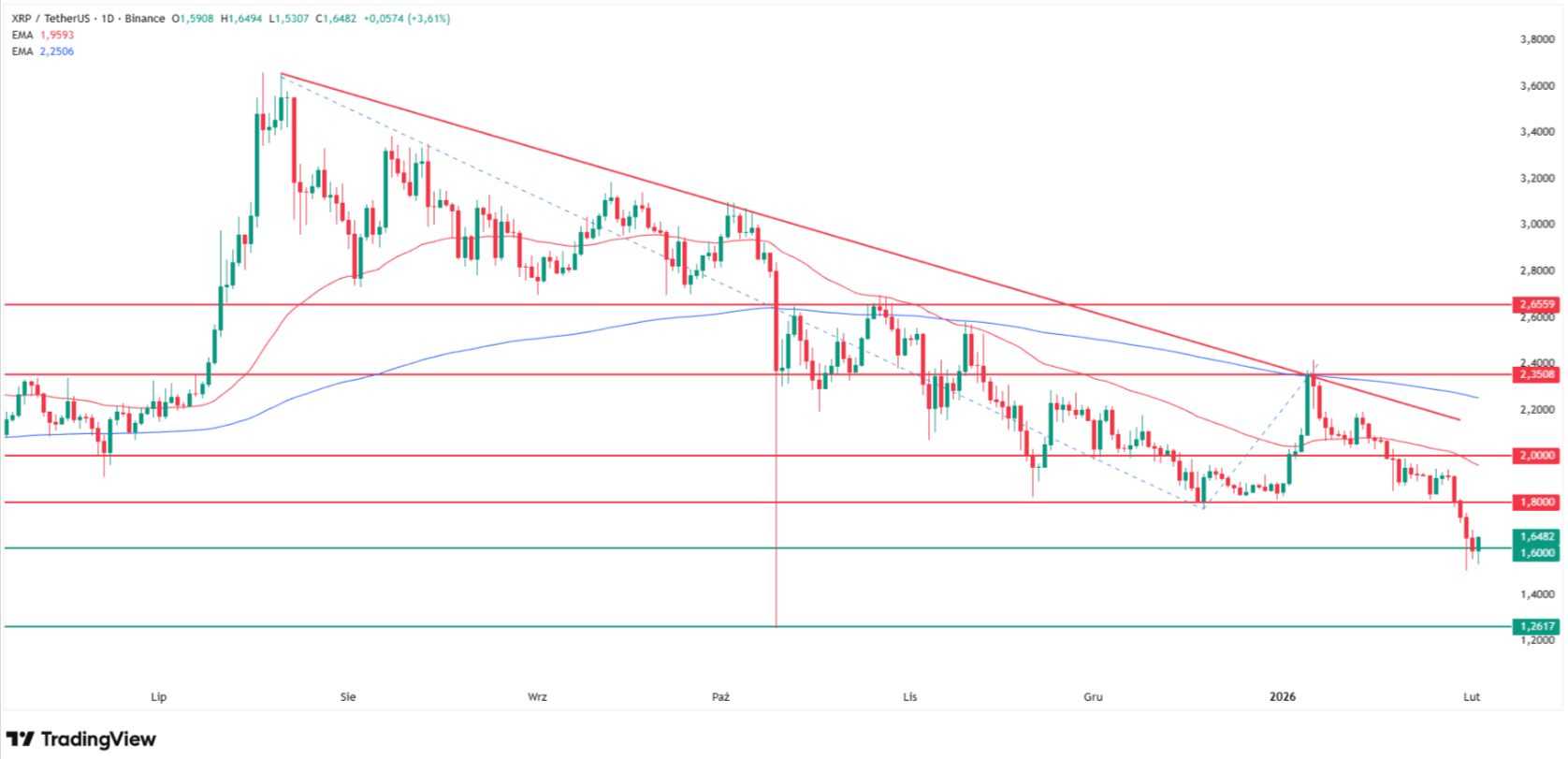
XRP trades at $1.63 after five consecutive losing sessions pushed it to November 2024 lows.
The first bearish target of $1.80 was achieved, with the cryptocurrency now forming temporary support at $1.51-1.60 before targeting $1.25-1.26
The ultra-bearish scenario points to $0.53 based on 100% Fibonacci extension, a potential 67% decline from current levels.
Why XRP price is going down today? Check the current XRP/USDT technical analysis
XRP trades
at $1.63 on Monday, February 2, 2026, up 2.5% but offering little comfort
after five consecutive down sessions pushed the cryptocurrency
to its lowest level since November 2024.
In this
article, I'll explain why XRP is falling today and provide detailed technical
analysis of the XRP/USDT chart with three downside targets.
Why XRP Is Falling?
Crypto Market Collapse:
$2.2 Billion Liquidated
XRP's
weakness stems from systemic crypto market failure. Saturday's crash saw $2.2
billion in futures liquidations, dubbed "Black Sunday II,” with
335,000 traders wiped out. XRP dropped 10% to $1.58 during the weekend selloff,
extending weekly losses to -11.48%.
The altcoin
carnage hit hard. Peters notes: "Altcoins have also been hit hard, with
the total market capitalisation excluding bitcoin falling 11% to $1.02 trillion".
Beyond
broader crypto weakness, XRP faces specific pressures.
Geopolitical
tensions are weighing heavily on risk assets. Vasily Shilov, CBDO at SwapSpace,
points to concerns surrounding the situation with Iran as the
main news factor dragging markets lower. But Saturday's decline was likely
exacerbated by something unexpected: the release of new documents in the Jeffrey
Epstein case containing significant incriminating evidence against Trump.
These
materials also mention Strategy CEO Michael Saylor in extremely negative terms,
and given that Strategy controls massive Bitcoin holdings, the revelation may
have fueled weekend selling when liquidity was already thin.
The Federal
Reserve chair transition added another layer of uncertainty. Paul Howard,
Director at Wincent, notes the irony: "What was meant to be a bullish move
for the markets rotating out Fed chairman to Warsh appears to have (at
least) coincided with a broad risk sell-off the last 24h."
Howard
emphasizes this is likely temporary turbulence rather than a fundamental shift.
"What we are seeing is more likely to be a knee-jerk reaction,"
he explains. Looking ahead, "this will bring faster structural change on
the way macro economic policy is implemented by an administration we know is
already in favor of a progressive crypto landscape."
XRP's
technical weakness compounds these macro factors, with the token breaking
critical support levels during thin weekend liquidity when even modest selling
pressure can trigger outsized price moves.
XRP Technical Analysis:
Three Downside Targets
XRP quickly
realized my first short-term bearish target of $1.80 (mid-December
lows), which I outlined in
my previous analysis.
The cryptocurrency is now forming short-term support between $1.51-1.60,
but I view this as only a temporary pause before continued depreciation.
100% Fibonacci extension
measured on last year's downtrend
Based
on December corrective rally
Represents -67%
from current levels
Follow
me on X for more crypto market analysis: @ChmielDk
Bullish Reversal Requirements
What would
change my bearish outlook? A return above $1.80 resistance is definitely
not enough. I would expect at minimum:
Reclaim $2.00 psychological
level and 50 EMA
Break downtrend line
from July highs (tested multiple times)
Close above 200 EMA at
$2.20 (uptrend/downtrend separator)
Breakout
above $2.35 (early 2026 highs)
Only then
would XRP bulls truly free themselves from bearish control, opening the path
to $2.66 (October highs) and eventually the $3.00 psychological
level. But currently, these are just "what-ifs."
Level
Type
Significance
$2.35
Resistance
2026 highs, bull breakout needed
$2.20
Resistance
200 EMA, trend separator
$2.00
Resistance
Psychological, 50 EMA
$1.80
Resistance
Target 1
(hit), mid-Dec lows
$1.63
Current
Monday recovery price
$1.51-1.60
Support
Short-term base forming
$1.25-1.26
Target 2
Oct flash
crash, next major support
$0.53
Target 3
100% Fib extension, -67% potential
XRP Market Outlook
XRP's -20.25%
monthly and -44.17% yearly performance reflects deep
structural weakness. While Monday's 2.5% bounce offers temporary relief, the
downtrend from July highs remains firmly intact with the 200 EMA acting as a
ceiling.
Paul
Howard's longer-term view provides some hope: "This will bring faster
structural change on the way macro economic policy is implemented by an
administration we know is already in favor of a progressive crypto
landscape." However, short-term technicals point decisively lower.
I'm
targeting $1.25-1.26 as the next destination, with the $0.53 ultra-bearish
scenario remaining on the table if broader crypto weakness persists. XRP needs
a decisive break above $2.20-2.35 to invalidate this bearish outlook—currently,
that looks unlikely.
FAQ, XRP Price Analysis
Why is XRP going down
today?
XRP fell to
$1.60 (lowest since Nov 2024) after five straight red days amid $2.2B crypto
liquidations, $1.49B Bitcoin ETF outflows, and altcoin market cap dropping 11%
to $1.02T. Kevin Warsh's Fed nomination, Iran tensions, and Epstein document
releases mentioning Michael Saylor triggered risk-off sentiment.
How low can XRP go?
XRP hit my
first target at $1.80 (mid-Dec lows). My medium-term target is $1.25-1.26 (Oct
flash crash lows), with an ultra-bearish scenario at $0.53 based on 100%
Fibonacci extension, representing a potential 67% decline from current $1.63
levels. Short-term support exists at $1.51-1.60.
Will XRP recover?
Recovery
requires breaking the July downtrend line and reclaiming $2.00, $2.20 (200
EMA), and $2.35 (2026 highs) to open paths toward $2.66 and $3.00. Currently
down 20.25% monthly and 44.17% yearly, XRP shows no technical signs of trend
reversal. Paul Howard notes long-term "progressive crypto landscape"
potential, but short-term outlook remains bearish.
Is XRP a buy now?
XRP is
testing $1.51-1.60 support after falling 11.48% in seven days, but I view this
as only a temporary pause before targeting $1.25-1.26. With the downtrend from
July highs intact, 200 EMA resistance at $2.20, and broader crypto weakness
($2.2B weekend liquidations), extreme caution is warranted. Wait for clear
trend break above $2.35 before considering long positions.
XRP trades
at $1.63 on Monday, February 2, 2026, up 2.5% but offering little comfort
after five consecutive down sessions pushed the cryptocurrency
to its lowest level since November 2024.
In this
article, I'll explain why XRP is falling today and provide detailed technical
analysis of the XRP/USDT chart with three downside targets.
Why XRP Is Falling?
Crypto Market Collapse:
$2.2 Billion Liquidated
XRP's
weakness stems from systemic crypto market failure. Saturday's crash saw $2.2
billion in futures liquidations, dubbed "Black Sunday II,” with
335,000 traders wiped out. XRP dropped 10% to $1.58 during the weekend selloff,
extending weekly losses to -11.48%.
The altcoin
carnage hit hard. Peters notes: "Altcoins have also been hit hard, with
the total market capitalisation excluding bitcoin falling 11% to $1.02 trillion".
Beyond
broader crypto weakness, XRP faces specific pressures.
Geopolitical
tensions are weighing heavily on risk assets. Vasily Shilov, CBDO at SwapSpace,
points to concerns surrounding the situation with Iran as the
main news factor dragging markets lower. But Saturday's decline was likely
exacerbated by something unexpected: the release of new documents in the Jeffrey
Epstein case containing significant incriminating evidence against Trump.
These
materials also mention Strategy CEO Michael Saylor in extremely negative terms,
and given that Strategy controls massive Bitcoin holdings, the revelation may
have fueled weekend selling when liquidity was already thin.
The Federal
Reserve chair transition added another layer of uncertainty. Paul Howard,
Director at Wincent, notes the irony: "What was meant to be a bullish move
for the markets rotating out Fed chairman to Warsh appears to have (at
least) coincided with a broad risk sell-off the last 24h."
Howard
emphasizes this is likely temporary turbulence rather than a fundamental shift.
"What we are seeing is more likely to be a knee-jerk reaction,"
he explains. Looking ahead, "this will bring faster structural change on
the way macro economic policy is implemented by an administration we know is
already in favor of a progressive crypto landscape."
XRP's
technical weakness compounds these macro factors, with the token breaking
critical support levels during thin weekend liquidity when even modest selling
pressure can trigger outsized price moves.
XRP Technical Analysis:
Three Downside Targets
XRP quickly
realized my first short-term bearish target of $1.80 (mid-December
lows), which I outlined in
my previous analysis.
The cryptocurrency is now forming short-term support between $1.51-1.60,
but I view this as only a temporary pause before continued depreciation.
100% Fibonacci extension
measured on last year's downtrend
Based
on December corrective rally
Represents -67%
from current levels
Follow
me on X for more crypto market analysis: @ChmielDk
Bullish Reversal Requirements
What would
change my bearish outlook? A return above $1.80 resistance is definitely
not enough. I would expect at minimum:
Reclaim $2.00 psychological
level and 50 EMA
Break downtrend line
from July highs (tested multiple times)
Close above 200 EMA at
$2.20 (uptrend/downtrend separator)
Breakout
above $2.35 (early 2026 highs)
Only then
would XRP bulls truly free themselves from bearish control, opening the path
to $2.66 (October highs) and eventually the $3.00 psychological
level. But currently, these are just "what-ifs."
Level
Type
Significance
$2.35
Resistance
2026 highs, bull breakout needed
$2.20
Resistance
200 EMA, trend separator
$2.00
Resistance
Psychological, 50 EMA
$1.80
Resistance
Target 1
(hit), mid-Dec lows
$1.63
Current
Monday recovery price
$1.51-1.60
Support
Short-term base forming
$1.25-1.26
Target 2
Oct flash
crash, next major support
$0.53
Target 3
100% Fib extension, -67% potential
XRP Market Outlook
XRP's -20.25%
monthly and -44.17% yearly performance reflects deep
structural weakness. While Monday's 2.5% bounce offers temporary relief, the
downtrend from July highs remains firmly intact with the 200 EMA acting as a
ceiling.
Paul
Howard's longer-term view provides some hope: "This will bring faster
structural change on the way macro economic policy is implemented by an
administration we know is already in favor of a progressive crypto
landscape." However, short-term technicals point decisively lower.
I'm
targeting $1.25-1.26 as the next destination, with the $0.53 ultra-bearish
scenario remaining on the table if broader crypto weakness persists. XRP needs
a decisive break above $2.20-2.35 to invalidate this bearish outlook—currently,
that looks unlikely.
FAQ, XRP Price Analysis
Why is XRP going down
today?
XRP fell to
$1.60 (lowest since Nov 2024) after five straight red days amid $2.2B crypto
liquidations, $1.49B Bitcoin ETF outflows, and altcoin market cap dropping 11%
to $1.02T. Kevin Warsh's Fed nomination, Iran tensions, and Epstein document
releases mentioning Michael Saylor triggered risk-off sentiment.
How low can XRP go?
XRP hit my
first target at $1.80 (mid-Dec lows). My medium-term target is $1.25-1.26 (Oct
flash crash lows), with an ultra-bearish scenario at $0.53 based on 100%
Fibonacci extension, representing a potential 67% decline from current $1.63
levels. Short-term support exists at $1.51-1.60.
Will XRP recover?
Recovery
requires breaking the July downtrend line and reclaiming $2.00, $2.20 (200
EMA), and $2.35 (2026 highs) to open paths toward $2.66 and $3.00. Currently
down 20.25% monthly and 44.17% yearly, XRP shows no technical signs of trend
reversal. Paul Howard notes long-term "progressive crypto landscape"
potential, but short-term outlook remains bearish.
Is XRP a buy now?
XRP is
testing $1.51-1.60 support after falling 11.48% in seven days, but I view this
as only a temporary pause before targeting $1.25-1.26. With the downtrend from
July highs intact, 200 EMA resistance at $2.20, and broader crypto weakness
($2.2B weekend liquidations), extreme caution is warranted. Wait for clear
trend break above $2.35 before considering long positions.
Damian Chmiel is a Senior Analyst & Editor at Finance Magnates with more than 15 years of experience in the CFD and online trading industry. Active as both a trader and journalist since 2010, he focuses on broker coverage, fintech innovation, and regulatory developments across Europe, the Middle East, and Asia.
His work includes interviews with C-level leaders at major brokerages and fintech platforms, as well as co-authoring Finance Magnates’ quarterly industry benchmarking reports. Damian’s reporting is data-driven, market-aware, and grounded in direct industry engagement. His analysis and commentary have also been cited by external media outlets, including Investing.com, Binance, The Asset, Stockhead, and Dispatch.
Education:
MA in Finance and Accounting, Cracow University of Economics
How Low Can Bitcoin Go? After Worst Quarter Since 2018, BTC Price Predictions Remain Bearish
Featured Videos
Axi Winner Spotlight 🏆 | Global Most Innovative Broker 2025 #Innovation #Trading #Fintech #Broker
Axi Winner Spotlight 🏆 | Global Most Innovative Broker 2025 #Innovation #Trading #Fintech #Broker
Axi Winner Spotlight 🏆 | Global Most Innovative Broker 2025 #Innovation #Trading #Fintech #Broker
Axi Winner Spotlight 🏆 | Global Most Innovative Broker 2025 #Innovation #Trading #Fintech #Broker
Axi takes the spotlight at the Finance Magnates Awards, winning Global Most Innovative Broker 2025.
Olivia Xenofontos and Ivanna Openko share how the team will feel: proud, motivated, and ready to keep delivering.
They also describe the night as well-organized, focused, and enjoyable for all.
👉 Be part of FM Awards 2026.
Axi takes the spotlight at the Finance Magnates Awards, winning Global Most Innovative Broker 2025.
Olivia Xenofontos and Ivanna Openko share how the team will feel: proud, motivated, and ready to keep delivering.
They also describe the night as well-organized, focused, and enjoyable for all.
👉 Be part of FM Awards 2026.
Axi takes the spotlight at the Finance Magnates Awards, winning Global Most Innovative Broker 2025.
Olivia Xenofontos and Ivanna Openko share how the team will feel: proud, motivated, and ready to keep delivering.
They also describe the night as well-organized, focused, and enjoyable for all.
👉 Be part of FM Awards 2026.
Axi takes the spotlight at the Finance Magnates Awards, winning Global Most Innovative Broker 2025.
Olivia Xenofontos and Ivanna Openko share how the team will feel: proud, motivated, and ready to keep delivering.
They also describe the night as well-organized, focused, and enjoyable for all.
👉 Be part of FM Awards 2026.
Recognition that matters.
Built on transparency.
Driven by the industry.
The Finance Magnates Awards 2026.
Nominations are now open.
🔗 https://awards.financemagnates.com/?utm_source=SM&utm_medium=social&utm_campaign=recognition-matters
Recognition that matters.
Built on transparency.
Driven by the industry.
The Finance Magnates Awards 2026.
Nominations are now open.
🔗 https://awards.financemagnates.com/?utm_source=SM&utm_medium=social&utm_campaign=recognition-matters
Recognition that matters.
Built on transparency.
Driven by the industry.
The Finance Magnates Awards 2026.
Nominations are now open.
🔗 https://awards.financemagnates.com/?utm_source=SM&utm_medium=social&utm_campaign=recognition-matters
Recognition that matters.
Built on transparency.
Driven by the industry.
The Finance Magnates Awards 2026.
Nominations are now open.
🔗 https://awards.financemagnates.com/?utm_source=SM&utm_medium=social&utm_campaign=recognition-matters
Recognition that matters.
Built on transparency.
Driven by the industry.
The Finance Magnates Awards 2026.
Nominations are now open.
🔗 https://awards.financemagnates.com/?utm_source=SM&utm_medium=social&utm_campaign=recognition-matters
Recognition that matters.
Built on transparency.
Driven by the industry.
The Finance Magnates Awards 2026.
Nominations are now open.
🔗 https://awards.financemagnates.com/?utm_source=SM&utm_medium=social&utm_campaign=recognition-matters
Tickmill Winner Spotlight | Broker of the Year 2025 (LATAM) 🏆 | Finance Magnates Awards #Trading
Tickmill Winner Spotlight | Broker of the Year 2025 (LATAM) 🏆 | Finance Magnates Awards #Trading
Tickmill Winner Spotlight | Broker of the Year 2025 (LATAM) 🏆 | Finance Magnates Awards #Trading
Tickmill Winner Spotlight | Broker of the Year 2025 (LATAM) 🏆 | Finance Magnates Awards #Trading
Tickmill Winner Spotlight | Broker of the Year 2025 (LATAM) 🏆 | Finance Magnates Awards #Trading
Tickmill Winner Spotlight | Broker of the Year 2025 (LATAM) 🏆 | Finance Magnates Awards #Trading
What helped Tickmill stand out this year?
In this Winner Spotlight, Johnny Khalil, Executive Director at Tickmill Europe, shares how listening closely to clients and delivering strong trading conditions made the difference.
A big thank you to the community whose support continues to drive progress every day.
👉 Think your brand has what it takes? Nominate for the 2026 Finance Magnates Awards: https://awards.financemagnates.com/#nominate
What helped Tickmill stand out this year?
In this Winner Spotlight, Johnny Khalil, Executive Director at Tickmill Europe, shares how listening closely to clients and delivering strong trading conditions made the difference.
A big thank you to the community whose support continues to drive progress every day.
👉 Think your brand has what it takes? Nominate for the 2026 Finance Magnates Awards: https://awards.financemagnates.com/#nominate
What helped Tickmill stand out this year?
In this Winner Spotlight, Johnny Khalil, Executive Director at Tickmill Europe, shares how listening closely to clients and delivering strong trading conditions made the difference.
A big thank you to the community whose support continues to drive progress every day.
👉 Think your brand has what it takes? Nominate for the 2026 Finance Magnates Awards: https://awards.financemagnates.com/#nominate
What helped Tickmill stand out this year?
In this Winner Spotlight, Johnny Khalil, Executive Director at Tickmill Europe, shares how listening closely to clients and delivering strong trading conditions made the difference.
A big thank you to the community whose support continues to drive progress every day.
👉 Think your brand has what it takes? Nominate for the 2026 Finance Magnates Awards: https://awards.financemagnates.com/#nominate
What helped Tickmill stand out this year?
In this Winner Spotlight, Johnny Khalil, Executive Director at Tickmill Europe, shares how listening closely to clients and delivering strong trading conditions made the difference.
A big thank you to the community whose support continues to drive progress every day.
👉 Think your brand has what it takes? Nominate for the 2026 Finance Magnates Awards: https://awards.financemagnates.com/#nominate
What helped Tickmill stand out this year?
In this Winner Spotlight, Johnny Khalil, Executive Director at Tickmill Europe, shares how listening closely to clients and delivering strong trading conditions made the difference.
A big thank you to the community whose support continues to drive progress every day.
👉 Think your brand has what it takes? Nominate for the 2026 Finance Magnates Awards: https://awards.financemagnates.com/#nominate
CMC Markets’ Artur Delijergijevs on Metals Demand, Volatility, & Stable Execution
CMC Markets’ Artur Delijergijevs on Metals Demand, Volatility, & Stable Execution
CMC Markets’ Artur Delijergijevs on Metals Demand, Volatility, & Stable Execution
CMC Markets’ Artur Delijergijevs on Metals Demand, Volatility, & Stable Execution
CMC Markets’ Artur Delijergijevs on Metals Demand, Volatility, & Stable Execution
CMC Markets’ Artur Delijergijevs on Metals Demand, Volatility, & Stable Execution
In this exclusive Executive Interview, Finance Magnates speaks with Artur Delijergijevs, Head of Systematic Market Making at CMC Markets, about the current state of metals demand and market volatility.
Delijergijevs offers a desk-level view on:
- Metals Demand: Why metals are seeing the strongest demand from both retail and institutional clients right now.
- The Safe-Haven Debate: Questioning whether gold still fits the classic safe-haven definition given large daily price movements.
- Volatile Market Prep: How a market-making desk prepares its systems and pricing for stressed market conditions and high-impact economic events.
- Hybrid Execution: Why the best execution model combines electronic speed with human relationship support, especially during volatility.
- AI in Workflow: Where CMC Markets is integrating machine learning for risk management and pricing, and the limitations of AI during stressed markets.
- Dubai's Role: The strategic importance of Dubai’s location for covering global trading sessions across Asia, Europe, and the US.
Watch to understand how CMC Markets maintains stable pricing and reliable execution quality in high-volatility environments.
#CMCmarkets #forex #metals #gold #trading #volatility #MarketMaking #iFXDubai #FinanceMagnates #Finance #Fintech #Execution #AlgorithmicTrading #RiskManagement
In this exclusive Executive Interview, Finance Magnates speaks with Artur Delijergijevs, Head of Systematic Market Making at CMC Markets, about the current state of metals demand and market volatility.
Delijergijevs offers a desk-level view on:
- Metals Demand: Why metals are seeing the strongest demand from both retail and institutional clients right now.
- The Safe-Haven Debate: Questioning whether gold still fits the classic safe-haven definition given large daily price movements.
- Volatile Market Prep: How a market-making desk prepares its systems and pricing for stressed market conditions and high-impact economic events.
- Hybrid Execution: Why the best execution model combines electronic speed with human relationship support, especially during volatility.
- AI in Workflow: Where CMC Markets is integrating machine learning for risk management and pricing, and the limitations of AI during stressed markets.
- Dubai's Role: The strategic importance of Dubai’s location for covering global trading sessions across Asia, Europe, and the US.
Watch to understand how CMC Markets maintains stable pricing and reliable execution quality in high-volatility environments.
#CMCmarkets #forex #metals #gold #trading #volatility #MarketMaking #iFXDubai #FinanceMagnates #Finance #Fintech #Execution #AlgorithmicTrading #RiskManagement
In this exclusive Executive Interview, Finance Magnates speaks with Artur Delijergijevs, Head of Systematic Market Making at CMC Markets, about the current state of metals demand and market volatility.
Delijergijevs offers a desk-level view on:
- Metals Demand: Why metals are seeing the strongest demand from both retail and institutional clients right now.
- The Safe-Haven Debate: Questioning whether gold still fits the classic safe-haven definition given large daily price movements.
- Volatile Market Prep: How a market-making desk prepares its systems and pricing for stressed market conditions and high-impact economic events.
- Hybrid Execution: Why the best execution model combines electronic speed with human relationship support, especially during volatility.
- AI in Workflow: Where CMC Markets is integrating machine learning for risk management and pricing, and the limitations of AI during stressed markets.
- Dubai's Role: The strategic importance of Dubai’s location for covering global trading sessions across Asia, Europe, and the US.
Watch to understand how CMC Markets maintains stable pricing and reliable execution quality in high-volatility environments.
#CMCmarkets #forex #metals #gold #trading #volatility #MarketMaking #iFXDubai #FinanceMagnates #Finance #Fintech #Execution #AlgorithmicTrading #RiskManagement
In this exclusive Executive Interview, Finance Magnates speaks with Artur Delijergijevs, Head of Systematic Market Making at CMC Markets, about the current state of metals demand and market volatility.
Delijergijevs offers a desk-level view on:
- Metals Demand: Why metals are seeing the strongest demand from both retail and institutional clients right now.
- The Safe-Haven Debate: Questioning whether gold still fits the classic safe-haven definition given large daily price movements.
- Volatile Market Prep: How a market-making desk prepares its systems and pricing for stressed market conditions and high-impact economic events.
- Hybrid Execution: Why the best execution model combines electronic speed with human relationship support, especially during volatility.
- AI in Workflow: Where CMC Markets is integrating machine learning for risk management and pricing, and the limitations of AI during stressed markets.
- Dubai's Role: The strategic importance of Dubai’s location for covering global trading sessions across Asia, Europe, and the US.
Watch to understand how CMC Markets maintains stable pricing and reliable execution quality in high-volatility environments.
#CMCmarkets #forex #metals #gold #trading #volatility #MarketMaking #iFXDubai #FinanceMagnates #Finance #Fintech #Execution #AlgorithmicTrading #RiskManagement
In this exclusive Executive Interview, Finance Magnates speaks with Artur Delijergijevs, Head of Systematic Market Making at CMC Markets, about the current state of metals demand and market volatility.
Delijergijevs offers a desk-level view on:
- Metals Demand: Why metals are seeing the strongest demand from both retail and institutional clients right now.
- The Safe-Haven Debate: Questioning whether gold still fits the classic safe-haven definition given large daily price movements.
- Volatile Market Prep: How a market-making desk prepares its systems and pricing for stressed market conditions and high-impact economic events.
- Hybrid Execution: Why the best execution model combines electronic speed with human relationship support, especially during volatility.
- AI in Workflow: Where CMC Markets is integrating machine learning for risk management and pricing, and the limitations of AI during stressed markets.
- Dubai's Role: The strategic importance of Dubai’s location for covering global trading sessions across Asia, Europe, and the US.
Watch to understand how CMC Markets maintains stable pricing and reliable execution quality in high-volatility environments.
#CMCmarkets #forex #metals #gold #trading #volatility #MarketMaking #iFXDubai #FinanceMagnates #Finance #Fintech #Execution #AlgorithmicTrading #RiskManagement
In this exclusive Executive Interview, Finance Magnates speaks with Artur Delijergijevs, Head of Systematic Market Making at CMC Markets, about the current state of metals demand and market volatility.
Delijergijevs offers a desk-level view on:
- Metals Demand: Why metals are seeing the strongest demand from both retail and institutional clients right now.
- The Safe-Haven Debate: Questioning whether gold still fits the classic safe-haven definition given large daily price movements.
- Volatile Market Prep: How a market-making desk prepares its systems and pricing for stressed market conditions and high-impact economic events.
- Hybrid Execution: Why the best execution model combines electronic speed with human relationship support, especially during volatility.
- AI in Workflow: Where CMC Markets is integrating machine learning for risk management and pricing, and the limitations of AI during stressed markets.
- Dubai's Role: The strategic importance of Dubai’s location for covering global trading sessions across Asia, Europe, and the US.
Watch to understand how CMC Markets maintains stable pricing and reliable execution quality in high-volatility environments.
#CMCmarkets #forex #metals #gold #trading #volatility #MarketMaking #iFXDubai #FinanceMagnates #Finance #Fintech #Execution #AlgorithmicTrading #RiskManagement
Finance Magnates Awards 2026 – Nominations Now Open
Finance Magnates Awards 2026 – Nominations Now Open
Finance Magnates Awards 2026 – Nominations Now Open
Finance Magnates Awards 2026 – Nominations Now Open
Finance Magnates Awards 2026 – Nominations Now Open
Finance Magnates Awards 2026 – Nominations Now Open
The Finance Magnates Awards 2026 nominations are now open. 🏆
From fintech innovators to leading brokers, this is where the finance industry celebrates its biggest achievements.
Winners will be announced at the Cyprus Gala Dinner on November 6, 2026.
Nominate your brand now.
https://awards.financemagnates.com/?utm_source=linkedin&utm_medium=video&utm_campaign=nominations-open
#FMAwards #FinanceMagnates #FintechAwards #Fintech #FinanceIndustry
The Finance Magnates Awards 2026 nominations are now open. 🏆
From fintech innovators to leading brokers, this is where the finance industry celebrates its biggest achievements.
Winners will be announced at the Cyprus Gala Dinner on November 6, 2026.
Nominate your brand now.
https://awards.financemagnates.com/?utm_source=linkedin&utm_medium=video&utm_campaign=nominations-open
#FMAwards #FinanceMagnates #FintechAwards #Fintech #FinanceIndustry
The Finance Magnates Awards 2026 nominations are now open. 🏆
From fintech innovators to leading brokers, this is where the finance industry celebrates its biggest achievements.
Winners will be announced at the Cyprus Gala Dinner on November 6, 2026.
Nominate your brand now.
https://awards.financemagnates.com/?utm_source=linkedin&utm_medium=video&utm_campaign=nominations-open
#FMAwards #FinanceMagnates #FintechAwards #Fintech #FinanceIndustry
The Finance Magnates Awards 2026 nominations are now open. 🏆
From fintech innovators to leading brokers, this is where the finance industry celebrates its biggest achievements.
Winners will be announced at the Cyprus Gala Dinner on November 6, 2026.
Nominate your brand now.
https://awards.financemagnates.com/?utm_source=linkedin&utm_medium=video&utm_campaign=nominations-open
#FMAwards #FinanceMagnates #FintechAwards #Fintech #FinanceIndustry
The Finance Magnates Awards 2026 nominations are now open. 🏆
From fintech innovators to leading brokers, this is where the finance industry celebrates its biggest achievements.
Winners will be announced at the Cyprus Gala Dinner on November 6, 2026.
Nominate your brand now.
https://awards.financemagnates.com/?utm_source=linkedin&utm_medium=video&utm_campaign=nominations-open
#FMAwards #FinanceMagnates #FintechAwards #Fintech #FinanceIndustry
The Finance Magnates Awards 2026 nominations are now open. 🏆
From fintech innovators to leading brokers, this is where the finance industry celebrates its biggest achievements.
Winners will be announced at the Cyprus Gala Dinner on November 6, 2026.
Nominate your brand now.
https://awards.financemagnates.com/?utm_source=linkedin&utm_medium=video&utm_campaign=nominations-open
#FMAwards #FinanceMagnates #FintechAwards #Fintech #FinanceIndustry