Edward Ridgely highlights growing systematic strategies and cross-venue trading in prediction markets.
The so-called “pro-tail traders” push prediction market infrastructure toward execution tools resembling traditional trading screens.
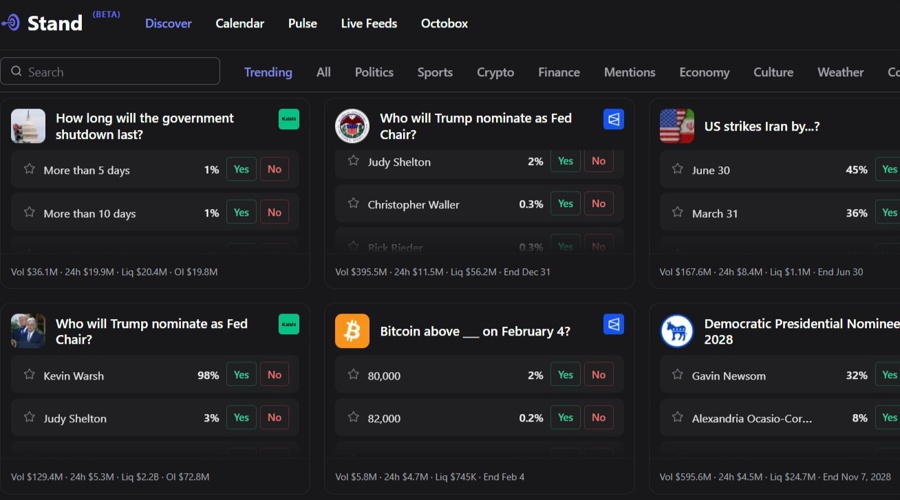
Stand's prediction markets platform
Prediction
markets are drawing a new class of active traders who treat event contracts
less like wagers and more like another screen on the trading desk. From
geopolitics and tariffs to crypto price paths, contract prices are increasingly
used as live probability signals that update as narratives shift.
Edward Ridgely, co-founder of Stand
“You're
seeing more systematic strategies, more cross-venue monitoring, and a growing
need for infrastructure that lets people see and execute across markets in one
place,” Edward Ridgely, co-founder of Stand, told FinanceMagnates.com.
His
terminal is approaching $200 million in annualized trading volume after adding
Kalshi alongside Polymarket, giving traders access to the two largest
prediction-market venues through a single interface.
Stand Adds Kalshi
Integration as Platform Volume Nears $200M
“Traders
are increasingly using prediction markets the way they use other markets, to
price uncertainty, express views quickly, and react as information changes,”
Ridgely added.
For
exchanges pushing deeper into traditional finance, prediction markets are the
latest frontier after adding CFDs and tokenized stocks in 2025.
That
backdrop is where Stand sits. Similar themes can now be priced simultaneously
across multiple platforms, opening up relative-value trades when implied
probabilities diverge.
“What's
changed is the behavior,” Stands co-founded said.
“On
Stand, users actually deposit funds,” Ridgely told FinanceMagnates.com.
That setup, he argues, allows the platform to automate trades in ways that
simple account connectors cannot. “We provide pro-tail users a cadre of
automations that would not be possible if we simply allowed users to connect
their Polymarket or Kalshi accounts.”
The
terminal offers stop orders, pegged orders, copy trading and batch order
placement, as well as tools to manage multiple existing orders at once. Through
a feature called Octobox, traders can monitor and trade up to eight markets on
a single screen and receive alerts when large participants enter or exit a
market.
“Traders
can trade up to 10x more, much faster, and in secure manner through
Stand,” Ridgely said.
For some
desks, prediction markets now sit alongside traditional risk monitors.
Russia–Ukraine contracts are watched next to oil inputs, while macro and
policy-linked markets, including tariff outcomes, help calibrate event risk and
positioning.
Regulators Weigh
Similarities to Binary Options
The
regulatory picture remains uneven across jurisdictions. Some
authorities compare prediction markets to binary options, which have been
heavily restricted or banned after losses among retail clients. ASIC, for
instance, found that 80% of retail customers lost money trading binary options,
prompting tough restrictions.
“Regulation
is critical and we need more clarity to protect users,” Ridgely told
FinanceMagnates.com. “However, prediction markets have been around for a
long time and even before them, retail users were making trades in their
communities around elections, entertainment awards, and sports events. The
reality is this behavior is not new. It will be better served with regulatory
oversight and clear guardrails to protect retail and prevent the bad
actors.”
Ridgely
sees reasons for cautious optimism. “Overall, the path is clearing under
the current White House administration but there's still uncertainty,” he
told FinanceMagnates.com. “You can see that optimism from Coinbase,
Robinhood, and SIG all entering the foray. These are multi-billion dollar
companies that would not jeopardize their standing if they didn't think there
was a real opportunity in a regulatory compliant industry.”
Stand Positions Itself
Outside the U.S.
To navigate
the evolving rulebook, Stand operates outside the U.S. and adheres to
Polymarket and Kalshi’s terms, including geo-blocking restricted regions.
Ridgely said most of the terminal’s users are in Europe and Asia, where traders
are looking to plug prediction contracts into broader macro and event-driven
strategies.
For now,
prediction markets sit at an awkward intersection of finance, gambling and
information markets. Infrastructure providers such as Stand are betting that,
with clearer guardrails and deeper liquidity, event contracts will settle
closer to the trading tools used in other markets than to retail betting apps.
Prediction
markets are drawing a new class of active traders who treat event contracts
less like wagers and more like another screen on the trading desk. From
geopolitics and tariffs to crypto price paths, contract prices are increasingly
used as live probability signals that update as narratives shift.
Edward Ridgely, co-founder of Stand
“You're
seeing more systematic strategies, more cross-venue monitoring, and a growing
need for infrastructure that lets people see and execute across markets in one
place,” Edward Ridgely, co-founder of Stand, told FinanceMagnates.com.
His
terminal is approaching $200 million in annualized trading volume after adding
Kalshi alongside Polymarket, giving traders access to the two largest
prediction-market venues through a single interface.
Stand Adds Kalshi
Integration as Platform Volume Nears $200M
“Traders
are increasingly using prediction markets the way they use other markets, to
price uncertainty, express views quickly, and react as information changes,”
Ridgely added.
For
exchanges pushing deeper into traditional finance, prediction markets are the
latest frontier after adding CFDs and tokenized stocks in 2025.
That
backdrop is where Stand sits. Similar themes can now be priced simultaneously
across multiple platforms, opening up relative-value trades when implied
probabilities diverge.
“What's
changed is the behavior,” Stands co-founded said.
“On
Stand, users actually deposit funds,” Ridgely told FinanceMagnates.com.
That setup, he argues, allows the platform to automate trades in ways that
simple account connectors cannot. “We provide pro-tail users a cadre of
automations that would not be possible if we simply allowed users to connect
their Polymarket or Kalshi accounts.”
The
terminal offers stop orders, pegged orders, copy trading and batch order
placement, as well as tools to manage multiple existing orders at once. Through
a feature called Octobox, traders can monitor and trade up to eight markets on
a single screen and receive alerts when large participants enter or exit a
market.
“Traders
can trade up to 10x more, much faster, and in secure manner through
Stand,” Ridgely said.
For some
desks, prediction markets now sit alongside traditional risk monitors.
Russia–Ukraine contracts are watched next to oil inputs, while macro and
policy-linked markets, including tariff outcomes, help calibrate event risk and
positioning.
Regulators Weigh
Similarities to Binary Options
The
regulatory picture remains uneven across jurisdictions. Some
authorities compare prediction markets to binary options, which have been
heavily restricted or banned after losses among retail clients. ASIC, for
instance, found that 80% of retail customers lost money trading binary options,
prompting tough restrictions.
“Regulation
is critical and we need more clarity to protect users,” Ridgely told
FinanceMagnates.com. “However, prediction markets have been around for a
long time and even before them, retail users were making trades in their
communities around elections, entertainment awards, and sports events. The
reality is this behavior is not new. It will be better served with regulatory
oversight and clear guardrails to protect retail and prevent the bad
actors.”
Ridgely
sees reasons for cautious optimism. “Overall, the path is clearing under
the current White House administration but there's still uncertainty,” he
told FinanceMagnates.com. “You can see that optimism from Coinbase,
Robinhood, and SIG all entering the foray. These are multi-billion dollar
companies that would not jeopardize their standing if they didn't think there
was a real opportunity in a regulatory compliant industry.”
Stand Positions Itself
Outside the U.S.
To navigate
the evolving rulebook, Stand operates outside the U.S. and adheres to
Polymarket and Kalshi’s terms, including geo-blocking restricted regions.
Ridgely said most of the terminal’s users are in Europe and Asia, where traders
are looking to plug prediction contracts into broader macro and event-driven
strategies.
For now,
prediction markets sit at an awkward intersection of finance, gambling and
information markets. Infrastructure providers such as Stand are betting that,
with clearer guardrails and deeper liquidity, event contracts will settle
closer to the trading tools used in other markets than to retail betting apps.
Damian Chmiel is a Senior Analyst & Editor at Finance Magnates with more than 15 years of experience in the CFD and online trading industry. Active as both a trader and journalist since 2010, he focuses on broker coverage, fintech innovation, and regulatory developments across Europe, the Middle East, and Asia.
His work includes interviews with C-level leaders at major brokerages and fintech platforms, as well as co-authoring Finance Magnates’ quarterly industry benchmarking reports. Damian’s reporting is data-driven, market-aware, and grounded in direct industry engagement. His analysis and commentary have also been cited by external media outlets, including Investing.com, Binance, The Asset, Stockhead, and Dispatch.
Education:
MA in Finance and Accounting, Cracow University of Economics
UK Brokers to Pay 22% Charge on ISA Cash Interest as eToro Survey Shows Savers Unprepared
Featured Videos
CMC Founder Downplays Volatility Hit; Devexperts Names CEO
CMC Founder Downplays Volatility Hit; Devexperts Names CEO
CMC Founder Downplays Volatility Hit; Devexperts Names CEO
CMC Founder Downplays Volatility Hit; Devexperts Names CEO
Today’s financial news recap covers low volatility pressures brokers, Devexperts names a new CEO, Saxo cuts onboarding time, and OKX reaches a 25 billion dollar valuation.
Finance Magnates Daily Recap brings you the latest news from forex and CFD brokers, fintech, payments, cryptocurrency, digital assets, trading platforms, financial regulation and global markets.
Get the key company news, executive moves, deals, regulatory updates and market developments of the day, in just a few minutes. New episodes published every weekday.
Read more: https://www.financemagnates.com
#FinanceMagnates #ForexNews #FintechNews
Today’s financial news recap covers low volatility pressures brokers, Devexperts names a new CEO, Saxo cuts onboarding time, and OKX reaches a 25 billion dollar valuation.
Finance Magnates Daily Recap brings you the latest news from forex and CFD brokers, fintech, payments, cryptocurrency, digital assets, trading platforms, financial regulation and global markets.
Get the key company news, executive moves, deals, regulatory updates and market developments of the day, in just a few minutes. New episodes published every weekday.
Read more: https://www.financemagnates.com
#FinanceMagnates #ForexNews #FintechNews
Today’s financial news recap covers low volatility pressures brokers, Devexperts names a new CEO, Saxo cuts onboarding time, and OKX reaches a 25 billion dollar valuation.
Finance Magnates Daily Recap brings you the latest news from forex and CFD brokers, fintech, payments, cryptocurrency, digital assets, trading platforms, financial regulation and global markets.
Get the key company news, executive moves, deals, regulatory updates and market developments of the day, in just a few minutes. New episodes published every weekday.
Read more: https://www.financemagnates.com
#FinanceMagnates #ForexNews #FintechNews
Today’s financial news recap covers low volatility pressures brokers, Devexperts names a new CEO, Saxo cuts onboarding time, and OKX reaches a 25 billion dollar valuation.
Finance Magnates Daily Recap brings you the latest news from forex and CFD brokers, fintech, payments, cryptocurrency, digital assets, trading platforms, financial regulation and global markets.
Get the key company news, executive moves, deals, regulatory updates and market developments of the day, in just a few minutes. New episodes published every weekday.
Read more: https://www.financemagnates.com
#FinanceMagnates #ForexNews #FintechNews
Today’s financial news recap covers Trade Nation buys FXCM's UK client book, Trading 212 reports higher revenue, the CFTC's move to allow perpetual index futures.
Finance Magnates Daily Recap brings you the latest news from forex and CFD brokers, fintech, payments, cryptocurrency, digital assets, trading platforms, financial regulation and global markets.
Get the key company news, executive moves, deals, regulatory updates and market developments of the day, in just a few minutes. New episodes published every weekday.
Read more: https://www.financemagnates.com
#FinanceMagnates #ForexNews #FintechNews
Today’s financial news recap covers Trade Nation buys FXCM's UK client book, Trading 212 reports higher revenue, the CFTC's move to allow perpetual index futures.
Finance Magnates Daily Recap brings you the latest news from forex and CFD brokers, fintech, payments, cryptocurrency, digital assets, trading platforms, financial regulation and global markets.
Get the key company news, executive moves, deals, regulatory updates and market developments of the day, in just a few minutes. New episodes published every weekday.
Read more: https://www.financemagnates.com
#FinanceMagnates #ForexNews #FintechNews
Today’s financial news recap covers Trade Nation buys FXCM's UK client book, Trading 212 reports higher revenue, the CFTC's move to allow perpetual index futures.
Finance Magnates Daily Recap brings you the latest news from forex and CFD brokers, fintech, payments, cryptocurrency, digital assets, trading platforms, financial regulation and global markets.
Get the key company news, executive moves, deals, regulatory updates and market developments of the day, in just a few minutes. New episodes published every weekday.
Read more: https://www.financemagnates.com
#FinanceMagnates #ForexNews #FintechNews
Today’s financial news recap covers Trade Nation buys FXCM's UK client book, Trading 212 reports higher revenue, the CFTC's move to allow perpetual index futures.
Finance Magnates Daily Recap brings you the latest news from forex and CFD brokers, fintech, payments, cryptocurrency, digital assets, trading platforms, financial regulation and global markets.
Get the key company news, executive moves, deals, regulatory updates and market developments of the day, in just a few minutes. New episodes published every weekday.
Read more: https://www.financemagnates.com
#FinanceMagnates #ForexNews #FintechNews
Today’s financial news recap covers Trade Nation buys FXCM's UK client book, Trading 212 reports higher revenue, the CFTC's move to allow perpetual index futures.
Finance Magnates Daily Recap brings you the latest news from forex and CFD brokers, fintech, payments, cryptocurrency, digital assets, trading platforms, financial regulation and global markets.
Get the key company news, executive moves, deals, regulatory updates and market developments of the day, in just a few minutes. New episodes published every weekday.
Read more: https://www.financemagnates.com
#FinanceMagnates #ForexNews #FintechNews
Today’s financial news recap covers Trade Nation buys FXCM's UK client book, Trading 212 reports higher revenue, the CFTC's move to allow perpetual index futures.
Finance Magnates Daily Recap brings you the latest news from forex and CFD brokers, fintech, payments, cryptocurrency, digital assets, trading platforms, financial regulation and global markets.
Get the key company news, executive moves, deals, regulatory updates and market developments of the day, in just a few minutes. New episodes published every weekday.
Read more: https://www.financemagnates.com
#FinanceMagnates #ForexNews #FintechNews
Your career isn’t a linear path.
Your career isn’t a linear path.
Your career isn’t a linear path.
Your career isn’t a linear path.
Your career isn’t a linear path.
Your career isn’t a linear path.
Roles change. Career goals change. Sometimes you want a completely new challenge.
But the skills and knowledge you build along the way can stay with you and give you something to build on.
For Jeff Patterson, that continued growth is key to long-term career development.
You bring the skills. FM Academy helps you build the knowledge.
#FMAcademy #FinanceMagnates #FinanceCareers #ProfessionalDevelopment #Fintech
Roles change. Career goals change. Sometimes you want a completely new challenge.
But the skills and knowledge you build along the way can stay with you and give you something to build on.
For Jeff Patterson, that continued growth is key to long-term career development.
You bring the skills. FM Academy helps you build the knowledge.
#FMAcademy #FinanceMagnates #FinanceCareers #ProfessionalDevelopment #Fintech
Roles change. Career goals change. Sometimes you want a completely new challenge.
But the skills and knowledge you build along the way can stay with you and give you something to build on.
For Jeff Patterson, that continued growth is key to long-term career development.
You bring the skills. FM Academy helps you build the knowledge.
#FMAcademy #FinanceMagnates #FinanceCareers #ProfessionalDevelopment #Fintech
Roles change. Career goals change. Sometimes you want a completely new challenge.
But the skills and knowledge you build along the way can stay with you and give you something to build on.
For Jeff Patterson, that continued growth is key to long-term career development.
You bring the skills. FM Academy helps you build the knowledge.
#FMAcademy #FinanceMagnates #FinanceCareers #ProfessionalDevelopment #Fintech
Roles change. Career goals change. Sometimes you want a completely new challenge.
But the skills and knowledge you build along the way can stay with you and give you something to build on.
For Jeff Patterson, that continued growth is key to long-term career development.
You bring the skills. FM Academy helps you build the knowledge.
#FMAcademy #FinanceMagnates #FinanceCareers #ProfessionalDevelopment #Fintech
Roles change. Career goals change. Sometimes you want a completely new challenge.
But the skills and knowledge you build along the way can stay with you and give you something to build on.
For Jeff Patterson, that continued growth is key to long-term career development.
You bring the skills. FM Academy helps you build the knowledge.
#FMAcademy #FinanceMagnates #FinanceCareers #ProfessionalDevelopment #Fintech
IG Group Tech Chiefs Exit; Pepperstone Revenue Grows
IG Group Tech Chiefs Exit; Pepperstone Revenue Grows
IG Group Tech Chiefs Exit; Pepperstone Revenue Grows
IG Group Tech Chiefs Exit; Pepperstone Revenue Grows
IG Group Tech Chiefs Exit; Pepperstone Revenue Grows
IG Group Tech Chiefs Exit; Pepperstone Revenue Grows
Today’s financial news recap covers IG Group loses two technology chiefs, Pepperstone reports double-digit growth, and eToro backs a euro stablecoin.
Finance Magnates Daily Recap brings you the latest news from forex and CFD brokers, fintech, payments, cryptocurrency, digital assets, trading platforms, financial regulation and global markets.
Get the key company news, executive moves, deals, regulatory updates and market developments of the day, in just a few minutes. New episodes published every weekday.
Read more: https://www.financemagnates.com
#FinanceMagnates #ForexNews #FintechNews
Today’s financial news recap covers IG Group loses two technology chiefs, Pepperstone reports double-digit growth, and eToro backs a euro stablecoin.
Finance Magnates Daily Recap brings you the latest news from forex and CFD brokers, fintech, payments, cryptocurrency, digital assets, trading platforms, financial regulation and global markets.
Get the key company news, executive moves, deals, regulatory updates and market developments of the day, in just a few minutes. New episodes published every weekday.
Read more: https://www.financemagnates.com
#FinanceMagnates #ForexNews #FintechNews
Today’s financial news recap covers IG Group loses two technology chiefs, Pepperstone reports double-digit growth, and eToro backs a euro stablecoin.
Finance Magnates Daily Recap brings you the latest news from forex and CFD brokers, fintech, payments, cryptocurrency, digital assets, trading platforms, financial regulation and global markets.
Get the key company news, executive moves, deals, regulatory updates and market developments of the day, in just a few minutes. New episodes published every weekday.
Read more: https://www.financemagnates.com
#FinanceMagnates #ForexNews #FintechNews
Today’s financial news recap covers IG Group loses two technology chiefs, Pepperstone reports double-digit growth, and eToro backs a euro stablecoin.
Finance Magnates Daily Recap brings you the latest news from forex and CFD brokers, fintech, payments, cryptocurrency, digital assets, trading platforms, financial regulation and global markets.
Get the key company news, executive moves, deals, regulatory updates and market developments of the day, in just a few minutes. New episodes published every weekday.
Read more: https://www.financemagnates.com
#FinanceMagnates #ForexNews #FintechNews
Today’s financial news recap covers IG Group loses two technology chiefs, Pepperstone reports double-digit growth, and eToro backs a euro stablecoin.
Finance Magnates Daily Recap brings you the latest news from forex and CFD brokers, fintech, payments, cryptocurrency, digital assets, trading platforms, financial regulation and global markets.
Get the key company news, executive moves, deals, regulatory updates and market developments of the day, in just a few minutes. New episodes published every weekday.
Read more: https://www.financemagnates.com
#FinanceMagnates #ForexNews #FintechNews
Today’s financial news recap covers IG Group loses two technology chiefs, Pepperstone reports double-digit growth, and eToro backs a euro stablecoin.
Finance Magnates Daily Recap brings you the latest news from forex and CFD brokers, fintech, payments, cryptocurrency, digital assets, trading platforms, financial regulation and global markets.
Get the key company news, executive moves, deals, regulatory updates and market developments of the day, in just a few minutes. New episodes published every weekday.
Read more: https://www.financemagnates.com
#FinanceMagnates #ForexNews #FintechNews
Today’s financial news recap covers IG Group expects lower Q3 revenue, MetaQuotes adds Benzinga news, Match-Trader launches an MCP, and brokers weigh build versus buy.
Finance Magnates Daily Recap brings you the latest news from forex and CFD brokers, fintech, payments, cryptocurrency, digital assets, trading platforms, financial regulation and global markets.
Get the key company news, executive moves, deals, regulatory updates and market developments of the day, in just a few minutes. New episodes published every weekday.
Read more: https://www.financemagnates.com
#FinanceMagnates #ForexNews #FintechNews
Today’s financial news recap covers IG Group expects lower Q3 revenue, MetaQuotes adds Benzinga news, Match-Trader launches an MCP, and brokers weigh build versus buy.
Finance Magnates Daily Recap brings you the latest news from forex and CFD brokers, fintech, payments, cryptocurrency, digital assets, trading platforms, financial regulation and global markets.
Get the key company news, executive moves, deals, regulatory updates and market developments of the day, in just a few minutes. New episodes published every weekday.
Read more: https://www.financemagnates.com
#FinanceMagnates #ForexNews #FintechNews
Today’s financial news recap covers IG Group expects lower Q3 revenue, MetaQuotes adds Benzinga news, Match-Trader launches an MCP, and brokers weigh build versus buy.
Finance Magnates Daily Recap brings you the latest news from forex and CFD brokers, fintech, payments, cryptocurrency, digital assets, trading platforms, financial regulation and global markets.
Get the key company news, executive moves, deals, regulatory updates and market developments of the day, in just a few minutes. New episodes published every weekday.
Read more: https://www.financemagnates.com
#FinanceMagnates #ForexNews #FintechNews
Today’s financial news recap covers IG Group expects lower Q3 revenue, MetaQuotes adds Benzinga news, Match-Trader launches an MCP, and brokers weigh build versus buy.
Finance Magnates Daily Recap brings you the latest news from forex and CFD brokers, fintech, payments, cryptocurrency, digital assets, trading platforms, financial regulation and global markets.
Get the key company news, executive moves, deals, regulatory updates and market developments of the day, in just a few minutes. New episodes published every weekday.
Read more: https://www.financemagnates.com
#FinanceMagnates #ForexNews #FintechNews
Today’s financial news recap covers IG Group expects lower Q3 revenue, MetaQuotes adds Benzinga news, Match-Trader launches an MCP, and brokers weigh build versus buy.
Finance Magnates Daily Recap brings you the latest news from forex and CFD brokers, fintech, payments, cryptocurrency, digital assets, trading platforms, financial regulation and global markets.
Get the key company news, executive moves, deals, regulatory updates and market developments of the day, in just a few minutes. New episodes published every weekday.
Read more: https://www.financemagnates.com
#FinanceMagnates #ForexNews #FintechNews
Today’s financial news recap covers IG Group expects lower Q3 revenue, MetaQuotes adds Benzinga news, Match-Trader launches an MCP, and brokers weigh build versus buy.
Finance Magnates Daily Recap brings you the latest news from forex and CFD brokers, fintech, payments, cryptocurrency, digital assets, trading platforms, financial regulation and global markets.
Get the key company news, executive moves, deals, regulatory updates and market developments of the day, in just a few minutes. New episodes published every weekday.
Read more: https://www.financemagnates.com
#FinanceMagnates #ForexNews #FintechNews