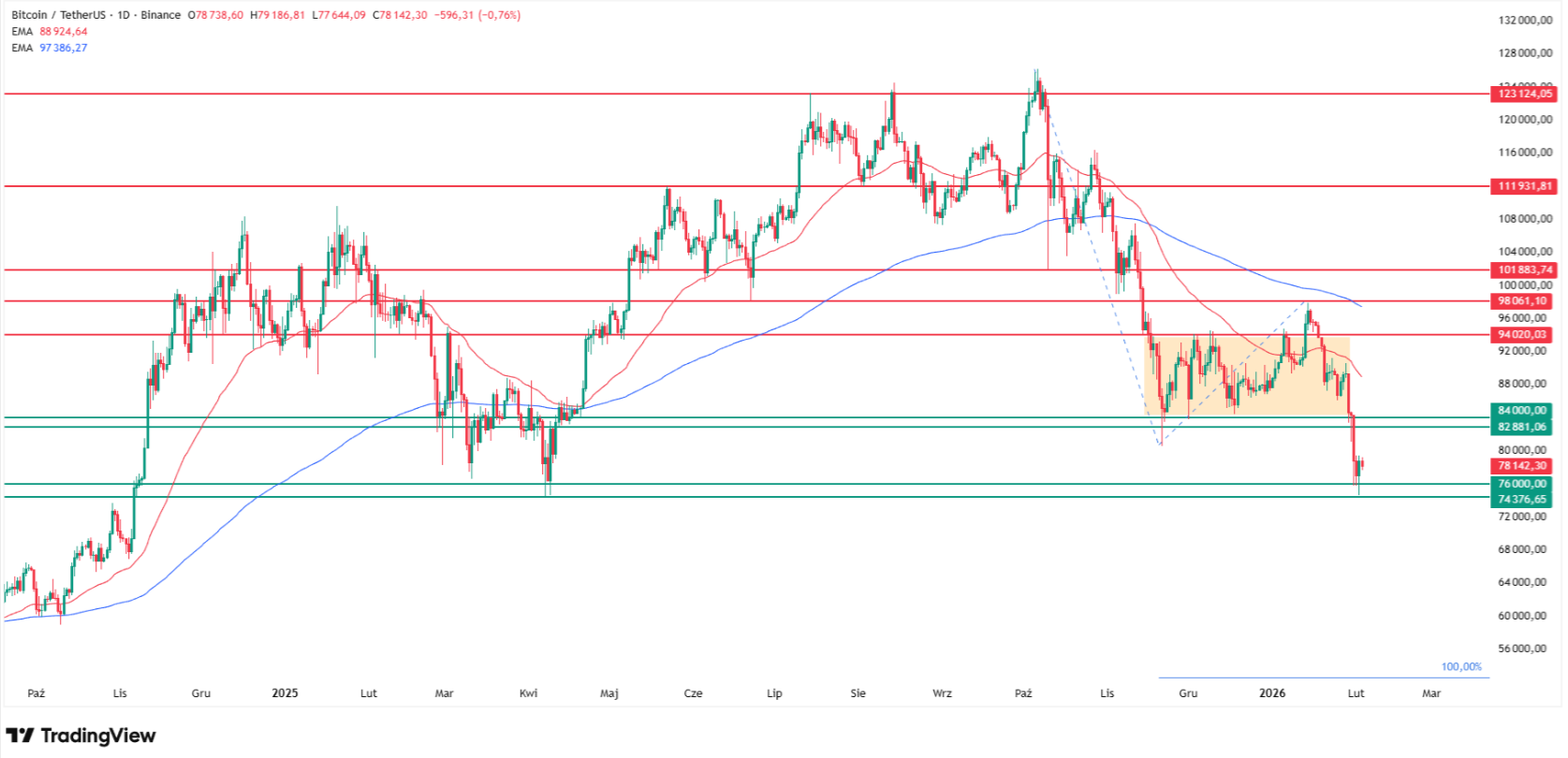
Bitcoin touched $74,420 this week and now positions for a potential return to all-time highs above $126,000.
The bullish path requires breaking $97,000 (200 EMA) to confirm a resumption of the uptrend.
Alternative bearish Bitcoin price predictions target $68,000 (200-week EMA) or ultra-bearish $53,000 (100% Fibonacci extension).
Let's check the newest Bitcoin price prediction. Will BTC fall this month?
Bitcoin price
(BTC) hit my $74,000 bearish target this week, exactly
as I predicted three months ago in November 2025. Now trading at $77,986 on
Tuesday, February 3, 2026, I'm accumulating at current levels for a potential
return to all-time highs.
The bullish
path requires breaking $97,000 to confirm the uptrend, but I'm also prepared
for alternative bearish scenarios targeting $68,000 or even $53,000 if key
support fails.
In this article, I am analyzing how high can Bitcoin
go after the latest correction and looking at BTC/USDT chart.
Bitcoin price technical analysis and my prediction of $74,000. Source: Tradingview.com
As I said
throughout those three months: from
this moment of reaching $74K, I assume the possibility of re-accumulation
and the return of strong hands to the game, which should push Bitcoin back
upward. That's exactly the phase we're entering now.
True to my
word, I've been executing purchases yesterday around $75,000 levels. Why
accumulate before confirmation of the uptrend? Because by the time we have
certainty about returning toward all-time highs, buying at attractive
prices may be too late.
Follow
me on X for more Bitcoin market analysis: @ChmielDk
The Bullish Case:
Step-by-Step Path to ATH
For Bitcoin
to return to its bullish trajectory and target new all-time highs, price must
navigate through several critical resistance levels. Here's my roadmap:
Step 1: Return to
Consolidation Range ($84-85K)
Bitcoin
must first reclaim the consolidation range established between November and
late January. This means moving above at least $84,000-85,000, which would
signal that buyers are regaining control.
Step 2: Break the 50 EMA
($89K)
The 50-day
exponential moving average currently sits around $89,000. Breaking above this
level confirms short-term momentum has shifted bullish and attracts technical
traders back into long positions.
Step 3: The Critical
Breakout ($97K)
This is
the line in the sand. The $97,000 level marks both the upper
boundary of the November-January consolidation and the 200-day moving average.
In my view, the 200 EMA separates uptrend from downtrend, it's the decisive
battleground.
Successfully
breaking $97,000 would accomplish two things simultaneously: escape the
months-long consolidation range and flip the 200 EMA from resistance to
support. Only then will we have real certainty that Bitcoin is returning toward
all-time highs above $126,000.
Joel
Kruger, crypto strategist at LMAX, sees early signs of this potential recovery:
"The crypto market has stabilized over the past 24 hours after a sharp
weekend selloff that pushed prices into meaningful longer-term technical
support. The ability to hold those key levels combined with improving intraday
momentum suggests we could be seeing signs of the start to a bigger
recovery."
Why Bitcoin Crashed So
Hard? Market Structure Breakdown
The descent
to $74,000 wasn't just about bearish technicals. Paul Howard, Director at
Wincent, explains the structural fragilities that amplified the selloff.
The real
issue emerges during stress: "Many market makers withdraw liquidity when
market conditions don't suit them and that's why we often see these big
gap downs." Howard spoke with three small-to-mid size market makers
last week, all of whom are looking to exit the space, yet they're currently
providing liquidity behind hundreds of projects.
The
situation worsens with "hundreds of second-tier venues with poorly or
undocumented liquidation mechanisms." Their weak credit worthiness means
legitimate liquidity providers won't post real liquidity there, creating a
vicious cycle during selloffs.
Technical Stabilization:
On-Chain Metrics Hold Firm
Despite the
price carnage, underlying fundamentals haven't deteriorated. Kruger emphasizes
this crucial point: "Importantly, there has been no material
deterioration in on-chain or flow-based indicators, keeping the medium-term
technical picture intact."
Current
technical readings show Bitcoin trading at $77,986, down 0.87% on the day but
holding well above the $74,420 yearly low. The 50-day moving average sits at
$88,955, while the 200-day moving average, my critical uptrend/downtrend
separator, rests at $97,000.
Bitcoin
remains 48% below its 200-day EMA, a significant deviation that
typically resolves either through sharp price recovery or extended
consolidation. My bet is on recovery, which is why I'm accumulating now.
If Bitcoin
fails to reclaim $84-85k and instead breaks below current levels, the next
major support appears around $68,000, where the 200-week
exponential moving average provides long-term trend support. At each such
descent, I plan to add to my positions.
Ultra-Bearish Target:
$53,000
My
long-term ultra-bearish scenario targets approximately $53,000,
which represents a 100% Fibonacci extension measured from the current trend and
aligns with the lowest levels from September 2024. This would represent a -32%
decline from current levels.
My Strategy: Flexible
Positioning
Here's
where I differ from many "hardcore holders": I don't forget the
possibility of profiting from declines. Being a structural bull waiting
for ATH return doesn't prohibit earning when the market moves down.
If my
$68,000 support gets broken, I'll open short positions targeting $53,000. If
that level also fails, I'll continue with shorts to $53,000 while
simultaneously preparing to accumulate for the long-term. This flexibility
allows me to profit in both directions while maintaining my conviction in
Bitcoin's eventual return to new highs.
The
coordinated risk-off move reflected Kevin Warsh's Fed Chair nomination,
geopolitical tensions with Iran, and structural liquidity issues that Paul
Howard described. Bitcoin's ability to hold $74,000 and recover to $78,000
while these headwinds persist actually reinforces my bullish conviction.
The beauty
of having a clear framework is that Bitcoin will tell us which scenario is
playing out. I don't need to guess, I just need to react appropriately at each
level.
Bitcoin Price Analysis,
FAQ
What is Bitcoin price
today?
Bitcoin is
trading at $77,986 on Tuesday, February 3, 2026, down 0.87% on the day after
hitting the author's predicted $74,420 target this week. The cryptocurrency is
attempting to stabilize after a sharp weekend selloff, holding above the yearly
low with improving intraday momentum according to LMAX strategist Joel Kruger.
How high can Bitcoin go?
Bitcoin's
path to new all-time highs above $126,000 requires breaking three key
resistance levels: $84-85k (consolidation range), $89k (50 EMA), and critically
$97k (200 EMA and consolidation top). Only a confirmed breakout above $97,000
would signal the return to uptrend and open the path toward ATH, according to
the author's technical framework.
How low can Bitcoin go?
I identify
two bearish scenarios: Support Level 1 at $68,000 (200-week EMA) and an
ultra-bearish target at $53,000 (100% Fibonacci extension from current trend,
aligned with September 2024 lows), representing a potential 32% decline from
current $77,986 levels. However, on-chain metrics show "no material
deterioration" according to LMAX's Joel Kruger, keeping the medium-term
picture intact.
Is Bitcoin a buy now?
Yes. I am actively
accumulating at current $78k levels following his successful $74k target
prediction from November 2025.
Bitcoin price
(BTC) hit my $74,000 bearish target this week, exactly
as I predicted three months ago in November 2025. Now trading at $77,986 on
Tuesday, February 3, 2026, I'm accumulating at current levels for a potential
return to all-time highs.
The bullish
path requires breaking $97,000 to confirm the uptrend, but I'm also prepared
for alternative bearish scenarios targeting $68,000 or even $53,000 if key
support fails.
In this article, I am analyzing how high can Bitcoin
go after the latest correction and looking at BTC/USDT chart.
Bitcoin price technical analysis and my prediction of $74,000. Source: Tradingview.com
As I said
throughout those three months: from
this moment of reaching $74K, I assume the possibility of re-accumulation
and the return of strong hands to the game, which should push Bitcoin back
upward. That's exactly the phase we're entering now.
True to my
word, I've been executing purchases yesterday around $75,000 levels. Why
accumulate before confirmation of the uptrend? Because by the time we have
certainty about returning toward all-time highs, buying at attractive
prices may be too late.
Follow
me on X for more Bitcoin market analysis: @ChmielDk
The Bullish Case:
Step-by-Step Path to ATH
For Bitcoin
to return to its bullish trajectory and target new all-time highs, price must
navigate through several critical resistance levels. Here's my roadmap:
Step 1: Return to
Consolidation Range ($84-85K)
Bitcoin
must first reclaim the consolidation range established between November and
late January. This means moving above at least $84,000-85,000, which would
signal that buyers are regaining control.
Step 2: Break the 50 EMA
($89K)
The 50-day
exponential moving average currently sits around $89,000. Breaking above this
level confirms short-term momentum has shifted bullish and attracts technical
traders back into long positions.
Step 3: The Critical
Breakout ($97K)
This is
the line in the sand. The $97,000 level marks both the upper
boundary of the November-January consolidation and the 200-day moving average.
In my view, the 200 EMA separates uptrend from downtrend, it's the decisive
battleground.
Successfully
breaking $97,000 would accomplish two things simultaneously: escape the
months-long consolidation range and flip the 200 EMA from resistance to
support. Only then will we have real certainty that Bitcoin is returning toward
all-time highs above $126,000.
Joel
Kruger, crypto strategist at LMAX, sees early signs of this potential recovery:
"The crypto market has stabilized over the past 24 hours after a sharp
weekend selloff that pushed prices into meaningful longer-term technical
support. The ability to hold those key levels combined with improving intraday
momentum suggests we could be seeing signs of the start to a bigger
recovery."
Why Bitcoin Crashed So
Hard? Market Structure Breakdown
The descent
to $74,000 wasn't just about bearish technicals. Paul Howard, Director at
Wincent, explains the structural fragilities that amplified the selloff.
The real
issue emerges during stress: "Many market makers withdraw liquidity when
market conditions don't suit them and that's why we often see these big
gap downs." Howard spoke with three small-to-mid size market makers
last week, all of whom are looking to exit the space, yet they're currently
providing liquidity behind hundreds of projects.
The
situation worsens with "hundreds of second-tier venues with poorly or
undocumented liquidation mechanisms." Their weak credit worthiness means
legitimate liquidity providers won't post real liquidity there, creating a
vicious cycle during selloffs.
Technical Stabilization:
On-Chain Metrics Hold Firm
Despite the
price carnage, underlying fundamentals haven't deteriorated. Kruger emphasizes
this crucial point: "Importantly, there has been no material
deterioration in on-chain or flow-based indicators, keeping the medium-term
technical picture intact."
Current
technical readings show Bitcoin trading at $77,986, down 0.87% on the day but
holding well above the $74,420 yearly low. The 50-day moving average sits at
$88,955, while the 200-day moving average, my critical uptrend/downtrend
separator, rests at $97,000.
Bitcoin
remains 48% below its 200-day EMA, a significant deviation that
typically resolves either through sharp price recovery or extended
consolidation. My bet is on recovery, which is why I'm accumulating now.
If Bitcoin
fails to reclaim $84-85k and instead breaks below current levels, the next
major support appears around $68,000, where the 200-week
exponential moving average provides long-term trend support. At each such
descent, I plan to add to my positions.
Ultra-Bearish Target:
$53,000
My
long-term ultra-bearish scenario targets approximately $53,000,
which represents a 100% Fibonacci extension measured from the current trend and
aligns with the lowest levels from September 2024. This would represent a -32%
decline from current levels.
My Strategy: Flexible
Positioning
Here's
where I differ from many "hardcore holders": I don't forget the
possibility of profiting from declines. Being a structural bull waiting
for ATH return doesn't prohibit earning when the market moves down.
If my
$68,000 support gets broken, I'll open short positions targeting $53,000. If
that level also fails, I'll continue with shorts to $53,000 while
simultaneously preparing to accumulate for the long-term. This flexibility
allows me to profit in both directions while maintaining my conviction in
Bitcoin's eventual return to new highs.
The
coordinated risk-off move reflected Kevin Warsh's Fed Chair nomination,
geopolitical tensions with Iran, and structural liquidity issues that Paul
Howard described. Bitcoin's ability to hold $74,000 and recover to $78,000
while these headwinds persist actually reinforces my bullish conviction.
The beauty
of having a clear framework is that Bitcoin will tell us which scenario is
playing out. I don't need to guess, I just need to react appropriately at each
level.
Bitcoin Price Analysis,
FAQ
What is Bitcoin price
today?
Bitcoin is
trading at $77,986 on Tuesday, February 3, 2026, down 0.87% on the day after
hitting the author's predicted $74,420 target this week. The cryptocurrency is
attempting to stabilize after a sharp weekend selloff, holding above the yearly
low with improving intraday momentum according to LMAX strategist Joel Kruger.
How high can Bitcoin go?
Bitcoin's
path to new all-time highs above $126,000 requires breaking three key
resistance levels: $84-85k (consolidation range), $89k (50 EMA), and critically
$97k (200 EMA and consolidation top). Only a confirmed breakout above $97,000
would signal the return to uptrend and open the path toward ATH, according to
the author's technical framework.
How low can Bitcoin go?
I identify
two bearish scenarios: Support Level 1 at $68,000 (200-week EMA) and an
ultra-bearish target at $53,000 (100% Fibonacci extension from current trend,
aligned with September 2024 lows), representing a potential 32% decline from
current $77,986 levels. However, on-chain metrics show "no material
deterioration" according to LMAX's Joel Kruger, keeping the medium-term
picture intact.
Is Bitcoin a buy now?
Yes. I am actively
accumulating at current $78k levels following his successful $74k target
prediction from November 2025.
Damian Chmiel is a Senior Analyst & Editor at Finance Magnates with more than 15 years of experience in the CFD and online trading industry. Active as both a trader and journalist since 2010, he focuses on broker coverage, fintech innovation, and regulatory developments across Europe, the Middle East, and Asia.
His work includes interviews with C-level leaders at major brokerages and fintech platforms, as well as co-authoring Finance Magnates’ quarterly industry benchmarking reports. Damian’s reporting is data-driven, market-aware, and grounded in direct industry engagement. His analysis and commentary have also been cited by external media outlets, including Investing.com, Binance, The Asset, Stockhead, and Dispatch.
Education:
MA in Finance and Accounting, Cracow University of Economics
Why Is Dogecoin Going Up Today? DOGE Price Prediction Shows 25% Upside Potential
Featured Videos
XTB Adds Overnight US Stock Trading; Nasdaq Ventures Invests in One Trading
XTB Adds Overnight US Stock Trading; Nasdaq Ventures Invests in One Trading
XTB Adds Overnight US Stock Trading; Nasdaq Ventures Invests in One Trading
XTB Adds Overnight US Stock Trading; Nasdaq Ventures Invests in One Trading
Today’s financial news recap covers XTB expands overnight US stock trading, Fortrade reports higher revenue, Nasdaq backs One Trading, and Vest Labs raises 13 million dollars.
Finance Magnates Daily Recap brings you the latest news from forex and CFD brokers, fintech, payments, cryptocurrency, digital assets, trading platforms, financial regulation and global markets.
Get the key company news, executive moves, deals, regulatory updates and market developments of the day, in just a few minutes. New episodes published every weekday.
Read more: https://www.financemagnates.com
#FinanceMagnates #ForexNews #FintechNews
Today’s financial news recap covers XTB expands overnight US stock trading, Fortrade reports higher revenue, Nasdaq backs One Trading, and Vest Labs raises 13 million dollars.
Finance Magnates Daily Recap brings you the latest news from forex and CFD brokers, fintech, payments, cryptocurrency, digital assets, trading platforms, financial regulation and global markets.
Get the key company news, executive moves, deals, regulatory updates and market developments of the day, in just a few minutes. New episodes published every weekday.
Read more: https://www.financemagnates.com
#FinanceMagnates #ForexNews #FintechNews
Today’s financial news recap covers XTB expands overnight US stock trading, Fortrade reports higher revenue, Nasdaq backs One Trading, and Vest Labs raises 13 million dollars.
Finance Magnates Daily Recap brings you the latest news from forex and CFD brokers, fintech, payments, cryptocurrency, digital assets, trading platforms, financial regulation and global markets.
Get the key company news, executive moves, deals, regulatory updates and market developments of the day, in just a few minutes. New episodes published every weekday.
Read more: https://www.financemagnates.com
#FinanceMagnates #ForexNews #FintechNews
Today’s financial news recap covers XTB expands overnight US stock trading, Fortrade reports higher revenue, Nasdaq backs One Trading, and Vest Labs raises 13 million dollars.
Finance Magnates Daily Recap brings you the latest news from forex and CFD brokers, fintech, payments, cryptocurrency, digital assets, trading platforms, financial regulation and global markets.
Get the key company news, executive moves, deals, regulatory updates and market developments of the day, in just a few minutes. New episodes published every weekday.
Read more: https://www.financemagnates.com
#FinanceMagnates #ForexNews #FintechNews
CMC Founder Downplays Volatility Hit; Devexperts Names CEO
CMC Founder Downplays Volatility Hit; Devexperts Names CEO
CMC Founder Downplays Volatility Hit; Devexperts Names CEO
CMC Founder Downplays Volatility Hit; Devexperts Names CEO
CMC Founder Downplays Volatility Hit; Devexperts Names CEO
CMC Founder Downplays Volatility Hit; Devexperts Names CEO
Today’s financial news recap covers low volatility pressures brokers, Devexperts names a new CEO, Saxo cuts onboarding time, and OKX reaches a 25 billion dollar valuation.
Finance Magnates Daily Recap brings you the latest news from forex and CFD brokers, fintech, payments, cryptocurrency, digital assets, trading platforms, financial regulation and global markets.
Get the key company news, executive moves, deals, regulatory updates and market developments of the day, in just a few minutes. New episodes published every weekday.
Read more: https://www.financemagnates.com
#FinanceMagnates #ForexNews #FintechNews
Today’s financial news recap covers low volatility pressures brokers, Devexperts names a new CEO, Saxo cuts onboarding time, and OKX reaches a 25 billion dollar valuation.
Finance Magnates Daily Recap brings you the latest news from forex and CFD brokers, fintech, payments, cryptocurrency, digital assets, trading platforms, financial regulation and global markets.
Get the key company news, executive moves, deals, regulatory updates and market developments of the day, in just a few minutes. New episodes published every weekday.
Read more: https://www.financemagnates.com
#FinanceMagnates #ForexNews #FintechNews
Today’s financial news recap covers low volatility pressures brokers, Devexperts names a new CEO, Saxo cuts onboarding time, and OKX reaches a 25 billion dollar valuation.
Finance Magnates Daily Recap brings you the latest news from forex and CFD brokers, fintech, payments, cryptocurrency, digital assets, trading platforms, financial regulation and global markets.
Get the key company news, executive moves, deals, regulatory updates and market developments of the day, in just a few minutes. New episodes published every weekday.
Read more: https://www.financemagnates.com
#FinanceMagnates #ForexNews #FintechNews
Today’s financial news recap covers low volatility pressures brokers, Devexperts names a new CEO, Saxo cuts onboarding time, and OKX reaches a 25 billion dollar valuation.
Finance Magnates Daily Recap brings you the latest news from forex and CFD brokers, fintech, payments, cryptocurrency, digital assets, trading platforms, financial regulation and global markets.
Get the key company news, executive moves, deals, regulatory updates and market developments of the day, in just a few minutes. New episodes published every weekday.
Read more: https://www.financemagnates.com
#FinanceMagnates #ForexNews #FintechNews
Today’s financial news recap covers low volatility pressures brokers, Devexperts names a new CEO, Saxo cuts onboarding time, and OKX reaches a 25 billion dollar valuation.
Finance Magnates Daily Recap brings you the latest news from forex and CFD brokers, fintech, payments, cryptocurrency, digital assets, trading platforms, financial regulation and global markets.
Get the key company news, executive moves, deals, regulatory updates and market developments of the day, in just a few minutes. New episodes published every weekday.
Read more: https://www.financemagnates.com
#FinanceMagnates #ForexNews #FintechNews
Today’s financial news recap covers low volatility pressures brokers, Devexperts names a new CEO, Saxo cuts onboarding time, and OKX reaches a 25 billion dollar valuation.
Finance Magnates Daily Recap brings you the latest news from forex and CFD brokers, fintech, payments, cryptocurrency, digital assets, trading platforms, financial regulation and global markets.
Get the key company news, executive moves, deals, regulatory updates and market developments of the day, in just a few minutes. New episodes published every weekday.
Read more: https://www.financemagnates.com
#FinanceMagnates #ForexNews #FintechNews
Today’s financial news recap covers Trade Nation buys FXCM's UK client book, Trading 212 reports higher revenue, the CFTC's move to allow perpetual index futures.
Finance Magnates Daily Recap brings you the latest news from forex and CFD brokers, fintech, payments, cryptocurrency, digital assets, trading platforms, financial regulation and global markets.
Get the key company news, executive moves, deals, regulatory updates and market developments of the day, in just a few minutes. New episodes published every weekday.
Read more: https://www.financemagnates.com
#FinanceMagnates #ForexNews #FintechNews
Today’s financial news recap covers Trade Nation buys FXCM's UK client book, Trading 212 reports higher revenue, the CFTC's move to allow perpetual index futures.
Finance Magnates Daily Recap brings you the latest news from forex and CFD brokers, fintech, payments, cryptocurrency, digital assets, trading platforms, financial regulation and global markets.
Get the key company news, executive moves, deals, regulatory updates and market developments of the day, in just a few minutes. New episodes published every weekday.
Read more: https://www.financemagnates.com
#FinanceMagnates #ForexNews #FintechNews
Today’s financial news recap covers Trade Nation buys FXCM's UK client book, Trading 212 reports higher revenue, the CFTC's move to allow perpetual index futures.
Finance Magnates Daily Recap brings you the latest news from forex and CFD brokers, fintech, payments, cryptocurrency, digital assets, trading platforms, financial regulation and global markets.
Get the key company news, executive moves, deals, regulatory updates and market developments of the day, in just a few minutes. New episodes published every weekday.
Read more: https://www.financemagnates.com
#FinanceMagnates #ForexNews #FintechNews
Today’s financial news recap covers Trade Nation buys FXCM's UK client book, Trading 212 reports higher revenue, the CFTC's move to allow perpetual index futures.
Finance Magnates Daily Recap brings you the latest news from forex and CFD brokers, fintech, payments, cryptocurrency, digital assets, trading platforms, financial regulation and global markets.
Get the key company news, executive moves, deals, regulatory updates and market developments of the day, in just a few minutes. New episodes published every weekday.
Read more: https://www.financemagnates.com
#FinanceMagnates #ForexNews #FintechNews
Today’s financial news recap covers Trade Nation buys FXCM's UK client book, Trading 212 reports higher revenue, the CFTC's move to allow perpetual index futures.
Finance Magnates Daily Recap brings you the latest news from forex and CFD brokers, fintech, payments, cryptocurrency, digital assets, trading platforms, financial regulation and global markets.
Get the key company news, executive moves, deals, regulatory updates and market developments of the day, in just a few minutes. New episodes published every weekday.
Read more: https://www.financemagnates.com
#FinanceMagnates #ForexNews #FintechNews
Today’s financial news recap covers Trade Nation buys FXCM's UK client book, Trading 212 reports higher revenue, the CFTC's move to allow perpetual index futures.
Finance Magnates Daily Recap brings you the latest news from forex and CFD brokers, fintech, payments, cryptocurrency, digital assets, trading platforms, financial regulation and global markets.
Get the key company news, executive moves, deals, regulatory updates and market developments of the day, in just a few minutes. New episodes published every weekday.
Read more: https://www.financemagnates.com
#FinanceMagnates #ForexNews #FintechNews
Your career isn’t a linear path.
Your career isn’t a linear path.
Your career isn’t a linear path.
Your career isn’t a linear path.
Your career isn’t a linear path.
Your career isn’t a linear path.
Roles change. Career goals change. Sometimes you want a completely new challenge.
But the skills and knowledge you build along the way can stay with you and give you something to build on.
For Jeff Patterson, that continued growth is key to long-term career development.
You bring the skills. FM Academy helps you build the knowledge.
#FMAcademy #FinanceMagnates #FinanceCareers #ProfessionalDevelopment #Fintech
Roles change. Career goals change. Sometimes you want a completely new challenge.
But the skills and knowledge you build along the way can stay with you and give you something to build on.
For Jeff Patterson, that continued growth is key to long-term career development.
You bring the skills. FM Academy helps you build the knowledge.
#FMAcademy #FinanceMagnates #FinanceCareers #ProfessionalDevelopment #Fintech
Roles change. Career goals change. Sometimes you want a completely new challenge.
But the skills and knowledge you build along the way can stay with you and give you something to build on.
For Jeff Patterson, that continued growth is key to long-term career development.
You bring the skills. FM Academy helps you build the knowledge.
#FMAcademy #FinanceMagnates #FinanceCareers #ProfessionalDevelopment #Fintech
Roles change. Career goals change. Sometimes you want a completely new challenge.
But the skills and knowledge you build along the way can stay with you and give you something to build on.
For Jeff Patterson, that continued growth is key to long-term career development.
You bring the skills. FM Academy helps you build the knowledge.
#FMAcademy #FinanceMagnates #FinanceCareers #ProfessionalDevelopment #Fintech
Roles change. Career goals change. Sometimes you want a completely new challenge.
But the skills and knowledge you build along the way can stay with you and give you something to build on.
For Jeff Patterson, that continued growth is key to long-term career development.
You bring the skills. FM Academy helps you build the knowledge.
#FMAcademy #FinanceMagnates #FinanceCareers #ProfessionalDevelopment #Fintech
Roles change. Career goals change. Sometimes you want a completely new challenge.
But the skills and knowledge you build along the way can stay with you and give you something to build on.
For Jeff Patterson, that continued growth is key to long-term career development.
You bring the skills. FM Academy helps you build the knowledge.
#FMAcademy #FinanceMagnates #FinanceCareers #ProfessionalDevelopment #Fintech
IG Group Tech Chiefs Exit; Pepperstone Revenue Grows
IG Group Tech Chiefs Exit; Pepperstone Revenue Grows
IG Group Tech Chiefs Exit; Pepperstone Revenue Grows
IG Group Tech Chiefs Exit; Pepperstone Revenue Grows
IG Group Tech Chiefs Exit; Pepperstone Revenue Grows
IG Group Tech Chiefs Exit; Pepperstone Revenue Grows
Today’s financial news recap covers IG Group loses two technology chiefs, Pepperstone reports double-digit growth, and eToro backs a euro stablecoin.
Finance Magnates Daily Recap brings you the latest news from forex and CFD brokers, fintech, payments, cryptocurrency, digital assets, trading platforms, financial regulation and global markets.
Get the key company news, executive moves, deals, regulatory updates and market developments of the day, in just a few minutes. New episodes published every weekday.
Read more: https://www.financemagnates.com
#FinanceMagnates #ForexNews #FintechNews
Today’s financial news recap covers IG Group loses two technology chiefs, Pepperstone reports double-digit growth, and eToro backs a euro stablecoin.
Finance Magnates Daily Recap brings you the latest news from forex and CFD brokers, fintech, payments, cryptocurrency, digital assets, trading platforms, financial regulation and global markets.
Get the key company news, executive moves, deals, regulatory updates and market developments of the day, in just a few minutes. New episodes published every weekday.
Read more: https://www.financemagnates.com
#FinanceMagnates #ForexNews #FintechNews
Today’s financial news recap covers IG Group loses two technology chiefs, Pepperstone reports double-digit growth, and eToro backs a euro stablecoin.
Finance Magnates Daily Recap brings you the latest news from forex and CFD brokers, fintech, payments, cryptocurrency, digital assets, trading platforms, financial regulation and global markets.
Get the key company news, executive moves, deals, regulatory updates and market developments of the day, in just a few minutes. New episodes published every weekday.
Read more: https://www.financemagnates.com
#FinanceMagnates #ForexNews #FintechNews
Today’s financial news recap covers IG Group loses two technology chiefs, Pepperstone reports double-digit growth, and eToro backs a euro stablecoin.
Finance Magnates Daily Recap brings you the latest news from forex and CFD brokers, fintech, payments, cryptocurrency, digital assets, trading platforms, financial regulation and global markets.
Get the key company news, executive moves, deals, regulatory updates and market developments of the day, in just a few minutes. New episodes published every weekday.
Read more: https://www.financemagnates.com
#FinanceMagnates #ForexNews #FintechNews
Today’s financial news recap covers IG Group loses two technology chiefs, Pepperstone reports double-digit growth, and eToro backs a euro stablecoin.
Finance Magnates Daily Recap brings you the latest news from forex and CFD brokers, fintech, payments, cryptocurrency, digital assets, trading platforms, financial regulation and global markets.
Get the key company news, executive moves, deals, regulatory updates and market developments of the day, in just a few minutes. New episodes published every weekday.
Read more: https://www.financemagnates.com
#FinanceMagnates #ForexNews #FintechNews
Today’s financial news recap covers IG Group loses two technology chiefs, Pepperstone reports double-digit growth, and eToro backs a euro stablecoin.
Finance Magnates Daily Recap brings you the latest news from forex and CFD brokers, fintech, payments, cryptocurrency, digital assets, trading platforms, financial regulation and global markets.
Get the key company news, executive moves, deals, regulatory updates and market developments of the day, in just a few minutes. New episodes published every weekday.
Read more: https://www.financemagnates.com
#FinanceMagnates #ForexNews #FintechNews