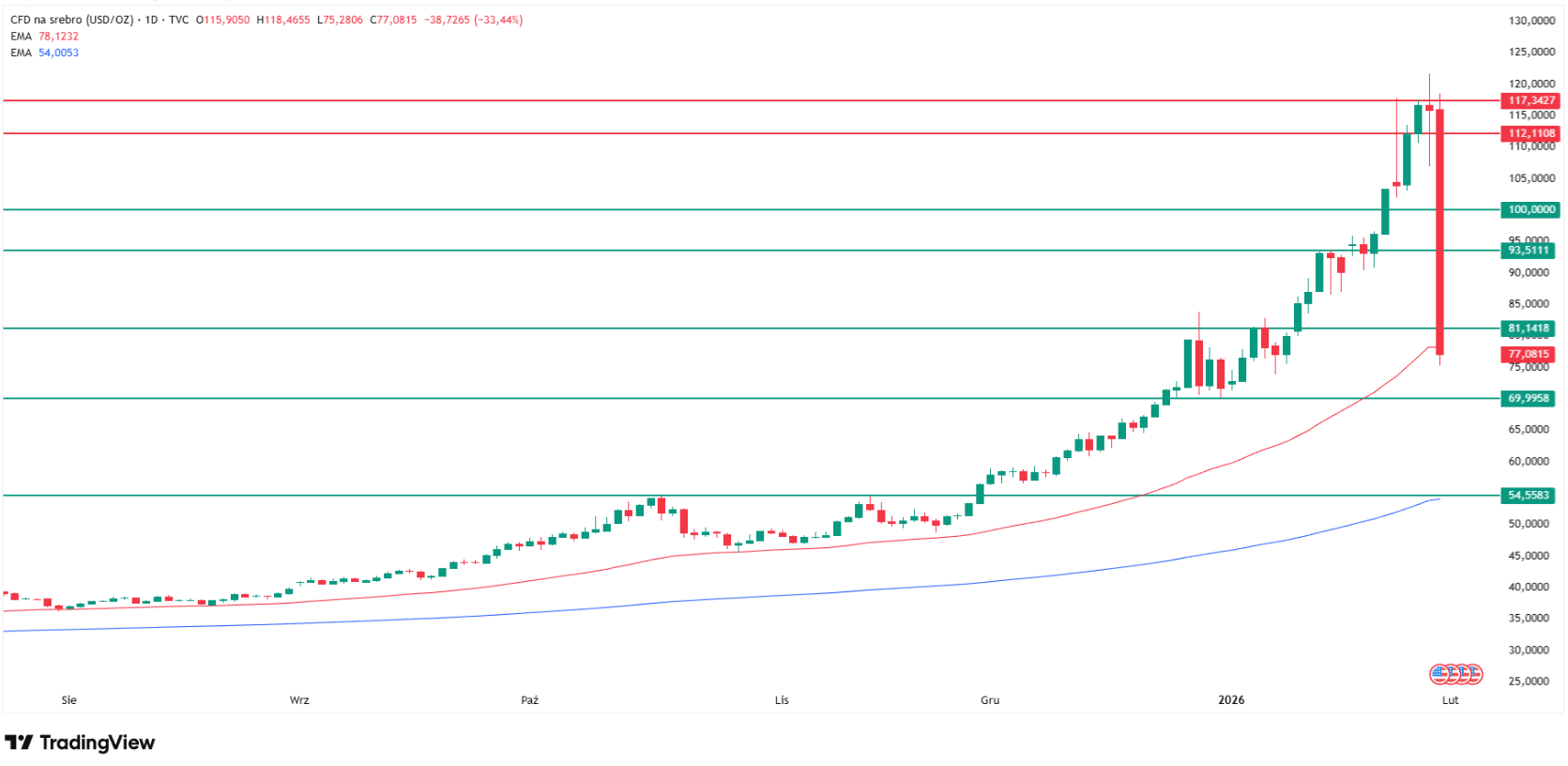
Silver price crashed 33% from $121 to $76 on January 30, 2026, in one of the most violent precious metals selloffs in history.
Reuters exclusive about ending US strategic metals support triggered algorithmic panic selling that forced mass liquidations.
Why silver price is going down today and what are the newest silver price forecasts?
Silver
crashed nearly 33% in a single trading session on January 30,
2026, plunging from above $121 per ounce to $76. This marks one of the most
violent selloffs in precious metals history, wiping out weeks of gains in just
48 hours.
The crash
was triggered by a perfect storm of hawkish Fed nomination
news, aggressive dollar strength, and cascading forced liquidations across
commodity markets.
What Triggered the Silver Price
Massacre?
"The
precious metals market turned into a slaughterhouse when, in just 48 hours,
silver crashed from historic peaks above $121 to $76, posting a nearly 33%
decline," said Max Bączkowski, independent analyst and trader in comments
to FinanceMagnates.com.
He
attributed the collapse to Kevin Warsh's Fed nomination, the resulting
dollar rally, and mass forced liquidations triggered by unclear Reuters
communication about market conditions.
President
Trump announced Friday morning his intention to nominate Kevin Warsh as
the next Federal Reserve chair, a candidate markets perceive as
significantly more hawkish than alternatives. This nomination sent shockwaves
through precious metals markets. Warsh, a former Fed governor, is viewed as
less dovish on monetary policy, which immediately strengthened the US dollar
and pressured dollar-denominated commodities like silver.
The Bloomberg
Dollar Spot Index rallied 0.4% on the news, gaining against all major
peers. Since silver trades inversely to dollar strength, this currency move
amplified selling pressure. Treasury yields also jumped, 10-year rates climbed
three basis points while 30-year yields surged five basis points, making
non-yielding assets like silver less attractive.
Forced Liquidations
Created Market Chaos
Reuters
published an "Exclusive" report citing anonymous sources claiming the
end of US government support for strategic metals, triggering algorithmic
trading systems to immediately dump positions.
"Trading
algorithms, programmed to detect negative signals from key agencies, began
selling in a fraction of a second," Bączkowski explained, noting that
capital fled from commodities to the dollar before anyone could verify the
story's fragile
The entire Reuters article that crashed the rare earth market has been rewritten, and it turns out the "reporting" that sparked the selling was fake news https://t.co/mYgEeguYkg
The Energy
Department told
Reuters in a statement after the story was published that the article was
“false and relies on unnamed sources that are either misinformed or
deliberately misleading.”
The selloff
didn't spare other precious metals. Gold tumbled 10% to below
$4,700 per ounce after reaching record highs above $5,100 earlier in the week.
Platinum and palladium also collapsed, creating what Bączkowski called an
"abyss" that swallowed the entire precious metals complex.
In my
earlier article published today, I
noted silver was down about 17%, but by day's end, losses had doubled
to over 32%. The white metal crashed from $115 to below $78, eventually
stabilizing near the 50-day exponential moving average (50 EMA) and
a critical support zone at $70.81 per ounce.
This
support level coincides with historical peaks from the turn of
2025/2026, creating a strong technical floor. If silver holds this area through
the weekend and allows markets to calm, I'd expect a demand response
rather than supply pressure next week.
Even if
selling continues, silver has substantial support ahead, most importantly
at $55 per ounce, which aligns with the 200-day exponential moving
average (200 EMA).
Despite the
brutal one-day move, silver's long-term fundamentals remain intact.
Supply deficits continue as industrial demand, particularly from solar panels
and electric vehicles, hits record levels. Geopolitical uncertainties that
drove the initial rally haven't disappeared; they've simply been overwhelmed by
short-term dollar dynamics.
The 200
EMA at $55 represents the ultimate line in the sand for bulls. A close
above $80 would suggest the worst is over and buyers are returning. Conversely,
a break below $70 could trigger another leg down toward that 200-day average,
though physical market tightness may limit downside.
Kevin
Warsh's hawkish Fed chair nomination strengthened the dollar and triggered
forced liquidations across precious metals markets.
Where is silver finding
support?
Silver
stabilized at the 50 EMA near $70.81, with major support at the 200 EMA around
$55 per ounce.
Is this a buying
opportunity?
Yes. If
silver holds above $70 through the weekend, technical analysis suggests
potential for a demand response next week, though volatility remains elevated.
Will silver ever go up
again?
Technical
analysis suggests silver found strong support at the 50-day exponential moving
average near $70.81, which coincides with historical peaks from late 2025. If
this level holds through the weekend, a demand response is likely next week.
Silver
crashed nearly 33% in a single trading session on January 30,
2026, plunging from above $121 per ounce to $76. This marks one of the most
violent selloffs in precious metals history, wiping out weeks of gains in just
48 hours.
The crash
was triggered by a perfect storm of hawkish Fed nomination
news, aggressive dollar strength, and cascading forced liquidations across
commodity markets.
What Triggered the Silver Price
Massacre?
"The
precious metals market turned into a slaughterhouse when, in just 48 hours,
silver crashed from historic peaks above $121 to $76, posting a nearly 33%
decline," said Max Bączkowski, independent analyst and trader in comments
to FinanceMagnates.com.
He
attributed the collapse to Kevin Warsh's Fed nomination, the resulting
dollar rally, and mass forced liquidations triggered by unclear Reuters
communication about market conditions.
President
Trump announced Friday morning his intention to nominate Kevin Warsh as
the next Federal Reserve chair, a candidate markets perceive as
significantly more hawkish than alternatives. This nomination sent shockwaves
through precious metals markets. Warsh, a former Fed governor, is viewed as
less dovish on monetary policy, which immediately strengthened the US dollar
and pressured dollar-denominated commodities like silver.
The Bloomberg
Dollar Spot Index rallied 0.4% on the news, gaining against all major
peers. Since silver trades inversely to dollar strength, this currency move
amplified selling pressure. Treasury yields also jumped, 10-year rates climbed
three basis points while 30-year yields surged five basis points, making
non-yielding assets like silver less attractive.
Forced Liquidations
Created Market Chaos
Reuters
published an "Exclusive" report citing anonymous sources claiming the
end of US government support for strategic metals, triggering algorithmic
trading systems to immediately dump positions.
"Trading
algorithms, programmed to detect negative signals from key agencies, began
selling in a fraction of a second," Bączkowski explained, noting that
capital fled from commodities to the dollar before anyone could verify the
story's fragile
The entire Reuters article that crashed the rare earth market has been rewritten, and it turns out the "reporting" that sparked the selling was fake news https://t.co/mYgEeguYkg
The Energy
Department told
Reuters in a statement after the story was published that the article was
“false and relies on unnamed sources that are either misinformed or
deliberately misleading.”
The selloff
didn't spare other precious metals. Gold tumbled 10% to below
$4,700 per ounce after reaching record highs above $5,100 earlier in the week.
Platinum and palladium also collapsed, creating what Bączkowski called an
"abyss" that swallowed the entire precious metals complex.
In my
earlier article published today, I
noted silver was down about 17%, but by day's end, losses had doubled
to over 32%. The white metal crashed from $115 to below $78, eventually
stabilizing near the 50-day exponential moving average (50 EMA) and
a critical support zone at $70.81 per ounce.
This
support level coincides with historical peaks from the turn of
2025/2026, creating a strong technical floor. If silver holds this area through
the weekend and allows markets to calm, I'd expect a demand response
rather than supply pressure next week.
Even if
selling continues, silver has substantial support ahead, most importantly
at $55 per ounce, which aligns with the 200-day exponential moving
average (200 EMA).
Despite the
brutal one-day move, silver's long-term fundamentals remain intact.
Supply deficits continue as industrial demand, particularly from solar panels
and electric vehicles, hits record levels. Geopolitical uncertainties that
drove the initial rally haven't disappeared; they've simply been overwhelmed by
short-term dollar dynamics.
The 200
EMA at $55 represents the ultimate line in the sand for bulls. A close
above $80 would suggest the worst is over and buyers are returning. Conversely,
a break below $70 could trigger another leg down toward that 200-day average,
though physical market tightness may limit downside.
Kevin
Warsh's hawkish Fed chair nomination strengthened the dollar and triggered
forced liquidations across precious metals markets.
Where is silver finding
support?
Silver
stabilized at the 50 EMA near $70.81, with major support at the 200 EMA around
$55 per ounce.
Is this a buying
opportunity?
Yes. If
silver holds above $70 through the weekend, technical analysis suggests
potential for a demand response next week, though volatility remains elevated.
Will silver ever go up
again?
Technical
analysis suggests silver found strong support at the 50-day exponential moving
average near $70.81, which coincides with historical peaks from late 2025. If
this level holds through the weekend, a demand response is likely next week.
Damian Chmiel is a Senior Analyst & Editor at Finance Magnates with more than 15 years of experience in the CFD and online trading industry. Active as both a trader and journalist since 2010, he focuses on broker coverage, fintech innovation, and regulatory developments across Europe, the Middle East, and Asia.
His work includes interviews with C-level leaders at major brokerages and fintech platforms, as well as co-authoring Finance Magnates’ quarterly industry benchmarking reports. Damian’s reporting is data-driven, market-aware, and grounded in direct industry engagement. His analysis and commentary have also been cited by external media outlets, including Investing.com, Binance, The Asset, Stockhead, and Dispatch.
Education:
MA in Finance and Accounting, Cracow University of Economics
Why Is Dogecoin Going Up Today? DOGE Price Prediction Shows 25% Upside Potential
Featured Videos
XTB Adds Overnight US Stock Trading; Nasdaq Ventures Invests in One Trading
XTB Adds Overnight US Stock Trading; Nasdaq Ventures Invests in One Trading
XTB Adds Overnight US Stock Trading; Nasdaq Ventures Invests in One Trading
XTB Adds Overnight US Stock Trading; Nasdaq Ventures Invests in One Trading
Today’s financial news recap covers XTB expands overnight US stock trading, Fortrade reports higher revenue, Nasdaq backs One Trading, and Vest Labs raises 13 million dollars.
Finance Magnates Daily Recap brings you the latest news from forex and CFD brokers, fintech, payments, cryptocurrency, digital assets, trading platforms, financial regulation and global markets.
Get the key company news, executive moves, deals, regulatory updates and market developments of the day, in just a few minutes. New episodes published every weekday.
Read more: https://www.financemagnates.com
#FinanceMagnates #ForexNews #FintechNews
Today’s financial news recap covers XTB expands overnight US stock trading, Fortrade reports higher revenue, Nasdaq backs One Trading, and Vest Labs raises 13 million dollars.
Finance Magnates Daily Recap brings you the latest news from forex and CFD brokers, fintech, payments, cryptocurrency, digital assets, trading platforms, financial regulation and global markets.
Get the key company news, executive moves, deals, regulatory updates and market developments of the day, in just a few minutes. New episodes published every weekday.
Read more: https://www.financemagnates.com
#FinanceMagnates #ForexNews #FintechNews
Today’s financial news recap covers XTB expands overnight US stock trading, Fortrade reports higher revenue, Nasdaq backs One Trading, and Vest Labs raises 13 million dollars.
Finance Magnates Daily Recap brings you the latest news from forex and CFD brokers, fintech, payments, cryptocurrency, digital assets, trading platforms, financial regulation and global markets.
Get the key company news, executive moves, deals, regulatory updates and market developments of the day, in just a few minutes. New episodes published every weekday.
Read more: https://www.financemagnates.com
#FinanceMagnates #ForexNews #FintechNews
Today’s financial news recap covers XTB expands overnight US stock trading, Fortrade reports higher revenue, Nasdaq backs One Trading, and Vest Labs raises 13 million dollars.
Finance Magnates Daily Recap brings you the latest news from forex and CFD brokers, fintech, payments, cryptocurrency, digital assets, trading platforms, financial regulation and global markets.
Get the key company news, executive moves, deals, regulatory updates and market developments of the day, in just a few minutes. New episodes published every weekday.
Read more: https://www.financemagnates.com
#FinanceMagnates #ForexNews #FintechNews
CMC Founder Downplays Volatility Hit; Devexperts Names CEO
CMC Founder Downplays Volatility Hit; Devexperts Names CEO
CMC Founder Downplays Volatility Hit; Devexperts Names CEO
CMC Founder Downplays Volatility Hit; Devexperts Names CEO
CMC Founder Downplays Volatility Hit; Devexperts Names CEO
CMC Founder Downplays Volatility Hit; Devexperts Names CEO
Today’s financial news recap covers low volatility pressures brokers, Devexperts names a new CEO, Saxo cuts onboarding time, and OKX reaches a 25 billion dollar valuation.
Finance Magnates Daily Recap brings you the latest news from forex and CFD brokers, fintech, payments, cryptocurrency, digital assets, trading platforms, financial regulation and global markets.
Get the key company news, executive moves, deals, regulatory updates and market developments of the day, in just a few minutes. New episodes published every weekday.
Read more: https://www.financemagnates.com
#FinanceMagnates #ForexNews #FintechNews
Today’s financial news recap covers low volatility pressures brokers, Devexperts names a new CEO, Saxo cuts onboarding time, and OKX reaches a 25 billion dollar valuation.
Finance Magnates Daily Recap brings you the latest news from forex and CFD brokers, fintech, payments, cryptocurrency, digital assets, trading platforms, financial regulation and global markets.
Get the key company news, executive moves, deals, regulatory updates and market developments of the day, in just a few minutes. New episodes published every weekday.
Read more: https://www.financemagnates.com
#FinanceMagnates #ForexNews #FintechNews
Today’s financial news recap covers low volatility pressures brokers, Devexperts names a new CEO, Saxo cuts onboarding time, and OKX reaches a 25 billion dollar valuation.
Finance Magnates Daily Recap brings you the latest news from forex and CFD brokers, fintech, payments, cryptocurrency, digital assets, trading platforms, financial regulation and global markets.
Get the key company news, executive moves, deals, regulatory updates and market developments of the day, in just a few minutes. New episodes published every weekday.
Read more: https://www.financemagnates.com
#FinanceMagnates #ForexNews #FintechNews
Today’s financial news recap covers low volatility pressures brokers, Devexperts names a new CEO, Saxo cuts onboarding time, and OKX reaches a 25 billion dollar valuation.
Finance Magnates Daily Recap brings you the latest news from forex and CFD brokers, fintech, payments, cryptocurrency, digital assets, trading platforms, financial regulation and global markets.
Get the key company news, executive moves, deals, regulatory updates and market developments of the day, in just a few minutes. New episodes published every weekday.
Read more: https://www.financemagnates.com
#FinanceMagnates #ForexNews #FintechNews
Today’s financial news recap covers low volatility pressures brokers, Devexperts names a new CEO, Saxo cuts onboarding time, and OKX reaches a 25 billion dollar valuation.
Finance Magnates Daily Recap brings you the latest news from forex and CFD brokers, fintech, payments, cryptocurrency, digital assets, trading platforms, financial regulation and global markets.
Get the key company news, executive moves, deals, regulatory updates and market developments of the day, in just a few minutes. New episodes published every weekday.
Read more: https://www.financemagnates.com
#FinanceMagnates #ForexNews #FintechNews
Today’s financial news recap covers low volatility pressures brokers, Devexperts names a new CEO, Saxo cuts onboarding time, and OKX reaches a 25 billion dollar valuation.
Finance Magnates Daily Recap brings you the latest news from forex and CFD brokers, fintech, payments, cryptocurrency, digital assets, trading platforms, financial regulation and global markets.
Get the key company news, executive moves, deals, regulatory updates and market developments of the day, in just a few minutes. New episodes published every weekday.
Read more: https://www.financemagnates.com
#FinanceMagnates #ForexNews #FintechNews
Today’s financial news recap covers Trade Nation buys FXCM's UK client book, Trading 212 reports higher revenue, the CFTC's move to allow perpetual index futures.
Finance Magnates Daily Recap brings you the latest news from forex and CFD brokers, fintech, payments, cryptocurrency, digital assets, trading platforms, financial regulation and global markets.
Get the key company news, executive moves, deals, regulatory updates and market developments of the day, in just a few minutes. New episodes published every weekday.
Read more: https://www.financemagnates.com
#FinanceMagnates #ForexNews #FintechNews
Today’s financial news recap covers Trade Nation buys FXCM's UK client book, Trading 212 reports higher revenue, the CFTC's move to allow perpetual index futures.
Finance Magnates Daily Recap brings you the latest news from forex and CFD brokers, fintech, payments, cryptocurrency, digital assets, trading platforms, financial regulation and global markets.
Get the key company news, executive moves, deals, regulatory updates and market developments of the day, in just a few minutes. New episodes published every weekday.
Read more: https://www.financemagnates.com
#FinanceMagnates #ForexNews #FintechNews
Today’s financial news recap covers Trade Nation buys FXCM's UK client book, Trading 212 reports higher revenue, the CFTC's move to allow perpetual index futures.
Finance Magnates Daily Recap brings you the latest news from forex and CFD brokers, fintech, payments, cryptocurrency, digital assets, trading platforms, financial regulation and global markets.
Get the key company news, executive moves, deals, regulatory updates and market developments of the day, in just a few minutes. New episodes published every weekday.
Read more: https://www.financemagnates.com
#FinanceMagnates #ForexNews #FintechNews
Today’s financial news recap covers Trade Nation buys FXCM's UK client book, Trading 212 reports higher revenue, the CFTC's move to allow perpetual index futures.
Finance Magnates Daily Recap brings you the latest news from forex and CFD brokers, fintech, payments, cryptocurrency, digital assets, trading platforms, financial regulation and global markets.
Get the key company news, executive moves, deals, regulatory updates and market developments of the day, in just a few minutes. New episodes published every weekday.
Read more: https://www.financemagnates.com
#FinanceMagnates #ForexNews #FintechNews
Today’s financial news recap covers Trade Nation buys FXCM's UK client book, Trading 212 reports higher revenue, the CFTC's move to allow perpetual index futures.
Finance Magnates Daily Recap brings you the latest news from forex and CFD brokers, fintech, payments, cryptocurrency, digital assets, trading platforms, financial regulation and global markets.
Get the key company news, executive moves, deals, regulatory updates and market developments of the day, in just a few minutes. New episodes published every weekday.
Read more: https://www.financemagnates.com
#FinanceMagnates #ForexNews #FintechNews
Today’s financial news recap covers Trade Nation buys FXCM's UK client book, Trading 212 reports higher revenue, the CFTC's move to allow perpetual index futures.
Finance Magnates Daily Recap brings you the latest news from forex and CFD brokers, fintech, payments, cryptocurrency, digital assets, trading platforms, financial regulation and global markets.
Get the key company news, executive moves, deals, regulatory updates and market developments of the day, in just a few minutes. New episodes published every weekday.
Read more: https://www.financemagnates.com
#FinanceMagnates #ForexNews #FintechNews
Your career isn’t a linear path.
Your career isn’t a linear path.
Your career isn’t a linear path.
Your career isn’t a linear path.
Your career isn’t a linear path.
Your career isn’t a linear path.
Roles change. Career goals change. Sometimes you want a completely new challenge.
But the skills and knowledge you build along the way can stay with you and give you something to build on.
For Jeff Patterson, that continued growth is key to long-term career development.
You bring the skills. FM Academy helps you build the knowledge.
#FMAcademy #FinanceMagnates #FinanceCareers #ProfessionalDevelopment #Fintech
Roles change. Career goals change. Sometimes you want a completely new challenge.
But the skills and knowledge you build along the way can stay with you and give you something to build on.
For Jeff Patterson, that continued growth is key to long-term career development.
You bring the skills. FM Academy helps you build the knowledge.
#FMAcademy #FinanceMagnates #FinanceCareers #ProfessionalDevelopment #Fintech
Roles change. Career goals change. Sometimes you want a completely new challenge.
But the skills and knowledge you build along the way can stay with you and give you something to build on.
For Jeff Patterson, that continued growth is key to long-term career development.
You bring the skills. FM Academy helps you build the knowledge.
#FMAcademy #FinanceMagnates #FinanceCareers #ProfessionalDevelopment #Fintech
Roles change. Career goals change. Sometimes you want a completely new challenge.
But the skills and knowledge you build along the way can stay with you and give you something to build on.
For Jeff Patterson, that continued growth is key to long-term career development.
You bring the skills. FM Academy helps you build the knowledge.
#FMAcademy #FinanceMagnates #FinanceCareers #ProfessionalDevelopment #Fintech
Roles change. Career goals change. Sometimes you want a completely new challenge.
But the skills and knowledge you build along the way can stay with you and give you something to build on.
For Jeff Patterson, that continued growth is key to long-term career development.
You bring the skills. FM Academy helps you build the knowledge.
#FMAcademy #FinanceMagnates #FinanceCareers #ProfessionalDevelopment #Fintech
Roles change. Career goals change. Sometimes you want a completely new challenge.
But the skills and knowledge you build along the way can stay with you and give you something to build on.
For Jeff Patterson, that continued growth is key to long-term career development.
You bring the skills. FM Academy helps you build the knowledge.
#FMAcademy #FinanceMagnates #FinanceCareers #ProfessionalDevelopment #Fintech
IG Group Tech Chiefs Exit; Pepperstone Revenue Grows
IG Group Tech Chiefs Exit; Pepperstone Revenue Grows
IG Group Tech Chiefs Exit; Pepperstone Revenue Grows
IG Group Tech Chiefs Exit; Pepperstone Revenue Grows
IG Group Tech Chiefs Exit; Pepperstone Revenue Grows
IG Group Tech Chiefs Exit; Pepperstone Revenue Grows
Today’s financial news recap covers IG Group loses two technology chiefs, Pepperstone reports double-digit growth, and eToro backs a euro stablecoin.
Finance Magnates Daily Recap brings you the latest news from forex and CFD brokers, fintech, payments, cryptocurrency, digital assets, trading platforms, financial regulation and global markets.
Get the key company news, executive moves, deals, regulatory updates and market developments of the day, in just a few minutes. New episodes published every weekday.
Read more: https://www.financemagnates.com
#FinanceMagnates #ForexNews #FintechNews
Today’s financial news recap covers IG Group loses two technology chiefs, Pepperstone reports double-digit growth, and eToro backs a euro stablecoin.
Finance Magnates Daily Recap brings you the latest news from forex and CFD brokers, fintech, payments, cryptocurrency, digital assets, trading platforms, financial regulation and global markets.
Get the key company news, executive moves, deals, regulatory updates and market developments of the day, in just a few minutes. New episodes published every weekday.
Read more: https://www.financemagnates.com
#FinanceMagnates #ForexNews #FintechNews
Today’s financial news recap covers IG Group loses two technology chiefs, Pepperstone reports double-digit growth, and eToro backs a euro stablecoin.
Finance Magnates Daily Recap brings you the latest news from forex and CFD brokers, fintech, payments, cryptocurrency, digital assets, trading platforms, financial regulation and global markets.
Get the key company news, executive moves, deals, regulatory updates and market developments of the day, in just a few minutes. New episodes published every weekday.
Read more: https://www.financemagnates.com
#FinanceMagnates #ForexNews #FintechNews
Today’s financial news recap covers IG Group loses two technology chiefs, Pepperstone reports double-digit growth, and eToro backs a euro stablecoin.
Finance Magnates Daily Recap brings you the latest news from forex and CFD brokers, fintech, payments, cryptocurrency, digital assets, trading platforms, financial regulation and global markets.
Get the key company news, executive moves, deals, regulatory updates and market developments of the day, in just a few minutes. New episodes published every weekday.
Read more: https://www.financemagnates.com
#FinanceMagnates #ForexNews #FintechNews
Today’s financial news recap covers IG Group loses two technology chiefs, Pepperstone reports double-digit growth, and eToro backs a euro stablecoin.
Finance Magnates Daily Recap brings you the latest news from forex and CFD brokers, fintech, payments, cryptocurrency, digital assets, trading platforms, financial regulation and global markets.
Get the key company news, executive moves, deals, regulatory updates and market developments of the day, in just a few minutes. New episodes published every weekday.
Read more: https://www.financemagnates.com
#FinanceMagnates #ForexNews #FintechNews
Today’s financial news recap covers IG Group loses two technology chiefs, Pepperstone reports double-digit growth, and eToro backs a euro stablecoin.
Finance Magnates Daily Recap brings you the latest news from forex and CFD brokers, fintech, payments, cryptocurrency, digital assets, trading platforms, financial regulation and global markets.
Get the key company news, executive moves, deals, regulatory updates and market developments of the day, in just a few minutes. New episodes published every weekday.
Read more: https://www.financemagnates.com
#FinanceMagnates #ForexNews #FintechNews