Polish fintech boss says crypto push and options trading will unlock growth beyond traditional CFD business.
The company added 864,000 accounts in 2025, matching two decades of earlier expansion in a single year.
Omar Arnaout, CEO of XTB
XTB doesn't
see limits to how fast it can grow, even after adding more clients last year
than it accumulated in its first 20 years of operation.
Omar
Arnaout, the broker's chief executive, told Polish financial daily Parkiet that
bringing in two million new accounts annually “is completely
realistic” within a few years. The Warsaw-listed company pulled in 864,000
clients during 2025, a 73 percent jump that pushed its total base past 2.16
million.
“It
took us 20 years to have a million clients,” Arnaout said
in the interview published this week. “In 2025, we acquired over
860,000 clients. So in one year we did practically what took 20 years.”
When asked
where the ceiling is for client acquisition growth, Arnaout was blunt: “We
still don't see that ceiling.”
XTB
reported record fourth-quarter revenue of 610.1 million złoty ($173 million)
and net profit of 180.5 million złoty in preliminary results released last month. For the full year, the company
posted 644 million złoty in net profit, falling short of the billion-złoty
threshold that analysts have floated as the next psychological milestone.
“If
conditions had been favorable, I think that billion really would have been
broken,” the CEO told Parkiet. The number of active clients climbed 70
percent during the year, reaching 1.19 million, but many of those traders sat
on the sidelines when markets stalled.
XTB added
117,000 clients in the first 28 days of January alone, according to company
disclosures. Arnaout wouldn't discuss specific monthly performance but said his
personal goal for 2026 includes crossing the billion-złoty profit mark. The
company has publicly committed to signing up one million new clients this year,
which would work out to roughly 250,000 per quarter at minimum.
“That's
the minimum,” Arnaout said. “Our aspirations are definitely
bigger.”
Crypto License Opens New
Revenue Stream
The broker
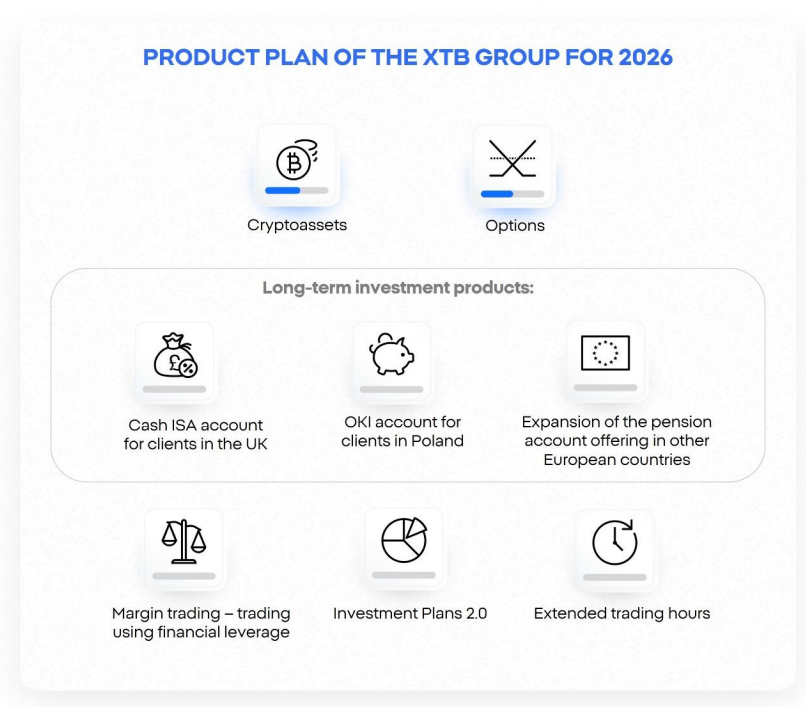
secured approval from Cyprus regulators in December to offer spot
cryptocurrency trading under the EU's Markets in Crypto-Assets framework.
That authorization came after months of
legislative gridlock in Poland, where President Karol Nawrocki vetoed crypto
legislation that parliament had passed.
“If we
add cryptocurrencies to the offer, we're entering an entirely new business,
we're starting a completely different competitive battle,” Arnaout
explained. “That's a completely new client base, so I don't see that
ceiling.”
XTB plans
to launch spot crypto trading in Cyprus first, then roll out to other markets
once it clears regulatory hurdles in each jurisdiction. The company is waiting
to see how Poland's legislative process plays out but won't delay indefinitely.
Arnaout said XTB will make a decision by the second quarter, or third quarter
at the latest, on how to proceed.
The crypto
push fits into Arnaout's broader vision of building what he described last year as a “super
app” that handles everything from investing to payments. That strategy has
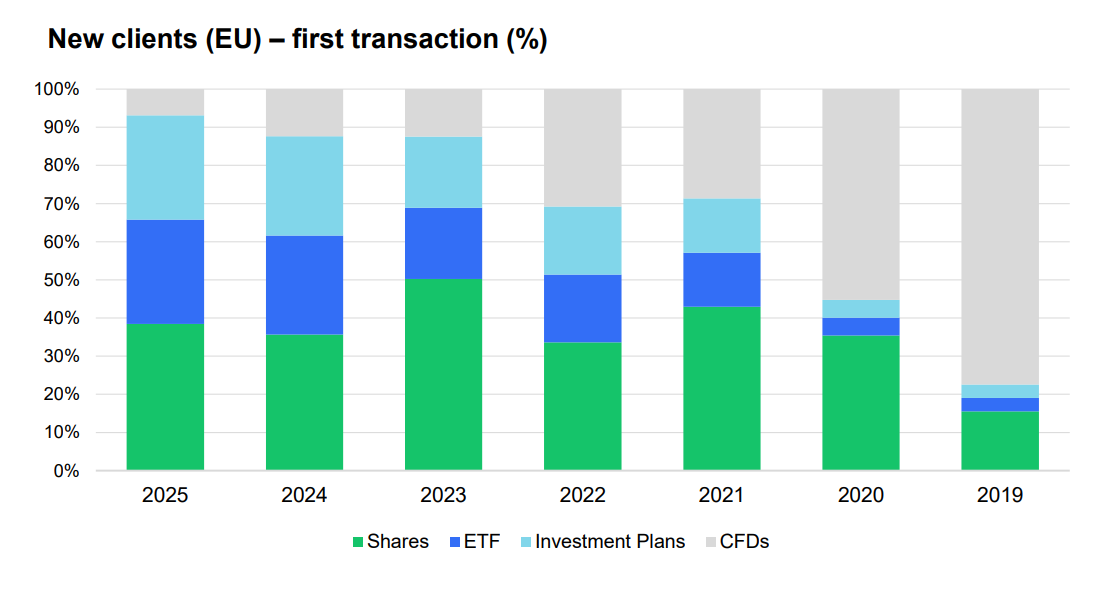
already reshaped the company's customer mix, with only 7 percent of new clients now choosing
CFDs as their first transaction, down from 80 percent in 2019.
Source: XTB
Options Already Live in
Cyprus
The broker
began offering options trading to Cypriot clients late last year and expects to
extend the service to at least one other European branch during the first
quarter of 2026. Like crypto, options represent a fee-generating product that
could reduce XTB's dependence on CFD spreads for revenue.
“If
the client base grows dynamically and interest in CFDs is maintained, that will
positively impact our business,” Arnaout said. But he acknowledged that
XTB's stock and ETF products, along with interest paid on idle cash, don't yet
produce meaningful income because the user base remains too small. Crypto and
options could change that math by adding paid services to the platform.
The company
also announced plans last week to introduce margin lending for stock purchases
and extend trading hours to 24 hours a day, five days a week. Those announcements sent XTB shares up 12 percent
in the biggest single-day jump since 2021, even as full-year profit dropped 25
percent.
Source: XTB
Competition Heats Up in
Polish Market
Poland
continues to drive a disproportionate share of XTB's growth, even as the broker
operates across multiple countries. Brand recognition has reached a point where
XTB is often the first choice for Polish investors opening new accounts,
Arnaout said.
But rivals
are circling. German fintech Trade Republic
entered Poland last
year, launching a direct challenge to XTB's market leadership. ING Bank
Securities, the
country's fourth-largest brokerage, is preparing its own offensive with
tax-sheltered retirement accounts and expanded foreign market access.
“I
would like to be able to say that we will have much greater diversification,
but at this pace of business development in Poland, it still seems unrealistic
for now, although foreign branches are also developing very quickly,” Arnaout told Parkiet.
The CEO
said XTB won't sacrifice profitability to chase expansion in 2026. Marketing
budgets will stay aggressive because becoming Europe's largest retail broker
requires sustained ad spending, but other costs face tighter controls.
Headcount
is budgeted to rise just one percent this year, the slowest pace in company
history, though total personnel expenses will climb about 16 to 17 percent due
to raises and other compensation adjustments.
“Approaching
the budget for this year, for the first time we were very cautious,”
Arnaout said. “If I'm talking about my goals, I would like to exceed that
billion złoty profit this year.”
Client
assets held at XTB reached approximately 10.8 billion euros by the end of 2025.
The average cost to acquire each new account held steady at 700 złoty for the
full year and 600 złoty in the fourth quarter.
XTB doesn't
see limits to how fast it can grow, even after adding more clients last year
than it accumulated in its first 20 years of operation.
Omar
Arnaout, the broker's chief executive, told Polish financial daily Parkiet that
bringing in two million new accounts annually “is completely
realistic” within a few years. The Warsaw-listed company pulled in 864,000
clients during 2025, a 73 percent jump that pushed its total base past 2.16
million.
“It
took us 20 years to have a million clients,” Arnaout said
in the interview published this week. “In 2025, we acquired over
860,000 clients. So in one year we did practically what took 20 years.”
When asked
where the ceiling is for client acquisition growth, Arnaout was blunt: “We
still don't see that ceiling.”
XTB
reported record fourth-quarter revenue of 610.1 million złoty ($173 million)
and net profit of 180.5 million złoty in preliminary results released last month. For the full year, the company
posted 644 million złoty in net profit, falling short of the billion-złoty
threshold that analysts have floated as the next psychological milestone.
“If
conditions had been favorable, I think that billion really would have been
broken,” the CEO told Parkiet. The number of active clients climbed 70
percent during the year, reaching 1.19 million, but many of those traders sat
on the sidelines when markets stalled.
XTB added
117,000 clients in the first 28 days of January alone, according to company
disclosures. Arnaout wouldn't discuss specific monthly performance but said his
personal goal for 2026 includes crossing the billion-złoty profit mark. The
company has publicly committed to signing up one million new clients this year,
which would work out to roughly 250,000 per quarter at minimum.
“That's
the minimum,” Arnaout said. “Our aspirations are definitely
bigger.”
Crypto License Opens New
Revenue Stream
The broker
secured approval from Cyprus regulators in December to offer spot
cryptocurrency trading under the EU's Markets in Crypto-Assets framework.
That authorization came after months of
legislative gridlock in Poland, where President Karol Nawrocki vetoed crypto
legislation that parliament had passed.
“If we
add cryptocurrencies to the offer, we're entering an entirely new business,
we're starting a completely different competitive battle,” Arnaout
explained. “That's a completely new client base, so I don't see that
ceiling.”
XTB plans
to launch spot crypto trading in Cyprus first, then roll out to other markets
once it clears regulatory hurdles in each jurisdiction. The company is waiting
to see how Poland's legislative process plays out but won't delay indefinitely.
Arnaout said XTB will make a decision by the second quarter, or third quarter
at the latest, on how to proceed.
The crypto
push fits into Arnaout's broader vision of building what he described last year as a “super
app” that handles everything from investing to payments. That strategy has
already reshaped the company's customer mix, with only 7 percent of new clients now choosing
CFDs as their first transaction, down from 80 percent in 2019.
Source: XTB
Options Already Live in
Cyprus
The broker
began offering options trading to Cypriot clients late last year and expects to
extend the service to at least one other European branch during the first
quarter of 2026. Like crypto, options represent a fee-generating product that
could reduce XTB's dependence on CFD spreads for revenue.
“If
the client base grows dynamically and interest in CFDs is maintained, that will
positively impact our business,” Arnaout said. But he acknowledged that
XTB's stock and ETF products, along with interest paid on idle cash, don't yet
produce meaningful income because the user base remains too small. Crypto and
options could change that math by adding paid services to the platform.
The company
also announced plans last week to introduce margin lending for stock purchases
and extend trading hours to 24 hours a day, five days a week. Those announcements sent XTB shares up 12 percent
in the biggest single-day jump since 2021, even as full-year profit dropped 25
percent.
Source: XTB
Competition Heats Up in
Polish Market
Poland
continues to drive a disproportionate share of XTB's growth, even as the broker
operates across multiple countries. Brand recognition has reached a point where
XTB is often the first choice for Polish investors opening new accounts,
Arnaout said.
But rivals
are circling. German fintech Trade Republic
entered Poland last
year, launching a direct challenge to XTB's market leadership. ING Bank
Securities, the
country's fourth-largest brokerage, is preparing its own offensive with
tax-sheltered retirement accounts and expanded foreign market access.
“I
would like to be able to say that we will have much greater diversification,
but at this pace of business development in Poland, it still seems unrealistic
for now, although foreign branches are also developing very quickly,” Arnaout told Parkiet.
The CEO
said XTB won't sacrifice profitability to chase expansion in 2026. Marketing
budgets will stay aggressive because becoming Europe's largest retail broker
requires sustained ad spending, but other costs face tighter controls.
Headcount
is budgeted to rise just one percent this year, the slowest pace in company
history, though total personnel expenses will climb about 16 to 17 percent due
to raises and other compensation adjustments.
“Approaching
the budget for this year, for the first time we were very cautious,”
Arnaout said. “If I'm talking about my goals, I would like to exceed that
billion złoty profit this year.”
Client
assets held at XTB reached approximately 10.8 billion euros by the end of 2025.
The average cost to acquire each new account held steady at 700 złoty for the
full year and 600 złoty in the fourth quarter.
Damian Chmiel is a Senior Analyst & Editor at Finance Magnates with more than 15 years of experience in the CFD and online trading industry. Active as both a trader and journalist since 2010, he focuses on broker coverage, fintech innovation, and regulatory developments across Europe, the Middle East, and Asia.
His work includes interviews with C-level leaders at major brokerages and fintech platforms, as well as co-authoring Finance Magnates’ quarterly industry benchmarking reports. Damian’s reporting is data-driven, market-aware, and grounded in direct industry engagement. His analysis and commentary have also been cited by external media outlets, including Investing.com, Binance, The Asset, Stockhead, and Dispatch.
Education:
MA in Finance and Accounting, Cracow University of Economics
FTMO Says Monthly Rewards Near $15 Million in September
Featured Videos
AvaTrade to Acquire Most of FXCM; NAGA Raises $8M
AvaTrade to Acquire Most of FXCM; NAGA Raises $8M
AvaTrade to Acquire Most of FXCM; NAGA Raises $8M
AvaTrade to Acquire Most of FXCM; NAGA Raises $8M
Today’s financial news recap covers AvaTrade agrees to acquire most of FXCM, NAGA secures eight million dollars in new financing, and Wise seeks a tax settlement in the UK.
Finance Magnates Daily Recap brings you the latest news from forex and CFD brokers, fintech, payments, cryptocurrency, digital assets, trading platforms, financial regulation and global markets.
Get the key company news, executive moves, deals, regulatory updates and market developments of the day, in just a few minutes. New episodes published every weekday.
Read more: https://www.financemagnates.com
#FinanceMagnates #ForexNews #FintechNews
Today’s financial news recap covers AvaTrade agrees to acquire most of FXCM, NAGA secures eight million dollars in new financing, and Wise seeks a tax settlement in the UK.
Finance Magnates Daily Recap brings you the latest news from forex and CFD brokers, fintech, payments, cryptocurrency, digital assets, trading platforms, financial regulation and global markets.
Get the key company news, executive moves, deals, regulatory updates and market developments of the day, in just a few minutes. New episodes published every weekday.
Read more: https://www.financemagnates.com
#FinanceMagnates #ForexNews #FintechNews
Today’s financial news recap covers AvaTrade agrees to acquire most of FXCM, NAGA secures eight million dollars in new financing, and Wise seeks a tax settlement in the UK.
Finance Magnates Daily Recap brings you the latest news from forex and CFD brokers, fintech, payments, cryptocurrency, digital assets, trading platforms, financial regulation and global markets.
Get the key company news, executive moves, deals, regulatory updates and market developments of the day, in just a few minutes. New episodes published every weekday.
Read more: https://www.financemagnates.com
#FinanceMagnates #ForexNews #FintechNews
Today’s financial news recap covers AvaTrade agrees to acquire most of FXCM, NAGA secures eight million dollars in new financing, and Wise seeks a tax settlement in the UK.
Finance Magnates Daily Recap brings you the latest news from forex and CFD brokers, fintech, payments, cryptocurrency, digital assets, trading platforms, financial regulation and global markets.
Get the key company news, executive moves, deals, regulatory updates and market developments of the day, in just a few minutes. New episodes published every weekday.
Read more: https://www.financemagnates.com
#FinanceMagnates #ForexNews #FintechNews
XTB Adds Overnight US Stock Trading; Nasdaq Ventures Invests in One Trading
XTB Adds Overnight US Stock Trading; Nasdaq Ventures Invests in One Trading
XTB Adds Overnight US Stock Trading; Nasdaq Ventures Invests in One Trading
XTB Adds Overnight US Stock Trading; Nasdaq Ventures Invests in One Trading
XTB Adds Overnight US Stock Trading; Nasdaq Ventures Invests in One Trading
XTB Adds Overnight US Stock Trading; Nasdaq Ventures Invests in One Trading
Today’s financial news recap covers XTB expands overnight US stock trading, Fortrade reports higher revenue, Nasdaq backs One Trading, and Vest Labs raises 13 million dollars.
Finance Magnates Daily Recap brings you the latest news from forex and CFD brokers, fintech, payments, cryptocurrency, digital assets, trading platforms, financial regulation and global markets.
Get the key company news, executive moves, deals, regulatory updates and market developments of the day, in just a few minutes. New episodes published every weekday.
Read more: https://www.financemagnates.com
#FinanceMagnates #ForexNews #FintechNews
Today’s financial news recap covers XTB expands overnight US stock trading, Fortrade reports higher revenue, Nasdaq backs One Trading, and Vest Labs raises 13 million dollars.
Finance Magnates Daily Recap brings you the latest news from forex and CFD brokers, fintech, payments, cryptocurrency, digital assets, trading platforms, financial regulation and global markets.
Get the key company news, executive moves, deals, regulatory updates and market developments of the day, in just a few minutes. New episodes published every weekday.
Read more: https://www.financemagnates.com
#FinanceMagnates #ForexNews #FintechNews
Today’s financial news recap covers XTB expands overnight US stock trading, Fortrade reports higher revenue, Nasdaq backs One Trading, and Vest Labs raises 13 million dollars.
Finance Magnates Daily Recap brings you the latest news from forex and CFD brokers, fintech, payments, cryptocurrency, digital assets, trading platforms, financial regulation and global markets.
Get the key company news, executive moves, deals, regulatory updates and market developments of the day, in just a few minutes. New episodes published every weekday.
Read more: https://www.financemagnates.com
#FinanceMagnates #ForexNews #FintechNews
Today’s financial news recap covers XTB expands overnight US stock trading, Fortrade reports higher revenue, Nasdaq backs One Trading, and Vest Labs raises 13 million dollars.
Finance Magnates Daily Recap brings you the latest news from forex and CFD brokers, fintech, payments, cryptocurrency, digital assets, trading platforms, financial regulation and global markets.
Get the key company news, executive moves, deals, regulatory updates and market developments of the day, in just a few minutes. New episodes published every weekday.
Read more: https://www.financemagnates.com
#FinanceMagnates #ForexNews #FintechNews
Today’s financial news recap covers XTB expands overnight US stock trading, Fortrade reports higher revenue, Nasdaq backs One Trading, and Vest Labs raises 13 million dollars.
Finance Magnates Daily Recap brings you the latest news from forex and CFD brokers, fintech, payments, cryptocurrency, digital assets, trading platforms, financial regulation and global markets.
Get the key company news, executive moves, deals, regulatory updates and market developments of the day, in just a few minutes. New episodes published every weekday.
Read more: https://www.financemagnates.com
#FinanceMagnates #ForexNews #FintechNews
Today’s financial news recap covers XTB expands overnight US stock trading, Fortrade reports higher revenue, Nasdaq backs One Trading, and Vest Labs raises 13 million dollars.
Finance Magnates Daily Recap brings you the latest news from forex and CFD brokers, fintech, payments, cryptocurrency, digital assets, trading platforms, financial regulation and global markets.
Get the key company news, executive moves, deals, regulatory updates and market developments of the day, in just a few minutes. New episodes published every weekday.
Read more: https://www.financemagnates.com
#FinanceMagnates #ForexNews #FintechNews
CMC Founder Downplays Volatility Hit; Devexperts Names CEO
CMC Founder Downplays Volatility Hit; Devexperts Names CEO
CMC Founder Downplays Volatility Hit; Devexperts Names CEO
CMC Founder Downplays Volatility Hit; Devexperts Names CEO
CMC Founder Downplays Volatility Hit; Devexperts Names CEO
CMC Founder Downplays Volatility Hit; Devexperts Names CEO
Today’s financial news recap covers low volatility pressures brokers, Devexperts names a new CEO, Saxo cuts onboarding time, and OKX reaches a 25 billion dollar valuation.
Finance Magnates Daily Recap brings you the latest news from forex and CFD brokers, fintech, payments, cryptocurrency, digital assets, trading platforms, financial regulation and global markets.
Get the key company news, executive moves, deals, regulatory updates and market developments of the day, in just a few minutes. New episodes published every weekday.
Read more: https://www.financemagnates.com
#FinanceMagnates #ForexNews #FintechNews
Today’s financial news recap covers low volatility pressures brokers, Devexperts names a new CEO, Saxo cuts onboarding time, and OKX reaches a 25 billion dollar valuation.
Finance Magnates Daily Recap brings you the latest news from forex and CFD brokers, fintech, payments, cryptocurrency, digital assets, trading platforms, financial regulation and global markets.
Get the key company news, executive moves, deals, regulatory updates and market developments of the day, in just a few minutes. New episodes published every weekday.
Read more: https://www.financemagnates.com
#FinanceMagnates #ForexNews #FintechNews
Today’s financial news recap covers low volatility pressures brokers, Devexperts names a new CEO, Saxo cuts onboarding time, and OKX reaches a 25 billion dollar valuation.
Finance Magnates Daily Recap brings you the latest news from forex and CFD brokers, fintech, payments, cryptocurrency, digital assets, trading platforms, financial regulation and global markets.
Get the key company news, executive moves, deals, regulatory updates and market developments of the day, in just a few minutes. New episodes published every weekday.
Read more: https://www.financemagnates.com
#FinanceMagnates #ForexNews #FintechNews
Today’s financial news recap covers low volatility pressures brokers, Devexperts names a new CEO, Saxo cuts onboarding time, and OKX reaches a 25 billion dollar valuation.
Finance Magnates Daily Recap brings you the latest news from forex and CFD brokers, fintech, payments, cryptocurrency, digital assets, trading platforms, financial regulation and global markets.
Get the key company news, executive moves, deals, regulatory updates and market developments of the day, in just a few minutes. New episodes published every weekday.
Read more: https://www.financemagnates.com
#FinanceMagnates #ForexNews #FintechNews
Today’s financial news recap covers low volatility pressures brokers, Devexperts names a new CEO, Saxo cuts onboarding time, and OKX reaches a 25 billion dollar valuation.
Finance Magnates Daily Recap brings you the latest news from forex and CFD brokers, fintech, payments, cryptocurrency, digital assets, trading platforms, financial regulation and global markets.
Get the key company news, executive moves, deals, regulatory updates and market developments of the day, in just a few minutes. New episodes published every weekday.
Read more: https://www.financemagnates.com
#FinanceMagnates #ForexNews #FintechNews
Today’s financial news recap covers low volatility pressures brokers, Devexperts names a new CEO, Saxo cuts onboarding time, and OKX reaches a 25 billion dollar valuation.
Finance Magnates Daily Recap brings you the latest news from forex and CFD brokers, fintech, payments, cryptocurrency, digital assets, trading platforms, financial regulation and global markets.
Get the key company news, executive moves, deals, regulatory updates and market developments of the day, in just a few minutes. New episodes published every weekday.
Read more: https://www.financemagnates.com
#FinanceMagnates #ForexNews #FintechNews
Today’s financial news recap covers Trade Nation buys FXCM's UK client book, Trading 212 reports higher revenue, the CFTC's move to allow perpetual index futures.
Finance Magnates Daily Recap brings you the latest news from forex and CFD brokers, fintech, payments, cryptocurrency, digital assets, trading platforms, financial regulation and global markets.
Get the key company news, executive moves, deals, regulatory updates and market developments of the day, in just a few minutes. New episodes published every weekday.
Read more: https://www.financemagnates.com
#FinanceMagnates #ForexNews #FintechNews
Today’s financial news recap covers Trade Nation buys FXCM's UK client book, Trading 212 reports higher revenue, the CFTC's move to allow perpetual index futures.
Finance Magnates Daily Recap brings you the latest news from forex and CFD brokers, fintech, payments, cryptocurrency, digital assets, trading platforms, financial regulation and global markets.
Get the key company news, executive moves, deals, regulatory updates and market developments of the day, in just a few minutes. New episodes published every weekday.
Read more: https://www.financemagnates.com
#FinanceMagnates #ForexNews #FintechNews
Today’s financial news recap covers Trade Nation buys FXCM's UK client book, Trading 212 reports higher revenue, the CFTC's move to allow perpetual index futures.
Finance Magnates Daily Recap brings you the latest news from forex and CFD brokers, fintech, payments, cryptocurrency, digital assets, trading platforms, financial regulation and global markets.
Get the key company news, executive moves, deals, regulatory updates and market developments of the day, in just a few minutes. New episodes published every weekday.
Read more: https://www.financemagnates.com
#FinanceMagnates #ForexNews #FintechNews
Today’s financial news recap covers Trade Nation buys FXCM's UK client book, Trading 212 reports higher revenue, the CFTC's move to allow perpetual index futures.
Finance Magnates Daily Recap brings you the latest news from forex and CFD brokers, fintech, payments, cryptocurrency, digital assets, trading platforms, financial regulation and global markets.
Get the key company news, executive moves, deals, regulatory updates and market developments of the day, in just a few minutes. New episodes published every weekday.
Read more: https://www.financemagnates.com
#FinanceMagnates #ForexNews #FintechNews
Today’s financial news recap covers Trade Nation buys FXCM's UK client book, Trading 212 reports higher revenue, the CFTC's move to allow perpetual index futures.
Finance Magnates Daily Recap brings you the latest news from forex and CFD brokers, fintech, payments, cryptocurrency, digital assets, trading platforms, financial regulation and global markets.
Get the key company news, executive moves, deals, regulatory updates and market developments of the day, in just a few minutes. New episodes published every weekday.
Read more: https://www.financemagnates.com
#FinanceMagnates #ForexNews #FintechNews
Today’s financial news recap covers Trade Nation buys FXCM's UK client book, Trading 212 reports higher revenue, the CFTC's move to allow perpetual index futures.
Finance Magnates Daily Recap brings you the latest news from forex and CFD brokers, fintech, payments, cryptocurrency, digital assets, trading platforms, financial regulation and global markets.
Get the key company news, executive moves, deals, regulatory updates and market developments of the day, in just a few minutes. New episodes published every weekday.
Read more: https://www.financemagnates.com
#FinanceMagnates #ForexNews #FintechNews
Your career isn’t a linear path.
Your career isn’t a linear path.
Your career isn’t a linear path.
Your career isn’t a linear path.
Your career isn’t a linear path.
Your career isn’t a linear path.
Roles change. Career goals change. Sometimes you want a completely new challenge.
But the skills and knowledge you build along the way can stay with you and give you something to build on.
For Jeff Patterson, that continued growth is key to long-term career development.
You bring the skills. FM Academy helps you build the knowledge.
#FMAcademy #FinanceMagnates #FinanceCareers #ProfessionalDevelopment #Fintech
Roles change. Career goals change. Sometimes you want a completely new challenge.
But the skills and knowledge you build along the way can stay with you and give you something to build on.
For Jeff Patterson, that continued growth is key to long-term career development.
You bring the skills. FM Academy helps you build the knowledge.
#FMAcademy #FinanceMagnates #FinanceCareers #ProfessionalDevelopment #Fintech
Roles change. Career goals change. Sometimes you want a completely new challenge.
But the skills and knowledge you build along the way can stay with you and give you something to build on.
For Jeff Patterson, that continued growth is key to long-term career development.
You bring the skills. FM Academy helps you build the knowledge.
#FMAcademy #FinanceMagnates #FinanceCareers #ProfessionalDevelopment #Fintech
Roles change. Career goals change. Sometimes you want a completely new challenge.
But the skills and knowledge you build along the way can stay with you and give you something to build on.
For Jeff Patterson, that continued growth is key to long-term career development.
You bring the skills. FM Academy helps you build the knowledge.
#FMAcademy #FinanceMagnates #FinanceCareers #ProfessionalDevelopment #Fintech
Roles change. Career goals change. Sometimes you want a completely new challenge.
But the skills and knowledge you build along the way can stay with you and give you something to build on.
For Jeff Patterson, that continued growth is key to long-term career development.
You bring the skills. FM Academy helps you build the knowledge.
#FMAcademy #FinanceMagnates #FinanceCareers #ProfessionalDevelopment #Fintech
Roles change. Career goals change. Sometimes you want a completely new challenge.
But the skills and knowledge you build along the way can stay with you and give you something to build on.
For Jeff Patterson, that continued growth is key to long-term career development.
You bring the skills. FM Academy helps you build the knowledge.
#FMAcademy #FinanceMagnates #FinanceCareers #ProfessionalDevelopment #Fintech