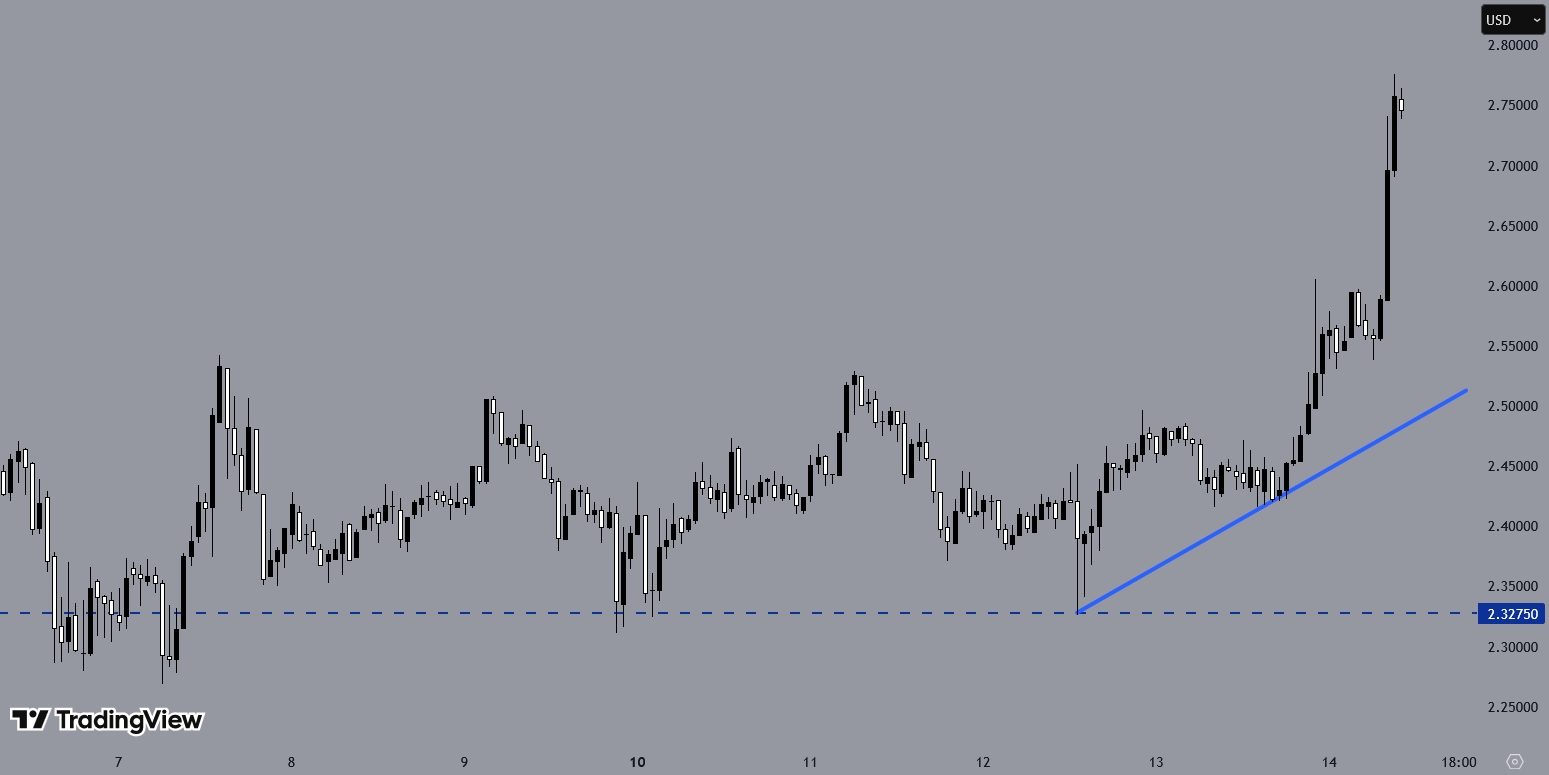
Meanwhile, the XRPUSD H1 chart indicates a bullish trend
that began yesterday. The price reached approximately 2.78000 and may continue
its upward movement for the near term.
The SEC’s acknowledgment is only the first step in the
approval process. The filing will be published in the Federal Register,
allowing a 21-day public comment period. After that, the SEC can approve,
reject, or extend the review by initiating further proceedings.
The decision follows a history of the SEC refusing to engage
with altcoin ETF applications under former Chairman Gary Gensler. Solana ETF
applications were withdrawn in recent months after the SEC declined to discuss
them. The agency has also acknowledged filings for a Dogecoin ETF, a shift from
past policies where altcoin ETF applications were typically rejected or
withdrawn.
XRPUSD Shows Bullish Momentum After Support
The XRPUSD H1 chart shows that after finding support at
2.32750, the price made a bullish move. It faced rejection around 2.50000,
followed by a bearish correction. After consolidating for a while, the price
made a strong move upward. As of now, the price remains bullish and may
continue its upward movement.
The model assigns a 70% probability of a positive legal
outcome for Ripple, which could boost investor confidence and institutional
adoption. Increased use of Ripple's ODL platform may also raise demand for XRP.
Market sentiment, especially Bitcoin's performance and global economic
conditions, will influence XRP’s price movement.
More Firms Await SEC XRP ETF Acknowledgment
Other firms, including Bitwise Invest, 21Shares, Canary
Funds, and WisdomTree Funds, have also filed for XRP ETFs. However, their
applications have not yet been formally acknowledged. Meanwhile, President Trump has nominated Paul Atkins as the
next SEC chairman. Until his confirmation, Mark Uyeda is serving as the acting
chairman.
Ripple's Key Moves: Legal, DeFi, and Partnerships
Recently, Ripple has been engaged with several notable
developments across various sectors. The company has partnered with Revolut
and Zero Hash to expand access to its RLUSD stablecoin, aiming to
strengthen its market position and challenge the dominance of USDT and USDC.
This collaboration could enhance RLUSD’s visibility in the competitive
stablecoin market.
🚨 New partner alert: Ripple USD – a trusted, transparent, and regulated stablecoin built for payments – is now available for trading on @ZeroHashX and @RevolutApp!
Ripple whales have been actively acquiring XRP tokens, with
recent data showing that large
investors purchased 520 million XRP during a recent price dip. This ongoing
accumulation has drawn attention to Ripple's market activity.
The SEC’s reassignment of Jorge Tenreiro, who previously
oversaw cryptocurrency cases such as Ripple’s and Coinbase’s, has
raised questions about the agency’s approach to crypto litigation.
Tenreiro's move to the IT department has sparked speculation on how it might
affect future decisions in Ripple's ongoing legal battle.
JUST IN: 🇺🇸 SEC Transfers Top Crypto Litigator Jorge Tenreiro to IT Department!
He played a key role in both the @Ripple and @coinbase lawsuits, another sign this case is almost over! 💥📈
Ripple
recently donated $100,000 in XRP to aid communities affected by California
wildfires. Through The Giving Block platform, Ripple’s donation supports
organizations like World Central Kitchen and GiveDirectly, contributing to
relief efforts.
In DeFi, Ripple
has teamed up with Chainlink to integrate RLUSD with decentralized finance
applications on Ethereum. This partnership aims to expand RLUSD’s use case,
offering trading and lending features within the DeFi ecosystem.
.@Ripple x @Chainlink: $RLUSD has adopted the Chainlink standard for verifiable data to fuel DeFi adoption with real-time, secure pricing data.
Ripple is exploring XRP’s
potential inclusion in a US crypto reserve, though concerns about
centralization have emerged. Ripple's David Schwartz defended the
decentralization of the XRP Ledger, emphasizing its resilience to manipulation
and its independent nature.
In Japan, Ripple
expects XRP Ledger adoption by banks by 2025, as stated by SBI CEO
Yoshitaka Kitao. This initiative aims to improve cross-border payments and
currency conversions for remittances, enhancing Japan’s financial
infrastructure.
Lastly, the XRP
Ledger (XRPL) faced a brief disruption due to an issue with its consensus
mechanism, causing validations to fail and ledgers to "drift apart."
Ripple’s CTO David Schwartz confirmed the issue was resolved after a validator
reset the consensus, restoring normal network operations.
Meanwhile, the XRPUSD H1 chart indicates a bullish trend
that began yesterday. The price reached approximately 2.78000 and may continue
its upward movement for the near term.
The SEC’s acknowledgment is only the first step in the
approval process. The filing will be published in the Federal Register,
allowing a 21-day public comment period. After that, the SEC can approve,
reject, or extend the review by initiating further proceedings.
The decision follows a history of the SEC refusing to engage
with altcoin ETF applications under former Chairman Gary Gensler. Solana ETF
applications were withdrawn in recent months after the SEC declined to discuss
them. The agency has also acknowledged filings for a Dogecoin ETF, a shift from
past policies where altcoin ETF applications were typically rejected or
withdrawn.
XRPUSD Shows Bullish Momentum After Support
The XRPUSD H1 chart shows that after finding support at
2.32750, the price made a bullish move. It faced rejection around 2.50000,
followed by a bearish correction. After consolidating for a while, the price
made a strong move upward. As of now, the price remains bullish and may
continue its upward movement.
The model assigns a 70% probability of a positive legal
outcome for Ripple, which could boost investor confidence and institutional
adoption. Increased use of Ripple's ODL platform may also raise demand for XRP.
Market sentiment, especially Bitcoin's performance and global economic
conditions, will influence XRP’s price movement.
More Firms Await SEC XRP ETF Acknowledgment
Other firms, including Bitwise Invest, 21Shares, Canary
Funds, and WisdomTree Funds, have also filed for XRP ETFs. However, their
applications have not yet been formally acknowledged. Meanwhile, President Trump has nominated Paul Atkins as the
next SEC chairman. Until his confirmation, Mark Uyeda is serving as the acting
chairman.
Ripple's Key Moves: Legal, DeFi, and Partnerships
Recently, Ripple has been engaged with several notable
developments across various sectors. The company has partnered with Revolut
and Zero Hash to expand access to its RLUSD stablecoin, aiming to
strengthen its market position and challenge the dominance of USDT and USDC.
This collaboration could enhance RLUSD’s visibility in the competitive
stablecoin market.
🚨 New partner alert: Ripple USD – a trusted, transparent, and regulated stablecoin built for payments – is now available for trading on @ZeroHashX and @RevolutApp!
Ripple whales have been actively acquiring XRP tokens, with
recent data showing that large
investors purchased 520 million XRP during a recent price dip. This ongoing
accumulation has drawn attention to Ripple's market activity.
The SEC’s reassignment of Jorge Tenreiro, who previously
oversaw cryptocurrency cases such as Ripple’s and Coinbase’s, has
raised questions about the agency’s approach to crypto litigation.
Tenreiro's move to the IT department has sparked speculation on how it might
affect future decisions in Ripple's ongoing legal battle.
JUST IN: 🇺🇸 SEC Transfers Top Crypto Litigator Jorge Tenreiro to IT Department!
He played a key role in both the @Ripple and @coinbase lawsuits, another sign this case is almost over! 💥📈
Ripple
recently donated $100,000 in XRP to aid communities affected by California
wildfires. Through The Giving Block platform, Ripple’s donation supports
organizations like World Central Kitchen and GiveDirectly, contributing to
relief efforts.
In DeFi, Ripple
has teamed up with Chainlink to integrate RLUSD with decentralized finance
applications on Ethereum. This partnership aims to expand RLUSD’s use case,
offering trading and lending features within the DeFi ecosystem.
.@Ripple x @Chainlink: $RLUSD has adopted the Chainlink standard for verifiable data to fuel DeFi adoption with real-time, secure pricing data.
Ripple is exploring XRP’s
potential inclusion in a US crypto reserve, though concerns about
centralization have emerged. Ripple's David Schwartz defended the
decentralization of the XRP Ledger, emphasizing its resilience to manipulation
and its independent nature.
In Japan, Ripple
expects XRP Ledger adoption by banks by 2025, as stated by SBI CEO
Yoshitaka Kitao. This initiative aims to improve cross-border payments and
currency conversions for remittances, enhancing Japan’s financial
infrastructure.
Lastly, the XRP
Ledger (XRPL) faced a brief disruption due to an issue with its consensus
mechanism, causing validations to fail and ledgers to "drift apart."
Ripple’s CTO David Schwartz confirmed the issue was resolved after a validator
reset the consensus, restoring normal network operations.
Tareq is a financial writer with 15 years of experience covering global markets. His work spans technical analysis, forex broker reviews, and market sentiment, with a focus on topics relevant to retail traders. He joined Finance Magnates in 2023.
At Finance Magnates, he serves as News Editor, covering retail forex and CFD brokers, cryptocurrency exchanges, fintech firms, and regulatory developments shaping the trading industry. He holds an Honours degree in Information Technology from Anfell College, London.
Education:
Honours degree Information Technology, Anfell College, London
How High Can Google Stock Go? Mizuho Sees $460 GOOGL Target
Featured Videos
FM Daily Brief - 29 May 2026
Today is Friday, the 29th of May 2026, and these are our main stories: three global regulators are converging on trading platform design, and a Singapore prop firm launches a deferred-fee challenge model.
Today is Thursday, the 28th of May 2026, and these are our main stories: the chair of CySEC makes clear that prediction markets look like binary options to Brussels, Robinhood enters the age of AI agents, and a Google engineer faces insider trading charges over Polymarket activity.
Nick Strain, Country Manager Singapore at LMAX Digital, discusses the future of digital assets and shares his views on crypto markets, perpetuals, institutional adoption, tokenization, and why regulatory clarity remains the biggest driver in the space.
The discussion, hosted by Jonathan Fine, Content Strategist at Finance Magnates, covers:
Crypto market sentiment
Bitcoin and Ethereum's role as macro assets
The mechanics of perpetuals and funding rates
Institutional adoption beyond buying crypto
The opportunity in tokenization and programmable money
The critical role of regulation in market growth
Nick Strain, Country Manager Singapore at LMAX Digital, discusses the future of digital assets and shares his views on crypto markets, perpetuals, institutional adoption, tokenization, and why regulatory clarity remains the biggest driver in the space.
The discussion, hosted by Jonathan Fine, Content Strategist at Finance Magnates, covers:
Crypto market sentiment
Bitcoin and Ethereum's role as macro assets
The mechanics of perpetuals and funding rates
Institutional adoption beyond buying crypto
The opportunity in tokenization and programmable money
The critical role of regulation in market growth
Nick Strain, Country Manager Singapore at LMAX Digital, discusses the future of digital assets and shares his views on crypto markets, perpetuals, institutional adoption, tokenization, and why regulatory clarity remains the biggest driver in the space.
The discussion, hosted by Jonathan Fine, Content Strategist at Finance Magnates, covers:
Crypto market sentiment
Bitcoin and Ethereum's role as macro assets
The mechanics of perpetuals and funding rates
Institutional adoption beyond buying crypto
The opportunity in tokenization and programmable money
The critical role of regulation in market growth
Nick Strain, Country Manager Singapore at LMAX Digital, discusses the future of digital assets and shares his views on crypto markets, perpetuals, institutional adoption, tokenization, and why regulatory clarity remains the biggest driver in the space.
The discussion, hosted by Jonathan Fine, Content Strategist at Finance Magnates, covers:
Crypto market sentiment
Bitcoin and Ethereum's role as macro assets
The mechanics of perpetuals and funding rates
Institutional adoption beyond buying crypto
The opportunity in tokenization and programmable money
The critical role of regulation in market growth
Nick Strain, Country Manager Singapore at LMAX Digital, discusses the future of digital assets and shares his views on crypto markets, perpetuals, institutional adoption, tokenization, and why regulatory clarity remains the biggest driver in the space.
The discussion, hosted by Jonathan Fine, Content Strategist at Finance Magnates, covers:
Crypto market sentiment
Bitcoin and Ethereum's role as macro assets
The mechanics of perpetuals and funding rates
Institutional adoption beyond buying crypto
The opportunity in tokenization and programmable money
The critical role of regulation in market growth
Nick Strain, Country Manager Singapore at LMAX Digital, discusses the future of digital assets and shares his views on crypto markets, perpetuals, institutional adoption, tokenization, and why regulatory clarity remains the biggest driver in the space.
The discussion, hosted by Jonathan Fine, Content Strategist at Finance Magnates, covers:
Crypto market sentiment
Bitcoin and Ethereum's role as macro assets
The mechanics of perpetuals and funding rates
Institutional adoption beyond buying crypto
The opportunity in tokenization and programmable money
The critical role of regulation in market growth
FM Daily Brief - 27 May 2026
Today is Wednesday, the 27th of May 2026, and these are our main stories: questions are swirling around the futures of FXCM and Tradu, as owner Jefferies reportedly weighs a sale, an acquisition of a prop firm, and the demographics of prediction markets.
FYNXT CEO Samuel Aeby: Why Brokers Need Operating Systems, Not Just CRMs
Should brokers build their own technology, or buy existing solutions? And with AI changing how firms manage clients, retention, and risk, are traditional CRM systems still enough?
At the Finance Magnates Singapore Summit, Jonathan Fine, Content Strategist at Finance Magnates, spoke with Samuel Aeby, CEO & Founder of FYNXT, about the future of broker technology, AI, and why operational complexity may be holding firms back.
🎥 Watch the interview: What does Samuel Aeby think most brokers are getting wrong when it comes to technology?
Should brokers build their own technology, or buy existing solutions? And with AI changing how firms manage clients, retention, and risk, are traditional CRM systems still enough?
At the Finance Magnates Singapore Summit, Jonathan Fine, Content Strategist at Finance Magnates, spoke with Samuel Aeby, CEO & Founder of FYNXT, about the future of broker technology, AI, and why operational complexity may be holding firms back.
🎥 Watch the interview: What does Samuel Aeby think most brokers are getting wrong when it comes to technology?
Should brokers build their own technology, or buy existing solutions? And with AI changing how firms manage clients, retention, and risk, are traditional CRM systems still enough?
At the Finance Magnates Singapore Summit, Jonathan Fine, Content Strategist at Finance Magnates, spoke with Samuel Aeby, CEO & Founder of FYNXT, about the future of broker technology, AI, and why operational complexity may be holding firms back.
🎥 Watch the interview: What does Samuel Aeby think most brokers are getting wrong when it comes to technology?
Should brokers build their own technology, or buy existing solutions? And with AI changing how firms manage clients, retention, and risk, are traditional CRM systems still enough?
At the Finance Magnates Singapore Summit, Jonathan Fine, Content Strategist at Finance Magnates, spoke with Samuel Aeby, CEO & Founder of FYNXT, about the future of broker technology, AI, and why operational complexity may be holding firms back.
🎥 Watch the interview: What does Samuel Aeby think most brokers are getting wrong when it comes to technology?
Should brokers build their own technology, or buy existing solutions? And with AI changing how firms manage clients, retention, and risk, are traditional CRM systems still enough?
At the Finance Magnates Singapore Summit, Jonathan Fine, Content Strategist at Finance Magnates, spoke with Samuel Aeby, CEO & Founder of FYNXT, about the future of broker technology, AI, and why operational complexity may be holding firms back.
🎥 Watch the interview: What does Samuel Aeby think most brokers are getting wrong when it comes to technology?
Should brokers build their own technology, or buy existing solutions? And with AI changing how firms manage clients, retention, and risk, are traditional CRM systems still enough?
At the Finance Magnates Singapore Summit, Jonathan Fine, Content Strategist at Finance Magnates, spoke with Samuel Aeby, CEO & Founder of FYNXT, about the future of broker technology, AI, and why operational complexity may be holding firms back.
🎥 Watch the interview: What does Samuel Aeby think most brokers are getting wrong when it comes to technology?