

Back in the 6th century BC, ancient Greek fabulist Aesop came up with the story The Tortoise and the Hare, which still resonates today. The story’s moral: slow and steady wins the race. I found applying the same logic to crypto regulation quite useful, and more specifically, using it as a basis for comparing US and EU crypto policy.
Two Paths to Regulation
The US CLARITY Act aims to solve the issue of crypto regulation once and for all, including the hardest part of it – DeFi. And that ambition is largely why the process is taking time. By contrast, the European Union took a step-by-step approach, starting with the parts of the market that fit existing regulatory tools.
While slow and steady has real virtues, the axiom may need updating because, in this case at least, the hare is not off course; it just seems to be running a longer track.
MiCA Takes the Lead
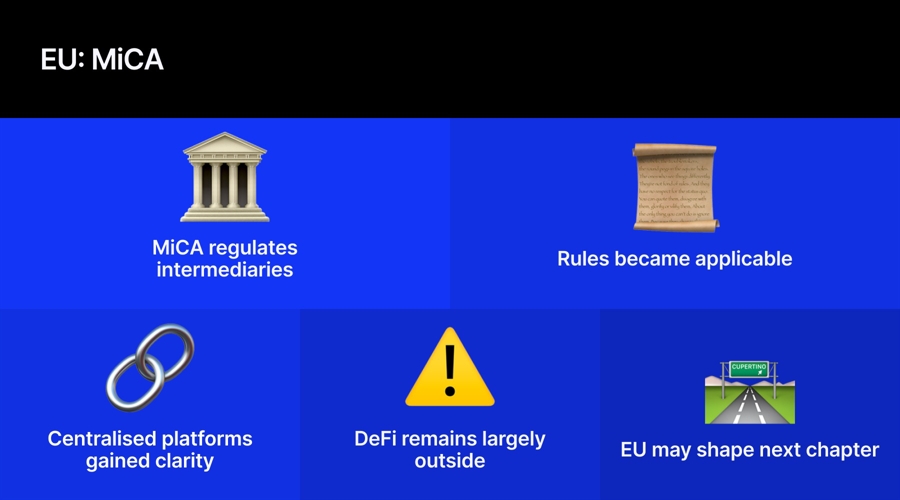
The EU's Markets in Crypto-Assets Regulation (MiCA) has had a strong start; it became fully applicable in July 2026, when the last national transition periods for existing providers ended. Meaning centralised crypto platforms finally had a consistent rulebook for licensing pathways and conduct standards to refer to, subsequently leading to a clearer way of operating across the EU.
Where MiCA Falls Short
Still, it would be too early to say that MiCA has solved all the issues involving crypto in the EU. For now, its scope is fairly limited, and it remains a regulatory framework for identifiable intermediaries, leaving decentralised platforms largely out of the conversation. Furthermore, in many instances, it’s not clear how current MiCA regulations would even be applied to DeFi.
As Recital 22 makes abundantly clear, crypto-asset services provided in a fully decentralised manner, without any intermediary, fall outside MiCA’s purview. So, it’s fair to say that MiCA has gotten only a part of crypto regulation right.
The other part, which includes the non-custodial, protocol-level stack, remains outside MiCA’s tailored authorisation framework. Despite supervisors having signalled that decentralisation will be judged on substance, and not labels, so many arrangements marketed as DeFi may still have an identifiable intermediary somewhere in the stack.
- Germany Leads MiCA Register With 22% of CASP Entities
- Hungary Set to Drop Tough National Crypto Rules After Near-Total Industry Exodus
- Europe's Post-MiCA Reshuffle: Two Data Points, One Confused Market
CLARITY Takes the Broader Route
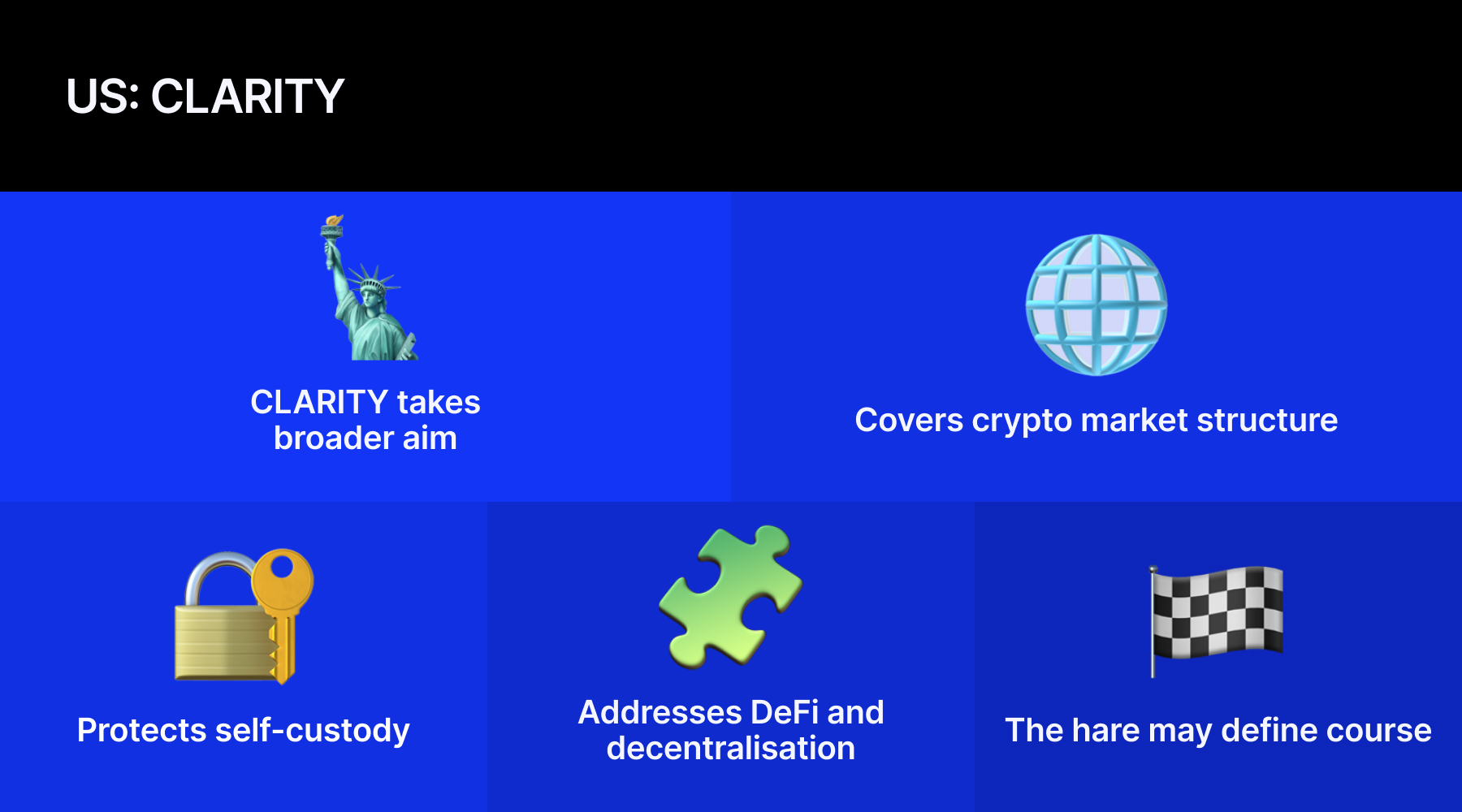
Across the pond, the CLARITY Act aims to encompass a much broader scope, with the goal of covering just about all of crypto, including market structure, token classification, self-custody protections, and DeFi-specific issues.
The CLARITY Act attempts what no major jurisdiction has yet done in statute; i.e., defining what counts as genuinely decentralised, protecting software developers, and tying obligations to custody and control instead of to labels.
A Longer Road Ahead
While this would, in theory, be a more complete approach, adopting such a comprehensive document is a lot more complex and is understandably taking longer to execute.
At the time of writing this piece, the floor consideration of the CLARITY Act has slipped past the August recess, and the negotiations continue, with focus on yield language and ethics provisions, and the midterm calendar pressure also factoring in. But that is the trade-off of attempting to pass a bill that rewrites rules for the financial system as we know it.
Looking at both approaches, MiCA has enacted regulation for the intermediary layer, delivering a workable regime, which was a real achievement. However, in choosing to leave DeFi questions for later, it has generated quite a bit of criticism.
That being said, MiCA is not supposed to be the end of the EU's crypto journey. So, when Brussels writes that second chapter, the most developed reference text on the table will most likely be the CLARITY Act, and its decentralisation tests, its developer protections, and its obligations tied to control will form the basis of how the EU shapes its policy for decentralised protocols.
CLARITY’s more complete path demonstrates how hard the task at hand is. The tortoise won the first lap, but the hare may yet define the course.
The views expressed are the author’s own and do not constitute legal advice.


