Gold jumped 3% to $4,850 per ounce, and silver surged nearly 7% to after the US and Iran announced a two-week ceasefire.
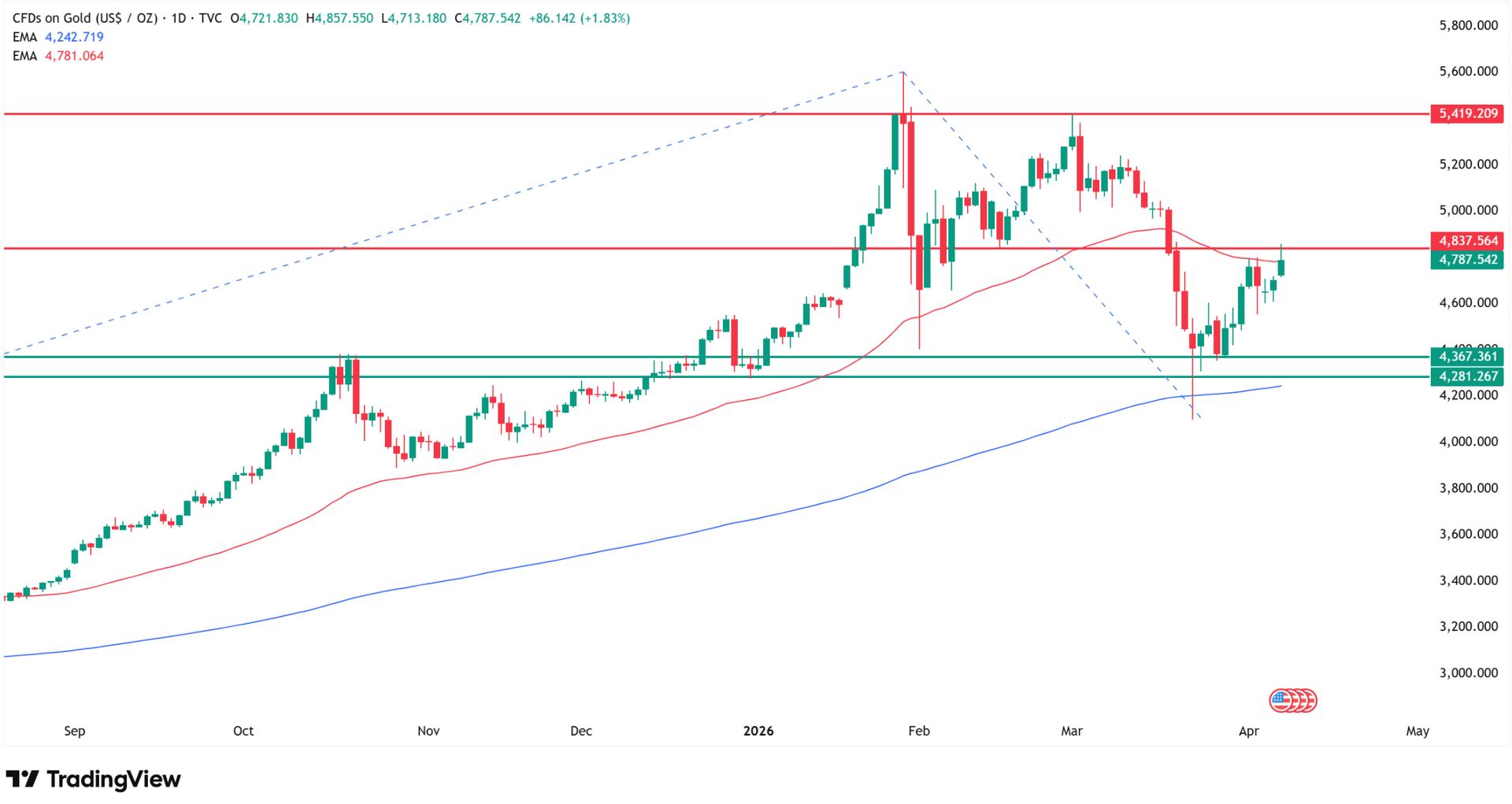
Gold is capped at the 50 EMA, roughly at the midpoint of the consolidation from January's all-time high.
Institutional gold price forecasts remain wide: JPMorgan targets $6,300 gold by year-end, Bank of America projects silver at $135-$309
Let's check the current gold and silver prices and the most up to date forecasts
Gold surged
to $4,850 per ounce today (Wednesday), April 8, 2026, gaining over 3% as the
US-Iran two-week ceasefire triggered a sharp reversal in the dollar and oil
markets. Silver outperformed with a nearly 7% rally to $77 per ounce, its
highest level since March 18.
The
ceasefire announcement followed President Trump's acceptance of a 10-point
Iranian proposal as a starting point for negotiations. Oil fell below $100 per
barrel for the first time since the conflict began in late February, removing
the inflationary pressure that had been the primary headwind for precious
metals.
Follow
me on X for real-time market analysis: @ChmielDk
Why Gold and Silver Are
Going Up? Iran Ceasefire Weakens the Dollar
"Gold
is rising nearly 2% today on the wave of a Middle East ceasefire to around
$4,800, and silver exceeds $77 per ounce, gaining nearly 6%," said Michal
Stajniak, Analyst at XTB. "The prospect of lower oil prices and opening of
the Strait of Hormuz appears to ease inflationary risk, and consequently the
prospect of monetary policy tightening by central banks."
Marek
Rogalski, Chief Market Analyst at DM BOŚ, noted that silver continues to earn
its "turbo-gold" label. "Technically, the breakout of the recent
peak at $76.10 confirms the upward move that started after the March 23
panic," Rogalski said. "Theoretically, the market has an open path to
around $79.50-$80.00, where significant resistance can be identified."
Rogalski
pointed to a broader macro catalyst: "Investors will return to precious
metals when the scenario of Fed rate cuts in December or Q1 2026 starts being
played more strongly. This could give arguments for dollar weakness, as other
central banks will likely remain in an 'inflationary' narrative."
The key
drivers behind today's rally:
US-Iran ceasefire halts military strikes for two
weeks, oil drops below $100/barrel
Dollar weakness of 0.8% against the euro makes
gold cheaper for non-dollar buyers
Rate cut expectations rising as lower oil reduces
inflation pressure on the Fed
Industrial demand for silver stabilizing as
energy market risks ease
Petrodollar risk if growing Chinese influence
in the Middle East reshapes energy trade flows
Gold Technical Analysis: XAU/USD
50 EMA Blocks at $4,850
Gold traded
at $4,780 per ounce at the time of my analysis, up nearly 2%, but briefly
gained approximately 4% and tested $4,857 as the intraday high. The local
resistance I marked on my chart, together with the 50 EMA, blocked further
gains roughly at the midpoint of the consolidation that has defined trading
since January's all-time high.
The upper
boundary of this range sits at $5,400, the highest session close in gold's
history. The intraday ATH reached $5,600 on January 29 before the correction
that followed. Support is the $4,300 zone, the lows tested in late March that
previously served as the October 2025 highs. As my March 25 analysis documented, the pin bar reversal at
the 200 EMA near $4,200 marked the correction low.
Why gold price is going up today? Source: Tradingview.com
Applying
Fibonacci extensions to the 2025 uptrend and the 2026 correction, the 100%
extension falls at approximately $7,000 per ounce. From current levels, that
represents a potential 50% gain.
Level
Type
Notes
$5,600
Resistance (intraday ATH)
January
29 high, never held on close
$5,400
Resistance (closing ATH)
Upper boundary of 2026 consolidation
$4,850
Resistance (50 EMA)
Currently
blocking, midpoint of range
$4,300
Support
Late
March lows, October 2025 highs
$4,200
Support (200 EMA)
March
correction low, structural bull/bear line
$7,000
Fibonacci target
100% extension of 2025 trend
As I wrote
in my previous Goldman Sachs analysis, gold remains trapped in the lower
half of the January consolidation range. A daily close above the 50 EMA at
$4,850 would be the first signal that the correction phase is ending. A break
below $4,300 reopens the path toward the 200 EMA.
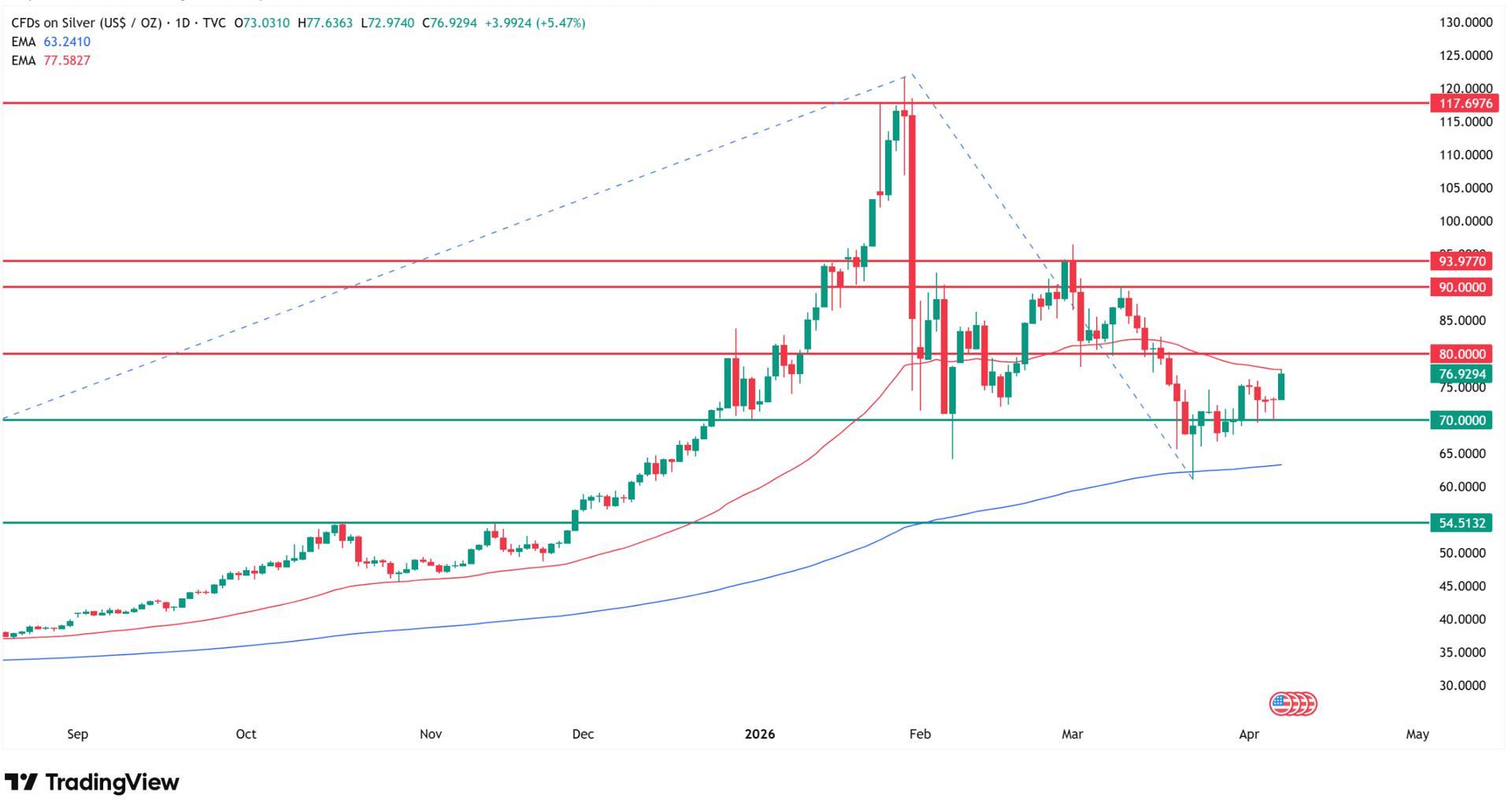
Silver shot
up more than 5% on Wednesday, testing levels above $77 per ounce. The rally
stopped at exactly the level I identified in my most recent silver analysis: the upper boundary of the
consolidation between the 50 and 200 EMA, where the 50 EMA acts as resistance.
Despite the
5%+ daily gain, technically not much has changed. The key support at $70 per
ounce, which my March 20 analysis confirmed has held for the third
time this year, remains the floor. The 200 EMA near $63 is the deeper
structural support. Main resistance sits in the $90-$94 zone, where the early
March highs were recorded.
Why silver price is surging? Source: Tradingview.com
My
Fibonacci extensions, stretched across last year's uptrend and the 2026
correction, project a 100% target near $155 per ounce. That would represent a
100% gain from current levels.
Level
Type
Notes
$90-$94
Resistance zone
Early March 2026 highs
$77
Resistance (50 EMA)
Current upper consolidation boundary
$70
Support
Held three times in 2026
$63
Support (200 EMA)
Structural bull/bear line
$155
Fibonacci target
100% extension, +100% from current
Gold and Silver Price
Predictions for 2026
Institutional
forecasts for both metals remain extraordinarily wide, reflecting the
uncertainty around war, monetary policy, and physical market dynamics. As the FinanceMagnates.com comprehensive
February analysis
established, a Reuters poll of 30 analysts placed the median 2026 gold forecast
at $4,746.50, remarkably close to where gold trades today. The same poll set
silver's median at $79.50.
As the February analysis of the $7,300
gold prediction
showed, JPMorgan's $6,300 target rests on approximately 800 tonnes of projected
central bank gold purchases. Wells Fargo raised its range to $6,100-$6,300 in
late March. For silver, Bank of America's Michael Widmer maintains his $135-$309 target
based on gold-silver ratio compression.
Fed stays hawkish through
year-end, yields rise above 4.5%
Gold fails to close above 50
EMA, retests $4,300 support
Silver breaks below $70, opens
path toward $55 on my chart
FAQ
Why are gold and silver
going up today?
Gold surged
3% to $4,850 and silver jumped nearly 7% to $77 on April 8, 2026, after the US
and Iran announced a two-week ceasefire. The deal sent oil below $100 per
barrel, weakened the dollar by 0.8% against the euro, and boosted rate cut
expectations, all of which directly support precious metals.
How high can gold go in
2026?
My
Fibonacci extension based on the 2025 uptrend and 2026 correction targets
$7,000 per ounce, representing a 50% gain from current levels. Institutional
forecasts range from Goldman Sachs at $5,400 to JPMorgan at $6,300 and UBS at
$5,600. The Reuters 30-analyst median sits at $4,746.50.
How high can silver go in
2026?
My
Fibonacci extension projects $155 per ounce, a potential 100% gain from current
prices near $77. Analyst Marek Rogalski sees near-term resistance at
$79.50-$80. Bank of America's Michael Widmer targets $135-$309 based on
gold-silver ratio compression, while Citigroup set a $150-$170 target.
What is the gold price
prediction for 2026?
JPMorgan
targets $6,300 based on 800 tonnes of central bank purchases. Wells Fargo
raised its forecast to $6,100-$6,300 in late March. Goldman Sachs maintains
$5,400. My chart shows gold consolidating between $4,300 support and $5,400
resistance, with the 50 EMA at $4,850 as the immediate barrier.
Why is silver called
turbo-gold?
Silver
amplifies gold's moves in both directions due to its smaller market and dual
industrial/monetary role. On April 8, silver gained nearly 7% versus gold's 3%.
DM BOŚ analyst Marek Rogalski notes silver has been called
"turbo-gold" for some time, with the breakout above $76.10 confirming
the uptrend from the March 23 panic low.
Gold surged
to $4,850 per ounce today (Wednesday), April 8, 2026, gaining over 3% as the
US-Iran two-week ceasefire triggered a sharp reversal in the dollar and oil
markets. Silver outperformed with a nearly 7% rally to $77 per ounce, its
highest level since March 18.
The
ceasefire announcement followed President Trump's acceptance of a 10-point
Iranian proposal as a starting point for negotiations. Oil fell below $100 per
barrel for the first time since the conflict began in late February, removing
the inflationary pressure that had been the primary headwind for precious
metals.
Follow
me on X for real-time market analysis: @ChmielDk
Why Gold and Silver Are
Going Up? Iran Ceasefire Weakens the Dollar
"Gold
is rising nearly 2% today on the wave of a Middle East ceasefire to around
$4,800, and silver exceeds $77 per ounce, gaining nearly 6%," said Michal
Stajniak, Analyst at XTB. "The prospect of lower oil prices and opening of
the Strait of Hormuz appears to ease inflationary risk, and consequently the
prospect of monetary policy tightening by central banks."
Marek
Rogalski, Chief Market Analyst at DM BOŚ, noted that silver continues to earn
its "turbo-gold" label. "Technically, the breakout of the recent
peak at $76.10 confirms the upward move that started after the March 23
panic," Rogalski said. "Theoretically, the market has an open path to
around $79.50-$80.00, where significant resistance can be identified."
Rogalski
pointed to a broader macro catalyst: "Investors will return to precious
metals when the scenario of Fed rate cuts in December or Q1 2026 starts being
played more strongly. This could give arguments for dollar weakness, as other
central banks will likely remain in an 'inflationary' narrative."
The key
drivers behind today's rally:
US-Iran ceasefire halts military strikes for two
weeks, oil drops below $100/barrel
Dollar weakness of 0.8% against the euro makes
gold cheaper for non-dollar buyers
Rate cut expectations rising as lower oil reduces
inflation pressure on the Fed
Industrial demand for silver stabilizing as
energy market risks ease
Petrodollar risk if growing Chinese influence
in the Middle East reshapes energy trade flows
Gold Technical Analysis: XAU/USD
50 EMA Blocks at $4,850
Gold traded
at $4,780 per ounce at the time of my analysis, up nearly 2%, but briefly
gained approximately 4% and tested $4,857 as the intraday high. The local
resistance I marked on my chart, together with the 50 EMA, blocked further
gains roughly at the midpoint of the consolidation that has defined trading
since January's all-time high.
The upper
boundary of this range sits at $5,400, the highest session close in gold's
history. The intraday ATH reached $5,600 on January 29 before the correction
that followed. Support is the $4,300 zone, the lows tested in late March that
previously served as the October 2025 highs. As my March 25 analysis documented, the pin bar reversal at
the 200 EMA near $4,200 marked the correction low.
Why gold price is going up today? Source: Tradingview.com
Applying
Fibonacci extensions to the 2025 uptrend and the 2026 correction, the 100%
extension falls at approximately $7,000 per ounce. From current levels, that
represents a potential 50% gain.
Level
Type
Notes
$5,600
Resistance (intraday ATH)
January
29 high, never held on close
$5,400
Resistance (closing ATH)
Upper boundary of 2026 consolidation
$4,850
Resistance (50 EMA)
Currently
blocking, midpoint of range
$4,300
Support
Late
March lows, October 2025 highs
$4,200
Support (200 EMA)
March
correction low, structural bull/bear line
$7,000
Fibonacci target
100% extension of 2025 trend
As I wrote
in my previous Goldman Sachs analysis, gold remains trapped in the lower
half of the January consolidation range. A daily close above the 50 EMA at
$4,850 would be the first signal that the correction phase is ending. A break
below $4,300 reopens the path toward the 200 EMA.
Silver shot
up more than 5% on Wednesday, testing levels above $77 per ounce. The rally
stopped at exactly the level I identified in my most recent silver analysis: the upper boundary of the
consolidation between the 50 and 200 EMA, where the 50 EMA acts as resistance.
Despite the
5%+ daily gain, technically not much has changed. The key support at $70 per
ounce, which my March 20 analysis confirmed has held for the third
time this year, remains the floor. The 200 EMA near $63 is the deeper
structural support. Main resistance sits in the $90-$94 zone, where the early
March highs were recorded.
Why silver price is surging? Source: Tradingview.com
My
Fibonacci extensions, stretched across last year's uptrend and the 2026
correction, project a 100% target near $155 per ounce. That would represent a
100% gain from current levels.
Level
Type
Notes
$90-$94
Resistance zone
Early March 2026 highs
$77
Resistance (50 EMA)
Current upper consolidation boundary
$70
Support
Held three times in 2026
$63
Support (200 EMA)
Structural bull/bear line
$155
Fibonacci target
100% extension, +100% from current
Gold and Silver Price
Predictions for 2026
Institutional
forecasts for both metals remain extraordinarily wide, reflecting the
uncertainty around war, monetary policy, and physical market dynamics. As the FinanceMagnates.com comprehensive
February analysis
established, a Reuters poll of 30 analysts placed the median 2026 gold forecast
at $4,746.50, remarkably close to where gold trades today. The same poll set
silver's median at $79.50.
As the February analysis of the $7,300
gold prediction
showed, JPMorgan's $6,300 target rests on approximately 800 tonnes of projected
central bank gold purchases. Wells Fargo raised its range to $6,100-$6,300 in
late March. For silver, Bank of America's Michael Widmer maintains his $135-$309 target
based on gold-silver ratio compression.
Fed stays hawkish through
year-end, yields rise above 4.5%
Gold fails to close above 50
EMA, retests $4,300 support
Silver breaks below $70, opens
path toward $55 on my chart
FAQ
Why are gold and silver
going up today?
Gold surged
3% to $4,850 and silver jumped nearly 7% to $77 on April 8, 2026, after the US
and Iran announced a two-week ceasefire. The deal sent oil below $100 per
barrel, weakened the dollar by 0.8% against the euro, and boosted rate cut
expectations, all of which directly support precious metals.
How high can gold go in
2026?
My
Fibonacci extension based on the 2025 uptrend and 2026 correction targets
$7,000 per ounce, representing a 50% gain from current levels. Institutional
forecasts range from Goldman Sachs at $5,400 to JPMorgan at $6,300 and UBS at
$5,600. The Reuters 30-analyst median sits at $4,746.50.
How high can silver go in
2026?
My
Fibonacci extension projects $155 per ounce, a potential 100% gain from current
prices near $77. Analyst Marek Rogalski sees near-term resistance at
$79.50-$80. Bank of America's Michael Widmer targets $135-$309 based on
gold-silver ratio compression, while Citigroup set a $150-$170 target.
What is the gold price
prediction for 2026?
JPMorgan
targets $6,300 based on 800 tonnes of central bank purchases. Wells Fargo
raised its forecast to $6,100-$6,300 in late March. Goldman Sachs maintains
$5,400. My chart shows gold consolidating between $4,300 support and $5,400
resistance, with the 50 EMA at $4,850 as the immediate barrier.
Why is silver called
turbo-gold?
Silver
amplifies gold's moves in both directions due to its smaller market and dual
industrial/monetary role. On April 8, silver gained nearly 7% versus gold's 3%.
DM BOŚ analyst Marek Rogalski notes silver has been called
"turbo-gold" for some time, with the breakout above $76.10 confirming
the uptrend from the March 23 panic low.
Damian Chmiel is a Senior Analyst & Editor at Finance Magnates with more than 15 years of experience in the CFD and online trading industry. Active as both a trader and journalist since 2010, he focuses on broker coverage, fintech innovation, and regulatory developments across Europe, the Middle East, and Asia.
His work includes interviews with C-level leaders at major brokerages and fintech platforms, as well as co-authoring Finance Magnates’ quarterly industry benchmarking reports. Damian’s reporting is data-driven, market-aware, and grounded in direct industry engagement. His analysis and commentary have also been cited by external media outlets, including Investing.com, Binance, The Asset, Stockhead, and Dispatch.
Education:
MA in Finance and Accounting, Cracow University of Economics
Why Is Dogecoin Going Up Today? DOGE Price Prediction Shows 25% Upside Potential
Featured Videos
XTB Adds Overnight US Stock Trading; Nasdaq Ventures Invests in One Trading
XTB Adds Overnight US Stock Trading; Nasdaq Ventures Invests in One Trading
XTB Adds Overnight US Stock Trading; Nasdaq Ventures Invests in One Trading
XTB Adds Overnight US Stock Trading; Nasdaq Ventures Invests in One Trading
Today’s financial news recap covers XTB expands overnight US stock trading, Fortrade reports higher revenue, Nasdaq backs One Trading, and Vest Labs raises 13 million dollars.
Finance Magnates Daily Recap brings you the latest news from forex and CFD brokers, fintech, payments, cryptocurrency, digital assets, trading platforms, financial regulation and global markets.
Get the key company news, executive moves, deals, regulatory updates and market developments of the day, in just a few minutes. New episodes published every weekday.
Read more: https://www.financemagnates.com
#FinanceMagnates #ForexNews #FintechNews
Today’s financial news recap covers XTB expands overnight US stock trading, Fortrade reports higher revenue, Nasdaq backs One Trading, and Vest Labs raises 13 million dollars.
Finance Magnates Daily Recap brings you the latest news from forex and CFD brokers, fintech, payments, cryptocurrency, digital assets, trading platforms, financial regulation and global markets.
Get the key company news, executive moves, deals, regulatory updates and market developments of the day, in just a few minutes. New episodes published every weekday.
Read more: https://www.financemagnates.com
#FinanceMagnates #ForexNews #FintechNews
Today’s financial news recap covers XTB expands overnight US stock trading, Fortrade reports higher revenue, Nasdaq backs One Trading, and Vest Labs raises 13 million dollars.
Finance Magnates Daily Recap brings you the latest news from forex and CFD brokers, fintech, payments, cryptocurrency, digital assets, trading platforms, financial regulation and global markets.
Get the key company news, executive moves, deals, regulatory updates and market developments of the day, in just a few minutes. New episodes published every weekday.
Read more: https://www.financemagnates.com
#FinanceMagnates #ForexNews #FintechNews
Today’s financial news recap covers XTB expands overnight US stock trading, Fortrade reports higher revenue, Nasdaq backs One Trading, and Vest Labs raises 13 million dollars.
Finance Magnates Daily Recap brings you the latest news from forex and CFD brokers, fintech, payments, cryptocurrency, digital assets, trading platforms, financial regulation and global markets.
Get the key company news, executive moves, deals, regulatory updates and market developments of the day, in just a few minutes. New episodes published every weekday.
Read more: https://www.financemagnates.com
#FinanceMagnates #ForexNews #FintechNews
CMC Founder Downplays Volatility Hit; Devexperts Names CEO
CMC Founder Downplays Volatility Hit; Devexperts Names CEO
CMC Founder Downplays Volatility Hit; Devexperts Names CEO
CMC Founder Downplays Volatility Hit; Devexperts Names CEO
CMC Founder Downplays Volatility Hit; Devexperts Names CEO
CMC Founder Downplays Volatility Hit; Devexperts Names CEO
Today’s financial news recap covers low volatility pressures brokers, Devexperts names a new CEO, Saxo cuts onboarding time, and OKX reaches a 25 billion dollar valuation.
Finance Magnates Daily Recap brings you the latest news from forex and CFD brokers, fintech, payments, cryptocurrency, digital assets, trading platforms, financial regulation and global markets.
Get the key company news, executive moves, deals, regulatory updates and market developments of the day, in just a few minutes. New episodes published every weekday.
Read more: https://www.financemagnates.com
#FinanceMagnates #ForexNews #FintechNews
Today’s financial news recap covers low volatility pressures brokers, Devexperts names a new CEO, Saxo cuts onboarding time, and OKX reaches a 25 billion dollar valuation.
Finance Magnates Daily Recap brings you the latest news from forex and CFD brokers, fintech, payments, cryptocurrency, digital assets, trading platforms, financial regulation and global markets.
Get the key company news, executive moves, deals, regulatory updates and market developments of the day, in just a few minutes. New episodes published every weekday.
Read more: https://www.financemagnates.com
#FinanceMagnates #ForexNews #FintechNews
Today’s financial news recap covers low volatility pressures brokers, Devexperts names a new CEO, Saxo cuts onboarding time, and OKX reaches a 25 billion dollar valuation.
Finance Magnates Daily Recap brings you the latest news from forex and CFD brokers, fintech, payments, cryptocurrency, digital assets, trading platforms, financial regulation and global markets.
Get the key company news, executive moves, deals, regulatory updates and market developments of the day, in just a few minutes. New episodes published every weekday.
Read more: https://www.financemagnates.com
#FinanceMagnates #ForexNews #FintechNews
Today’s financial news recap covers low volatility pressures brokers, Devexperts names a new CEO, Saxo cuts onboarding time, and OKX reaches a 25 billion dollar valuation.
Finance Magnates Daily Recap brings you the latest news from forex and CFD brokers, fintech, payments, cryptocurrency, digital assets, trading platforms, financial regulation and global markets.
Get the key company news, executive moves, deals, regulatory updates and market developments of the day, in just a few minutes. New episodes published every weekday.
Read more: https://www.financemagnates.com
#FinanceMagnates #ForexNews #FintechNews
Today’s financial news recap covers low volatility pressures brokers, Devexperts names a new CEO, Saxo cuts onboarding time, and OKX reaches a 25 billion dollar valuation.
Finance Magnates Daily Recap brings you the latest news from forex and CFD brokers, fintech, payments, cryptocurrency, digital assets, trading platforms, financial regulation and global markets.
Get the key company news, executive moves, deals, regulatory updates and market developments of the day, in just a few minutes. New episodes published every weekday.
Read more: https://www.financemagnates.com
#FinanceMagnates #ForexNews #FintechNews
Today’s financial news recap covers low volatility pressures brokers, Devexperts names a new CEO, Saxo cuts onboarding time, and OKX reaches a 25 billion dollar valuation.
Finance Magnates Daily Recap brings you the latest news from forex and CFD brokers, fintech, payments, cryptocurrency, digital assets, trading platforms, financial regulation and global markets.
Get the key company news, executive moves, deals, regulatory updates and market developments of the day, in just a few minutes. New episodes published every weekday.
Read more: https://www.financemagnates.com
#FinanceMagnates #ForexNews #FintechNews
Today’s financial news recap covers Trade Nation buys FXCM's UK client book, Trading 212 reports higher revenue, the CFTC's move to allow perpetual index futures.
Finance Magnates Daily Recap brings you the latest news from forex and CFD brokers, fintech, payments, cryptocurrency, digital assets, trading platforms, financial regulation and global markets.
Get the key company news, executive moves, deals, regulatory updates and market developments of the day, in just a few minutes. New episodes published every weekday.
Read more: https://www.financemagnates.com
#FinanceMagnates #ForexNews #FintechNews
Today’s financial news recap covers Trade Nation buys FXCM's UK client book, Trading 212 reports higher revenue, the CFTC's move to allow perpetual index futures.
Finance Magnates Daily Recap brings you the latest news from forex and CFD brokers, fintech, payments, cryptocurrency, digital assets, trading platforms, financial regulation and global markets.
Get the key company news, executive moves, deals, regulatory updates and market developments of the day, in just a few minutes. New episodes published every weekday.
Read more: https://www.financemagnates.com
#FinanceMagnates #ForexNews #FintechNews
Today’s financial news recap covers Trade Nation buys FXCM's UK client book, Trading 212 reports higher revenue, the CFTC's move to allow perpetual index futures.
Finance Magnates Daily Recap brings you the latest news from forex and CFD brokers, fintech, payments, cryptocurrency, digital assets, trading platforms, financial regulation and global markets.
Get the key company news, executive moves, deals, regulatory updates and market developments of the day, in just a few minutes. New episodes published every weekday.
Read more: https://www.financemagnates.com
#FinanceMagnates #ForexNews #FintechNews
Today’s financial news recap covers Trade Nation buys FXCM's UK client book, Trading 212 reports higher revenue, the CFTC's move to allow perpetual index futures.
Finance Magnates Daily Recap brings you the latest news from forex and CFD brokers, fintech, payments, cryptocurrency, digital assets, trading platforms, financial regulation and global markets.
Get the key company news, executive moves, deals, regulatory updates and market developments of the day, in just a few minutes. New episodes published every weekday.
Read more: https://www.financemagnates.com
#FinanceMagnates #ForexNews #FintechNews
Today’s financial news recap covers Trade Nation buys FXCM's UK client book, Trading 212 reports higher revenue, the CFTC's move to allow perpetual index futures.
Finance Magnates Daily Recap brings you the latest news from forex and CFD brokers, fintech, payments, cryptocurrency, digital assets, trading platforms, financial regulation and global markets.
Get the key company news, executive moves, deals, regulatory updates and market developments of the day, in just a few minutes. New episodes published every weekday.
Read more: https://www.financemagnates.com
#FinanceMagnates #ForexNews #FintechNews
Today’s financial news recap covers Trade Nation buys FXCM's UK client book, Trading 212 reports higher revenue, the CFTC's move to allow perpetual index futures.
Finance Magnates Daily Recap brings you the latest news from forex and CFD brokers, fintech, payments, cryptocurrency, digital assets, trading platforms, financial regulation and global markets.
Get the key company news, executive moves, deals, regulatory updates and market developments of the day, in just a few minutes. New episodes published every weekday.
Read more: https://www.financemagnates.com
#FinanceMagnates #ForexNews #FintechNews
Your career isn’t a linear path.
Your career isn’t a linear path.
Your career isn’t a linear path.
Your career isn’t a linear path.
Your career isn’t a linear path.
Your career isn’t a linear path.
Roles change. Career goals change. Sometimes you want a completely new challenge.
But the skills and knowledge you build along the way can stay with you and give you something to build on.
For Jeff Patterson, that continued growth is key to long-term career development.
You bring the skills. FM Academy helps you build the knowledge.
#FMAcademy #FinanceMagnates #FinanceCareers #ProfessionalDevelopment #Fintech
Roles change. Career goals change. Sometimes you want a completely new challenge.
But the skills and knowledge you build along the way can stay with you and give you something to build on.
For Jeff Patterson, that continued growth is key to long-term career development.
You bring the skills. FM Academy helps you build the knowledge.
#FMAcademy #FinanceMagnates #FinanceCareers #ProfessionalDevelopment #Fintech
Roles change. Career goals change. Sometimes you want a completely new challenge.
But the skills and knowledge you build along the way can stay with you and give you something to build on.
For Jeff Patterson, that continued growth is key to long-term career development.
You bring the skills. FM Academy helps you build the knowledge.
#FMAcademy #FinanceMagnates #FinanceCareers #ProfessionalDevelopment #Fintech
Roles change. Career goals change. Sometimes you want a completely new challenge.
But the skills and knowledge you build along the way can stay with you and give you something to build on.
For Jeff Patterson, that continued growth is key to long-term career development.
You bring the skills. FM Academy helps you build the knowledge.
#FMAcademy #FinanceMagnates #FinanceCareers #ProfessionalDevelopment #Fintech
Roles change. Career goals change. Sometimes you want a completely new challenge.
But the skills and knowledge you build along the way can stay with you and give you something to build on.
For Jeff Patterson, that continued growth is key to long-term career development.
You bring the skills. FM Academy helps you build the knowledge.
#FMAcademy #FinanceMagnates #FinanceCareers #ProfessionalDevelopment #Fintech
Roles change. Career goals change. Sometimes you want a completely new challenge.
But the skills and knowledge you build along the way can stay with you and give you something to build on.
For Jeff Patterson, that continued growth is key to long-term career development.
You bring the skills. FM Academy helps you build the knowledge.
#FMAcademy #FinanceMagnates #FinanceCareers #ProfessionalDevelopment #Fintech
IG Group Tech Chiefs Exit; Pepperstone Revenue Grows
IG Group Tech Chiefs Exit; Pepperstone Revenue Grows
IG Group Tech Chiefs Exit; Pepperstone Revenue Grows
IG Group Tech Chiefs Exit; Pepperstone Revenue Grows
IG Group Tech Chiefs Exit; Pepperstone Revenue Grows
IG Group Tech Chiefs Exit; Pepperstone Revenue Grows
Today’s financial news recap covers IG Group loses two technology chiefs, Pepperstone reports double-digit growth, and eToro backs a euro stablecoin.
Finance Magnates Daily Recap brings you the latest news from forex and CFD brokers, fintech, payments, cryptocurrency, digital assets, trading platforms, financial regulation and global markets.
Get the key company news, executive moves, deals, regulatory updates and market developments of the day, in just a few minutes. New episodes published every weekday.
Read more: https://www.financemagnates.com
#FinanceMagnates #ForexNews #FintechNews
Today’s financial news recap covers IG Group loses two technology chiefs, Pepperstone reports double-digit growth, and eToro backs a euro stablecoin.
Finance Magnates Daily Recap brings you the latest news from forex and CFD brokers, fintech, payments, cryptocurrency, digital assets, trading platforms, financial regulation and global markets.
Get the key company news, executive moves, deals, regulatory updates and market developments of the day, in just a few minutes. New episodes published every weekday.
Read more: https://www.financemagnates.com
#FinanceMagnates #ForexNews #FintechNews
Today’s financial news recap covers IG Group loses two technology chiefs, Pepperstone reports double-digit growth, and eToro backs a euro stablecoin.
Finance Magnates Daily Recap brings you the latest news from forex and CFD brokers, fintech, payments, cryptocurrency, digital assets, trading platforms, financial regulation and global markets.
Get the key company news, executive moves, deals, regulatory updates and market developments of the day, in just a few minutes. New episodes published every weekday.
Read more: https://www.financemagnates.com
#FinanceMagnates #ForexNews #FintechNews
Today’s financial news recap covers IG Group loses two technology chiefs, Pepperstone reports double-digit growth, and eToro backs a euro stablecoin.
Finance Magnates Daily Recap brings you the latest news from forex and CFD brokers, fintech, payments, cryptocurrency, digital assets, trading platforms, financial regulation and global markets.
Get the key company news, executive moves, deals, regulatory updates and market developments of the day, in just a few minutes. New episodes published every weekday.
Read more: https://www.financemagnates.com
#FinanceMagnates #ForexNews #FintechNews
Today’s financial news recap covers IG Group loses two technology chiefs, Pepperstone reports double-digit growth, and eToro backs a euro stablecoin.
Finance Magnates Daily Recap brings you the latest news from forex and CFD brokers, fintech, payments, cryptocurrency, digital assets, trading platforms, financial regulation and global markets.
Get the key company news, executive moves, deals, regulatory updates and market developments of the day, in just a few minutes. New episodes published every weekday.
Read more: https://www.financemagnates.com
#FinanceMagnates #ForexNews #FintechNews
Today’s financial news recap covers IG Group loses two technology chiefs, Pepperstone reports double-digit growth, and eToro backs a euro stablecoin.
Finance Magnates Daily Recap brings you the latest news from forex and CFD brokers, fintech, payments, cryptocurrency, digital assets, trading platforms, financial regulation and global markets.
Get the key company news, executive moves, deals, regulatory updates and market developments of the day, in just a few minutes. New episodes published every weekday.
Read more: https://www.financemagnates.com
#FinanceMagnates #ForexNews #FintechNews