Silver has fallen for four consecutive sessions, losing nearly 20% from Monday's intraday high and touching its lowest level in six weeks.
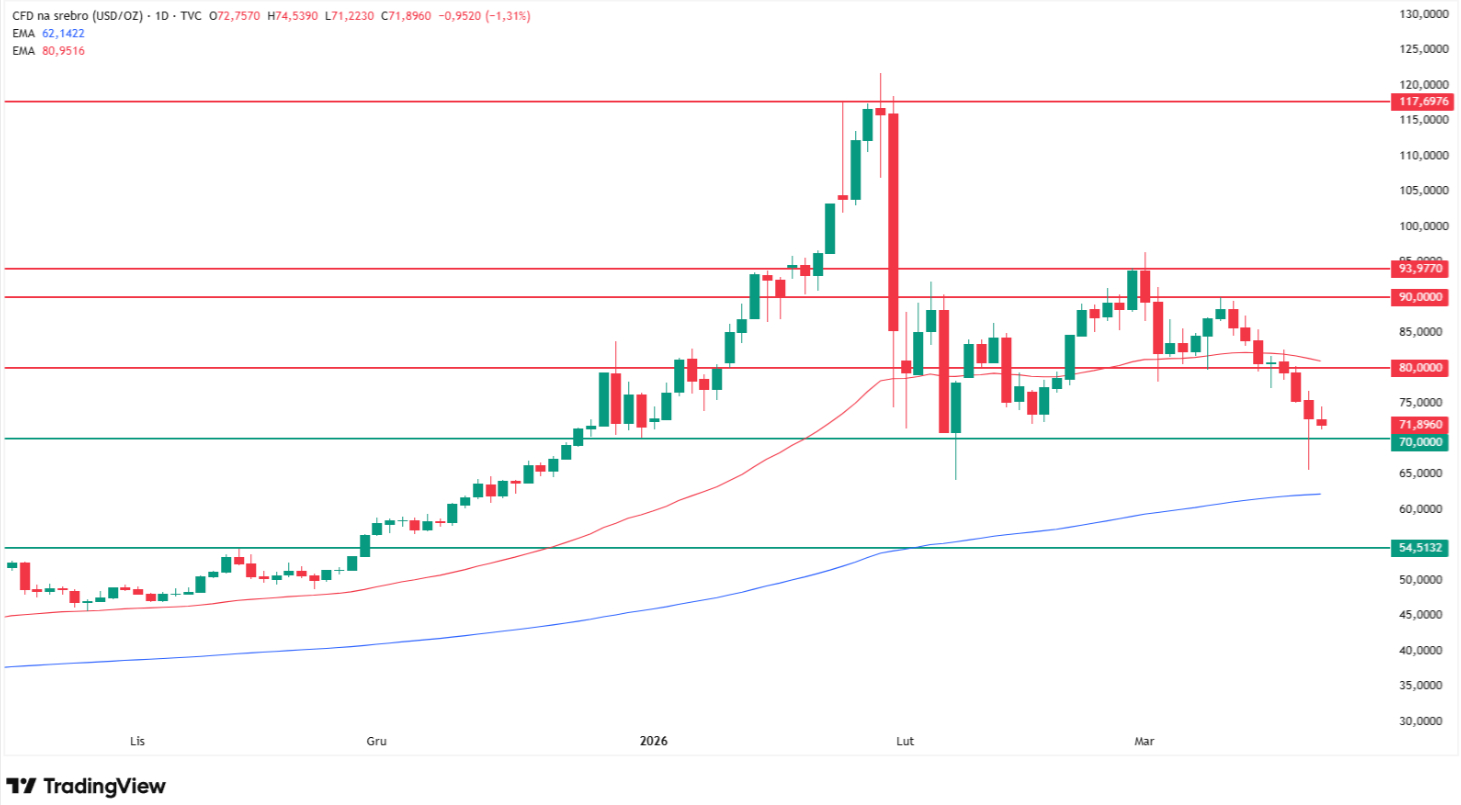
Technical analysis shows the $70 support has held for the third time since the start of 2026, providing a potential swing trade bounce.
The bearish silver price prediction, however, targets a potential 25% downturn to below $55 per ounce.
Why silver price is going down today and what are the newest silver price forecasts?
Silver
price is having a brutal week. The metal has fallen for four straight
sessions, losing nearly 20% from Monday's closing highs in what is turning
into one of the sharpest multi-day corrections of 2026.
On Friday,
March 20, 2026, spot silver is down over 1% and trading near $72 per
ounce - its lowest price since early February and now deeply into the
support zone that has stopped every significant selloff since the start of this
year.
The
question that every silver trader is asking right now is the same one I am
asking on my chart: is $70 going to hold for the third time, or is this
the break that opens the real downside?
In this
article, I will break down technical analysis of the XAG/USD chart, examine why
the metal is selling off so hard, and compile the most significant silver price
predictions for 2026. Based on my over 15 years of experience as an analyst and
retail investor, here is what I am watching.
Follow
me on X for real-time silver market analysis: @ChmielDk
Why Silver Is Crashing? The
Fed Delivered a Body Blow
Wednesday's
Federal Reserve decision was the trigger, but the setup had been building for
weeks. The Fed held rates at 3.5%-3.75% and revised its 2026 dot plot down to
just one cut, citing persistent inflation from oil prices elevated by the
Strait of Hormuz situation.
For silver
- which had run from $40 to $121 in roughly fourteen months almost entirely on
dovish Fed expectations and dollar weakness - the signal hit like a
sledgehammer. The hawkish hold pushed the Dollar Index above 99.9 and Treasury
yields to 4.2%, both direct headwinds for non-yielding precious metals.
Silver
amplifies gold's moves in both directions, and my Thursday gold
analysis confirmed
exactly that pattern: gold dropped 6% over two sessions while silver dropped
nearly 20% from its weekly high.
Silver Technical Analysis:
$70 Holds for the Third Time - For Now
As my chart
shows, silver has fallen for four consecutive sessions and from Monday's
intraday peak to Friday's low near $71, the decline is approaching
20%. However, the most important observation on my chart is not the scale of
the fall - it is what is happening at the bottom.
The $70
support level has now held for the third time since the start of 2026.
That is not a coincidence. It represents a genuine zone where buyers have
repeatedly stepped in, and as long as it continues to hold on a closing basis,
the consolidation structure I have been tracking for six weeks remains intact.
In the
context of swing trading this consolidation, the current position at the bottom
of the range - with $70 holding - points to a bounce back toward the
upper boundary as the higher-probability near-term move.
The path
upward has obstacles: a local resistance around $80.50, defined by
the December 26 highs, will create friction on any recovery. Above that, the
upper consolidation boundary at $90-$94 - last tested on
February 27 and March 2, where a bearish engulfing pattern caused a sharp
reversal - remains the ceiling of the range.
But I must
be honest about the downside scenario on my chart, because it is serious.
A daily close below $70 changes everything. Below that level,
the next meaningful support is the 200-day MA at approximately $62.
Below $62, the final structural support before a truly significant retracement
is the October 2025 historical highs at $55 per ounce.
Why silver price is falling? Source: Tradingview.com
From
Friday's $72, that extreme scenario represents a potential decline of
approximately 25%.
Level
Type
Notes
$121
All-time high (Jan 29, 2026)
Silver -41% from here
$90-$94
Upper consolidation band
Bearish
engulf rejection Feb 27/Mar 2
$80.50
Local resistance
Dec 26
highs, friction on any bounce
$72
Current price (Mar 20)
-1%+ Friday, four red sessions
$70
Critical support (3x tested)
Lower consolidation boundary
$62
Bear target 1
200-day MA
$55
Bear target 2
Oct 2025 historical highs, -25%
The Cycle Warning: A 3-4
Year Bear Market?
Most silver
commentary focuses on the next few weeks. @CyclesFan is thinking in
years. His January 28 post - which generated 37,000 views -
delivered a blunt warning: "This is going to end badly. We have a 7-year
cycle low coming in late 2029. Once this parabolic rally tops, if it hasn't
topped already, silver is headed into a 3-4 year bear market."
This is going to end badly. We have a 7 year cycle low coming in late 2029. Once this parabolic rally tops, if it hasn't topped already, silver is headed into a 3-4 year bear market.https://t.co/Er8v7bxscP
Whether the
January 29 high was the cycle top that he was warning about, or whether it was
only a temporary peak before an eventual higher high, is the question that
determines whether the how high can
silver go analysis targeting $300 in 2026 is still live, or whether CyclesFan's 3-4
year bear market has already begun.
The BIS
quarterly review adds institutional weight to the caution: their March 2026
analysis frames the January spike and crash as a classic boom-bust driven by
speculative excess rather than a durable repricing of fundamental value.
The analyst
forecast range for silver in 2026 is among the widest of any asset class,
reflecting genuine disagreement about whether January's $121 high was a peak or
a preview. The earlier
How Low Can Silver Go analysis established the downside framework at $55-$62. The institutional
forecasts for year-end cluster in a more optimistic range, but have been
shifting lower as the March correction deepens.
UBS holds
the most pessimistic institutional year-end target at $85,
representing roughly 18% upside from Friday's $72 price. Commerzbank's mid-year
estimate of $92 sits similarly. CoinCodex's algorithmic model
flags $56.82 as its near-term target but projects recovery
toward $83.92 by year-end.
At the bull
end, GoldSilver's Alan Hibbard expects silver to "perform better in 2026
than it did in 2025" and would "not be surprised to see the price
increase by over $100 per ounce to $175+". Robert Kiyosaki's $200 silver
prediction, made in the context of his "biggest bubble bust"
scenario, sits at the extreme end.
Bank of
America's Michael Widmer maintains his extraordinary $135-$309 target based on
gold-silver ratio compression and industrial demand.
Source
Silver Target
Notes
CoinCodex near-term model
$56.82
Bearish sentiment signal
My chart (extreme bear)
$55
Oct 2025 highs, -25% from current
My chart (bear target)
$62
200-day MA
UBS
$85 (year-end)
Most pessimistic institutional
Commerzbank
$92 (mid-2026)
GoldSilver / Hibbard
$175+
Supply deficit driven
Bank of America (Widmer)
$135-$309
Gold-silver ratio compression
Robert Kiyosaki
$200
Post-bubble-bust scenario
My chart (bull)
$120
ATH retest if $94 breaks
FAQ, Silver Price Analysis
Why is silver crashing
this week?
Silver has
fallen four consecutive sessions for a total decline approaching 20% from
Monday's intraday high, triggered by Wednesday's hawkish Federal Reserve
decision that cut 2026 rate cut projections from two to one while citing
persistent oil-driven inflation from the Strait of Hormuz situation.
How low can silver go in
2026?
As shown on
my chart, the $70 lower consolidation boundary is the critical line in the sand
- it has held for the third time this year and is currently being tested. A
sustained break below $70 targets the 200-day MA at $62, then
the October 2025 historical highs at $55 - representing
approximately 25% further downside from Friday's $72.
What is the silver price
prediction for 2026?
The range
spans from CoinCodex's near-term $56.82 and UBS's pessimistic $85 year-end
target to Bank of America's $135-$309 and GoldSilver's $175+ bull case. My
technical analysis identifies $120 (the January all-time high) as the bull
target if the $94 upper consolidation boundary breaks with conviction, and $55
as the bear target if $70 fails. The May Fed meeting is the next major catalyst
that could determine which scenario dominates the second quarter.
Is $70 a genuine support
level for silver?
Yes - and
my chart shows it has proven so on two prior occasions in 2026, generating
meaningful recoveries each time. The level coincides with the December 2025
lows and the February 2026 lows, making it a structurally significant zone with
genuine buying interest.
Silver
price is having a brutal week. The metal has fallen for four straight
sessions, losing nearly 20% from Monday's closing highs in what is turning
into one of the sharpest multi-day corrections of 2026.
On Friday,
March 20, 2026, spot silver is down over 1% and trading near $72 per
ounce - its lowest price since early February and now deeply into the
support zone that has stopped every significant selloff since the start of this
year.
The
question that every silver trader is asking right now is the same one I am
asking on my chart: is $70 going to hold for the third time, or is this
the break that opens the real downside?
In this
article, I will break down technical analysis of the XAG/USD chart, examine why
the metal is selling off so hard, and compile the most significant silver price
predictions for 2026. Based on my over 15 years of experience as an analyst and
retail investor, here is what I am watching.
Follow
me on X for real-time silver market analysis: @ChmielDk
Why Silver Is Crashing? The
Fed Delivered a Body Blow
Wednesday's
Federal Reserve decision was the trigger, but the setup had been building for
weeks. The Fed held rates at 3.5%-3.75% and revised its 2026 dot plot down to
just one cut, citing persistent inflation from oil prices elevated by the
Strait of Hormuz situation.
For silver
- which had run from $40 to $121 in roughly fourteen months almost entirely on
dovish Fed expectations and dollar weakness - the signal hit like a
sledgehammer. The hawkish hold pushed the Dollar Index above 99.9 and Treasury
yields to 4.2%, both direct headwinds for non-yielding precious metals.
Silver
amplifies gold's moves in both directions, and my Thursday gold
analysis confirmed
exactly that pattern: gold dropped 6% over two sessions while silver dropped
nearly 20% from its weekly high.
Silver Technical Analysis:
$70 Holds for the Third Time - For Now
As my chart
shows, silver has fallen for four consecutive sessions and from Monday's
intraday peak to Friday's low near $71, the decline is approaching
20%. However, the most important observation on my chart is not the scale of
the fall - it is what is happening at the bottom.
The $70
support level has now held for the third time since the start of 2026.
That is not a coincidence. It represents a genuine zone where buyers have
repeatedly stepped in, and as long as it continues to hold on a closing basis,
the consolidation structure I have been tracking for six weeks remains intact.
In the
context of swing trading this consolidation, the current position at the bottom
of the range - with $70 holding - points to a bounce back toward the
upper boundary as the higher-probability near-term move.
The path
upward has obstacles: a local resistance around $80.50, defined by
the December 26 highs, will create friction on any recovery. Above that, the
upper consolidation boundary at $90-$94 - last tested on
February 27 and March 2, where a bearish engulfing pattern caused a sharp
reversal - remains the ceiling of the range.
But I must
be honest about the downside scenario on my chart, because it is serious.
A daily close below $70 changes everything. Below that level,
the next meaningful support is the 200-day MA at approximately $62.
Below $62, the final structural support before a truly significant retracement
is the October 2025 historical highs at $55 per ounce.
Why silver price is falling? Source: Tradingview.com
From
Friday's $72, that extreme scenario represents a potential decline of
approximately 25%.
Level
Type
Notes
$121
All-time high (Jan 29, 2026)
Silver -41% from here
$90-$94
Upper consolidation band
Bearish
engulf rejection Feb 27/Mar 2
$80.50
Local resistance
Dec 26
highs, friction on any bounce
$72
Current price (Mar 20)
-1%+ Friday, four red sessions
$70
Critical support (3x tested)
Lower consolidation boundary
$62
Bear target 1
200-day MA
$55
Bear target 2
Oct 2025 historical highs, -25%
The Cycle Warning: A 3-4
Year Bear Market?
Most silver
commentary focuses on the next few weeks. @CyclesFan is thinking in
years. His January 28 post - which generated 37,000 views -
delivered a blunt warning: "This is going to end badly. We have a 7-year
cycle low coming in late 2029. Once this parabolic rally tops, if it hasn't
topped already, silver is headed into a 3-4 year bear market."
This is going to end badly. We have a 7 year cycle low coming in late 2029. Once this parabolic rally tops, if it hasn't topped already, silver is headed into a 3-4 year bear market.https://t.co/Er8v7bxscP
Whether the
January 29 high was the cycle top that he was warning about, or whether it was
only a temporary peak before an eventual higher high, is the question that
determines whether the how high can
silver go analysis targeting $300 in 2026 is still live, or whether CyclesFan's 3-4
year bear market has already begun.
The BIS
quarterly review adds institutional weight to the caution: their March 2026
analysis frames the January spike and crash as a classic boom-bust driven by
speculative excess rather than a durable repricing of fundamental value.
The analyst
forecast range for silver in 2026 is among the widest of any asset class,
reflecting genuine disagreement about whether January's $121 high was a peak or
a preview. The earlier
How Low Can Silver Go analysis established the downside framework at $55-$62. The institutional
forecasts for year-end cluster in a more optimistic range, but have been
shifting lower as the March correction deepens.
UBS holds
the most pessimistic institutional year-end target at $85,
representing roughly 18% upside from Friday's $72 price. Commerzbank's mid-year
estimate of $92 sits similarly. CoinCodex's algorithmic model
flags $56.82 as its near-term target but projects recovery
toward $83.92 by year-end.
At the bull
end, GoldSilver's Alan Hibbard expects silver to "perform better in 2026
than it did in 2025" and would "not be surprised to see the price
increase by over $100 per ounce to $175+". Robert Kiyosaki's $200 silver
prediction, made in the context of his "biggest bubble bust"
scenario, sits at the extreme end.
Bank of
America's Michael Widmer maintains his extraordinary $135-$309 target based on
gold-silver ratio compression and industrial demand.
Source
Silver Target
Notes
CoinCodex near-term model
$56.82
Bearish sentiment signal
My chart (extreme bear)
$55
Oct 2025 highs, -25% from current
My chart (bear target)
$62
200-day MA
UBS
$85 (year-end)
Most pessimistic institutional
Commerzbank
$92 (mid-2026)
GoldSilver / Hibbard
$175+
Supply deficit driven
Bank of America (Widmer)
$135-$309
Gold-silver ratio compression
Robert Kiyosaki
$200
Post-bubble-bust scenario
My chart (bull)
$120
ATH retest if $94 breaks
FAQ, Silver Price Analysis
Why is silver crashing
this week?
Silver has
fallen four consecutive sessions for a total decline approaching 20% from
Monday's intraday high, triggered by Wednesday's hawkish Federal Reserve
decision that cut 2026 rate cut projections from two to one while citing
persistent oil-driven inflation from the Strait of Hormuz situation.
How low can silver go in
2026?
As shown on
my chart, the $70 lower consolidation boundary is the critical line in the sand
- it has held for the third time this year and is currently being tested. A
sustained break below $70 targets the 200-day MA at $62, then
the October 2025 historical highs at $55 - representing
approximately 25% further downside from Friday's $72.
What is the silver price
prediction for 2026?
The range
spans from CoinCodex's near-term $56.82 and UBS's pessimistic $85 year-end
target to Bank of America's $135-$309 and GoldSilver's $175+ bull case. My
technical analysis identifies $120 (the January all-time high) as the bull
target if the $94 upper consolidation boundary breaks with conviction, and $55
as the bear target if $70 fails. The May Fed meeting is the next major catalyst
that could determine which scenario dominates the second quarter.
Is $70 a genuine support
level for silver?
Yes - and
my chart shows it has proven so on two prior occasions in 2026, generating
meaningful recoveries each time. The level coincides with the December 2025
lows and the February 2026 lows, making it a structurally significant zone with
genuine buying interest.
Damian Chmiel is a Senior Analyst & Editor at Finance Magnates with more than 15 years of experience in the CFD and online trading industry. Active as both a trader and journalist since 2010, he focuses on broker coverage, fintech innovation, and regulatory developments across Europe, the Middle East, and Asia.
His work includes interviews with C-level leaders at major brokerages and fintech platforms, as well as co-authoring Finance Magnates’ quarterly industry benchmarking reports. Damian’s reporting is data-driven, market-aware, and grounded in direct industry engagement. His analysis and commentary have also been cited by external media outlets, including Investing.com, Binance, The Asset, Stockhead, and Dispatch.
Education:
MA in Finance and Accounting, Cracow University of Economics
Why Is Dogecoin Going Up Today? DOGE Price Prediction Shows 25% Upside Potential
Featured Videos
AvaTrade to Acquire Most of FXCM; NAGA Raises $8M
AvaTrade to Acquire Most of FXCM; NAGA Raises $8M
AvaTrade to Acquire Most of FXCM; NAGA Raises $8M
AvaTrade to Acquire Most of FXCM; NAGA Raises $8M
Today’s financial news recap covers AvaTrade agrees to acquire most of FXCM, NAGA secures eight million dollars in new financing, and Wise seeks a tax settlement in the UK.
Finance Magnates Daily Recap brings you the latest news from forex and CFD brokers, fintech, payments, cryptocurrency, digital assets, trading platforms, financial regulation and global markets.
Get the key company news, executive moves, deals, regulatory updates and market developments of the day, in just a few minutes. New episodes published every weekday.
Read more: https://www.financemagnates.com
#FinanceMagnates #ForexNews #FintechNews
Today’s financial news recap covers AvaTrade agrees to acquire most of FXCM, NAGA secures eight million dollars in new financing, and Wise seeks a tax settlement in the UK.
Finance Magnates Daily Recap brings you the latest news from forex and CFD brokers, fintech, payments, cryptocurrency, digital assets, trading platforms, financial regulation and global markets.
Get the key company news, executive moves, deals, regulatory updates and market developments of the day, in just a few minutes. New episodes published every weekday.
Read more: https://www.financemagnates.com
#FinanceMagnates #ForexNews #FintechNews
Today’s financial news recap covers AvaTrade agrees to acquire most of FXCM, NAGA secures eight million dollars in new financing, and Wise seeks a tax settlement in the UK.
Finance Magnates Daily Recap brings you the latest news from forex and CFD brokers, fintech, payments, cryptocurrency, digital assets, trading platforms, financial regulation and global markets.
Get the key company news, executive moves, deals, regulatory updates and market developments of the day, in just a few minutes. New episodes published every weekday.
Read more: https://www.financemagnates.com
#FinanceMagnates #ForexNews #FintechNews
Today’s financial news recap covers AvaTrade agrees to acquire most of FXCM, NAGA secures eight million dollars in new financing, and Wise seeks a tax settlement in the UK.
Finance Magnates Daily Recap brings you the latest news from forex and CFD brokers, fintech, payments, cryptocurrency, digital assets, trading platforms, financial regulation and global markets.
Get the key company news, executive moves, deals, regulatory updates and market developments of the day, in just a few minutes. New episodes published every weekday.
Read more: https://www.financemagnates.com
#FinanceMagnates #ForexNews #FintechNews
XTB Adds Overnight US Stock Trading; Nasdaq Ventures Invests in One Trading
XTB Adds Overnight US Stock Trading; Nasdaq Ventures Invests in One Trading
XTB Adds Overnight US Stock Trading; Nasdaq Ventures Invests in One Trading
XTB Adds Overnight US Stock Trading; Nasdaq Ventures Invests in One Trading
XTB Adds Overnight US Stock Trading; Nasdaq Ventures Invests in One Trading
XTB Adds Overnight US Stock Trading; Nasdaq Ventures Invests in One Trading
Today’s financial news recap covers XTB expands overnight US stock trading, Fortrade reports higher revenue, Nasdaq backs One Trading, and Vest Labs raises 13 million dollars.
Finance Magnates Daily Recap brings you the latest news from forex and CFD brokers, fintech, payments, cryptocurrency, digital assets, trading platforms, financial regulation and global markets.
Get the key company news, executive moves, deals, regulatory updates and market developments of the day, in just a few minutes. New episodes published every weekday.
Read more: https://www.financemagnates.com
#FinanceMagnates #ForexNews #FintechNews
Today’s financial news recap covers XTB expands overnight US stock trading, Fortrade reports higher revenue, Nasdaq backs One Trading, and Vest Labs raises 13 million dollars.
Finance Magnates Daily Recap brings you the latest news from forex and CFD brokers, fintech, payments, cryptocurrency, digital assets, trading platforms, financial regulation and global markets.
Get the key company news, executive moves, deals, regulatory updates and market developments of the day, in just a few minutes. New episodes published every weekday.
Read more: https://www.financemagnates.com
#FinanceMagnates #ForexNews #FintechNews
Today’s financial news recap covers XTB expands overnight US stock trading, Fortrade reports higher revenue, Nasdaq backs One Trading, and Vest Labs raises 13 million dollars.
Finance Magnates Daily Recap brings you the latest news from forex and CFD brokers, fintech, payments, cryptocurrency, digital assets, trading platforms, financial regulation and global markets.
Get the key company news, executive moves, deals, regulatory updates and market developments of the day, in just a few minutes. New episodes published every weekday.
Read more: https://www.financemagnates.com
#FinanceMagnates #ForexNews #FintechNews
Today’s financial news recap covers XTB expands overnight US stock trading, Fortrade reports higher revenue, Nasdaq backs One Trading, and Vest Labs raises 13 million dollars.
Finance Magnates Daily Recap brings you the latest news from forex and CFD brokers, fintech, payments, cryptocurrency, digital assets, trading platforms, financial regulation and global markets.
Get the key company news, executive moves, deals, regulatory updates and market developments of the day, in just a few minutes. New episodes published every weekday.
Read more: https://www.financemagnates.com
#FinanceMagnates #ForexNews #FintechNews
Today’s financial news recap covers XTB expands overnight US stock trading, Fortrade reports higher revenue, Nasdaq backs One Trading, and Vest Labs raises 13 million dollars.
Finance Magnates Daily Recap brings you the latest news from forex and CFD brokers, fintech, payments, cryptocurrency, digital assets, trading platforms, financial regulation and global markets.
Get the key company news, executive moves, deals, regulatory updates and market developments of the day, in just a few minutes. New episodes published every weekday.
Read more: https://www.financemagnates.com
#FinanceMagnates #ForexNews #FintechNews
Today’s financial news recap covers XTB expands overnight US stock trading, Fortrade reports higher revenue, Nasdaq backs One Trading, and Vest Labs raises 13 million dollars.
Finance Magnates Daily Recap brings you the latest news from forex and CFD brokers, fintech, payments, cryptocurrency, digital assets, trading platforms, financial regulation and global markets.
Get the key company news, executive moves, deals, regulatory updates and market developments of the day, in just a few minutes. New episodes published every weekday.
Read more: https://www.financemagnates.com
#FinanceMagnates #ForexNews #FintechNews
CMC Founder Downplays Volatility Hit; Devexperts Names CEO
CMC Founder Downplays Volatility Hit; Devexperts Names CEO
CMC Founder Downplays Volatility Hit; Devexperts Names CEO
CMC Founder Downplays Volatility Hit; Devexperts Names CEO
CMC Founder Downplays Volatility Hit; Devexperts Names CEO
CMC Founder Downplays Volatility Hit; Devexperts Names CEO
Today’s financial news recap covers low volatility pressures brokers, Devexperts names a new CEO, Saxo cuts onboarding time, and OKX reaches a 25 billion dollar valuation.
Finance Magnates Daily Recap brings you the latest news from forex and CFD brokers, fintech, payments, cryptocurrency, digital assets, trading platforms, financial regulation and global markets.
Get the key company news, executive moves, deals, regulatory updates and market developments of the day, in just a few minutes. New episodes published every weekday.
Read more: https://www.financemagnates.com
#FinanceMagnates #ForexNews #FintechNews
Today’s financial news recap covers low volatility pressures brokers, Devexperts names a new CEO, Saxo cuts onboarding time, and OKX reaches a 25 billion dollar valuation.
Finance Magnates Daily Recap brings you the latest news from forex and CFD brokers, fintech, payments, cryptocurrency, digital assets, trading platforms, financial regulation and global markets.
Get the key company news, executive moves, deals, regulatory updates and market developments of the day, in just a few minutes. New episodes published every weekday.
Read more: https://www.financemagnates.com
#FinanceMagnates #ForexNews #FintechNews
Today’s financial news recap covers low volatility pressures brokers, Devexperts names a new CEO, Saxo cuts onboarding time, and OKX reaches a 25 billion dollar valuation.
Finance Magnates Daily Recap brings you the latest news from forex and CFD brokers, fintech, payments, cryptocurrency, digital assets, trading platforms, financial regulation and global markets.
Get the key company news, executive moves, deals, regulatory updates and market developments of the day, in just a few minutes. New episodes published every weekday.
Read more: https://www.financemagnates.com
#FinanceMagnates #ForexNews #FintechNews
Today’s financial news recap covers low volatility pressures brokers, Devexperts names a new CEO, Saxo cuts onboarding time, and OKX reaches a 25 billion dollar valuation.
Finance Magnates Daily Recap brings you the latest news from forex and CFD brokers, fintech, payments, cryptocurrency, digital assets, trading platforms, financial regulation and global markets.
Get the key company news, executive moves, deals, regulatory updates and market developments of the day, in just a few minutes. New episodes published every weekday.
Read more: https://www.financemagnates.com
#FinanceMagnates #ForexNews #FintechNews
Today’s financial news recap covers low volatility pressures brokers, Devexperts names a new CEO, Saxo cuts onboarding time, and OKX reaches a 25 billion dollar valuation.
Finance Magnates Daily Recap brings you the latest news from forex and CFD brokers, fintech, payments, cryptocurrency, digital assets, trading platforms, financial regulation and global markets.
Get the key company news, executive moves, deals, regulatory updates and market developments of the day, in just a few minutes. New episodes published every weekday.
Read more: https://www.financemagnates.com
#FinanceMagnates #ForexNews #FintechNews
Today’s financial news recap covers low volatility pressures brokers, Devexperts names a new CEO, Saxo cuts onboarding time, and OKX reaches a 25 billion dollar valuation.
Finance Magnates Daily Recap brings you the latest news from forex and CFD brokers, fintech, payments, cryptocurrency, digital assets, trading platforms, financial regulation and global markets.
Get the key company news, executive moves, deals, regulatory updates and market developments of the day, in just a few minutes. New episodes published every weekday.
Read more: https://www.financemagnates.com
#FinanceMagnates #ForexNews #FintechNews
Today’s financial news recap covers Trade Nation buys FXCM's UK client book, Trading 212 reports higher revenue, the CFTC's move to allow perpetual index futures.
Finance Magnates Daily Recap brings you the latest news from forex and CFD brokers, fintech, payments, cryptocurrency, digital assets, trading platforms, financial regulation and global markets.
Get the key company news, executive moves, deals, regulatory updates and market developments of the day, in just a few minutes. New episodes published every weekday.
Read more: https://www.financemagnates.com
#FinanceMagnates #ForexNews #FintechNews
Today’s financial news recap covers Trade Nation buys FXCM's UK client book, Trading 212 reports higher revenue, the CFTC's move to allow perpetual index futures.
Finance Magnates Daily Recap brings you the latest news from forex and CFD brokers, fintech, payments, cryptocurrency, digital assets, trading platforms, financial regulation and global markets.
Get the key company news, executive moves, deals, regulatory updates and market developments of the day, in just a few minutes. New episodes published every weekday.
Read more: https://www.financemagnates.com
#FinanceMagnates #ForexNews #FintechNews
Today’s financial news recap covers Trade Nation buys FXCM's UK client book, Trading 212 reports higher revenue, the CFTC's move to allow perpetual index futures.
Finance Magnates Daily Recap brings you the latest news from forex and CFD brokers, fintech, payments, cryptocurrency, digital assets, trading platforms, financial regulation and global markets.
Get the key company news, executive moves, deals, regulatory updates and market developments of the day, in just a few minutes. New episodes published every weekday.
Read more: https://www.financemagnates.com
#FinanceMagnates #ForexNews #FintechNews
Today’s financial news recap covers Trade Nation buys FXCM's UK client book, Trading 212 reports higher revenue, the CFTC's move to allow perpetual index futures.
Finance Magnates Daily Recap brings you the latest news from forex and CFD brokers, fintech, payments, cryptocurrency, digital assets, trading platforms, financial regulation and global markets.
Get the key company news, executive moves, deals, regulatory updates and market developments of the day, in just a few minutes. New episodes published every weekday.
Read more: https://www.financemagnates.com
#FinanceMagnates #ForexNews #FintechNews
Today’s financial news recap covers Trade Nation buys FXCM's UK client book, Trading 212 reports higher revenue, the CFTC's move to allow perpetual index futures.
Finance Magnates Daily Recap brings you the latest news from forex and CFD brokers, fintech, payments, cryptocurrency, digital assets, trading platforms, financial regulation and global markets.
Get the key company news, executive moves, deals, regulatory updates and market developments of the day, in just a few minutes. New episodes published every weekday.
Read more: https://www.financemagnates.com
#FinanceMagnates #ForexNews #FintechNews
Today’s financial news recap covers Trade Nation buys FXCM's UK client book, Trading 212 reports higher revenue, the CFTC's move to allow perpetual index futures.
Finance Magnates Daily Recap brings you the latest news from forex and CFD brokers, fintech, payments, cryptocurrency, digital assets, trading platforms, financial regulation and global markets.
Get the key company news, executive moves, deals, regulatory updates and market developments of the day, in just a few minutes. New episodes published every weekday.
Read more: https://www.financemagnates.com
#FinanceMagnates #ForexNews #FintechNews
Your career isn’t a linear path.
Your career isn’t a linear path.
Your career isn’t a linear path.
Your career isn’t a linear path.
Your career isn’t a linear path.
Your career isn’t a linear path.
Roles change. Career goals change. Sometimes you want a completely new challenge.
But the skills and knowledge you build along the way can stay with you and give you something to build on.
For Jeff Patterson, that continued growth is key to long-term career development.
You bring the skills. FM Academy helps you build the knowledge.
#FMAcademy #FinanceMagnates #FinanceCareers #ProfessionalDevelopment #Fintech
Roles change. Career goals change. Sometimes you want a completely new challenge.
But the skills and knowledge you build along the way can stay with you and give you something to build on.
For Jeff Patterson, that continued growth is key to long-term career development.
You bring the skills. FM Academy helps you build the knowledge.
#FMAcademy #FinanceMagnates #FinanceCareers #ProfessionalDevelopment #Fintech
Roles change. Career goals change. Sometimes you want a completely new challenge.
But the skills and knowledge you build along the way can stay with you and give you something to build on.
For Jeff Patterson, that continued growth is key to long-term career development.
You bring the skills. FM Academy helps you build the knowledge.
#FMAcademy #FinanceMagnates #FinanceCareers #ProfessionalDevelopment #Fintech
Roles change. Career goals change. Sometimes you want a completely new challenge.
But the skills and knowledge you build along the way can stay with you and give you something to build on.
For Jeff Patterson, that continued growth is key to long-term career development.
You bring the skills. FM Academy helps you build the knowledge.
#FMAcademy #FinanceMagnates #FinanceCareers #ProfessionalDevelopment #Fintech
Roles change. Career goals change. Sometimes you want a completely new challenge.
But the skills and knowledge you build along the way can stay with you and give you something to build on.
For Jeff Patterson, that continued growth is key to long-term career development.
You bring the skills. FM Academy helps you build the knowledge.
#FMAcademy #FinanceMagnates #FinanceCareers #ProfessionalDevelopment #Fintech
Roles change. Career goals change. Sometimes you want a completely new challenge.
But the skills and knowledge you build along the way can stay with you and give you something to build on.
For Jeff Patterson, that continued growth is key to long-term career development.
You bring the skills. FM Academy helps you build the knowledge.
#FMAcademy #FinanceMagnates #FinanceCareers #ProfessionalDevelopment #Fintech