The silver price rallied to $48.66 on Monday, consolidating near the October record high of $53.34, with CNBC analysis suggesting that silver could double to $100.
Robert Kiyosaki is predicting "$75 next", declaring "silver and Ethereum hot, hot, hot," while my Fibonacci technical analysis identifies $72 and $88 targets.
Silver prices are following gold this year in testing all-time highs, and despite the current correction experts are forecasting new reocrds soon.
How high can silver price go? Check XAG/USD technical analysis and silver price prediction
Silver
prices rebounded today (Monday), 3 November 2025, to $48.66 per ounce (+1.03%),
consolidating near record highs as analysts increasingly predict the white
metal could double toward $100 once it decisively breaks through the
psychologically critical $50 barrier.
My
technical analysis of XAG/USD, based on more than a decade of experience as a trader and
analyst, also confirms the potential for strong gains. In this article, I
examine why silver is increasing and how high the silver price could go.
Why Silver Price Is Going
Up Today?
After a
modest correction from historical highs tested in October, prices are
rebounding from the 50-day exponential moving average (50 EMA) and moving in
consolidation still close to record prices.
Silver Price Metrics
November 3, 2025
Current Price
$48.66/oz
Daily Change
+$0.495 (+1.03%)
Session Range
$47.80-$48.72
Year High (Oct 2025)
$53.34
Year Low
$28.31
YTD Gain
+71.9%
Silver's
rebound coincides with rising market turbulence as investors trimmed exposure
to risk assets. The Federal Reserve
delivered a quarter-point rate cut as expected, but Chair Jerome Powell's
remarks about data dependency limited expectations for additional easing in
December.
"Although
the central bank delivered a quarter-point rate cut, Chair Jerome Powell's
remarks about data dependency limited expectations for additional easing in
December," according to Jainam Mehta from Traders Union.
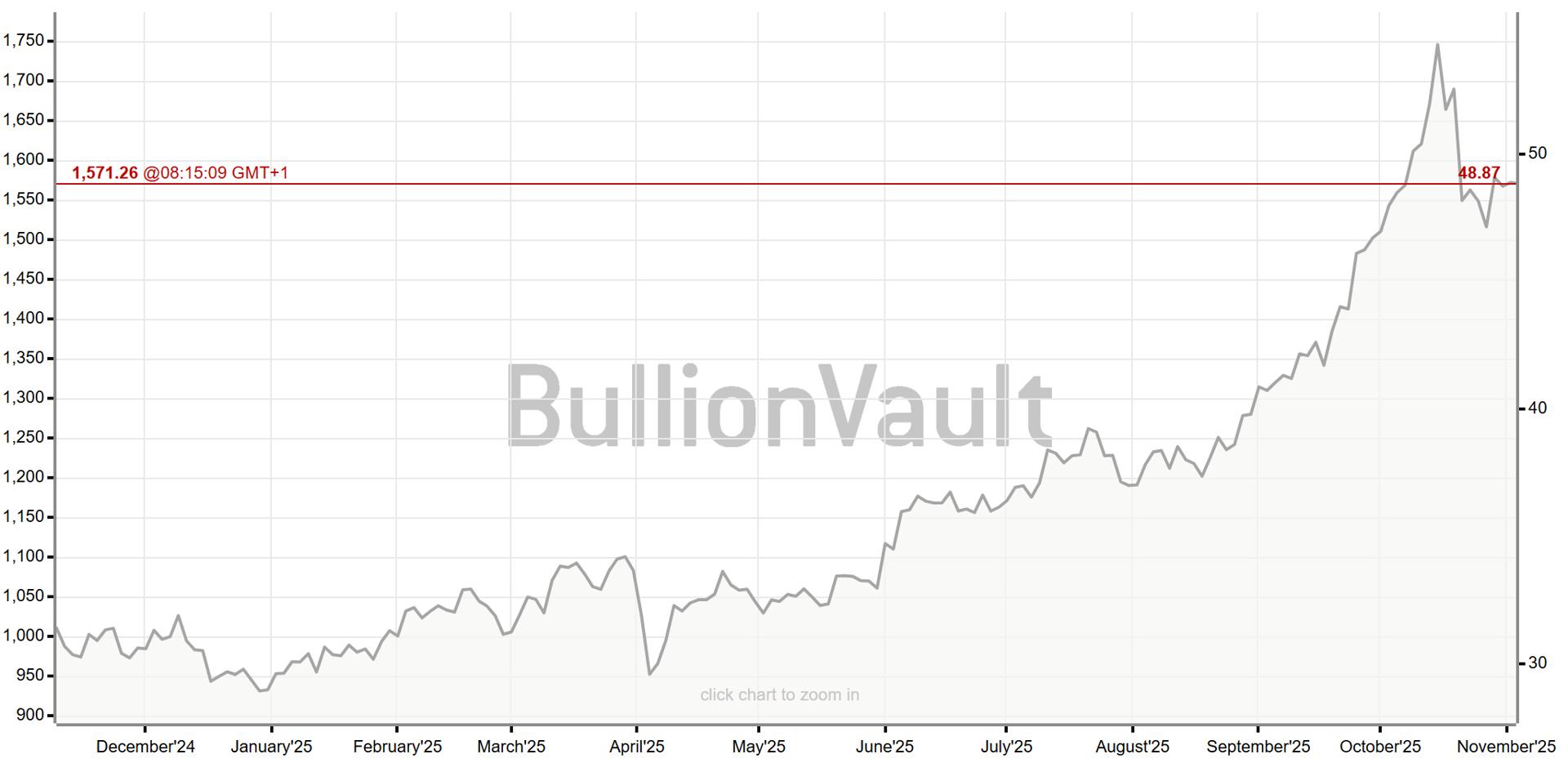
Silver price today. Source: Bullion Vault
The
Trump-Xi summit brought modest progress on trade but failed to deliver major
breakthroughs.
At this
moment, the most significant area will be resistance around $54, and breaking
through it will open the path to price discovery.
How High Can Silver Go? Analysts
See Silver Doubling to $100 After $50 Breakout
Several analysts
believe silver could surge dramatically once it crosses and holds above the $50
psychological threshold. According to a CNBC analysis published October 13,
silver could double to $100 per ounce after successfully breaching the $50 mark,
a level that has proven to be major resistance since the 2011 peak of $49.45
(which was briefly exceeded in October 2025 when silver hit $53.34).
"Despite recent gains, silver is still cheap compared to gold. Lower U.S. yields, limited availability of physical metal, and robust industrial and investor demand are propelling prices into new territory. With this persistent imbalance between supply and demand, a $100 silver price by the end of 2026 is certainly within reach," Solomon Global analysts predict.
Robert Kiyosaki’s Silver
Price Prediction: Whie Metal Heading to $75 Next
Kiyosaki
has been consistently bullish on silver throughout 2025, advocating for
precious metals as protection against fiat currency debasement and monetary
policy uncertainty. His $75 prediction aligns remarkably well with my technical
analysis using Fibonacci extensions, which I'll detail below.
Silver Technical Analysis:
Fibonacci Extensions Point to $72-$88 Targets
According
to my technical analysis, although nobody possesses a crystal ball, we can use
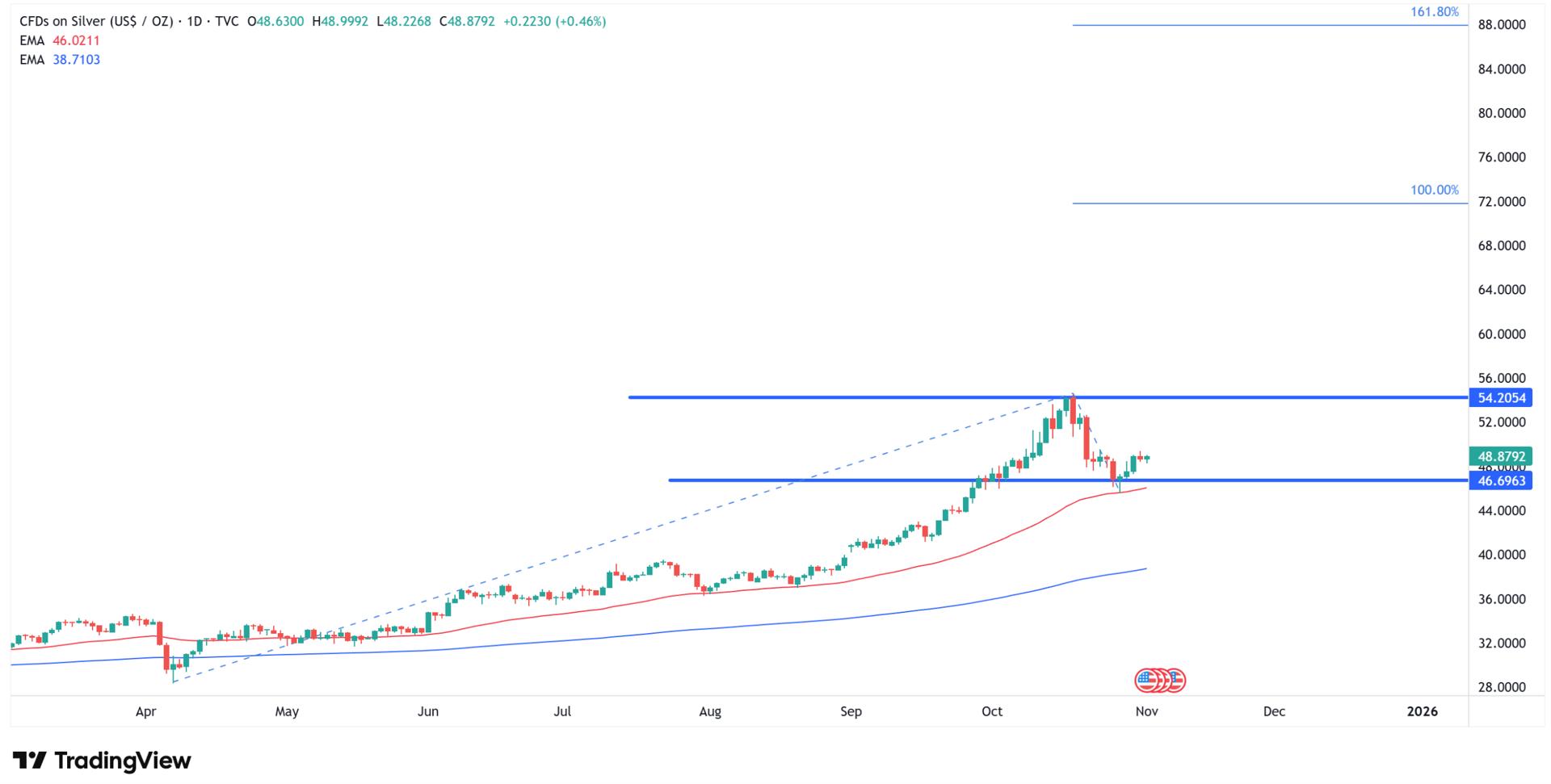
Fibonacci extensions for guidance. These extensions, stretched across the
uptrend observed from April lows this year to October highs and the correction
from the last two weeks, show that the 100% extension falls around $72,
which aligns perfectly with Robert Kiyosaki's predictions of further price
increases.
The 161.8%
Fibonacci extension lands around $88, which in turn aligns with
predictions that silver prices could double in the medium term. These technical
projections provide mathematical support for the bullish narratives emerging
from fundamental analysts and prominent investors.
The current
consolidation between $47-$49 represents a healthy pause after silver's
extraordinary 71.9% year-to-date rally. Silver starting the week at $48.83,
rebounding from the 50 EMA, suggests the white metal is building a platform for
the next leg higher rather than experiencing a trend reversal.
Major
financial institutions have published aggressively bullish silver forecasts.
Bank of America projects silver reaching a $65 peak in 2026,
averaging $56.25 for the year, representing 34% upside from current $48.66
levels.
Institution
2025 Forecast
2026 Forecast
Peak Target
Upside %
Bank of America
—
$56.25 avg
$65 peak
+34%
CoinPriceForecast
—
$70 end-2026
—
+44%
Robert Kiyosaki
$50+
$75
—
+54%
CNBC Analysis
—
—
$100 (post-$50 breakout)
+105%
Fibonacci 100%
—
—
$72
+48%
Fibonacci 161.8%
—
—
$88
+81%
According
to Traders Union's outlook: "Silver's short-term outlook remains
constructive as long as prices stay above $48.00 and the 200-EMA base. The
narrow consolidation range between $48.00 and $50.00 reflects a market
searching for balance after several volatile sessions."
Before you leave, please also check my previous analyses of the precious metals market:
Silver
trades at $48.66 after 71.9% YTD rally with institutional forecasts ranging
from HSBC's $50-$53 near-term to Bank of America's $65 peak 2026 (+34% upside),
Robert Kiyosaki predicting $75 (+54%), CNBC analysis suggesting $100 doubling
scenario after $50 breakout, and my Fibonacci technical analysis identifying
$72 (100% extension) and $88 (161.8% extension) targets from April-October
rally measured from recent two-week correction.
Why is silver rising so
fast?
Silver's
71.9% YTD gain driven by gold spillover effect (HSBC: "gains in gold
attract ancillary buying in silver" as gold crossed $4,000), London
physical market tightness from US tariff-driven flows creating supply
constraints, Federal Reserve rate cuts reducing opportunity cost of
non-yielding assets, safe-haven demand amid market volatility, industrial
demand acceleration (solar panels, EVs), volume surging to 10,227 (10.45x
average) indicating institutional accumulation, golden cross formation (50-day
MA $44.93 above 200-day MA $36.99).
Will silver hit $50 again this
year?
Yes. Silver
at $48.66 sits only 2.8% below $50 psychological barrier with Jainam Mehta
(Traders Union) noting "sustained move above $49.50-$50.00 could revive
bullish momentum," HSBC expecting test of $50 "in near term,"
RSI at 60.9 showing improving momentum, volume 10.45x average confirming buying
interest, though key resistance $48.33-$48.60 (20/50 EMA) must be broken first,
with failure to hold $48 risking retest of $47 support before another attempt.
Is silver a better
investment than gold now?
Yes. Silver
up 71.9% YTD vs gold +55% (silver outperforming), gold/silver ratio 82:1 vs
historical 60:1 average (silver undervalued 27% on relative basis). However,
silver exhibits higher volatility (50 vol asset requiring larger position risk
management), industrial demand provides structural support that gold lacks, but
gold remains the primary safe-haven with deeper liquidity for larger
allocations.
Silver
prices rebounded today (Monday), 3 November 2025, to $48.66 per ounce (+1.03%),
consolidating near record highs as analysts increasingly predict the white
metal could double toward $100 once it decisively breaks through the
psychologically critical $50 barrier.
My
technical analysis of XAG/USD, based on more than a decade of experience as a trader and
analyst, also confirms the potential for strong gains. In this article, I
examine why silver is increasing and how high the silver price could go.
Why Silver Price Is Going
Up Today?
After a
modest correction from historical highs tested in October, prices are
rebounding from the 50-day exponential moving average (50 EMA) and moving in
consolidation still close to record prices.
Silver Price Metrics
November 3, 2025
Current Price
$48.66/oz
Daily Change
+$0.495 (+1.03%)
Session Range
$47.80-$48.72
Year High (Oct 2025)
$53.34
Year Low
$28.31
YTD Gain
+71.9%
Silver's
rebound coincides with rising market turbulence as investors trimmed exposure
to risk assets. The Federal Reserve
delivered a quarter-point rate cut as expected, but Chair Jerome Powell's
remarks about data dependency limited expectations for additional easing in
December.
"Although
the central bank delivered a quarter-point rate cut, Chair Jerome Powell's
remarks about data dependency limited expectations for additional easing in
December," according to Jainam Mehta from Traders Union.
Silver price today. Source: Bullion Vault
The
Trump-Xi summit brought modest progress on trade but failed to deliver major
breakthroughs.
At this
moment, the most significant area will be resistance around $54, and breaking
through it will open the path to price discovery.
How High Can Silver Go? Analysts
See Silver Doubling to $100 After $50 Breakout
Several analysts
believe silver could surge dramatically once it crosses and holds above the $50
psychological threshold. According to a CNBC analysis published October 13,
silver could double to $100 per ounce after successfully breaching the $50 mark,
a level that has proven to be major resistance since the 2011 peak of $49.45
(which was briefly exceeded in October 2025 when silver hit $53.34).
"Despite recent gains, silver is still cheap compared to gold. Lower U.S. yields, limited availability of physical metal, and robust industrial and investor demand are propelling prices into new territory. With this persistent imbalance between supply and demand, a $100 silver price by the end of 2026 is certainly within reach," Solomon Global analysts predict.
Robert Kiyosaki’s Silver
Price Prediction: Whie Metal Heading to $75 Next
Kiyosaki
has been consistently bullish on silver throughout 2025, advocating for
precious metals as protection against fiat currency debasement and monetary
policy uncertainty. His $75 prediction aligns remarkably well with my technical
analysis using Fibonacci extensions, which I'll detail below.
Silver Technical Analysis:
Fibonacci Extensions Point to $72-$88 Targets
According
to my technical analysis, although nobody possesses a crystal ball, we can use
Fibonacci extensions for guidance. These extensions, stretched across the
uptrend observed from April lows this year to October highs and the correction
from the last two weeks, show that the 100% extension falls around $72,
which aligns perfectly with Robert Kiyosaki's predictions of further price
increases.
The 161.8%
Fibonacci extension lands around $88, which in turn aligns with
predictions that silver prices could double in the medium term. These technical
projections provide mathematical support for the bullish narratives emerging
from fundamental analysts and prominent investors.
The current
consolidation between $47-$49 represents a healthy pause after silver's
extraordinary 71.9% year-to-date rally. Silver starting the week at $48.83,
rebounding from the 50 EMA, suggests the white metal is building a platform for
the next leg higher rather than experiencing a trend reversal.
Major
financial institutions have published aggressively bullish silver forecasts.
Bank of America projects silver reaching a $65 peak in 2026,
averaging $56.25 for the year, representing 34% upside from current $48.66
levels.
Institution
2025 Forecast
2026 Forecast
Peak Target
Upside %
Bank of America
—
$56.25 avg
$65 peak
+34%
CoinPriceForecast
—
$70 end-2026
—
+44%
Robert Kiyosaki
$50+
$75
—
+54%
CNBC Analysis
—
—
$100 (post-$50 breakout)
+105%
Fibonacci 100%
—
—
$72
+48%
Fibonacci 161.8%
—
—
$88
+81%
According
to Traders Union's outlook: "Silver's short-term outlook remains
constructive as long as prices stay above $48.00 and the 200-EMA base. The
narrow consolidation range between $48.00 and $50.00 reflects a market
searching for balance after several volatile sessions."
Before you leave, please also check my previous analyses of the precious metals market:
Silver
trades at $48.66 after 71.9% YTD rally with institutional forecasts ranging
from HSBC's $50-$53 near-term to Bank of America's $65 peak 2026 (+34% upside),
Robert Kiyosaki predicting $75 (+54%), CNBC analysis suggesting $100 doubling
scenario after $50 breakout, and my Fibonacci technical analysis identifying
$72 (100% extension) and $88 (161.8% extension) targets from April-October
rally measured from recent two-week correction.
Why is silver rising so
fast?
Silver's
71.9% YTD gain driven by gold spillover effect (HSBC: "gains in gold
attract ancillary buying in silver" as gold crossed $4,000), London
physical market tightness from US tariff-driven flows creating supply
constraints, Federal Reserve rate cuts reducing opportunity cost of
non-yielding assets, safe-haven demand amid market volatility, industrial
demand acceleration (solar panels, EVs), volume surging to 10,227 (10.45x
average) indicating institutional accumulation, golden cross formation (50-day
MA $44.93 above 200-day MA $36.99).
Will silver hit $50 again this
year?
Yes. Silver
at $48.66 sits only 2.8% below $50 psychological barrier with Jainam Mehta
(Traders Union) noting "sustained move above $49.50-$50.00 could revive
bullish momentum," HSBC expecting test of $50 "in near term,"
RSI at 60.9 showing improving momentum, volume 10.45x average confirming buying
interest, though key resistance $48.33-$48.60 (20/50 EMA) must be broken first,
with failure to hold $48 risking retest of $47 support before another attempt.
Is silver a better
investment than gold now?
Yes. Silver
up 71.9% YTD vs gold +55% (silver outperforming), gold/silver ratio 82:1 vs
historical 60:1 average (silver undervalued 27% on relative basis). However,
silver exhibits higher volatility (50 vol asset requiring larger position risk
management), industrial demand provides structural support that gold lacks, but
gold remains the primary safe-haven with deeper liquidity for larger
allocations.
Damian Chmiel is a Senior Analyst & Editor at Finance Magnates with more than 15 years of experience in the CFD and online trading industry. Active as both a trader and journalist since 2010, he focuses on broker coverage, fintech innovation, and regulatory developments across Europe, the Middle East, and Asia.
His work includes interviews with C-level leaders at major brokerages and fintech platforms, as well as co-authoring Finance Magnates’ quarterly industry benchmarking reports. Damian’s reporting is data-driven, market-aware, and grounded in direct industry engagement. His analysis and commentary have also been cited by external media outlets, including Investing.com, Binance, The Asset, Stockhead, and Dispatch.
Education:
MA in Finance and Accounting, Cracow University of Economics
Inside the Prediction Markets: $1.6B Institutional Inflow Meets a Federal Crackdown
Featured Videos
FP Markets Winner Spotlight 🏆 | Global Broker of the Year 2025 #Trading #Broker #Innovation #Shorts
FP Markets Winner Spotlight 🏆 | Global Broker of the Year 2025 #Trading #Broker #Innovation #Shorts
FP Markets Winner Spotlight 🏆 | Global Broker of the Year 2025 #Trading #Broker #Innovation #Shorts
FP Markets Winner Spotlight 🏆 | Global Broker of the Year 2025 #Trading #Broker #Innovation #Shorts
FP Markets takes the spotlight as Global Broker of the Year 2025 at the Finance Magnates Awards.
Martin Stoilov, Head of Client Experience, shares that trust, innovation, and people played a key role in the company’s success, supported by a strong foundation of integrity and client-centricity.
Following this milestone, FP Markets continues to focus on growth, technology investment, and its core values of transparency and excellence.
👉 Be part of FM Awards 2026: https://awards.financemagnates.com/#nominate
FP Markets takes the spotlight as Global Broker of the Year 2025 at the Finance Magnates Awards.
Martin Stoilov, Head of Client Experience, shares that trust, innovation, and people played a key role in the company’s success, supported by a strong foundation of integrity and client-centricity.
Following this milestone, FP Markets continues to focus on growth, technology investment, and its core values of transparency and excellence.
👉 Be part of FM Awards 2026: https://awards.financemagnates.com/#nominate
FP Markets takes the spotlight as Global Broker of the Year 2025 at the Finance Magnates Awards.
Martin Stoilov, Head of Client Experience, shares that trust, innovation, and people played a key role in the company’s success, supported by a strong foundation of integrity and client-centricity.
Following this milestone, FP Markets continues to focus on growth, technology investment, and its core values of transparency and excellence.
👉 Be part of FM Awards 2026: https://awards.financemagnates.com/#nominate
FP Markets takes the spotlight as Global Broker of the Year 2025 at the Finance Magnates Awards.
Martin Stoilov, Head of Client Experience, shares that trust, innovation, and people played a key role in the company’s success, supported by a strong foundation of integrity and client-centricity.
Following this milestone, FP Markets continues to focus on growth, technology investment, and its core values of transparency and excellence.
👉 Be part of FM Awards 2026: https://awards.financemagnates.com/#nominate
In this video, we review @HolaPrimeMarketsOfficial, a multi-asset forex and CFDs broker offering different account types, trading platforms, and flexible trading conditions.
We cover the broker’s overall offering, including account options, trading environment, platforms like MT4 and MT5, and additional services such as managed accounts and fast withdrawals.
Watch the full video to see if Hola Prime Markets fits your trading needs.
📣 Stay up to date with the latest in finance and trading. Follow Finance Magnates for industry news, insights, and global event coverage.
Connect with us:
🔗 LinkedIn: /financemagnates
👍 Facebook: /financemagnates
📸 Instagram: https://www.instagram.com/financemagnates
🐦 X: https://x.com/financemagnates
🎥 TikTok: https://www.tiktok.com/tag/financemagnates
▶️ YouTube: /@financemagnates_official
#HolaPrime #ForexBroker #CFDTrading #FinanceMagnates #Trading #Forex #BrokerReview
In this video, we review @HolaPrimeMarketsOfficial, a multi-asset forex and CFDs broker offering different account types, trading platforms, and flexible trading conditions.
We cover the broker’s overall offering, including account options, trading environment, platforms like MT4 and MT5, and additional services such as managed accounts and fast withdrawals.
Watch the full video to see if Hola Prime Markets fits your trading needs.
📣 Stay up to date with the latest in finance and trading. Follow Finance Magnates for industry news, insights, and global event coverage.
Connect with us:
🔗 LinkedIn: /financemagnates
👍 Facebook: /financemagnates
📸 Instagram: https://www.instagram.com/financemagnates
🐦 X: https://x.com/financemagnates
🎥 TikTok: https://www.tiktok.com/tag/financemagnates
▶️ YouTube: /@financemagnates_official
#HolaPrime #ForexBroker #CFDTrading #FinanceMagnates #Trading #Forex #BrokerReview
In this video, we review @HolaPrimeMarketsOfficial, a multi-asset forex and CFDs broker offering different account types, trading platforms, and flexible trading conditions.
We cover the broker’s overall offering, including account options, trading environment, platforms like MT4 and MT5, and additional services such as managed accounts and fast withdrawals.
Watch the full video to see if Hola Prime Markets fits your trading needs.
📣 Stay up to date with the latest in finance and trading. Follow Finance Magnates for industry news, insights, and global event coverage.
Connect with us:
🔗 LinkedIn: /financemagnates
👍 Facebook: /financemagnates
📸 Instagram: https://www.instagram.com/financemagnates
🐦 X: https://x.com/financemagnates
🎥 TikTok: https://www.tiktok.com/tag/financemagnates
▶️ YouTube: /@financemagnates_official
#HolaPrime #ForexBroker #CFDTrading #FinanceMagnates #Trading #Forex #BrokerReview
In this video, we review @HolaPrimeMarketsOfficial, a multi-asset forex and CFDs broker offering different account types, trading platforms, and flexible trading conditions.
We cover the broker’s overall offering, including account options, trading environment, platforms like MT4 and MT5, and additional services such as managed accounts and fast withdrawals.
Watch the full video to see if Hola Prime Markets fits your trading needs.
📣 Stay up to date with the latest in finance and trading. Follow Finance Magnates for industry news, insights, and global event coverage.
Connect with us:
🔗 LinkedIn: /financemagnates
👍 Facebook: /financemagnates
📸 Instagram: https://www.instagram.com/financemagnates
🐦 X: https://x.com/financemagnates
🎥 TikTok: https://www.tiktok.com/tag/financemagnates
▶️ YouTube: /@financemagnates_official
#HolaPrime #ForexBroker #CFDTrading #FinanceMagnates #Trading #Forex #BrokerReview
In this video, we review @HolaPrimeMarketsOfficial, a multi-asset forex and CFDs broker offering different account types, trading platforms, and flexible trading conditions.
We cover the broker’s overall offering, including account options, trading environment, platforms like MT4 and MT5, and additional services such as managed accounts and fast withdrawals.
Watch the full video to see if Hola Prime Markets fits your trading needs.
📣 Stay up to date with the latest in finance and trading. Follow Finance Magnates for industry news, insights, and global event coverage.
Connect with us:
🔗 LinkedIn: /financemagnates
👍 Facebook: /financemagnates
📸 Instagram: https://www.instagram.com/financemagnates
🐦 X: https://x.com/financemagnates
🎥 TikTok: https://www.tiktok.com/tag/financemagnates
▶️ YouTube: /@financemagnates_official
#HolaPrime #ForexBroker #CFDTrading #FinanceMagnates #Trading #Forex #BrokerReview
In this video, we review @HolaPrimeMarketsOfficial, a multi-asset forex and CFDs broker offering different account types, trading platforms, and flexible trading conditions.
We cover the broker’s overall offering, including account options, trading environment, platforms like MT4 and MT5, and additional services such as managed accounts and fast withdrawals.
Watch the full video to see if Hola Prime Markets fits your trading needs.
📣 Stay up to date with the latest in finance and trading. Follow Finance Magnates for industry news, insights, and global event coverage.
Connect with us:
🔗 LinkedIn: /financemagnates
👍 Facebook: /financemagnates
📸 Instagram: https://www.instagram.com/financemagnates
🐦 X: https://x.com/financemagnates
🎥 TikTok: https://www.tiktok.com/tag/financemagnates
▶️ YouTube: /@financemagnates_official
#HolaPrime #ForexBroker #CFDTrading #FinanceMagnates #Trading #Forex #BrokerReview
Hola Prime Review: What You Need to Know | Full Breakdown by Finance Magnates
Hola Prime Review: What You Need to Know | Full Breakdown by Finance Magnates
Hola Prime Review: What You Need to Know | Full Breakdown by Finance Magnates
Hola Prime Review: What You Need to Know | Full Breakdown by Finance Magnates
Hola Prime Review: What You Need to Know | Full Breakdown by Finance Magnates
Hola Prime Review: What You Need to Know | Full Breakdown by Finance Magnates
In this video, we review @HolaPrime_Global, a proprietary trading firm offering evaluation programs and performance-based payouts in simulated market environments.
We cover how the challenge model works, including account types, profit splits (up to 95%), trading rules, and what it takes to reach a funded account. You’ll also learn about available platforms like MT4, MT5, cTrader, and more, along with insights into payouts, support, and trading conditions.
Watch the full video to see if Hola Prime fits your trading style.
📣 Stay up to date with the latest in finance and trading. Follow Finance Magnates for industry news, insights, and global event coverage.
Connect with us:
🔗 LinkedIn: /financemagnates
👍 Facebook: /financemagnates
📸 Instagram: https://www.instagram.com/financemagnates
🐦 X: https://x.com/financemagnates
🎥 TikTok: https://www.tiktok.com/tag/financemagnates
▶️ YouTube: /@financemagnates_official
#HolaPrime #PropFirm #Trading #FinanceMagnates #Forex #FuturesTrading #TradingReview #PropFirmReview
In this video, we review @HolaPrime_Global, a proprietary trading firm offering evaluation programs and performance-based payouts in simulated market environments.
We cover how the challenge model works, including account types, profit splits (up to 95%), trading rules, and what it takes to reach a funded account. You’ll also learn about available platforms like MT4, MT5, cTrader, and more, along with insights into payouts, support, and trading conditions.
Watch the full video to see if Hola Prime fits your trading style.
📣 Stay up to date with the latest in finance and trading. Follow Finance Magnates for industry news, insights, and global event coverage.
Connect with us:
🔗 LinkedIn: /financemagnates
👍 Facebook: /financemagnates
📸 Instagram: https://www.instagram.com/financemagnates
🐦 X: https://x.com/financemagnates
🎥 TikTok: https://www.tiktok.com/tag/financemagnates
▶️ YouTube: /@financemagnates_official
#HolaPrime #PropFirm #Trading #FinanceMagnates #Forex #FuturesTrading #TradingReview #PropFirmReview
In this video, we review @HolaPrime_Global, a proprietary trading firm offering evaluation programs and performance-based payouts in simulated market environments.
We cover how the challenge model works, including account types, profit splits (up to 95%), trading rules, and what it takes to reach a funded account. You’ll also learn about available platforms like MT4, MT5, cTrader, and more, along with insights into payouts, support, and trading conditions.
Watch the full video to see if Hola Prime fits your trading style.
📣 Stay up to date with the latest in finance and trading. Follow Finance Magnates for industry news, insights, and global event coverage.
Connect with us:
🔗 LinkedIn: /financemagnates
👍 Facebook: /financemagnates
📸 Instagram: https://www.instagram.com/financemagnates
🐦 X: https://x.com/financemagnates
🎥 TikTok: https://www.tiktok.com/tag/financemagnates
▶️ YouTube: /@financemagnates_official
#HolaPrime #PropFirm #Trading #FinanceMagnates #Forex #FuturesTrading #TradingReview #PropFirmReview
In this video, we review @HolaPrime_Global, a proprietary trading firm offering evaluation programs and performance-based payouts in simulated market environments.
We cover how the challenge model works, including account types, profit splits (up to 95%), trading rules, and what it takes to reach a funded account. You’ll also learn about available platforms like MT4, MT5, cTrader, and more, along with insights into payouts, support, and trading conditions.
Watch the full video to see if Hola Prime fits your trading style.
📣 Stay up to date with the latest in finance and trading. Follow Finance Magnates for industry news, insights, and global event coverage.
Connect with us:
🔗 LinkedIn: /financemagnates
👍 Facebook: /financemagnates
📸 Instagram: https://www.instagram.com/financemagnates
🐦 X: https://x.com/financemagnates
🎥 TikTok: https://www.tiktok.com/tag/financemagnates
▶️ YouTube: /@financemagnates_official
#HolaPrime #PropFirm #Trading #FinanceMagnates #Forex #FuturesTrading #TradingReview #PropFirmReview
In this video, we review @HolaPrime_Global, a proprietary trading firm offering evaluation programs and performance-based payouts in simulated market environments.
We cover how the challenge model works, including account types, profit splits (up to 95%), trading rules, and what it takes to reach a funded account. You’ll also learn about available platforms like MT4, MT5, cTrader, and more, along with insights into payouts, support, and trading conditions.
Watch the full video to see if Hola Prime fits your trading style.
📣 Stay up to date with the latest in finance and trading. Follow Finance Magnates for industry news, insights, and global event coverage.
Connect with us:
🔗 LinkedIn: /financemagnates
👍 Facebook: /financemagnates
📸 Instagram: https://www.instagram.com/financemagnates
🐦 X: https://x.com/financemagnates
🎥 TikTok: https://www.tiktok.com/tag/financemagnates
▶️ YouTube: /@financemagnates_official
#HolaPrime #PropFirm #Trading #FinanceMagnates #Forex #FuturesTrading #TradingReview #PropFirmReview
In this video, we review @HolaPrime_Global, a proprietary trading firm offering evaluation programs and performance-based payouts in simulated market environments.
We cover how the challenge model works, including account types, profit splits (up to 95%), trading rules, and what it takes to reach a funded account. You’ll also learn about available platforms like MT4, MT5, cTrader, and more, along with insights into payouts, support, and trading conditions.
Watch the full video to see if Hola Prime fits your trading style.
📣 Stay up to date with the latest in finance and trading. Follow Finance Magnates for industry news, insights, and global event coverage.
Connect with us:
🔗 LinkedIn: /financemagnates
👍 Facebook: /financemagnates
📸 Instagram: https://www.instagram.com/financemagnates
🐦 X: https://x.com/financemagnates
🎥 TikTok: https://www.tiktok.com/tag/financemagnates
▶️ YouTube: /@financemagnates_official
#HolaPrime #PropFirm #Trading #FinanceMagnates #Forex #FuturesTrading #TradingReview #PropFirmReview
Axi Winner Spotlight 🏆 | Global Most Innovative Broker 2025 #Innovation #Trading #Fintech #Broker
Axi Winner Spotlight 🏆 | Global Most Innovative Broker 2025 #Innovation #Trading #Fintech #Broker
Axi Winner Spotlight 🏆 | Global Most Innovative Broker 2025 #Innovation #Trading #Fintech #Broker
Axi Winner Spotlight 🏆 | Global Most Innovative Broker 2025 #Innovation #Trading #Fintech #Broker
Axi Winner Spotlight 🏆 | Global Most Innovative Broker 2025 #Innovation #Trading #Fintech #Broker
Axi Winner Spotlight 🏆 | Global Most Innovative Broker 2025 #Innovation #Trading #Fintech #Broker
Axi takes the spotlight at the Finance Magnates Awards, winning Global Most Innovative Broker 2025.
Olivia Xenofontos and Ivanna Openko share how the team will feel: proud, motivated, and ready to keep delivering.
They also describe the night as well-organized, focused, and enjoyable for all.
👉 Be part of FM Awards 2026.
Axi takes the spotlight at the Finance Magnates Awards, winning Global Most Innovative Broker 2025.
Olivia Xenofontos and Ivanna Openko share how the team will feel: proud, motivated, and ready to keep delivering.
They also describe the night as well-organized, focused, and enjoyable for all.
👉 Be part of FM Awards 2026.
Axi takes the spotlight at the Finance Magnates Awards, winning Global Most Innovative Broker 2025.
Olivia Xenofontos and Ivanna Openko share how the team will feel: proud, motivated, and ready to keep delivering.
They also describe the night as well-organized, focused, and enjoyable for all.
👉 Be part of FM Awards 2026.
Axi takes the spotlight at the Finance Magnates Awards, winning Global Most Innovative Broker 2025.
Olivia Xenofontos and Ivanna Openko share how the team will feel: proud, motivated, and ready to keep delivering.
They also describe the night as well-organized, focused, and enjoyable for all.
👉 Be part of FM Awards 2026.
Axi takes the spotlight at the Finance Magnates Awards, winning Global Most Innovative Broker 2025.
Olivia Xenofontos and Ivanna Openko share how the team will feel: proud, motivated, and ready to keep delivering.
They also describe the night as well-organized, focused, and enjoyable for all.
👉 Be part of FM Awards 2026.
Axi takes the spotlight at the Finance Magnates Awards, winning Global Most Innovative Broker 2025.
Olivia Xenofontos and Ivanna Openko share how the team will feel: proud, motivated, and ready to keep delivering.
They also describe the night as well-organized, focused, and enjoyable for all.
👉 Be part of FM Awards 2026.
Recognition that matters.
Built on transparency.
Driven by the industry.
The Finance Magnates Awards 2026.
Nominations are now open.
🔗 https://awards.financemagnates.com/?utm_source=SM&utm_medium=social&utm_campaign=recognition-matters
Recognition that matters.
Built on transparency.
Driven by the industry.
The Finance Magnates Awards 2026.
Nominations are now open.
🔗 https://awards.financemagnates.com/?utm_source=SM&utm_medium=social&utm_campaign=recognition-matters
Recognition that matters.
Built on transparency.
Driven by the industry.
The Finance Magnates Awards 2026.
Nominations are now open.
🔗 https://awards.financemagnates.com/?utm_source=SM&utm_medium=social&utm_campaign=recognition-matters
Recognition that matters.
Built on transparency.
Driven by the industry.
The Finance Magnates Awards 2026.
Nominations are now open.
🔗 https://awards.financemagnates.com/?utm_source=SM&utm_medium=social&utm_campaign=recognition-matters
Recognition that matters.
Built on transparency.
Driven by the industry.
The Finance Magnates Awards 2026.
Nominations are now open.
🔗 https://awards.financemagnates.com/?utm_source=SM&utm_medium=social&utm_campaign=recognition-matters
Recognition that matters.
Built on transparency.
Driven by the industry.
The Finance Magnates Awards 2026.
Nominations are now open.
🔗 https://awards.financemagnates.com/?utm_source=SM&utm_medium=social&utm_campaign=recognition-matters