Morgan Stanley raises its oil price forecasts, citing heightened geopolitical risk.
This morning, Israel killed two successors to Hezbollah's slain leader.
Geopolitical
tensions in the Middle East have caused oil prices to experience their
strongest gains since March 2023. This week, prices tested two-month highs. Analysts believe that if the conflict escalates, the upward trend may continue.
Notably,
Israeli Prime Minister Benjamin Netanyahu stated that airstrikes killed two
successors to Hezbollah's slain leader. The country is expanding its offensive
against the Iran-backed group, with ground operations extending into southern
Lebanon.
Will Oil Prices Return to $100 per Barrel?
Although
projections of oil prices jumping back to the psychological barrier of $100 per
barrel, last seen in 2022, currently seem distant, analysts are beginning to
raise their forecasts for the end of this year.
Morgan
Stanley recently raised its Brent price forecast for Q4 2024 to $80 per barrel
from $75, citing heightened geopolitical risks. Brent crude prices have already
tested such high levels this week, while US WTI crude has so far stopped at around
$78.
Morgan Stanley raised its Brent value forecast to $80 a barrel (from $75) for This autumn 2024https://t.co/0hejq852Z3
Morgan Stanley has bumped its forecast for Brent crude oil in the final quarter of 2024 to $80 / Barrel up from its previous forecast of $75 MS cite heighten... pic.twitter.com/gBiI328fzf
However, Tuesday's session brought a temporary easing of sentiment in the oil market, as
concerns about the Middle East conflict outweighed stronger worries about
global demand.
Oil Prices
Fell over 4% on Tuesday
Brent crude
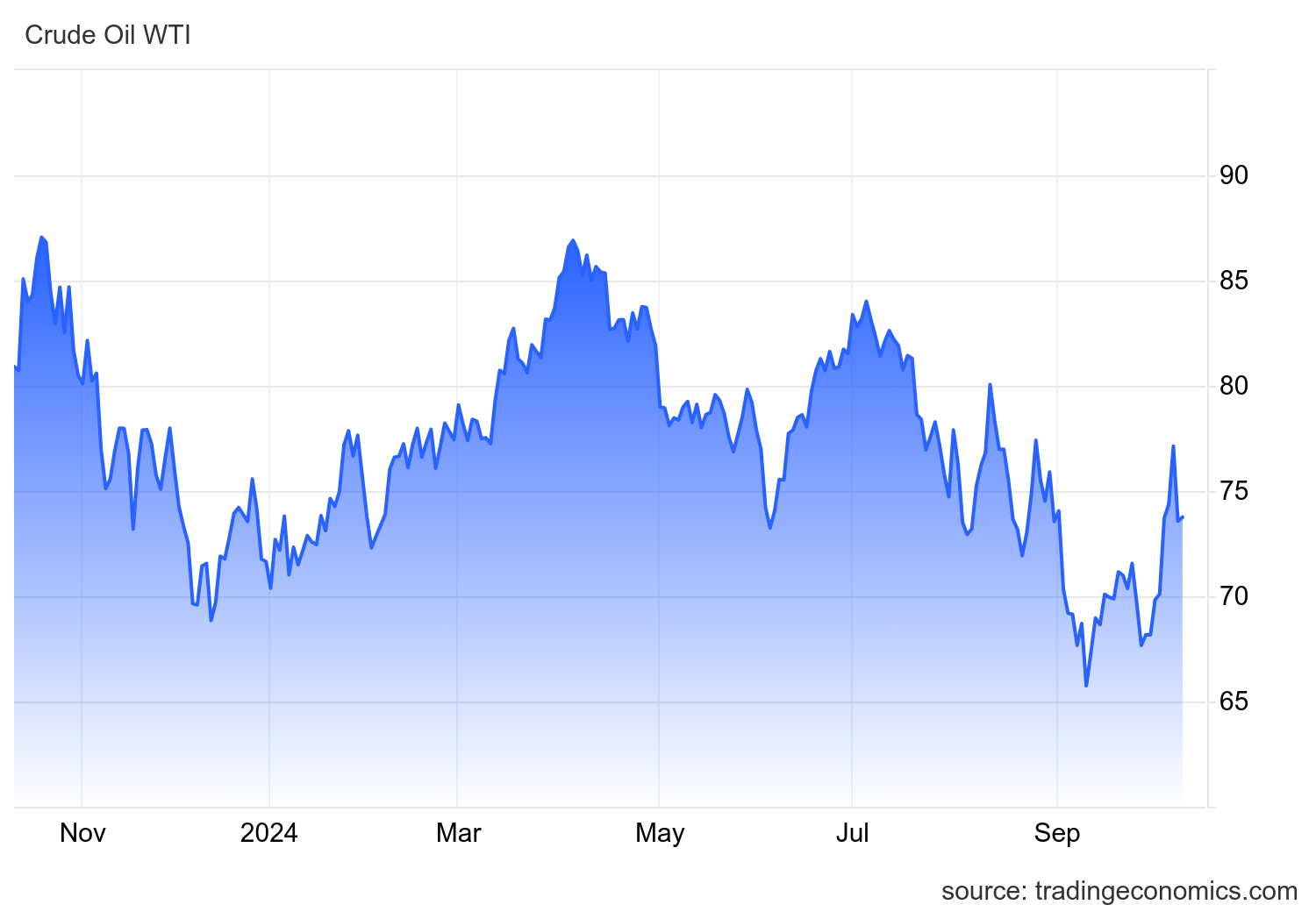
futures fell 4.2% to $78.25 a barrel, while US WTI crude dropped 4.1% to $74.80
per barrel. The decline comes after both benchmarks surged nearly 9% last week.
The retreat
in oil prices reflects a complex interplay of factors influencing the market.
While heightened tensions in the Middle East have raised concerns about
potential supply disruptions, these fears have been tempered by the absence of
actual production interruptions thus far.
Crude oil prices. Source: Tradingeconomics.com
“Oil
can keep ascending only for so long purely based on perceptions and not actual
supply disruption,” noted analysts at oil brokerage PMV. “The
geopolitical risk premium has an obscure and unforeseeable expiry date.”
Adding to
the downward pressure, China's return from its Golden Week holiday brought
disappointment as authorities refrained from announcing new economic stimulus
measures. This has reignited worries about oil demand in the world's
second-largest economy.
“Without
policy support, an economic slowdown could keep China's oil demand subdued in
the short to medium term,” Warren Patterson from ING added.
The fact
that the war premium in the oil market disappeared one day doesn't mean it
won't reappear the next, especially since it doesn't look like we're
approaching any resolution to the conflict.
Israel
Claims Elimination of Hezbollah Leader's Successors
Israeli
Prime Minister Benjamin Netanyahu announced today (Wednesday) that airstrikes
had killed two successors to Hezbollah's recently slain leader, Hassan
Nasrallah, as Israel intensified its ground offensive in southern Lebanon.
“We've
degraded Hezbollah's capabilities. We took out thousands of terrorists,
including Nasrallah himself and Nasrallah's replacement, and the replacement of
the replacement,” Netanyahu declared in a video statement. However, the
prime minister did not identify the alleged successors by name.
Israeli
Defense Minister Yoav Gallant suggested that Hashem Safieddine, widely
considered Nasrallah's likely successor, had “probably been
eliminated.” Military spokesman Daniel Hagari later stated that
Safieddine's status was being verified after an airstrike on Hezbollah's
intelligence headquarters last week.
BREAKING: It's just been confirmed that Hashem Sadieddine, Nasrallah’s successor and soon-to-be leader of Hezbollah, was killed in last week’s strike in Beirut.
While the world is busy vilifying Israel, Israel is busy protecting the world against the real terror and people who… pic.twitter.com/OGG5QRiNBE
The claims
come as Israel deployed a fourth army division into southern Lebanon, expanding
its ground operations against Hezbollah. The Israeli military reported that
airstrikes over the past 24 hours had killed at least 50 Hezbollah fighters,
including six sector commanders and regional officials.
The
conflict has escalated dramatically in recent weeks. Israel bombed
Hezbollah strongholds in Beirut's southern suburbs and Hezbollah launched
rocket attacks on northern Israeli cities, including Haifa.
As the
violence intensifies, concerns are growing about a wider regional conflict.
Iran, a key backer of both Hezbollah and Hamas, has warned Israel against
retaliatory strikes on Iranian territory following recent missile exchanges.
The ongoing
hostilities have resulted in over 1,000 deaths in Lebanon and displaced more
than a million people in the past two weeks. Israel maintains that its
objective is to secure its northern border and allow the return of thousands of
displaced residents.
Geopolitical
tensions in the Middle East have caused oil prices to experience their
strongest gains since March 2023. This week, prices tested two-month highs. Analysts believe that if the conflict escalates, the upward trend may continue.
Notably,
Israeli Prime Minister Benjamin Netanyahu stated that airstrikes killed two
successors to Hezbollah's slain leader. The country is expanding its offensive
against the Iran-backed group, with ground operations extending into southern
Lebanon.
Will Oil Prices Return to $100 per Barrel?
Although
projections of oil prices jumping back to the psychological barrier of $100 per
barrel, last seen in 2022, currently seem distant, analysts are beginning to
raise their forecasts for the end of this year.
Morgan
Stanley recently raised its Brent price forecast for Q4 2024 to $80 per barrel
from $75, citing heightened geopolitical risks. Brent crude prices have already
tested such high levels this week, while US WTI crude has so far stopped at around
$78.
Morgan Stanley raised its Brent value forecast to $80 a barrel (from $75) for This autumn 2024https://t.co/0hejq852Z3
Morgan Stanley has bumped its forecast for Brent crude oil in the final quarter of 2024 to $80 / Barrel up from its previous forecast of $75 MS cite heighten... pic.twitter.com/gBiI328fzf
However, Tuesday's session brought a temporary easing of sentiment in the oil market, as
concerns about the Middle East conflict outweighed stronger worries about
global demand.
Oil Prices
Fell over 4% on Tuesday
Brent crude
futures fell 4.2% to $78.25 a barrel, while US WTI crude dropped 4.1% to $74.80
per barrel. The decline comes after both benchmarks surged nearly 9% last week.
The retreat
in oil prices reflects a complex interplay of factors influencing the market.
While heightened tensions in the Middle East have raised concerns about
potential supply disruptions, these fears have been tempered by the absence of
actual production interruptions thus far.
Crude oil prices. Source: Tradingeconomics.com
“Oil
can keep ascending only for so long purely based on perceptions and not actual
supply disruption,” noted analysts at oil brokerage PMV. “The
geopolitical risk premium has an obscure and unforeseeable expiry date.”
Adding to
the downward pressure, China's return from its Golden Week holiday brought
disappointment as authorities refrained from announcing new economic stimulus
measures. This has reignited worries about oil demand in the world's
second-largest economy.
“Without
policy support, an economic slowdown could keep China's oil demand subdued in
the short to medium term,” Warren Patterson from ING added.
The fact
that the war premium in the oil market disappeared one day doesn't mean it
won't reappear the next, especially since it doesn't look like we're
approaching any resolution to the conflict.
Israel
Claims Elimination of Hezbollah Leader's Successors
Israeli
Prime Minister Benjamin Netanyahu announced today (Wednesday) that airstrikes
had killed two successors to Hezbollah's recently slain leader, Hassan
Nasrallah, as Israel intensified its ground offensive in southern Lebanon.
“We've
degraded Hezbollah's capabilities. We took out thousands of terrorists,
including Nasrallah himself and Nasrallah's replacement, and the replacement of
the replacement,” Netanyahu declared in a video statement. However, the
prime minister did not identify the alleged successors by name.
Israeli
Defense Minister Yoav Gallant suggested that Hashem Safieddine, widely
considered Nasrallah's likely successor, had “probably been
eliminated.” Military spokesman Daniel Hagari later stated that
Safieddine's status was being verified after an airstrike on Hezbollah's
intelligence headquarters last week.
BREAKING: It's just been confirmed that Hashem Sadieddine, Nasrallah’s successor and soon-to-be leader of Hezbollah, was killed in last week’s strike in Beirut.
While the world is busy vilifying Israel, Israel is busy protecting the world against the real terror and people who… pic.twitter.com/OGG5QRiNBE
The claims
come as Israel deployed a fourth army division into southern Lebanon, expanding
its ground operations against Hezbollah. The Israeli military reported that
airstrikes over the past 24 hours had killed at least 50 Hezbollah fighters,
including six sector commanders and regional officials.
The
conflict has escalated dramatically in recent weeks. Israel bombed
Hezbollah strongholds in Beirut's southern suburbs and Hezbollah launched
rocket attacks on northern Israeli cities, including Haifa.
As the
violence intensifies, concerns are growing about a wider regional conflict.
Iran, a key backer of both Hezbollah and Hamas, has warned Israel against
retaliatory strikes on Iranian territory following recent missile exchanges.
The ongoing
hostilities have resulted in over 1,000 deaths in Lebanon and displaced more
than a million people in the past two weeks. Israel maintains that its
objective is to secure its northern border and allow the return of thousands of
displaced residents.
Damian Chmiel is a Senior Analyst & Editor at Finance Magnates with more than 15 years of experience in the CFD and online trading industry. Active as both a trader and journalist since 2010, he focuses on broker coverage, fintech innovation, and regulatory developments across Europe, the Middle East, and Asia.
His work includes interviews with C-level leaders at major brokerages and fintech platforms, as well as co-authoring Finance Magnates’ quarterly industry benchmarking reports. Damian’s reporting is data-driven, market-aware, and grounded in direct industry engagement. His analysis and commentary have also been cited by external media outlets, including Investing.com, Binance, The Asset, Stockhead, and Dispatch.
Education:
MA in Finance and Accounting, Cracow University of Economics
Why Is Dogecoin Going Up Today? DOGE Price Prediction Shows 25% Upside Potential
Featured Videos
AvaTrade to Acquire Most of FXCM; NAGA Raises $8M
AvaTrade to Acquire Most of FXCM; NAGA Raises $8M
AvaTrade to Acquire Most of FXCM; NAGA Raises $8M
AvaTrade to Acquire Most of FXCM; NAGA Raises $8M
Today’s financial news recap covers AvaTrade agrees to acquire most of FXCM, NAGA secures eight million dollars in new financing, and Wise seeks a tax settlement in the UK.
Finance Magnates Daily Recap brings you the latest news from forex and CFD brokers, fintech, payments, cryptocurrency, digital assets, trading platforms, financial regulation and global markets.
Get the key company news, executive moves, deals, regulatory updates and market developments of the day, in just a few minutes. New episodes published every weekday.
Read more: https://www.financemagnates.com
#FinanceMagnates #ForexNews #FintechNews
Today’s financial news recap covers AvaTrade agrees to acquire most of FXCM, NAGA secures eight million dollars in new financing, and Wise seeks a tax settlement in the UK.
Finance Magnates Daily Recap brings you the latest news from forex and CFD brokers, fintech, payments, cryptocurrency, digital assets, trading platforms, financial regulation and global markets.
Get the key company news, executive moves, deals, regulatory updates and market developments of the day, in just a few minutes. New episodes published every weekday.
Read more: https://www.financemagnates.com
#FinanceMagnates #ForexNews #FintechNews
Today’s financial news recap covers AvaTrade agrees to acquire most of FXCM, NAGA secures eight million dollars in new financing, and Wise seeks a tax settlement in the UK.
Finance Magnates Daily Recap brings you the latest news from forex and CFD brokers, fintech, payments, cryptocurrency, digital assets, trading platforms, financial regulation and global markets.
Get the key company news, executive moves, deals, regulatory updates and market developments of the day, in just a few minutes. New episodes published every weekday.
Read more: https://www.financemagnates.com
#FinanceMagnates #ForexNews #FintechNews
Today’s financial news recap covers AvaTrade agrees to acquire most of FXCM, NAGA secures eight million dollars in new financing, and Wise seeks a tax settlement in the UK.
Finance Magnates Daily Recap brings you the latest news from forex and CFD brokers, fintech, payments, cryptocurrency, digital assets, trading platforms, financial regulation and global markets.
Get the key company news, executive moves, deals, regulatory updates and market developments of the day, in just a few minutes. New episodes published every weekday.
Read more: https://www.financemagnates.com
#FinanceMagnates #ForexNews #FintechNews
XTB Adds Overnight US Stock Trading; Nasdaq Ventures Invests in One Trading
XTB Adds Overnight US Stock Trading; Nasdaq Ventures Invests in One Trading
XTB Adds Overnight US Stock Trading; Nasdaq Ventures Invests in One Trading
XTB Adds Overnight US Stock Trading; Nasdaq Ventures Invests in One Trading
XTB Adds Overnight US Stock Trading; Nasdaq Ventures Invests in One Trading
XTB Adds Overnight US Stock Trading; Nasdaq Ventures Invests in One Trading
Today’s financial news recap covers XTB expands overnight US stock trading, Fortrade reports higher revenue, Nasdaq backs One Trading, and Vest Labs raises 13 million dollars.
Finance Magnates Daily Recap brings you the latest news from forex and CFD brokers, fintech, payments, cryptocurrency, digital assets, trading platforms, financial regulation and global markets.
Get the key company news, executive moves, deals, regulatory updates and market developments of the day, in just a few minutes. New episodes published every weekday.
Read more: https://www.financemagnates.com
#FinanceMagnates #ForexNews #FintechNews
Today’s financial news recap covers XTB expands overnight US stock trading, Fortrade reports higher revenue, Nasdaq backs One Trading, and Vest Labs raises 13 million dollars.
Finance Magnates Daily Recap brings you the latest news from forex and CFD brokers, fintech, payments, cryptocurrency, digital assets, trading platforms, financial regulation and global markets.
Get the key company news, executive moves, deals, regulatory updates and market developments of the day, in just a few minutes. New episodes published every weekday.
Read more: https://www.financemagnates.com
#FinanceMagnates #ForexNews #FintechNews
Today’s financial news recap covers XTB expands overnight US stock trading, Fortrade reports higher revenue, Nasdaq backs One Trading, and Vest Labs raises 13 million dollars.
Finance Magnates Daily Recap brings you the latest news from forex and CFD brokers, fintech, payments, cryptocurrency, digital assets, trading platforms, financial regulation and global markets.
Get the key company news, executive moves, deals, regulatory updates and market developments of the day, in just a few minutes. New episodes published every weekday.
Read more: https://www.financemagnates.com
#FinanceMagnates #ForexNews #FintechNews
Today’s financial news recap covers XTB expands overnight US stock trading, Fortrade reports higher revenue, Nasdaq backs One Trading, and Vest Labs raises 13 million dollars.
Finance Magnates Daily Recap brings you the latest news from forex and CFD brokers, fintech, payments, cryptocurrency, digital assets, trading platforms, financial regulation and global markets.
Get the key company news, executive moves, deals, regulatory updates and market developments of the day, in just a few minutes. New episodes published every weekday.
Read more: https://www.financemagnates.com
#FinanceMagnates #ForexNews #FintechNews
Today’s financial news recap covers XTB expands overnight US stock trading, Fortrade reports higher revenue, Nasdaq backs One Trading, and Vest Labs raises 13 million dollars.
Finance Magnates Daily Recap brings you the latest news from forex and CFD brokers, fintech, payments, cryptocurrency, digital assets, trading platforms, financial regulation and global markets.
Get the key company news, executive moves, deals, regulatory updates and market developments of the day, in just a few minutes. New episodes published every weekday.
Read more: https://www.financemagnates.com
#FinanceMagnates #ForexNews #FintechNews
Today’s financial news recap covers XTB expands overnight US stock trading, Fortrade reports higher revenue, Nasdaq backs One Trading, and Vest Labs raises 13 million dollars.
Finance Magnates Daily Recap brings you the latest news from forex and CFD brokers, fintech, payments, cryptocurrency, digital assets, trading platforms, financial regulation and global markets.
Get the key company news, executive moves, deals, regulatory updates and market developments of the day, in just a few minutes. New episodes published every weekday.
Read more: https://www.financemagnates.com
#FinanceMagnates #ForexNews #FintechNews
CMC Founder Downplays Volatility Hit; Devexperts Names CEO
CMC Founder Downplays Volatility Hit; Devexperts Names CEO
CMC Founder Downplays Volatility Hit; Devexperts Names CEO
CMC Founder Downplays Volatility Hit; Devexperts Names CEO
CMC Founder Downplays Volatility Hit; Devexperts Names CEO
CMC Founder Downplays Volatility Hit; Devexperts Names CEO
Today’s financial news recap covers low volatility pressures brokers, Devexperts names a new CEO, Saxo cuts onboarding time, and OKX reaches a 25 billion dollar valuation.
Finance Magnates Daily Recap brings you the latest news from forex and CFD brokers, fintech, payments, cryptocurrency, digital assets, trading platforms, financial regulation and global markets.
Get the key company news, executive moves, deals, regulatory updates and market developments of the day, in just a few minutes. New episodes published every weekday.
Read more: https://www.financemagnates.com
#FinanceMagnates #ForexNews #FintechNews
Today’s financial news recap covers low volatility pressures brokers, Devexperts names a new CEO, Saxo cuts onboarding time, and OKX reaches a 25 billion dollar valuation.
Finance Magnates Daily Recap brings you the latest news from forex and CFD brokers, fintech, payments, cryptocurrency, digital assets, trading platforms, financial regulation and global markets.
Get the key company news, executive moves, deals, regulatory updates and market developments of the day, in just a few minutes. New episodes published every weekday.
Read more: https://www.financemagnates.com
#FinanceMagnates #ForexNews #FintechNews
Today’s financial news recap covers low volatility pressures brokers, Devexperts names a new CEO, Saxo cuts onboarding time, and OKX reaches a 25 billion dollar valuation.
Finance Magnates Daily Recap brings you the latest news from forex and CFD brokers, fintech, payments, cryptocurrency, digital assets, trading platforms, financial regulation and global markets.
Get the key company news, executive moves, deals, regulatory updates and market developments of the day, in just a few minutes. New episodes published every weekday.
Read more: https://www.financemagnates.com
#FinanceMagnates #ForexNews #FintechNews
Today’s financial news recap covers low volatility pressures brokers, Devexperts names a new CEO, Saxo cuts onboarding time, and OKX reaches a 25 billion dollar valuation.
Finance Magnates Daily Recap brings you the latest news from forex and CFD brokers, fintech, payments, cryptocurrency, digital assets, trading platforms, financial regulation and global markets.
Get the key company news, executive moves, deals, regulatory updates and market developments of the day, in just a few minutes. New episodes published every weekday.
Read more: https://www.financemagnates.com
#FinanceMagnates #ForexNews #FintechNews
Today’s financial news recap covers low volatility pressures brokers, Devexperts names a new CEO, Saxo cuts onboarding time, and OKX reaches a 25 billion dollar valuation.
Finance Magnates Daily Recap brings you the latest news from forex and CFD brokers, fintech, payments, cryptocurrency, digital assets, trading platforms, financial regulation and global markets.
Get the key company news, executive moves, deals, regulatory updates and market developments of the day, in just a few minutes. New episodes published every weekday.
Read more: https://www.financemagnates.com
#FinanceMagnates #ForexNews #FintechNews
Today’s financial news recap covers low volatility pressures brokers, Devexperts names a new CEO, Saxo cuts onboarding time, and OKX reaches a 25 billion dollar valuation.
Finance Magnates Daily Recap brings you the latest news from forex and CFD brokers, fintech, payments, cryptocurrency, digital assets, trading platforms, financial regulation and global markets.
Get the key company news, executive moves, deals, regulatory updates and market developments of the day, in just a few minutes. New episodes published every weekday.
Read more: https://www.financemagnates.com
#FinanceMagnates #ForexNews #FintechNews
Today’s financial news recap covers Trade Nation buys FXCM's UK client book, Trading 212 reports higher revenue, the CFTC's move to allow perpetual index futures.
Finance Magnates Daily Recap brings you the latest news from forex and CFD brokers, fintech, payments, cryptocurrency, digital assets, trading platforms, financial regulation and global markets.
Get the key company news, executive moves, deals, regulatory updates and market developments of the day, in just a few minutes. New episodes published every weekday.
Read more: https://www.financemagnates.com
#FinanceMagnates #ForexNews #FintechNews
Today’s financial news recap covers Trade Nation buys FXCM's UK client book, Trading 212 reports higher revenue, the CFTC's move to allow perpetual index futures.
Finance Magnates Daily Recap brings you the latest news from forex and CFD brokers, fintech, payments, cryptocurrency, digital assets, trading platforms, financial regulation and global markets.
Get the key company news, executive moves, deals, regulatory updates and market developments of the day, in just a few minutes. New episodes published every weekday.
Read more: https://www.financemagnates.com
#FinanceMagnates #ForexNews #FintechNews
Today’s financial news recap covers Trade Nation buys FXCM's UK client book, Trading 212 reports higher revenue, the CFTC's move to allow perpetual index futures.
Finance Magnates Daily Recap brings you the latest news from forex and CFD brokers, fintech, payments, cryptocurrency, digital assets, trading platforms, financial regulation and global markets.
Get the key company news, executive moves, deals, regulatory updates and market developments of the day, in just a few minutes. New episodes published every weekday.
Read more: https://www.financemagnates.com
#FinanceMagnates #ForexNews #FintechNews
Today’s financial news recap covers Trade Nation buys FXCM's UK client book, Trading 212 reports higher revenue, the CFTC's move to allow perpetual index futures.
Finance Magnates Daily Recap brings you the latest news from forex and CFD brokers, fintech, payments, cryptocurrency, digital assets, trading platforms, financial regulation and global markets.
Get the key company news, executive moves, deals, regulatory updates and market developments of the day, in just a few minutes. New episodes published every weekday.
Read more: https://www.financemagnates.com
#FinanceMagnates #ForexNews #FintechNews
Today’s financial news recap covers Trade Nation buys FXCM's UK client book, Trading 212 reports higher revenue, the CFTC's move to allow perpetual index futures.
Finance Magnates Daily Recap brings you the latest news from forex and CFD brokers, fintech, payments, cryptocurrency, digital assets, trading platforms, financial regulation and global markets.
Get the key company news, executive moves, deals, regulatory updates and market developments of the day, in just a few minutes. New episodes published every weekday.
Read more: https://www.financemagnates.com
#FinanceMagnates #ForexNews #FintechNews
Today’s financial news recap covers Trade Nation buys FXCM's UK client book, Trading 212 reports higher revenue, the CFTC's move to allow perpetual index futures.
Finance Magnates Daily Recap brings you the latest news from forex and CFD brokers, fintech, payments, cryptocurrency, digital assets, trading platforms, financial regulation and global markets.
Get the key company news, executive moves, deals, regulatory updates and market developments of the day, in just a few minutes. New episodes published every weekday.
Read more: https://www.financemagnates.com
#FinanceMagnates #ForexNews #FintechNews
Your career isn’t a linear path.
Your career isn’t a linear path.
Your career isn’t a linear path.
Your career isn’t a linear path.
Your career isn’t a linear path.
Your career isn’t a linear path.
Roles change. Career goals change. Sometimes you want a completely new challenge.
But the skills and knowledge you build along the way can stay with you and give you something to build on.
For Jeff Patterson, that continued growth is key to long-term career development.
You bring the skills. FM Academy helps you build the knowledge.
#FMAcademy #FinanceMagnates #FinanceCareers #ProfessionalDevelopment #Fintech
Roles change. Career goals change. Sometimes you want a completely new challenge.
But the skills and knowledge you build along the way can stay with you and give you something to build on.
For Jeff Patterson, that continued growth is key to long-term career development.
You bring the skills. FM Academy helps you build the knowledge.
#FMAcademy #FinanceMagnates #FinanceCareers #ProfessionalDevelopment #Fintech
Roles change. Career goals change. Sometimes you want a completely new challenge.
But the skills and knowledge you build along the way can stay with you and give you something to build on.
For Jeff Patterson, that continued growth is key to long-term career development.
You bring the skills. FM Academy helps you build the knowledge.
#FMAcademy #FinanceMagnates #FinanceCareers #ProfessionalDevelopment #Fintech
Roles change. Career goals change. Sometimes you want a completely new challenge.
But the skills and knowledge you build along the way can stay with you and give you something to build on.
For Jeff Patterson, that continued growth is key to long-term career development.
You bring the skills. FM Academy helps you build the knowledge.
#FMAcademy #FinanceMagnates #FinanceCareers #ProfessionalDevelopment #Fintech
Roles change. Career goals change. Sometimes you want a completely new challenge.
But the skills and knowledge you build along the way can stay with you and give you something to build on.
For Jeff Patterson, that continued growth is key to long-term career development.
You bring the skills. FM Academy helps you build the knowledge.
#FMAcademy #FinanceMagnates #FinanceCareers #ProfessionalDevelopment #Fintech
Roles change. Career goals change. Sometimes you want a completely new challenge.
But the skills and knowledge you build along the way can stay with you and give you something to build on.
For Jeff Patterson, that continued growth is key to long-term career development.
You bring the skills. FM Academy helps you build the knowledge.
#FMAcademy #FinanceMagnates #FinanceCareers #ProfessionalDevelopment #Fintech