Japan’s Robinhood Joins the MCP Craze. Will the Industry Grapple with Existential Questions?

Tuesday, 09/06/2026 | 09:21 GMT by Adonis Adoni
  • Among others, Woodstock's MCP will allow clients to place buy and sell orders, including split orders.
  • The degree of autonomy AI agents have across the brokerage industry remains uneven.
Woodstock
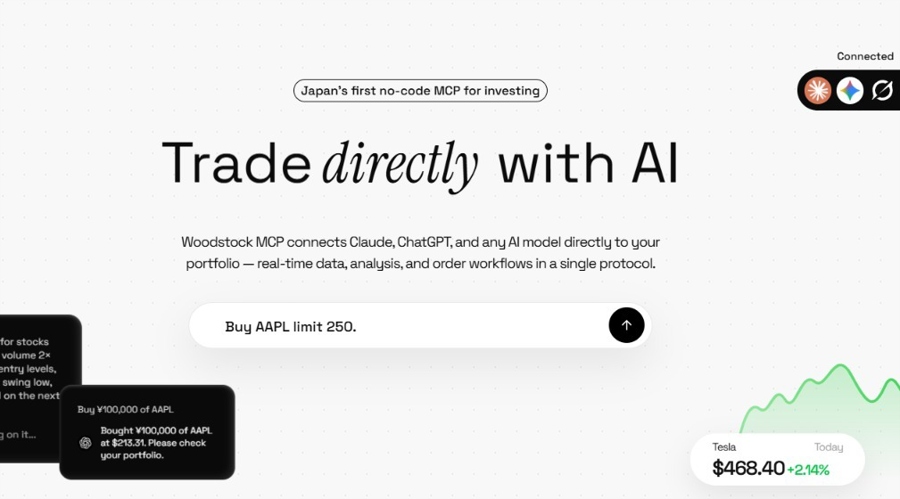
Woodstock's new page bets that prompting is the new trade.

Every few days, it seems, another trading platform allows clients to tether their AI agents to their trading accounts. Woodstock, a Japanese investing app that follows the Robinhood model, is the latest to join the Model Context Protocol (MCP) craze.

According to a statement, the company has released the Woodstock MCP service to “lower the barrier to investing through AI-assisted support.”

Not All MCPs Are Created Equal

The degree of autonomy for an MCP integration across the industry remains uneven. Most deployments so far have included some form of a walled garden to prevent algorithmic chaos.

For instance, the multi-asset broker Capital.com requires a two-step confirmation process before an agent can execute a trade.

Others, like Robinhood and eToro, have cordoned off specific portfolios to protect a client’s primary capital.

It’s unclear what restrictions Woodstock has imposed, if any.

According to the company, it will allow clients to retrieve current figures for share prices, market capitalisation and price-to-earnings ratios. It can also summarise financial statements and aggregate historical movements for US equities. Beyond mere data retrieval, the tool facilitates market, technical and fundamental analysis.

It can calculate resistance and support lines or prepare portfolio rebalancing proposals, and more importantly, it can place buy and sell orders, including split orders.

Woodstock plans to develop a knowledge base of AI prompts. The company intends to share these resources to help its user base refine their decision-making.

Regulators and Robots

Recent data suggests that retail participation is starting to solidify.

According to eToro, 19% of individual investors currently leverage AI applications for asset selection or portfolio adjustment, a notable rise from 13% just twelve months ago, while 39% express a willingness to adopt such technology.

Should the AI agent become the primary gateway to financial markets, the implications are stark. The trading app will most likely become a data and execution pipeline. The full scope of this evolution, from destination to utility, is still unfolding.

Less certain is the fallout when an AI agent goes rogue. Regulators have yet to provide clear signals, if any at all.

The EU AI Act contains a "human-in-the-loop" provision, which provides at least one direction. This requirement for human oversight likely explains the restrictions seen at Capital.com and elsewhere.

But if the AI agent becomes the de facto trader, the industry must ask whether existing MiFID rules are fit for purpose.

Rules designed around human behaviour and traditional risk profiles may struggle when faced with a machine that never sleeps and never doubts.

Every few days, it seems, another trading platform allows clients to tether their AI agents to their trading accounts. Woodstock, a Japanese investing app that follows the Robinhood model, is the latest to join the Model Context Protocol (MCP) craze.

According to a statement, the company has released the Woodstock MCP service to “lower the barrier to investing through AI-assisted support.”

Not All MCPs Are Created Equal

The degree of autonomy for an MCP integration across the industry remains uneven. Most deployments so far have included some form of a walled garden to prevent algorithmic chaos.

For instance, the multi-asset broker Capital.com requires a two-step confirmation process before an agent can execute a trade.

Others, like Robinhood and eToro, have cordoned off specific portfolios to protect a client’s primary capital.

It’s unclear what restrictions Woodstock has imposed, if any.

According to the company, it will allow clients to retrieve current figures for share prices, market capitalisation and price-to-earnings ratios. It can also summarise financial statements and aggregate historical movements for US equities. Beyond mere data retrieval, the tool facilitates market, technical and fundamental analysis.

It can calculate resistance and support lines or prepare portfolio rebalancing proposals, and more importantly, it can place buy and sell orders, including split orders.

Woodstock plans to develop a knowledge base of AI prompts. The company intends to share these resources to help its user base refine their decision-making.

Regulators and Robots

Recent data suggests that retail participation is starting to solidify.

According to eToro, 19% of individual investors currently leverage AI applications for asset selection or portfolio adjustment, a notable rise from 13% just twelve months ago, while 39% express a willingness to adopt such technology.

Should the AI agent become the primary gateway to financial markets, the implications are stark. The trading app will most likely become a data and execution pipeline. The full scope of this evolution, from destination to utility, is still unfolding.

Less certain is the fallout when an AI agent goes rogue. Regulators have yet to provide clear signals, if any at all.

The EU AI Act contains a "human-in-the-loop" provision, which provides at least one direction. This requirement for human oversight likely explains the restrictions seen at Capital.com and elsewhere.

But if the AI agent becomes the de facto trader, the industry must ask whether existing MiFID rules are fit for purpose.

Rules designed around human behaviour and traditional risk profiles may struggle when faced with a machine that never sleeps and never doubts.

About the Author: Adonis Adoni
Adonis Adoni
  • 50 Articles
  • 1 Follower
About the Author: Adonis Adoni
Adonis Adoni is a News Editor at Finance Magnates, with more than six years of experience covering the financial services industry, technology, and their intersection. His work includes C-suite interviews with leading technology and fintech companies across Europe, the US and Asia, exclusive coverage of M&A activity and capital raising, and data-driven industry reporting, with a strong emphasis on engagement and clear storytelling. Areas of Coverage: Online trading industry news Fintech companies Digital assets and crypto markets Regulatory and compliance developments Executive interviews Education: BA in Law – Nottingham Trent University LLM in Health Law – Nottingham Trent University
  • 50 Articles
  • 1 Follower

More from the Author

Trending

!"#$%&'()*+,-./0123456789:;<=>?@ABCDEFGHIJKLMNOPQRSTUVWXYZ[\]^_`abcdefghijklmnopqrstuvwxyz{|} !"#$%&'()*+,-./0123456789:;<=>?@ABCDEFGHIJKLMNOPQRSTUVWXYZ[\]^_`abcdefghijklmnopqrstuvwxyz{|}