

Crypto markets are gripped with extreme fear, while stocks from Seoul to Tokyo have been hit by a broad risk-off selloff. At the same time, prediction markets are offering a real-time look at how traders are pricing everything from Bitcoin downside risk to geopolitical escalation.
Prediction Markets Are Flashing Warning Signs Across Asset Classes
A look across major prediction markets suggests traders expect market volatility to persist, even after the recent selloff in stocks and cryptocurrencies.
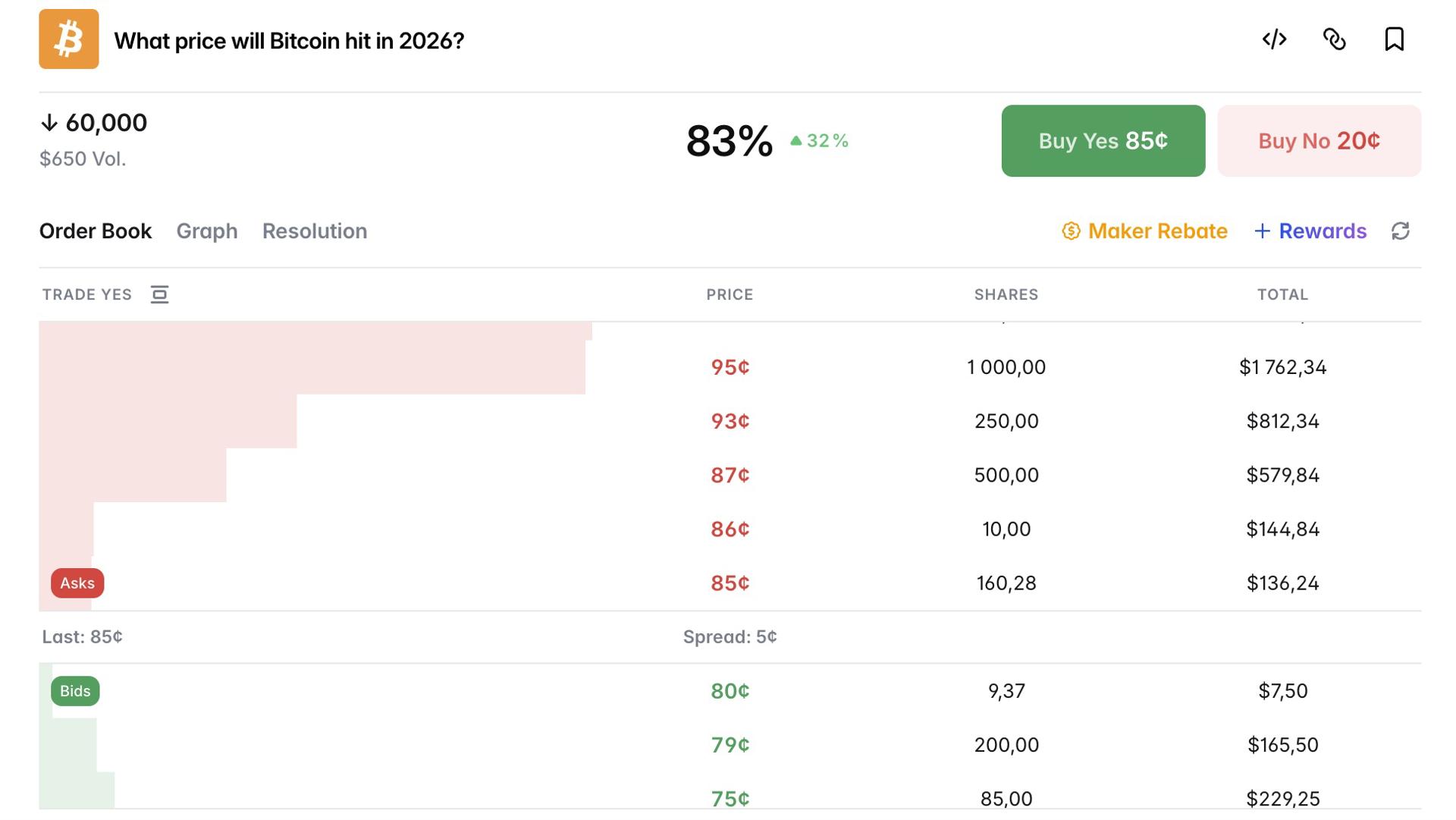
On Polymarket, contracts tied to Bitcoin's price path in 2026 have become increasingly skewed toward lower price targets. Even after a 50% decline from its peak, prediction markets remain skewed toward further downside in Bitcoin. Contracts tied to a move below $60,000 are pricing higher odds than a return to $100,000.
A similar pattern can be seen in equities. On Kalshi, contracts linked to the S&P 500 suggest traders see a meaningful chance of further downside from recent highs.
However, those same markets stop well short of pricing a repeat of 2008-style conditions or a broader financial crisis. Traders are positioning for more volatility and further downside, but not for a systemic collapse.
Why Traders Are Looking Beyond Asset Prices
The current selloff is being driven by factors that extend far beyond Bitcoin or the S&P 500. Expectations for Federal Reserve policy, geopolitical tensions in the Middle East, energy prices and broader economic growth concerns are all shaping investor sentiment across markets.
For traders trying to assess what comes next, a falling stock index or a declining Bitcoin price says little about which risks market participants consider most important, or how likely they believe different scenarios are.
- Inside the Prediction Markets: Trading Volume Hits $28.4B as Brokers and Market Makers Move In
- George Santos Probe Adds to Growing Insider-Trading Pressure on Prediction Markets
- Prediction Markets Force Sportsbooks to Rethink Their World Cup Strategy
This helps explain why traders are paying closer attention to prediction markets. They show how participants are assigning probabilities to the events and policy decisions that could drive the next market move.
Whether those expectations ultimately prove correct is a separate question. But as investors search for signals, prediction markets are increasingly becoming another source of market intelligence.
The current market turmoil is also highlighting a broader trend. Prediction markets now cover many of the same economic, political and policy risks that drive moves across stocks, cryptocurrencies and other financial markets.
The trend is also visible in trading activity. Prediction markets generated a record $29.4 billion in volume in May, and another $6 billion in the first week of June, suggesting traders are increasingly turning to these platforms during periods of heightened uncertainty.


