Singapore Private Equity Ecosystem Faces Balancing Act as Retail Capital Enters Frame

Friday, 08/05/2026 | 13:22 GMT by Paul Golden
  • MAS supports private markets growth while Singapore attracts PE, infrastructure, credit managers amid reallocation.
  • Retail capital in private markets raises concerns over liquidity, alignment and governance among investors.
Singapore

New flows will have to be carefully managed if Singapore is to maintain and enhance its status as a leading regional hub for private equity. Private equity is just one of many aspects of Singapore’s capital markets ecosystem that have benefited from regulatory support.

Singapore Summit: Meet the largest APAC brokers you know (and those you still don't!).

For example, the Monetary Authority of Singapore (MAS) private markets programme has encouraged leading private equity, infrastructure, and private credit managers to set up and expand in Singapore – a process that has enhanced the private market ecosystem.

Singapore’s Private Equity Hub Status Under Pressure

More recently, the government outlined plans to bring together representatives from the public and private sector to examine the financing ecosystem and propose strategies to establish Singapore as a hub for regional growth capital.

Abrar Mir, Managing Partner and Co-founder, Quadria Capital
Abrar Mir, Managing Partner and Co-founder, Quadria Capital, Source: LinkedIn

The growth capital workgroup will include representatives from private equity and is designed to increase understanding of how various types of financing assist companies at different stages of development.

Despite some high-profile LP downsizing, a number of private markets firms have increased their presence in Singapore. This increase in private markets activity reflects a structural repositioning rather than simple portfolio rebalancing, suggests Abrar Mir, managing partner and co-founder, Quadria Capital.

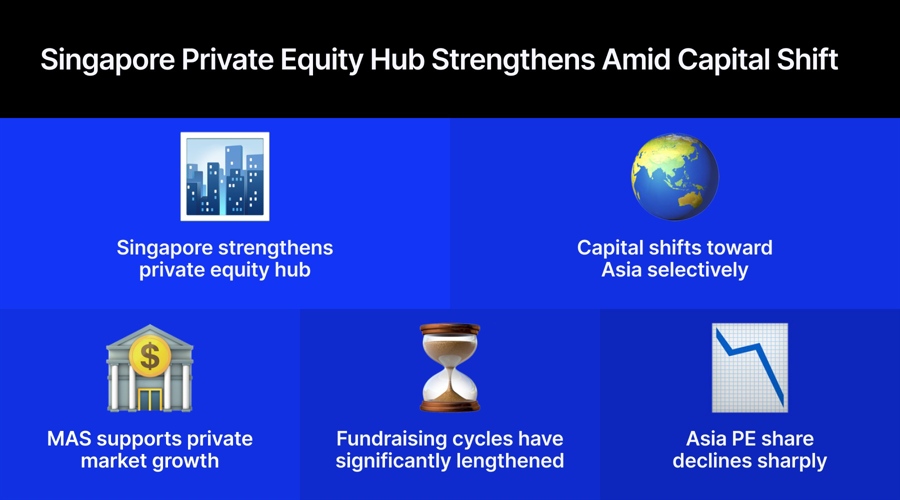
“While global private equity fundraising is down around 34% from its peak, Asia has been disproportionately impacted, declining by approximately 84% based on data from Preqin,” he says. “This does not represent a full withdrawal of capital, but rather a reallocation away from broad, China-heavy mandates toward more selective opportunities.”
Singapore

Asia’s share of global capital has fallen sharply from 46% to around 7%, with capital increasingly concentrated in North America and, more recently, Europe. In this context, Singapore has reinforced its role as the regional hub for deploying targeted Asia strategies and accessing both institutional and private wealth capital.

Fundraising Pressure Reshapes Regional Strategy

Ansel Tan, APAC Private Capital Analyst, PitchBook
Ansel Tan, APAC Private Capital Analyst, PitchBook, Source: LinkedIn

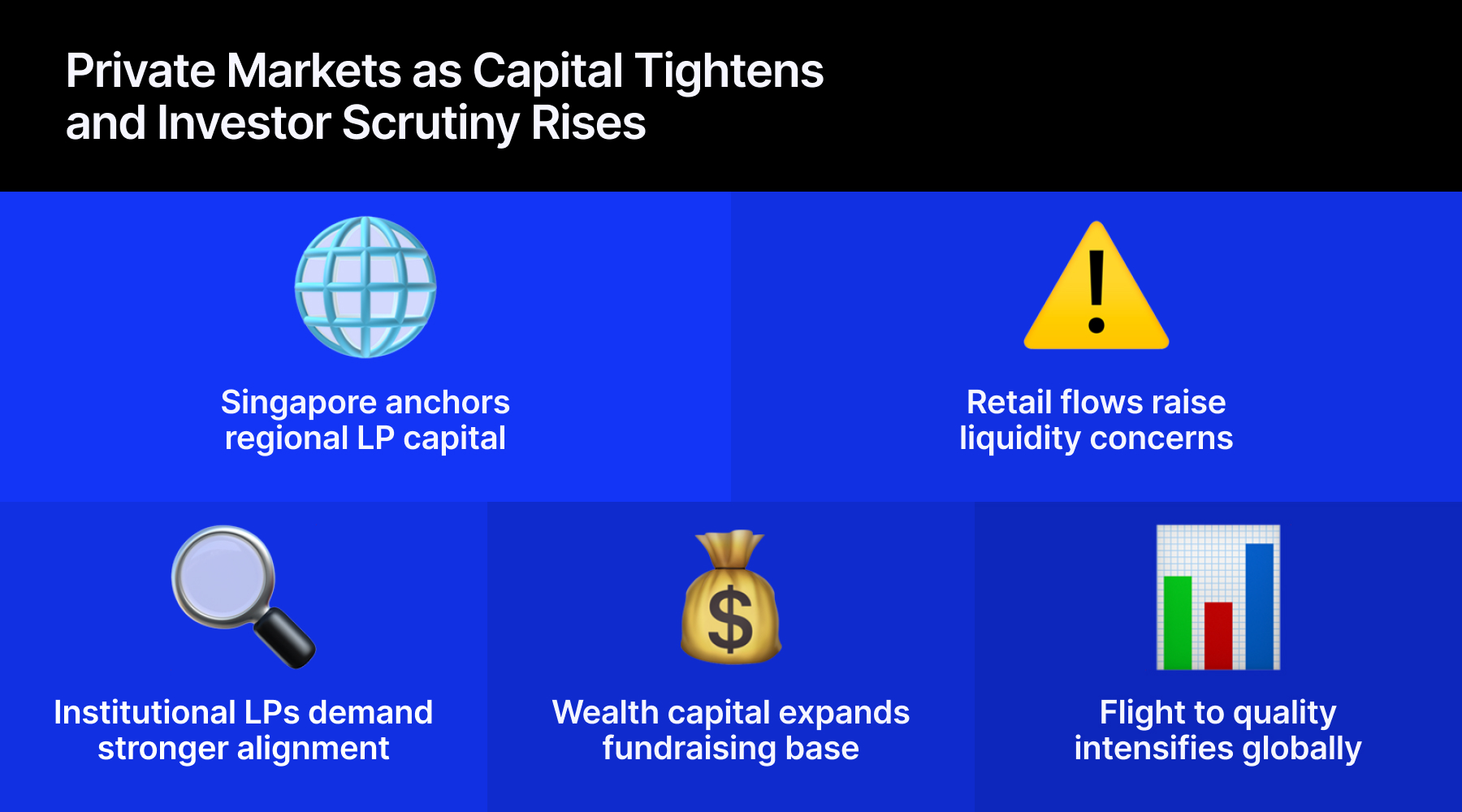
“Fundraising cycles have extended and, with fewer funds closing, proximity to capital has become critical,” adds Mir. “Singapore continues to anchor regional LP capital - from sovereign institutions to family offices - and many global LPs maintain a presence there, making it a natural base for managers.”

As a result, GPs are expanding their on-the-ground presence, diversifying into adjacent strategies and asset classes, while larger pan-Asian platforms continue to raise multi-billion-dollar funds, further reinforcing the need for local execution capabilities.

GPs increasing or establishing a presence in Singapore reflects longer-term positioning, agrees Ansel Tan, APAC private capital analyst at PitchBook.

“Singapore has become a base for regional private capital platforms, combining access to a deepening pool of private wealth, family office and cross-border capital, which is increasingly being allocated to private markets, alongside proximity to deal markets across Southeast Asia and the broader APAC region, including India and Japan,” he says.

Singapore also serves as a structuring and execution hub, reinforced by a supportive regulatory and tax environment that gives managers clarity and consistency in terms of deal documentation and cross-border fund structuring.

Rising Retail Participation Raises Alignment Concerns

Some traditional institutional investors have expressed concern about the money flowing into private market funds from wealthy individuals and even the mass retail market – concerns that mostly centre on alignment of interest.

Institutional LPs see the risk that GP behaviour could shift due to the growing prevalence of retail-focused vehicles and retail capital, which come with different liquidity expectations, operating requirements, and deal and fee dynamics.

“Key issues are liquidity and operational complexity, since these (semi-liquid) structures offer periodic redemptions against underlying assets that are illiquid,” explains Tan. “The recent redemption pressure and outflows in private credit have shone a spotlight on the liquidity mechanisms in these structures.”

Institutional LPs are wary that this inherent mismatch could influence portfolio construction, asset exit timing, and behaviour under market stress.

Operationally, retail-focused vehicles also require continuous deployment, active liquidity management processes, and more frequent valuation work, which increases demands across investment and operational teams and introduces a more complex operating model overall.

Governance and co-investment pressures intensify

“Another concern is reduced allocation and access to co-investments,” says Tan. “Institutional LPs have relied on no-fee, no-carry co-investments to manage overall costs and to gain more exposure to high-conviction deals. However, GPs may increasingly underwrite these deals with capital channelled through retail vehicles (which come in at higher fee levels), reducing the share available to traditional LPs.”

He suggests that LPs are starting to more stringently review governance and conflicts around these topics, such as proposing tighter language around retail allocation caps and reflecting these issues in manager selection processes.

The MAS has referred to growing interest from retail investors in such investments and interest from experienced industry players to offer private market investment fund products to retail investors.

Wealth Capital Expands Singapore’s Private Markets Base

According to Mir, the creation of the growth capital workgroup is a strong signal that the state is trying to deepen the private capital ecosystem and widen the capital base.

He acknowledges that concerns around the growing participation of private wealth in private markets are understandable, particularly in the current environment of weak exits and extended holding periods, where distributions have yet to meaningfully recover.

This creates a potential liquidity mismatch, as some wealth capital may have shorter time horizons than traditional institutional investors.

“However, wealth capital still represents a relatively small share of overall fundraising and is typically accessed through structured vehicles such as semi-liquid or evergreen funds, which incorporate gating mechanisms to manage redemption risk,” says Mir.

In markets like Singapore, private market investments are limited to accredited investors, which ensures a baseline level of sophistication and understanding of the risks involved. Importantly, there remains significant dry powder within the high-net-worth and wealth segment, alongside growing interest in areas such as impact.

Institutional Investors Double Down on Selectivity and Discipline

“As such, while product design and liquidity management are critical, private wealth capital can serve as a complementary and increasingly relevant source of funding, and many managers, including ourselves, are actively exploring these channels as part of a diversified fundraising strategy,” says Mir, adding that institutional LPs are becoming more selective and disciplined in response to the tougher fundraising environment and evolving capital base.

“With the number of funds closed globally down materially from the 2022 peak, we are seeing capital concentrate among a smaller group of managers. This has reinforced a clear flight to quality, with LPs prioritising managers with established track records, deep sector specialisation, and the ability to deliver distributions in a more challenging exit environment.”

At the same time, LPs are increasing scrutiny around alignment, governance, and liquidity, while also expanding co-investment programmes to maintain greater control over capital deployment.

In this context, Mir sees strong alignment with LPs who are looking for differentiated, sector-led platforms. Overall, rather than being displaced by retail capital, he believes institutional investors are reinforcing a more bifurcated market where access to capital is increasingly determined by demonstrated performance and specialisation.

New flows will have to be carefully managed if Singapore is to maintain and enhance its status as a leading regional hub for private equity. Private equity is just one of many aspects of Singapore’s capital markets ecosystem that have benefited from regulatory support.

Singapore Summit: Meet the largest APAC brokers you know (and those you still don't!).

For example, the Monetary Authority of Singapore (MAS) private markets programme has encouraged leading private equity, infrastructure, and private credit managers to set up and expand in Singapore – a process that has enhanced the private market ecosystem.

Singapore’s Private Equity Hub Status Under Pressure

More recently, the government outlined plans to bring together representatives from the public and private sector to examine the financing ecosystem and propose strategies to establish Singapore as a hub for regional growth capital.

Abrar Mir, Managing Partner and Co-founder, Quadria Capital
Abrar Mir, Managing Partner and Co-founder, Quadria Capital, Source: LinkedIn

The growth capital workgroup will include representatives from private equity and is designed to increase understanding of how various types of financing assist companies at different stages of development.

Despite some high-profile LP downsizing, a number of private markets firms have increased their presence in Singapore. This increase in private markets activity reflects a structural repositioning rather than simple portfolio rebalancing, suggests Abrar Mir, managing partner and co-founder, Quadria Capital.

“While global private equity fundraising is down around 34% from its peak, Asia has been disproportionately impacted, declining by approximately 84% based on data from Preqin,” he says. “This does not represent a full withdrawal of capital, but rather a reallocation away from broad, China-heavy mandates toward more selective opportunities.”

Singapore

Asia’s share of global capital has fallen sharply from 46% to around 7%, with capital increasingly concentrated in North America and, more recently, Europe. In this context, Singapore has reinforced its role as the regional hub for deploying targeted Asia strategies and accessing both institutional and private wealth capital.

Fundraising Pressure Reshapes Regional Strategy

Ansel Tan, APAC Private Capital Analyst, PitchBook
Ansel Tan, APAC Private Capital Analyst, PitchBook, Source: LinkedIn

“Fundraising cycles have extended and, with fewer funds closing, proximity to capital has become critical,” adds Mir. “Singapore continues to anchor regional LP capital - from sovereign institutions to family offices - and many global LPs maintain a presence there, making it a natural base for managers.”

As a result, GPs are expanding their on-the-ground presence, diversifying into adjacent strategies and asset classes, while larger pan-Asian platforms continue to raise multi-billion-dollar funds, further reinforcing the need for local execution capabilities.

GPs increasing or establishing a presence in Singapore reflects longer-term positioning, agrees Ansel Tan, APAC private capital analyst at PitchBook.

“Singapore has become a base for regional private capital platforms, combining access to a deepening pool of private wealth, family office and cross-border capital, which is increasingly being allocated to private markets, alongside proximity to deal markets across Southeast Asia and the broader APAC region, including India and Japan,” he says.

Singapore also serves as a structuring and execution hub, reinforced by a supportive regulatory and tax environment that gives managers clarity and consistency in terms of deal documentation and cross-border fund structuring.

Rising Retail Participation Raises Alignment Concerns

Some traditional institutional investors have expressed concern about the money flowing into private market funds from wealthy individuals and even the mass retail market – concerns that mostly centre on alignment of interest.

Institutional LPs see the risk that GP behaviour could shift due to the growing prevalence of retail-focused vehicles and retail capital, which come with different liquidity expectations, operating requirements, and deal and fee dynamics.

“Key issues are liquidity and operational complexity, since these (semi-liquid) structures offer periodic redemptions against underlying assets that are illiquid,” explains Tan. “The recent redemption pressure and outflows in private credit have shone a spotlight on the liquidity mechanisms in these structures.”

Institutional LPs are wary that this inherent mismatch could influence portfolio construction, asset exit timing, and behaviour under market stress.

Operationally, retail-focused vehicles also require continuous deployment, active liquidity management processes, and more frequent valuation work, which increases demands across investment and operational teams and introduces a more complex operating model overall.

Governance and co-investment pressures intensify

“Another concern is reduced allocation and access to co-investments,” says Tan. “Institutional LPs have relied on no-fee, no-carry co-investments to manage overall costs and to gain more exposure to high-conviction deals. However, GPs may increasingly underwrite these deals with capital channelled through retail vehicles (which come in at higher fee levels), reducing the share available to traditional LPs.”

He suggests that LPs are starting to more stringently review governance and conflicts around these topics, such as proposing tighter language around retail allocation caps and reflecting these issues in manager selection processes.

The MAS has referred to growing interest from retail investors in such investments and interest from experienced industry players to offer private market investment fund products to retail investors.

Wealth Capital Expands Singapore’s Private Markets Base

According to Mir, the creation of the growth capital workgroup is a strong signal that the state is trying to deepen the private capital ecosystem and widen the capital base.

He acknowledges that concerns around the growing participation of private wealth in private markets are understandable, particularly in the current environment of weak exits and extended holding periods, where distributions have yet to meaningfully recover.

This creates a potential liquidity mismatch, as some wealth capital may have shorter time horizons than traditional institutional investors.

“However, wealth capital still represents a relatively small share of overall fundraising and is typically accessed through structured vehicles such as semi-liquid or evergreen funds, which incorporate gating mechanisms to manage redemption risk,” says Mir.

In markets like Singapore, private market investments are limited to accredited investors, which ensures a baseline level of sophistication and understanding of the risks involved. Importantly, there remains significant dry powder within the high-net-worth and wealth segment, alongside growing interest in areas such as impact.

Institutional Investors Double Down on Selectivity and Discipline

“As such, while product design and liquidity management are critical, private wealth capital can serve as a complementary and increasingly relevant source of funding, and many managers, including ourselves, are actively exploring these channels as part of a diversified fundraising strategy,” says Mir, adding that institutional LPs are becoming more selective and disciplined in response to the tougher fundraising environment and evolving capital base.

“With the number of funds closed globally down materially from the 2022 peak, we are seeing capital concentrate among a smaller group of managers. This has reinforced a clear flight to quality, with LPs prioritising managers with established track records, deep sector specialisation, and the ability to deliver distributions in a more challenging exit environment.”

At the same time, LPs are increasing scrutiny around alignment, governance, and liquidity, while also expanding co-investment programmes to maintain greater control over capital deployment.

In this context, Mir sees strong alignment with LPs who are looking for differentiated, sector-led platforms. Overall, rather than being displaced by retail capital, he believes institutional investors are reinforcing a more bifurcated market where access to capital is increasingly determined by demonstrated performance and specialisation.

About the Author: Paul Golden
Paul Golden
  • 122 Articles
  • 12 Followers
About the Author: Paul Golden
Paul Golden is an experienced freelance financial journalist with a strong institutional background. Over the past two decades, he has written for globally recognised financial publications, covering topics such as market structure, regulation, trading behaviour, and economic policy.
  • 122 Articles
  • 12 Followers

More from the Author

Institutional FX

!"#$%&'()*+,-./0123456789:;<=>?@ABCDEFGHIJKLMNOPQRSTUVWXYZ[\]^_`abcdefghijklmnopqrstuvwxyz{|} !"#$%&'()*+,-./0123456789:;<=>?@ABCDEFGHIJKLMNOPQRSTUVWXYZ[\]^_`abcdefghijklmnopqrstuvwxyz{|}