AI Is Slowing Hiring at Prop Firms, Not Replacing Traders – Yet

Wednesday, 20/05/2026 | 15:41 GMT by Jared Kirui
  • In Acuiti’s Q2 survey, 44% of institutional prop firms said AI is prompting them to slow hiring.
  • The hiring impact of AI is strongest at firms that blend algorithmic trading with point and click execution.
  • In the retail brokerage sector, firms have in the past linked job cuts to AI.
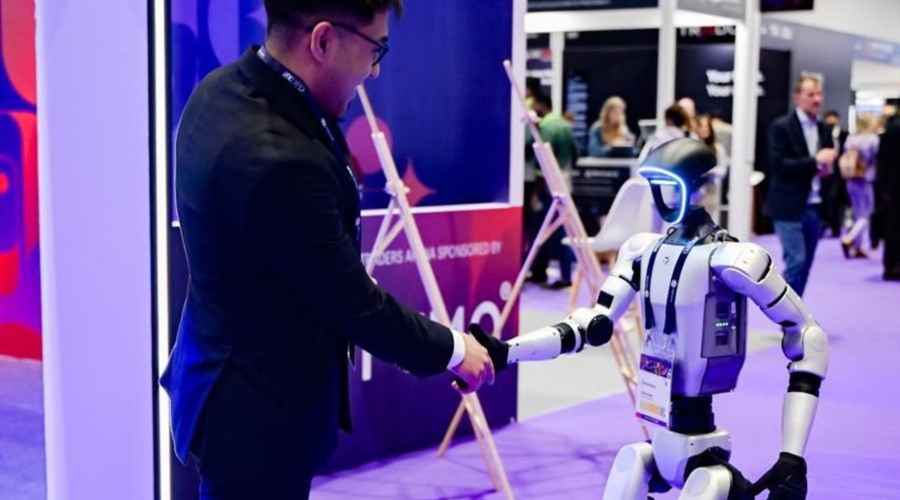
A humanoid robot at iFX EXPO Dubai

AI is prompting proprietary trading firms to slow hiring and focus on more specialized talent, but it is not yet driving widescale job cuts, according to Acuiti’s Q2 2026 Proprietary Trading Management Insight Report in association with Avelacom.

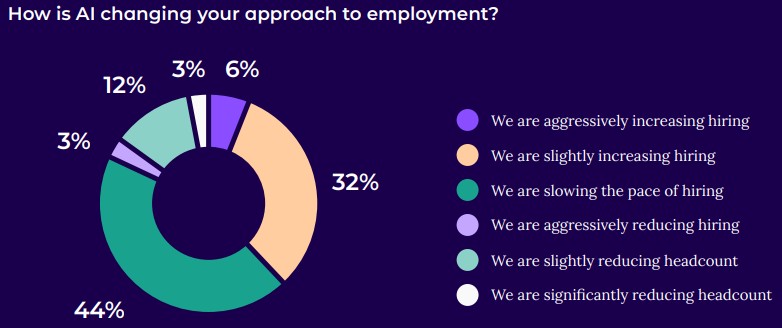
The survey, based on a global network of institutional prop firms, shows that managers mainly use AI to boost productivity of existing staff while becoming more selective about new roles. Asked how AI is changing their approach to employment, 44% of firms said they are slowing the pace of hiring.

Institutional proprietary trading firms trade with their own capital on regulated exchanges, using in‑house teams, technology, and colocation to run systematic and high‑frequency strategies. Retail‑style prop firms, by contrast, are built around selling funded accounts or evaluations to individual traders.

Nearly Half of Prop Firms Slowing Hiring

Only 15% reported reducing headcount due to AI productivity gains, with 3% “significantly” reducing staff and 12% slightly cutting headcount. By contrast, 32% are slightly increasing hiring and 6% are aggressively increasing hiring, suggesting a split between firms leaning into AI‑driven growth and those pausing to reassess their staffing needs.
Source: Acuiti

The trend is most pronounced at firms that combine algorithmic trading with point‑and‑click execution . These firms use AI to automate routine work, support decision‑making and increase throughput for existing teams. The report notes that, rather than pulling out of markets or shutting desks, most firms seek to run leaner, more efficient operations and demand clearer justification for each additional hire.

Continue reading: Everyone Talks About AI’s Power. Few Ask What It Does to Financial Decisions

As overall hiring momentum cools, the type of roles prop shops want is changing. Acuiti’s report finds that firms are moving away from broad-based recruitment and instead target highly specialized profiles, particularly in quantitative research, engineering and data science. These roles are central to developing, training and integrating AI models into trading strategies and infrastructure.

Demand Shifts to Quant, Data and Engineering Skills

Remonda Møller, the Founder of Muinmos, said at the Finance Magnates London Summit 2025 that AI is a major focus right now, but boards need a clear understanding of what they are adopting. In compliance, the key questions remain how usable, accurate and accountable any AI system actually is.

Muinmos' Founder and CEO, Remonda Kirketerp-Møller

“AI is a hot topic, but boards must understand what they are getting into. Its usability, accuracy, and accountability are fundamental in compliance.”

The AI findings sit alongside other structural themes in the report. During the first quarter of 2026, marked by heightened volatility driven by conflict in the Middle East and concerns about AI’s impact on corporate business models, 83% of firms said their operational performance was good or excellent.

However, 54% reported issues with market data feed capacity and latency, and 46% saw problems with order management and execution technology, highlighting pressure points as firms scale more automated, model‑driven strategies.

Together, the data suggests that AI is reshaping how prop firms think about headcount and skills, but in a gradual, targeted way. For now, productivity gains appear to translate into slower, more selective hiring rather than large‑scale displacement of traders and technologists.

Retail Brokers Lean on AI Too

In retail brokerage, AI has already appeared in layoff narratives. Early this year, eToro announced a plan to cut about 7% of its global workforce and explicitly cited “process automation and AI” as part of the push to operate more efficiently and focus on key priorities.

“We are reducing our global headcount by approximately 7%", CEO, Yoni Assia said. “We are aligning our resources with our key priorities and leveraging process automation and AI to operate more efficiently and focus on the areas most critical to our long-term success. This will sharpen our execution so we can move faster.”

Previously, the operator of FXCM and Tradu announced that it was preparing to cut more than 100 jobs and pointed to “agentic AI” as one factor behind that reduction. The question remains whether AI is becoming a genuine driver of leaner broker operations or simply a convenient label for cost-cutting.

Outside the trading industry, Meta signaled a similar shift late last year, saying it was considering cutting its metaverse budget by up to 30% and reallocating those resources toward AI.

AI is prompting proprietary trading firms to slow hiring and focus on more specialized talent, but it is not yet driving widescale job cuts, according to Acuiti’s Q2 2026 Proprietary Trading Management Insight Report in association with Avelacom.

The survey, based on a global network of institutional prop firms, shows that managers mainly use AI to boost productivity of existing staff while becoming more selective about new roles. Asked how AI is changing their approach to employment, 44% of firms said they are slowing the pace of hiring.

Institutional proprietary trading firms trade with their own capital on regulated exchanges, using in‑house teams, technology, and colocation to run systematic and high‑frequency strategies. Retail‑style prop firms, by contrast, are built around selling funded accounts or evaluations to individual traders.

Nearly Half of Prop Firms Slowing Hiring

Only 15% reported reducing headcount due to AI productivity gains, with 3% “significantly” reducing staff and 12% slightly cutting headcount. By contrast, 32% are slightly increasing hiring and 6% are aggressively increasing hiring, suggesting a split between firms leaning into AI‑driven growth and those pausing to reassess their staffing needs.

Source: Acuiti

The trend is most pronounced at firms that combine algorithmic trading with point‑and‑click execution . These firms use AI to automate routine work, support decision‑making and increase throughput for existing teams. The report notes that, rather than pulling out of markets or shutting desks, most firms seek to run leaner, more efficient operations and demand clearer justification for each additional hire.

Continue reading: Everyone Talks About AI’s Power. Few Ask What It Does to Financial Decisions

As overall hiring momentum cools, the type of roles prop shops want is changing. Acuiti’s report finds that firms are moving away from broad-based recruitment and instead target highly specialized profiles, particularly in quantitative research, engineering and data science. These roles are central to developing, training and integrating AI models into trading strategies and infrastructure.

Demand Shifts to Quant, Data and Engineering Skills

Remonda Møller, the Founder of Muinmos, said at the Finance Magnates London Summit 2025 that AI is a major focus right now, but boards need a clear understanding of what they are adopting. In compliance, the key questions remain how usable, accurate and accountable any AI system actually is.

Muinmos' Founder and CEO, Remonda Kirketerp-Møller

“AI is a hot topic, but boards must understand what they are getting into. Its usability, accuracy, and accountability are fundamental in compliance.”

The AI findings sit alongside other structural themes in the report. During the first quarter of 2026, marked by heightened volatility driven by conflict in the Middle East and concerns about AI’s impact on corporate business models, 83% of firms said their operational performance was good or excellent.

However, 54% reported issues with market data feed capacity and latency, and 46% saw problems with order management and execution technology, highlighting pressure points as firms scale more automated, model‑driven strategies.

Together, the data suggests that AI is reshaping how prop firms think about headcount and skills, but in a gradual, targeted way. For now, productivity gains appear to translate into slower, more selective hiring rather than large‑scale displacement of traders and technologists.

Retail Brokers Lean on AI Too

In retail brokerage, AI has already appeared in layoff narratives. Early this year, eToro announced a plan to cut about 7% of its global workforce and explicitly cited “process automation and AI” as part of the push to operate more efficiently and focus on key priorities.

“We are reducing our global headcount by approximately 7%", CEO, Yoni Assia said. “We are aligning our resources with our key priorities and leveraging process automation and AI to operate more efficiently and focus on the areas most critical to our long-term success. This will sharpen our execution so we can move faster.”

Previously, the operator of FXCM and Tradu announced that it was preparing to cut more than 100 jobs and pointed to “agentic AI” as one factor behind that reduction. The question remains whether AI is becoming a genuine driver of leaner broker operations or simply a convenient label for cost-cutting.

Outside the trading industry, Meta signaled a similar shift late last year, saying it was considering cutting its metaverse budget by up to 30% and reallocating those resources toward AI.

About the Author: Jared Kirui
Jared Kirui
  • 2804 Articles
  • 54 Followers
About the Author: Jared Kirui
Jared Kirui is an Editor at Finance Magnates with more than five years of experience in financial journalism. He covers online trading, fintech, payments, and crypto industries with a focus on companies, regulation and compliance, executive moves, trading technology, and market analysis. His work has been featured in other media outlets, including Benzinga, ZyCrypto, The Distributed, and The Daily Hodl. Education: Bachelor of Commerce degree (Finance option), University of Nairobi
  • 2804 Articles
  • 54 Followers

More from the Author

Institutional FX

!"#$%&'()*+,-./0123456789:;<=>?@ABCDEFGHIJKLMNOPQRSTUVWXYZ[\]^_`abcdefghijklmnopqrstuvwxyz{|} !"#$%&'()*+,-./0123456789:;<=>?@ABCDEFGHIJKLMNOPQRSTUVWXYZ[\]^_`abcdefghijklmnopqrstuvwxyz{|}