The $500 Trillion AI Bet Depends on Energy, Infrastructure, and Policy, Not Just Code

Tuesday, 26/05/2026 | 13:00 GMT by Anndy Lian
  • If valuation outpaces physical output, AI boom could trigger inflationary pressures globally.
  • Transition gap between financial markets and infrastructure could cause macroeconomic instability.
AI and $500 economy

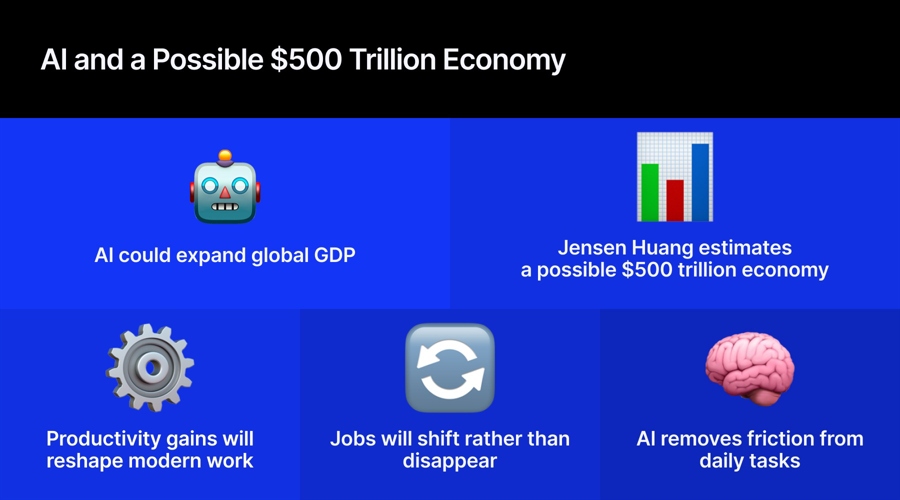
Jensen Huang's recent remarks on AI's economic trajectory are as bold as they are inevitable. “There's a belief that the world's GDP is somehow limited at a hundred trillion dollars,” he said. “AI is going to cause that hundred trillion dollars to become two hundred, three hundred, five hundred trillion... Everybody's jobs will change.”

The pitch is seductive, and on the micro level, largely correct. AI will not simply replace jobs; it will strip away friction. Workers will spend less time wrangling spreadsheets or typing prompts and more time orchestrating, deciding, and creating. Productivity will surge. Those who fail to integrate AI will lose to those who do.

But macroeconomics rarely bends to technological optimism. The real question is not whether AI expands the economic pie. It is how that expansion prices out, and who captures the gains.

Pressure-testing Huang's $500 trillion vision reveals two sharply different futures. One leads to structural deflation and abundance. The other leads to inflationary distortion.
AI and $500 economy

Scenario A: The Nominal Bubble

If the $500 trillion figure is driven more by financial engineering than physical output, the result could be an inflationary shock.

A booming AI sector would generate enormous paper wealth across companies such as NVIDIA, Microsoft, and OpenAI. Investors and founders would recycle those gains into real-world assets: housing, energy, food, and commodities. That is classic demand-pull inflation, amplified by unprecedented liquidity .

At the same time, AI's digital promise collides with physical bottlenecks. Training models requires vast amounts of copper, semiconductors, data centers, and electricity. Competition for those constrained resources pushes up costs across the broader economy while non-AI sectors struggle to keep pace.

In this scenario, the $500 trillion economy is not real growth. It is a valuation bubble chasing finite real-world supply.

Scenario B: The Deflationary Engine

The counterargument is that AI could create genuine GDP expansion while driving structural deflation.

Jensen Huang, Founder and CEO of Nvidia, Source: Wikipedia

GDP is ultimately price multiplied by quantity. If AI removes the constraints of human labor and intelligence, the quantity of goods and services could scale dramatically even as prices fall.

When AI automates coding, legal work, diagnostics, research, and eventually physical production through robotics and automated manufacturing, the marginal cost of creating products and services collapses. Software, logistics, energy optimization, and even manufacturing become radically cheaper.

If output expands severalfold while costs decline, the economy grows in real terms. Living costs fall, purchasing power rises, and abundance—not inflation—defines the outcome.

This is the future Huang is implicitly betting on. And mathematically, it is possible.

The Dangerous Transition Gap

The real risk lies between those two scenarios.

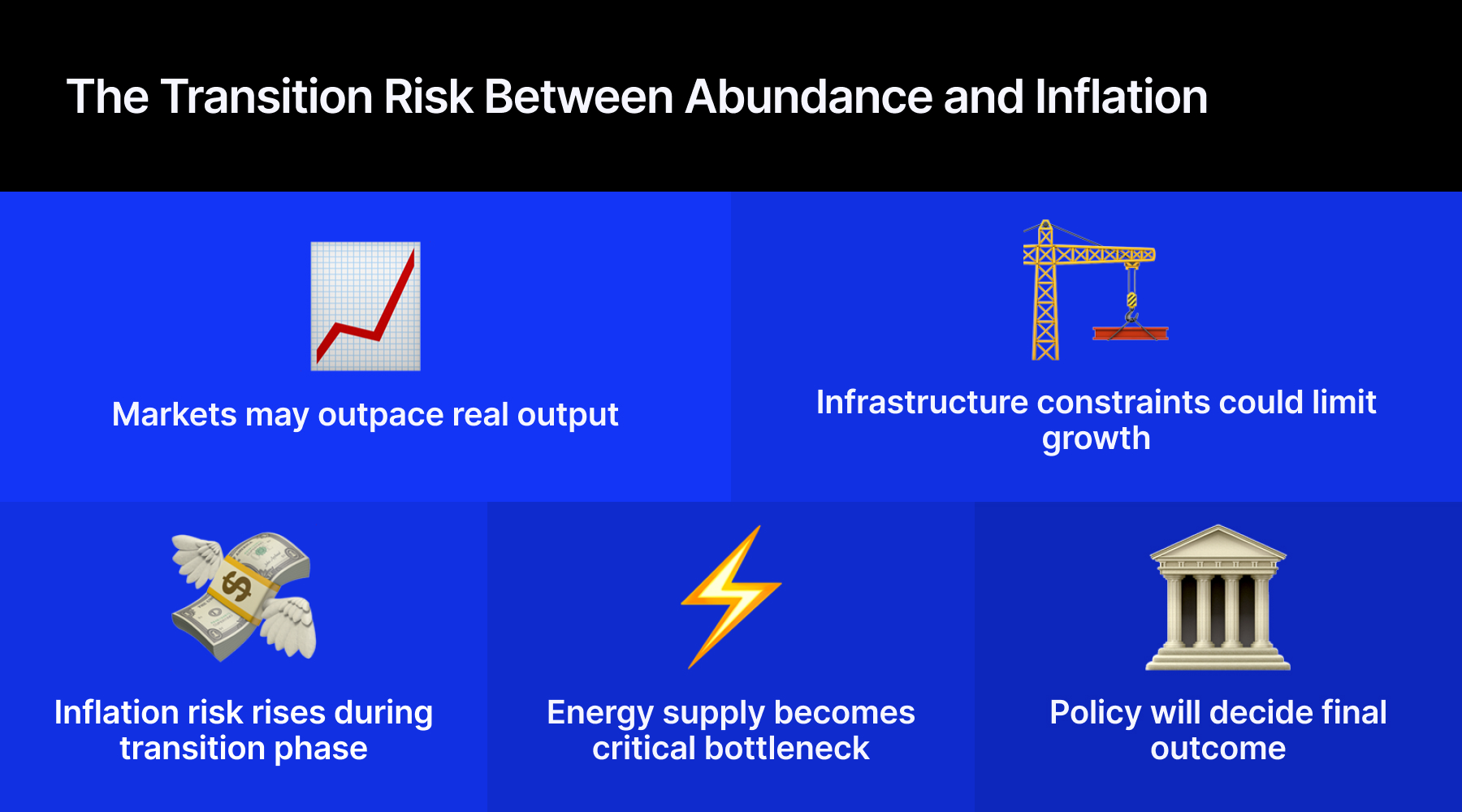
Markets may price in AI-driven abundance long before the physical infrastructure exists to support it. Building advanced energy grids, semiconductor fabs, robotics supply chains, and transmission networks could take 10 to 15 years.

That creates a dangerous mismatch. Capital floods into AI today, asset prices surge, and resource competition intensifies before supply-side abundance arrives. Energy, housing, metals, and essential goods could all become more expensive during the transition.

In effect, the path to abundance may first pass through inflation.

Central banks would face an impossible balancing act between suppressing inflation and supporting growth. Workers in disrupted industries could face displacement before new AI-augmented roles scale fast enough to absorb them. Social and political friction could undermine the productivity boom AI promises.

Abundance is not automatic. It has to be engineered.

The Real Question

Huang is probably right that GDP is not capped at $100 trillion. He is also right that AI will fundamentally change how people work.

But whether the world reaches $500 trillion through abundance or distortion will depend less on algorithms and more on institutions.

The outcome will hinge on energy policy, industrial capacity, monetary discipline, and labor adaptation. Technology creates productive capacity. Governments, central banks, and markets determine whether that capacity translates into stability.

AI will reshape the global economy. The real question is whether society can manage the transition as effectively as it trains the models powering it.

Jensen Huang's recent remarks on AI's economic trajectory are as bold as they are inevitable. “There's a belief that the world's GDP is somehow limited at a hundred trillion dollars,” he said. “AI is going to cause that hundred trillion dollars to become two hundred, three hundred, five hundred trillion... Everybody's jobs will change.”

The pitch is seductive, and on the micro level, largely correct. AI will not simply replace jobs; it will strip away friction. Workers will spend less time wrangling spreadsheets or typing prompts and more time orchestrating, deciding, and creating. Productivity will surge. Those who fail to integrate AI will lose to those who do.

But macroeconomics rarely bends to technological optimism. The real question is not whether AI expands the economic pie. It is how that expansion prices out, and who captures the gains.

Pressure-testing Huang's $500 trillion vision reveals two sharply different futures. One leads to structural deflation and abundance. The other leads to inflationary distortion.

AI and $500 economy

Scenario A: The Nominal Bubble

If the $500 trillion figure is driven more by financial engineering than physical output, the result could be an inflationary shock.

A booming AI sector would generate enormous paper wealth across companies such as NVIDIA, Microsoft, and OpenAI. Investors and founders would recycle those gains into real-world assets: housing, energy, food, and commodities. That is classic demand-pull inflation, amplified by unprecedented liquidity .

At the same time, AI's digital promise collides with physical bottlenecks. Training models requires vast amounts of copper, semiconductors, data centers, and electricity. Competition for those constrained resources pushes up costs across the broader economy while non-AI sectors struggle to keep pace.

In this scenario, the $500 trillion economy is not real growth. It is a valuation bubble chasing finite real-world supply.

Scenario B: The Deflationary Engine

The counterargument is that AI could create genuine GDP expansion while driving structural deflation.

Jensen Huang, Founder and CEO of Nvidia, Source: Wikipedia

GDP is ultimately price multiplied by quantity. If AI removes the constraints of human labor and intelligence, the quantity of goods and services could scale dramatically even as prices fall.

When AI automates coding, legal work, diagnostics, research, and eventually physical production through robotics and automated manufacturing, the marginal cost of creating products and services collapses. Software, logistics, energy optimization, and even manufacturing become radically cheaper.

If output expands severalfold while costs decline, the economy grows in real terms. Living costs fall, purchasing power rises, and abundance—not inflation—defines the outcome.

This is the future Huang is implicitly betting on. And mathematically, it is possible.

The Dangerous Transition Gap

The real risk lies between those two scenarios.

Markets may price in AI-driven abundance long before the physical infrastructure exists to support it. Building advanced energy grids, semiconductor fabs, robotics supply chains, and transmission networks could take 10 to 15 years.

That creates a dangerous mismatch. Capital floods into AI today, asset prices surge, and resource competition intensifies before supply-side abundance arrives. Energy, housing, metals, and essential goods could all become more expensive during the transition.

In effect, the path to abundance may first pass through inflation.

Central banks would face an impossible balancing act between suppressing inflation and supporting growth. Workers in disrupted industries could face displacement before new AI-augmented roles scale fast enough to absorb them. Social and political friction could undermine the productivity boom AI promises.

Abundance is not automatic. It has to be engineered.

The Real Question

Huang is probably right that GDP is not capped at $100 trillion. He is also right that AI will fundamentally change how people work.

But whether the world reaches $500 trillion through abundance or distortion will depend less on algorithms and more on institutions.

The outcome will hinge on energy policy, industrial capacity, monetary discipline, and labor adaptation. Technology creates productive capacity. Governments, central banks, and markets determine whether that capacity translates into stability.

AI will reshape the global economy. The real question is whether society can manage the transition as effectively as it trains the models powering it.

About the Author: Anndy Lian
Anndy Lian
  • 28 Articles
  • 14 Followers
About the Author: Anndy Lian
Anndy Lian is an all-rounded business strategist in Asia. He has provided advisory across a variety of industries for local, international, public listed companies and governments. He is an early blockchain adopter and experienced serial entrepreneur, book author, investor, board member and keynote speaker.
  • 28 Articles
  • 14 Followers

More from the Author

Institutional FX

!"#$%&'()*+,-./0123456789:;<=>?@ABCDEFGHIJKLMNOPQRSTUVWXYZ[\]^_`abcdefghijklmnopqrstuvwxyz{|} !"#$%&'()*+,-./0123456789:;<=>?@ABCDEFGHIJKLMNOPQRSTUVWXYZ[\]^_`abcdefghijklmnopqrstuvwxyz{|}