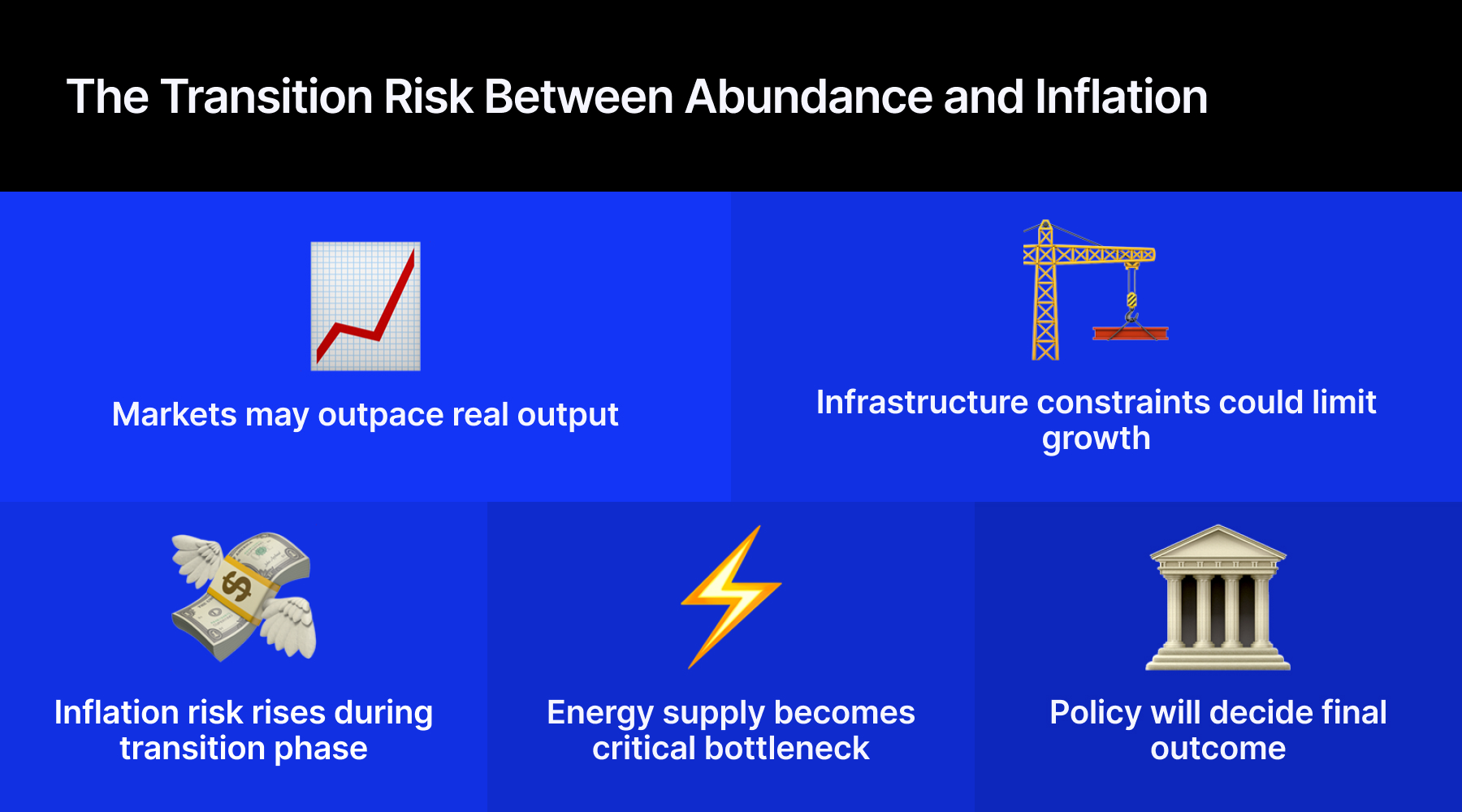
If valuation outpaces physical output, AI boom could trigger inflationary pressures globally.
Transition gap between financial markets and infrastructure could cause macroeconomic instability.
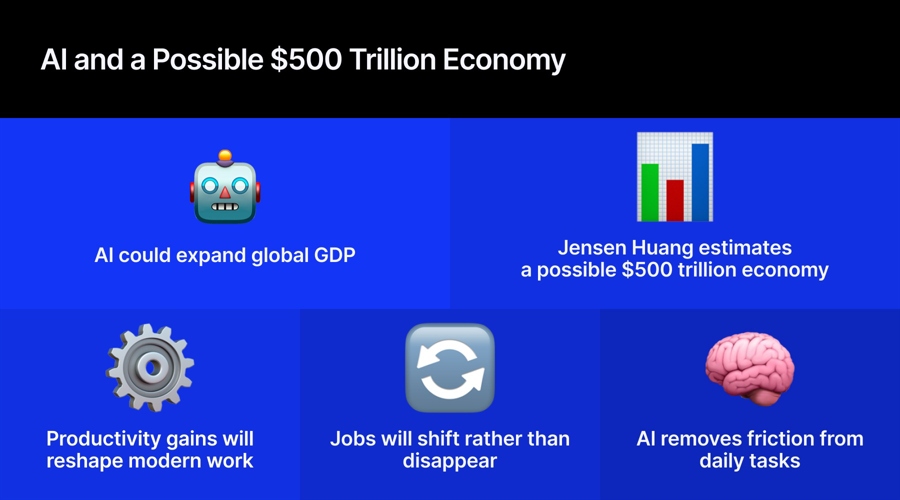
Jensen Huang's recent
remarks on AI's economic trajectory are as bold as they are inevitable.
“There's a belief that the world's GDP is somehow limited at a hundred trillion
dollars,” he said. “AI is going to cause that hundred trillion dollars to
become two hundred, three hundred, five hundred trillion... Everybody's jobs
will change.”
The pitch is
seductive, and on the micro level, largely correct. AI will not simply replace
jobs; it will strip away friction. Workers will spend less time wrangling
spreadsheets or typing prompts and more time orchestrating, deciding, and
creating. Productivity will surge. Those who fail to integrate AI will lose to
those who do.
But macroeconomics
rarely bends to technological optimism. The real question is not whether AI
expands the economic pie. It is how that expansion prices out, and who captures
the gains.
At the same time, AI's
digital promise collides with physical bottlenecks. Training models requires
vast amounts of copper, semiconductors, data centers, and electricity.
Competition for those constrained resources pushes up costs across the broader
economy while non-AI sectors struggle to keep pace.
In this scenario, the
$500 trillion economy is not real growth. It is a valuation bubble chasing
finite real-world supply.
Scenario B: The
Deflationary Engine
The counterargument is
that AI could create genuine GDP expansion while driving structural deflation.
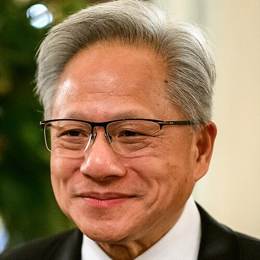
Jensen Huang, Founder and CEO of Nvidia, Source: Wikipedia
GDP is ultimately
price multiplied by quantity. If AI removes the constraints of human labor and
intelligence, the quantity of goods and services could scale dramatically even
as prices fall.
When AI automates
coding, legal work, diagnostics, research, and eventually physical production
through robotics and automated manufacturing, the marginal cost of creating
products and services collapses. Software, logistics, energy optimization, and
even manufacturing become radically cheaper.
If output expands
severalfold while costs decline, the economy grows in real terms. Living costs
fall, purchasing power rises, and abundance—not inflation—defines the outcome.
This is the future
Huang is implicitly betting on. And mathematically, it is possible.
The Dangerous
Transition Gap
The real risk lies
between those two scenarios.
Markets may price in
AI-driven abundance long before the physical infrastructure exists to support
it. Building advanced energy grids, semiconductor fabs, robotics supply chains,
and transmission networks could take 10 to 15 years.
Tariffs and the war aren't helping inflation, but one that not many expected to see was the AI story impacting inflation. Here's PPI (which flows into PCE) for semiconductors and other electrical components. pic.twitter.com/8R6b9ZqqrE
That creates a
dangerous mismatch. Capital floods into AI today, asset prices surge, and
resource competition intensifies before supply-side abundance arrives. Energy,
housing, metals, and essential goods could all become more expensive during the
transition.
In effect, the path to
abundance may first pass through inflation.
Central banks would
face an impossible balancing act between suppressing inflation and supporting
growth. Workers in disrupted industries could face displacement before new
AI-augmented roles scale fast enough to absorb them. Social and political
friction could undermine the productivity boom AI promises.
Abundance is not
automatic. It has to be engineered.
The Real Question
Huang is probably
right that GDP is not capped at $100 trillion. He is also right that AI will
fundamentally change how people work.
But whether the world
reaches $500 trillion through abundance or distortion will depend less on
algorithms and more on institutions.
The outcome will hinge
on energy policy, industrial capacity, monetary discipline, and labor
adaptation. Technology creates productive capacity. Governments, central banks,
and markets determine whether that capacity translates into stability.
AI will reshape the
global economy. The real question is whether society can manage the transition
as effectively as it trains the models powering it.
Jensen Huang's recent
remarks on AI's economic trajectory are as bold as they are inevitable.
“There's a belief that the world's GDP is somehow limited at a hundred trillion
dollars,” he said. “AI is going to cause that hundred trillion dollars to
become two hundred, three hundred, five hundred trillion... Everybody's jobs
will change.”
The pitch is
seductive, and on the micro level, largely correct. AI will not simply replace
jobs; it will strip away friction. Workers will spend less time wrangling
spreadsheets or typing prompts and more time orchestrating, deciding, and
creating. Productivity will surge. Those who fail to integrate AI will lose to
those who do.
But macroeconomics
rarely bends to technological optimism. The real question is not whether AI
expands the economic pie. It is how that expansion prices out, and who captures
the gains.
At the same time, AI's
digital promise collides with physical bottlenecks. Training models requires
vast amounts of copper, semiconductors, data centers, and electricity.
Competition for those constrained resources pushes up costs across the broader
economy while non-AI sectors struggle to keep pace.
In this scenario, the
$500 trillion economy is not real growth. It is a valuation bubble chasing
finite real-world supply.
Scenario B: The
Deflationary Engine
The counterargument is
that AI could create genuine GDP expansion while driving structural deflation.
Jensen Huang, Founder and CEO of Nvidia, Source: Wikipedia
GDP is ultimately
price multiplied by quantity. If AI removes the constraints of human labor and
intelligence, the quantity of goods and services could scale dramatically even
as prices fall.
When AI automates
coding, legal work, diagnostics, research, and eventually physical production
through robotics and automated manufacturing, the marginal cost of creating
products and services collapses. Software, logistics, energy optimization, and
even manufacturing become radically cheaper.
If output expands
severalfold while costs decline, the economy grows in real terms. Living costs
fall, purchasing power rises, and abundance—not inflation—defines the outcome.
This is the future
Huang is implicitly betting on. And mathematically, it is possible.
The Dangerous
Transition Gap
The real risk lies
between those two scenarios.
Markets may price in
AI-driven abundance long before the physical infrastructure exists to support
it. Building advanced energy grids, semiconductor fabs, robotics supply chains,
and transmission networks could take 10 to 15 years.
Tariffs and the war aren't helping inflation, but one that not many expected to see was the AI story impacting inflation. Here's PPI (which flows into PCE) for semiconductors and other electrical components. pic.twitter.com/8R6b9ZqqrE
That creates a
dangerous mismatch. Capital floods into AI today, asset prices surge, and
resource competition intensifies before supply-side abundance arrives. Energy,
housing, metals, and essential goods could all become more expensive during the
transition.
In effect, the path to
abundance may first pass through inflation.
Central banks would
face an impossible balancing act between suppressing inflation and supporting
growth. Workers in disrupted industries could face displacement before new
AI-augmented roles scale fast enough to absorb them. Social and political
friction could undermine the productivity boom AI promises.
Abundance is not
automatic. It has to be engineered.
The Real Question
Huang is probably
right that GDP is not capped at $100 trillion. He is also right that AI will
fundamentally change how people work.
But whether the world
reaches $500 trillion through abundance or distortion will depend less on
algorithms and more on institutions.
The outcome will hinge
on energy policy, industrial capacity, monetary discipline, and labor
adaptation. Technology creates productive capacity. Governments, central banks,
and markets determine whether that capacity translates into stability.
AI will reshape the
global economy. The real question is whether society can manage the transition
as effectively as it trains the models powering it.
Anndy Lian is an all-rounded business strategist in Asia. He has provided advisory across a variety of industries for local, international, public listed companies and governments. He is an early blockchain adopter and experienced serial entrepreneur, book author, investor, board member and keynote speaker.
Capital.com UAE Clients Trade $1T in H1; Saxo Signs Nine Athletes
Capital.com UAE Clients Trade $1T in H1; Saxo Signs Nine Athletes
Capital.com UAE Clients Trade $1T in H1; Saxo Signs Nine Athletes
Capital.com UAE Clients Trade $1T in H1; Saxo Signs Nine Athletes
Today’s financial news recap covers Capital.com’s trading data, Saxo Bank’s athlete campaign, Revolut’s Gibraltar crypto licence, and eToro’s new desktop terminal.
Finance Magnates Daily Recap brings you the latest news from forex and CFD brokers, fintech, payments, cryptocurrency, digital assets, trading platforms, financial regulation and global markets.
Get the key company news, executive moves, deals, regulatory updates and market developments of the day, in just a few minutes. New episodes published every weekday.
Read more: https://www.financemagnates.com
#FinanceMagnates #ForexNews #FintechNews
Today’s financial news recap covers Capital.com’s trading data, Saxo Bank’s athlete campaign, Revolut’s Gibraltar crypto licence, and eToro’s new desktop terminal.
Finance Magnates Daily Recap brings you the latest news from forex and CFD brokers, fintech, payments, cryptocurrency, digital assets, trading platforms, financial regulation and global markets.
Get the key company news, executive moves, deals, regulatory updates and market developments of the day, in just a few minutes. New episodes published every weekday.
Read more: https://www.financemagnates.com
#FinanceMagnates #ForexNews #FintechNews
Today’s financial news recap covers Capital.com’s trading data, Saxo Bank’s athlete campaign, Revolut’s Gibraltar crypto licence, and eToro’s new desktop terminal.
Finance Magnates Daily Recap brings you the latest news from forex and CFD brokers, fintech, payments, cryptocurrency, digital assets, trading platforms, financial regulation and global markets.
Get the key company news, executive moves, deals, regulatory updates and market developments of the day, in just a few minutes. New episodes published every weekday.
Read more: https://www.financemagnates.com
#FinanceMagnates #ForexNews #FintechNews
Today’s financial news recap covers Capital.com’s trading data, Saxo Bank’s athlete campaign, Revolut’s Gibraltar crypto licence, and eToro’s new desktop terminal.
Finance Magnates Daily Recap brings you the latest news from forex and CFD brokers, fintech, payments, cryptocurrency, digital assets, trading platforms, financial regulation and global markets.
Get the key company news, executive moves, deals, regulatory updates and market developments of the day, in just a few minutes. New episodes published every weekday.
Read more: https://www.financemagnates.com
#FinanceMagnates #ForexNews #FintechNews
CXM Group to Buy TD Markets; Interactive Brokers Raises Dividend
CXM Group to Buy TD Markets; Interactive Brokers Raises Dividend
CXM Group to Buy TD Markets; Interactive Brokers Raises Dividend
CXM Group to Buy TD Markets; Interactive Brokers Raises Dividend
CXM Group to Buy TD Markets; Interactive Brokers Raises Dividend
CXM Group to Buy TD Markets; Interactive Brokers Raises Dividend
Today’s financial news recap covers CXM Group agrees to acquire TD Markets, Interactive Brokers raises its dividend, Your Bourse and 4XPORTAL formalise a technology partnership, and IC completes its rebranding from IC Markets.
Finance Magnates Daily Recap brings you the latest news from forex and CFD brokers, fintech, payments, cryptocurrency, digital assets, trading platforms, financial regulation and global markets.
Get the key company news, executive moves, deals, regulatory updates and market developments of the day, in just a few minutes. New episodes published every weekday.
Read more: https://www.financemagnates.com
#FinanceMagnates #ForexNews #FintechNews
Today’s financial news recap covers CXM Group agrees to acquire TD Markets, Interactive Brokers raises its dividend, Your Bourse and 4XPORTAL formalise a technology partnership, and IC completes its rebranding from IC Markets.
Finance Magnates Daily Recap brings you the latest news from forex and CFD brokers, fintech, payments, cryptocurrency, digital assets, trading platforms, financial regulation and global markets.
Get the key company news, executive moves, deals, regulatory updates and market developments of the day, in just a few minutes. New episodes published every weekday.
Read more: https://www.financemagnates.com
#FinanceMagnates #ForexNews #FintechNews
Today’s financial news recap covers CXM Group agrees to acquire TD Markets, Interactive Brokers raises its dividend, Your Bourse and 4XPORTAL formalise a technology partnership, and IC completes its rebranding from IC Markets.
Finance Magnates Daily Recap brings you the latest news from forex and CFD brokers, fintech, payments, cryptocurrency, digital assets, trading platforms, financial regulation and global markets.
Get the key company news, executive moves, deals, regulatory updates and market developments of the day, in just a few minutes. New episodes published every weekday.
Read more: https://www.financemagnates.com
#FinanceMagnates #ForexNews #FintechNews
Today’s financial news recap covers CXM Group agrees to acquire TD Markets, Interactive Brokers raises its dividend, Your Bourse and 4XPORTAL formalise a technology partnership, and IC completes its rebranding from IC Markets.
Finance Magnates Daily Recap brings you the latest news from forex and CFD brokers, fintech, payments, cryptocurrency, digital assets, trading platforms, financial regulation and global markets.
Get the key company news, executive moves, deals, regulatory updates and market developments of the day, in just a few minutes. New episodes published every weekday.
Read more: https://www.financemagnates.com
#FinanceMagnates #ForexNews #FintechNews
Today’s financial news recap covers CXM Group agrees to acquire TD Markets, Interactive Brokers raises its dividend, Your Bourse and 4XPORTAL formalise a technology partnership, and IC completes its rebranding from IC Markets.
Finance Magnates Daily Recap brings you the latest news from forex and CFD brokers, fintech, payments, cryptocurrency, digital assets, trading platforms, financial regulation and global markets.
Get the key company news, executive moves, deals, regulatory updates and market developments of the day, in just a few minutes. New episodes published every weekday.
Read more: https://www.financemagnates.com
#FinanceMagnates #ForexNews #FintechNews
Today’s financial news recap covers CXM Group agrees to acquire TD Markets, Interactive Brokers raises its dividend, Your Bourse and 4XPORTAL formalise a technology partnership, and IC completes its rebranding from IC Markets.
Finance Magnates Daily Recap brings you the latest news from forex and CFD brokers, fintech, payments, cryptocurrency, digital assets, trading platforms, financial regulation and global markets.
Get the key company news, executive moves, deals, regulatory updates and market developments of the day, in just a few minutes. New episodes published every weekday.
Read more: https://www.financemagnates.com
#FinanceMagnates #ForexNews #FintechNews
Trade Nation Enters Poland; FCA Finds Gaps at Seven Brokers
Trade Nation Enters Poland; FCA Finds Gaps at Seven Brokers
Trade Nation Enters Poland; FCA Finds Gaps at Seven Brokers
Trade Nation Enters Poland; FCA Finds Gaps at Seven Brokers
Trade Nation Enters Poland; FCA Finds Gaps at Seven Brokers
Trade Nation Enters Poland; FCA Finds Gaps at Seven Brokers
Today’s financial news recap covers Trade Nation expands into Poland, the FCA finds surveillance gaps at seven UK retail brokers, perpetual futures on US stocks could launch within weeks, and Australia's crypto platforms face a new regulatory deadline.
Finance Magnates Daily Recap brings you the latest news from forex and CFD brokers, fintech, payments, cryptocurrency, digital assets, trading platforms, financial regulation and global markets.
Get the key company news, executive moves, deals, regulatory updates and market developments of the day, in just a few minutes. New episodes published every weekday.
Read more: https://www.financemagnates.com
#FinanceMagnates #ForexNews #FintechNews
Today’s financial news recap covers Trade Nation expands into Poland, the FCA finds surveillance gaps at seven UK retail brokers, perpetual futures on US stocks could launch within weeks, and Australia's crypto platforms face a new regulatory deadline.
Finance Magnates Daily Recap brings you the latest news from forex and CFD brokers, fintech, payments, cryptocurrency, digital assets, trading platforms, financial regulation and global markets.
Get the key company news, executive moves, deals, regulatory updates and market developments of the day, in just a few minutes. New episodes published every weekday.
Read more: https://www.financemagnates.com
#FinanceMagnates #ForexNews #FintechNews
Today’s financial news recap covers Trade Nation expands into Poland, the FCA finds surveillance gaps at seven UK retail brokers, perpetual futures on US stocks could launch within weeks, and Australia's crypto platforms face a new regulatory deadline.
Finance Magnates Daily Recap brings you the latest news from forex and CFD brokers, fintech, payments, cryptocurrency, digital assets, trading platforms, financial regulation and global markets.
Get the key company news, executive moves, deals, regulatory updates and market developments of the day, in just a few minutes. New episodes published every weekday.
Read more: https://www.financemagnates.com
#FinanceMagnates #ForexNews #FintechNews
Today’s financial news recap covers Trade Nation expands into Poland, the FCA finds surveillance gaps at seven UK retail brokers, perpetual futures on US stocks could launch within weeks, and Australia's crypto platforms face a new regulatory deadline.
Finance Magnates Daily Recap brings you the latest news from forex and CFD brokers, fintech, payments, cryptocurrency, digital assets, trading platforms, financial regulation and global markets.
Get the key company news, executive moves, deals, regulatory updates and market developments of the day, in just a few minutes. New episodes published every weekday.
Read more: https://www.financemagnates.com
#FinanceMagnates #ForexNews #FintechNews
Today’s financial news recap covers Trade Nation expands into Poland, the FCA finds surveillance gaps at seven UK retail brokers, perpetual futures on US stocks could launch within weeks, and Australia's crypto platforms face a new regulatory deadline.
Finance Magnates Daily Recap brings you the latest news from forex and CFD brokers, fintech, payments, cryptocurrency, digital assets, trading platforms, financial regulation and global markets.
Get the key company news, executive moves, deals, regulatory updates and market developments of the day, in just a few minutes. New episodes published every weekday.
Read more: https://www.financemagnates.com
#FinanceMagnates #ForexNews #FintechNews
Today’s financial news recap covers Trade Nation expands into Poland, the FCA finds surveillance gaps at seven UK retail brokers, perpetual futures on US stocks could launch within weeks, and Australia's crypto platforms face a new regulatory deadline.
Finance Magnates Daily Recap brings you the latest news from forex and CFD brokers, fintech, payments, cryptocurrency, digital assets, trading platforms, financial regulation and global markets.
Get the key company news, executive moves, deals, regulatory updates and market developments of the day, in just a few minutes. New episodes published every weekday.
Read more: https://www.financemagnates.com
#FinanceMagnates #ForexNews #FintechNews
FxPro Sells EU Clients to Capital.com; NAGA H1 Profit Revised
FxPro Sells EU Clients to Capital.com; NAGA H1 Profit Revised
FxPro Sells EU Clients to Capital.com; NAGA H1 Profit Revised
FxPro Sells EU Clients to Capital.com; NAGA H1 Profit Revised
FxPro Sells EU Clients to Capital.com; NAGA H1 Profit Revised
FxPro Sells EU Clients to Capital.com; NAGA H1 Profit Revised
Today’s financial news recap covers FxPro agrees to sell its European client book to Capital.com, NAGA raises its first-half profit estimate, Trade Republic prepares a fee-free pension account, and Interactive Brokers introduces Ether staking.
Finance Magnates Daily Recap brings you the latest news from forex and CFD brokers, fintech, payments, cryptocurrency, digital assets, trading platforms, financial regulation and global markets.
Get the key company news, executive moves, deals, regulatory updates and market developments of the day, in just a few minutes. New episodes published every weekday.
Read more: https://www.financemagnates.com
#FinanceMagnates #ForexNews #FintechNews
Today’s financial news recap covers FxPro agrees to sell its European client book to Capital.com, NAGA raises its first-half profit estimate, Trade Republic prepares a fee-free pension account, and Interactive Brokers introduces Ether staking.
Finance Magnates Daily Recap brings you the latest news from forex and CFD brokers, fintech, payments, cryptocurrency, digital assets, trading platforms, financial regulation and global markets.
Get the key company news, executive moves, deals, regulatory updates and market developments of the day, in just a few minutes. New episodes published every weekday.
Read more: https://www.financemagnates.com
#FinanceMagnates #ForexNews #FintechNews
Today’s financial news recap covers FxPro agrees to sell its European client book to Capital.com, NAGA raises its first-half profit estimate, Trade Republic prepares a fee-free pension account, and Interactive Brokers introduces Ether staking.
Finance Magnates Daily Recap brings you the latest news from forex and CFD brokers, fintech, payments, cryptocurrency, digital assets, trading platforms, financial regulation and global markets.
Get the key company news, executive moves, deals, regulatory updates and market developments of the day, in just a few minutes. New episodes published every weekday.
Read more: https://www.financemagnates.com
#FinanceMagnates #ForexNews #FintechNews
Today’s financial news recap covers FxPro agrees to sell its European client book to Capital.com, NAGA raises its first-half profit estimate, Trade Republic prepares a fee-free pension account, and Interactive Brokers introduces Ether staking.
Finance Magnates Daily Recap brings you the latest news from forex and CFD brokers, fintech, payments, cryptocurrency, digital assets, trading platforms, financial regulation and global markets.
Get the key company news, executive moves, deals, regulatory updates and market developments of the day, in just a few minutes. New episodes published every weekday.
Read more: https://www.financemagnates.com
#FinanceMagnates #ForexNews #FintechNews
Today’s financial news recap covers FxPro agrees to sell its European client book to Capital.com, NAGA raises its first-half profit estimate, Trade Republic prepares a fee-free pension account, and Interactive Brokers introduces Ether staking.
Finance Magnates Daily Recap brings you the latest news from forex and CFD brokers, fintech, payments, cryptocurrency, digital assets, trading platforms, financial regulation and global markets.
Get the key company news, executive moves, deals, regulatory updates and market developments of the day, in just a few minutes. New episodes published every weekday.
Read more: https://www.financemagnates.com
#FinanceMagnates #ForexNews #FintechNews
Today’s financial news recap covers FxPro agrees to sell its European client book to Capital.com, NAGA raises its first-half profit estimate, Trade Republic prepares a fee-free pension account, and Interactive Brokers introduces Ether staking.
Finance Magnates Daily Recap brings you the latest news from forex and CFD brokers, fintech, payments, cryptocurrency, digital assets, trading platforms, financial regulation and global markets.
Get the key company news, executive moves, deals, regulatory updates and market developments of the day, in just a few minutes. New episodes published every weekday.
Read more: https://www.financemagnates.com
#FinanceMagnates #ForexNews #FintechNews
Plus500 Plans US Super-App; Investec to Offer IG Platform
Plus500 Plans US Super-App; Investec to Offer IG Platform
Plus500 Plans US Super-App; Investec to Offer IG Platform
Plus500 Plans US Super-App; Investec to Offer IG Platform
Plus500 Plans US Super-App; Investec to Offer IG Platform
Plus500 Plans US Super-App; Investec to Offer IG Platform
Today’s financial news recap covers Plus500 plans a US trading super-app, Investec partners with IG, Trade Republic reports a sevenfold profit jump, and BingX adds thousands of US stocks.
Finance Magnates Daily Recap brings you the latest news from forex and CFD brokers, fintech, payments, cryptocurrency, digital assets, trading platforms, financial regulation and global markets.
Get the key company news, executive moves, deals, regulatory updates and market developments of the day, in just a few minutes. New episodes published every weekday.
Read more: https://www.financemagnates.com
#FinanceMagnates #ForexNews #FintechNews
Today’s financial news recap covers Plus500 plans a US trading super-app, Investec partners with IG, Trade Republic reports a sevenfold profit jump, and BingX adds thousands of US stocks.
Finance Magnates Daily Recap brings you the latest news from forex and CFD brokers, fintech, payments, cryptocurrency, digital assets, trading platforms, financial regulation and global markets.
Get the key company news, executive moves, deals, regulatory updates and market developments of the day, in just a few minutes. New episodes published every weekday.
Read more: https://www.financemagnates.com
#FinanceMagnates #ForexNews #FintechNews
Today’s financial news recap covers Plus500 plans a US trading super-app, Investec partners with IG, Trade Republic reports a sevenfold profit jump, and BingX adds thousands of US stocks.
Finance Magnates Daily Recap brings you the latest news from forex and CFD brokers, fintech, payments, cryptocurrency, digital assets, trading platforms, financial regulation and global markets.
Get the key company news, executive moves, deals, regulatory updates and market developments of the day, in just a few minutes. New episodes published every weekday.
Read more: https://www.financemagnates.com
#FinanceMagnates #ForexNews #FintechNews
Today’s financial news recap covers Plus500 plans a US trading super-app, Investec partners with IG, Trade Republic reports a sevenfold profit jump, and BingX adds thousands of US stocks.
Finance Magnates Daily Recap brings you the latest news from forex and CFD brokers, fintech, payments, cryptocurrency, digital assets, trading platforms, financial regulation and global markets.
Get the key company news, executive moves, deals, regulatory updates and market developments of the day, in just a few minutes. New episodes published every weekday.
Read more: https://www.financemagnates.com
#FinanceMagnates #ForexNews #FintechNews
Today’s financial news recap covers Plus500 plans a US trading super-app, Investec partners with IG, Trade Republic reports a sevenfold profit jump, and BingX adds thousands of US stocks.
Finance Magnates Daily Recap brings you the latest news from forex and CFD brokers, fintech, payments, cryptocurrency, digital assets, trading platforms, financial regulation and global markets.
Get the key company news, executive moves, deals, regulatory updates and market developments of the day, in just a few minutes. New episodes published every weekday.
Read more: https://www.financemagnates.com
#FinanceMagnates #ForexNews #FintechNews
Today’s financial news recap covers Plus500 plans a US trading super-app, Investec partners with IG, Trade Republic reports a sevenfold profit jump, and BingX adds thousands of US stocks.
Finance Magnates Daily Recap brings you the latest news from forex and CFD brokers, fintech, payments, cryptocurrency, digital assets, trading platforms, financial regulation and global markets.
Get the key company news, executive moves, deals, regulatory updates and market developments of the day, in just a few minutes. New episodes published every weekday.
Read more: https://www.financemagnates.com
#FinanceMagnates #ForexNews #FintechNews