Markets Swing on Politics as Study Flags Trump Era Extremes and Starmer Faces UK Pressure

Wednesday, 13/05/2026 | 13:01 GMT by Paul Golden
  • Paul Golden highlights Fundstrat findings linking government policy to extreme market swings since 1981.
  • He also dives into populism research showing long-term economic drag despite short-term political disruption benefits.
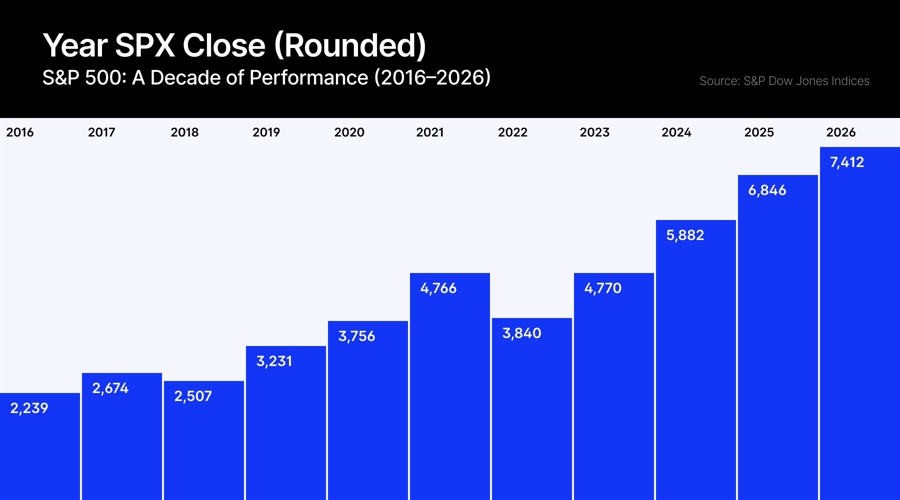
S&P Performance
2026 figure reflects YTD performance as of May 13

Donald Trump’s Predecessors on Market Volatility

Market research firms generally fly under the radar until they produce a piece of work that challenges deeply held beliefs. Fundstrat did just that recently when macro data scientist Alex Wang analysed the causes of the five best and worst market days during the last 12 US administrations dating from Ronald Reagan in 1981.

Singapore Summit: Meet the largest APAC brokers you know (and those you still don't!).

The chart considers the impact of a range of factors from corporate earnings and foreign events to economic data and interest rate expectations. Unsurprisingly, government policy was the most common theme – but the really interesting finding was how it dominated the peaks and troughs of one president in particular.

The research indicates that the current presidency was responsible for the five best and five worst market days since Trump took office for the second time. According to the analysis, this was not the case for any other president over the last 45 years.

White House spokesman Kush Desai told MarketWatch that since president Trump took office, publicly listed companies have reported blockbuster earnings reports and clocked multiple all-time high stock valuations because of his pro-growth agenda of tax cuts, deregulation, energy abundance and fair trade deals.

Hardika Singh, Economic Strategist at Fundstrat
Hardika Singh, Economic Strategist at Fundstrat, Source: LinkedIn

The best market day was 9 April 2025, when the S&P 500 rose almost 10% after the suspension of the so-called ‘liberation day’ tariffs. However, the unpredictability of Trump’s pronouncements is highlighted by the fact that one of the worst days came just 24 hours after these tariffs were announced.

Indeed, all the sharpest stock market falls since January 2025 can be linked to tariff announcements, while the gains have been highly concentrated.

Hardika Singh, an economic strategist at Fundstrat suggests that if the five best market days of the current administration were excluded, the S&P 500 would be down 2.7% since he took office instead of showing an 18.5% increase.

Perhaps disappointingly for those who believe that government policy should move markets, the research concluded that the losses pretty much cancelled out the gains, suggesting that much of the noise that has emanated from the White House over the last year-and-a-bit has been just that – noise.

Turmoil at the Top as Starmer Teeters

There’s a saying in football that you become a better player when you are out of the team – in other words, when those on the pitch are messing up the alternative can only be better.

To carry on the footballing analogy, the UK Labour party spent 14 years on the substitutes bench toning down some the messaging that has traditionally alarmed financial markets in a bid to make it more appealing to the business community, particularly in financial services.

Sadly for its supporters, since winning promotion to Downing Street, Keir Starmer has turned into the Ali Dia of British politics.

A series of U-turns and poorly considered policies have shaken confidence in his leadership and he now stands on the brink after poor local election results prompted dozens of his members of parliament to call for his departure.

David Morrison, senior market analyst at Trade Nation
David Morrison, Senior Market Analyst at Trade Nation, Source: LinkedIn

David Morrison, senior market analyst at Trade Nation notes that yields on UK government bonds have soared, with the key 10-year gilt yield pushing up by around 12 basis points before steadying. Investors are selling UK bank stocks with significant drops in the share prices of Barclays and Lloyds.

“Domestic political issues undermine sterling as Starmer desperately attempts to cling on to his position, for some reason,” says Morrison in a research note dated 12 May.

“Yet despite weakness across the British pound and euro against the US dollar, both currencies found some support due to the prospect of higher interest rates.”

Analysts currently expect the Bank of England to hike rates by around 75 basis points each before the end of the year.

MarketWatch data indicates that 10-year gilt yields are currently around 5.1%, while 30-year gilt yields have risen to almost 5.8%. The Financial Times Stock Exchange 100 Index opened today in the red.

One market analyst suggested that the turmoil at the top of the UK government would create more uncertainty in financial markets as analysts consider the potential impact on fiscal policy of a change of prime minister and perhaps more significantly, chancellor of exchequer.

Politics, Populism and Portfolios

Earlier this year, Capital Group published a paper exploring the global rise of populism (defined as a political style that frames politics as a struggle between the ‘people’ and the ‘elites’) and its impact on financial markets.

The authors note that populism reshapes politics and that its economic consequences are equally profound. They refer to research across 60 countries showing that after an initial wave of optimism, economic performance deteriorates with real GDP per capita growth slowing by roughly one percentage point per year in the first five years of populists taking power and remaining below trend even after 15 years.

That said, the paper also acknowledges that the alternative to populist governance is not necessarily inclusive growth. In many countries, the pre-populist trajectory was already characterised by income inequality, low productivity, demographic headwinds, political fragmentation and difficulty delivering meaningful structural reform. Populism often emerges as a break in this stagnation.

While evidence shows populist policies generally worsen long-term outcomes, they can disrupt entrenched inertia and create space for reform coalitions. This helps explain why some electorates view populism as a corrective to an underperforming status quo despite its economic risks.

For investors, these political and economic dynamics translate into tangible market risks and opportunities.

Historical trends and recent market behaviour indicate that populist regimes often disrupt traditional market dynamics, amplifying volatility and pressuring asset performance.

While populism typically heightens uncertainty and risk premia, periods of volatility can also create compelling entry points for long‑term investors, particularly in markets with strong institutions or credible reform agendas.

Moreover, episodes of financial repression (a common feature of populist policy frameworks, where interest rates are held below inflation or directed toward government financing) can temporarily support equity and realasset valuations by suppressing discount rates and limiting safer yield alternatives.

Donald Trump’s Predecessors on Market Volatility

Market research firms generally fly under the radar until they produce a piece of work that challenges deeply held beliefs. Fundstrat did just that recently when macro data scientist Alex Wang analysed the causes of the five best and worst market days during the last 12 US administrations dating from Ronald Reagan in 1981.

Singapore Summit: Meet the largest APAC brokers you know (and those you still don't!).

The chart considers the impact of a range of factors from corporate earnings and foreign events to economic data and interest rate expectations. Unsurprisingly, government policy was the most common theme – but the really interesting finding was how it dominated the peaks and troughs of one president in particular.

The research indicates that the current presidency was responsible for the five best and five worst market days since Trump took office for the second time. According to the analysis, this was not the case for any other president over the last 45 years.

White House spokesman Kush Desai told MarketWatch that since president Trump took office, publicly listed companies have reported blockbuster earnings reports and clocked multiple all-time high stock valuations because of his pro-growth agenda of tax cuts, deregulation, energy abundance and fair trade deals.

Hardika Singh, Economic Strategist at Fundstrat
Hardika Singh, Economic Strategist at Fundstrat, Source: LinkedIn

The best market day was 9 April 2025, when the S&P 500 rose almost 10% after the suspension of the so-called ‘liberation day’ tariffs. However, the unpredictability of Trump’s pronouncements is highlighted by the fact that one of the worst days came just 24 hours after these tariffs were announced.

Indeed, all the sharpest stock market falls since January 2025 can be linked to tariff announcements, while the gains have been highly concentrated.

Hardika Singh, an economic strategist at Fundstrat suggests that if the five best market days of the current administration were excluded, the S&P 500 would be down 2.7% since he took office instead of showing an 18.5% increase.

Perhaps disappointingly for those who believe that government policy should move markets, the research concluded that the losses pretty much cancelled out the gains, suggesting that much of the noise that has emanated from the White House over the last year-and-a-bit has been just that – noise.

Turmoil at the Top as Starmer Teeters

There’s a saying in football that you become a better player when you are out of the team – in other words, when those on the pitch are messing up the alternative can only be better.

To carry on the footballing analogy, the UK Labour party spent 14 years on the substitutes bench toning down some the messaging that has traditionally alarmed financial markets in a bid to make it more appealing to the business community, particularly in financial services.

Sadly for its supporters, since winning promotion to Downing Street, Keir Starmer has turned into the Ali Dia of British politics.

A series of U-turns and poorly considered policies have shaken confidence in his leadership and he now stands on the brink after poor local election results prompted dozens of his members of parliament to call for his departure.

David Morrison, senior market analyst at Trade Nation
David Morrison, Senior Market Analyst at Trade Nation, Source: LinkedIn

David Morrison, senior market analyst at Trade Nation notes that yields on UK government bonds have soared, with the key 10-year gilt yield pushing up by around 12 basis points before steadying. Investors are selling UK bank stocks with significant drops in the share prices of Barclays and Lloyds.

“Domestic political issues undermine sterling as Starmer desperately attempts to cling on to his position, for some reason,” says Morrison in a research note dated 12 May.

“Yet despite weakness across the British pound and euro against the US dollar, both currencies found some support due to the prospect of higher interest rates.”

Analysts currently expect the Bank of England to hike rates by around 75 basis points each before the end of the year.

MarketWatch data indicates that 10-year gilt yields are currently around 5.1%, while 30-year gilt yields have risen to almost 5.8%. The Financial Times Stock Exchange 100 Index opened today in the red.

One market analyst suggested that the turmoil at the top of the UK government would create more uncertainty in financial markets as analysts consider the potential impact on fiscal policy of a change of prime minister and perhaps more significantly, chancellor of exchequer.

Politics, Populism and Portfolios

Earlier this year, Capital Group published a paper exploring the global rise of populism (defined as a political style that frames politics as a struggle between the ‘people’ and the ‘elites’) and its impact on financial markets.

The authors note that populism reshapes politics and that its economic consequences are equally profound. They refer to research across 60 countries showing that after an initial wave of optimism, economic performance deteriorates with real GDP per capita growth slowing by roughly one percentage point per year in the first five years of populists taking power and remaining below trend even after 15 years.

That said, the paper also acknowledges that the alternative to populist governance is not necessarily inclusive growth. In many countries, the pre-populist trajectory was already characterised by income inequality, low productivity, demographic headwinds, political fragmentation and difficulty delivering meaningful structural reform. Populism often emerges as a break in this stagnation.

While evidence shows populist policies generally worsen long-term outcomes, they can disrupt entrenched inertia and create space for reform coalitions. This helps explain why some electorates view populism as a corrective to an underperforming status quo despite its economic risks.

For investors, these political and economic dynamics translate into tangible market risks and opportunities.

Historical trends and recent market behaviour indicate that populist regimes often disrupt traditional market dynamics, amplifying volatility and pressuring asset performance.

While populism typically heightens uncertainty and risk premia, periods of volatility can also create compelling entry points for long‑term investors, particularly in markets with strong institutions or credible reform agendas.

Moreover, episodes of financial repression (a common feature of populist policy frameworks, where interest rates are held below inflation or directed toward government financing) can temporarily support equity and realasset valuations by suppressing discount rates and limiting safer yield alternatives.

About the Author: Paul Golden
Paul Golden
  • 124 Articles
  • 12 Followers
About the Author: Paul Golden
Paul Golden is an experienced freelance financial journalist with a strong institutional background. Over the past two decades, he has written for globally recognised financial publications, covering topics such as market structure, regulation, trading behaviour, and economic policy.
  • 124 Articles
  • 12 Followers

More from the Author

Retail FX

!"#$%&'()*+,-./0123456789:;<=>?@ABCDEFGHIJKLMNOPQRSTUVWXYZ[\]^_`abcdefghijklmnopqrstuvwxyz{|} !"#$%&'()*+,-./0123456789:;<=>?@ABCDEFGHIJKLMNOPQRSTUVWXYZ[\]^_`abcdefghijklmnopqrstuvwxyz{|}