Data from SGX shows
that within equities, FTSE China A50 Index Futures remain the primary contract
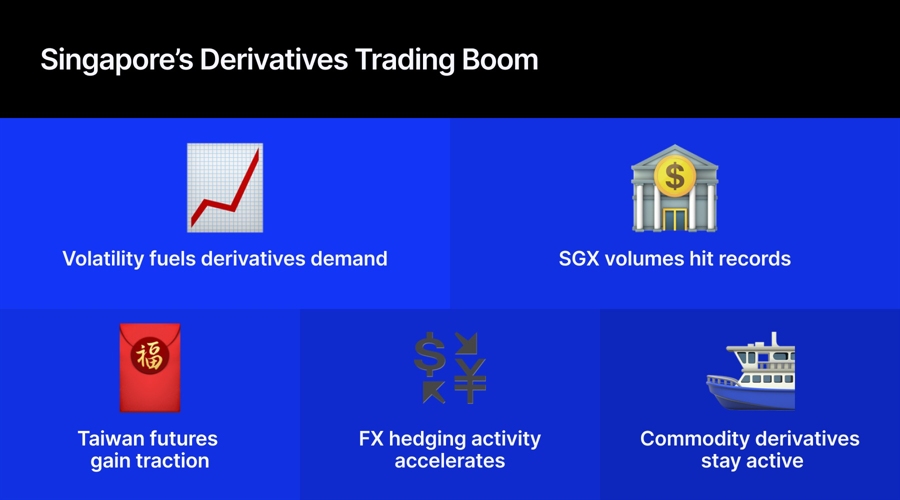
for China risk management, with Q1 daily average volumes of 548,000 lots
(approximately $8 billion). FTSE Taiwan Index Futures reached a record Q1 daily
average volume of 74,000 lots ($9.7 billion), supported by strong liquidity and
diversified index construction.
Equity and FX Derivatives Drive Growth
Micro FTSE Taiwan
Index Futures continue to gain traction, recording daily average volumes of
8,400 lots ($90 million), particularly among retail and active traders in Asia.
India-related derivatives have also seen rising engagement, reflecting India’s
growing weight in global and emerging market portfolios.
In commodities, SGX
continues to see strong participation across iron ore, fuel oil and freight
derivatives, with sustained activity over February and March as market
participants managed price and shipping cost volatility.
Victor Chia, Head of client success (dealing), Orient Futures Singapore
Victor Chia, head of
client success (dealing) at Orient Futures Singapore, says it should come as no
surprise that FX, equity and commodity derivatives have all experienced strong
activity as these are natural asset classes that are directly and immediately
impacted by news flow and geopolitical developments.
While cautioning that
market conditions continue to evolve and what drove volumes in the past year
may not necessarily persist, he accepts that the current global environment has
reinforced rather than weakened the case for operating out of Singapore.
“Singapore has
continued to demonstrate resilience and consistency, even as parts of the
global landscape have been affected by recent geopolitical and economic
disruptions,” says Chia. “In periods of uncertainty, this stability is not
merely advantageous but highly valued by firms seeking a reliable operating
base.”
Carlos Lim, Group head of securities and leveraged products, CGS International Securities
Demand is driven by
leverage and efficient access to different assets and in Singapore, this is
reinforced by its position as a regional hedging hub for Asian exposures,
particularly for global investors.
“Recent periods of
uncertainty have also caused investors to reposition their portfolios to hedge
against the noise,” observes Carlos Lim, group head of securities and leveraged
products, CGS International Securities.
Singapore’s Role as a Regional Hedging
Hub
Derivatives have
become an essential tool for hedging positions, diversifying portfolios and
managing exposure across global markets. More broadly, Singapore's status as a
premier global financial centre - combined with SGX's international marketplace
for Asian derivatives - makes it a natural hub for global trading activity.
Yujun Lin, CEO, Interactive Brokers Singapore
“In the first quarter
of the year we reported an increase in futures and options volumes on our
platform,” says Yujun Lin, CEO of Interactive Brokers Singapore. “Global client
trading volume in futures and options grew 20% and 16% respectively compared to
the same period in 2025.”
Lian Tuck Lee, head of
listed derivatives (Asia) at StoneX, refers to sustained growth in derivatives
volumes across global exchanges as market participants seek risk management
tools to manage exposure during periods of heightened volatility.
“International
investors increasingly use Asian-listed contracts to access and hedge exposures
to major markets such as China and India, where onshore access is limited,” he
says. “Global investors are allocating more capital to Asian assets, creating a
corresponding need for efficient hedging and risk transfer mechanisms.”
Lian Tuck Lee, Head of listed derivatives, Asia, StoneX
Singapore benefits
directly from this dynamic, acting as a neutral and well-regulated platform
where international and regional flows converge. The introduction of new
derivatives contracts - including those tied to emerging markets and non-Asian
exposures - has widened the investor base and strengthened Singapore’s role in
global price discovery.
“FX derivatives such
as USD/CNH and INR/USD have shown the strongest growth this year, reflecting
heightened currency volatility and increased hedging of cross-border
exposures,” he says. “This mirrors global trends where FX markets remain highly
sensitive to interest rate divergence and increased capital flows into Asia.”
Andreas Wigström, Managing director, LMAX Global
In addition, commodity
derivatives such as iron ore/metal derivatives have registered record trading
volumes and open interest levels, supported by global supply chain disruptions
and China-driven demand cycles.
Retail Participation Expands
Andreas Wigström,
managing director of LMAX Global, references demand for CFDs from institutional
and professional participants using these instruments to manage short-term risk
and gain flexible exposure across markets.
Jaycee Lai, Head of client services, IG Singapore
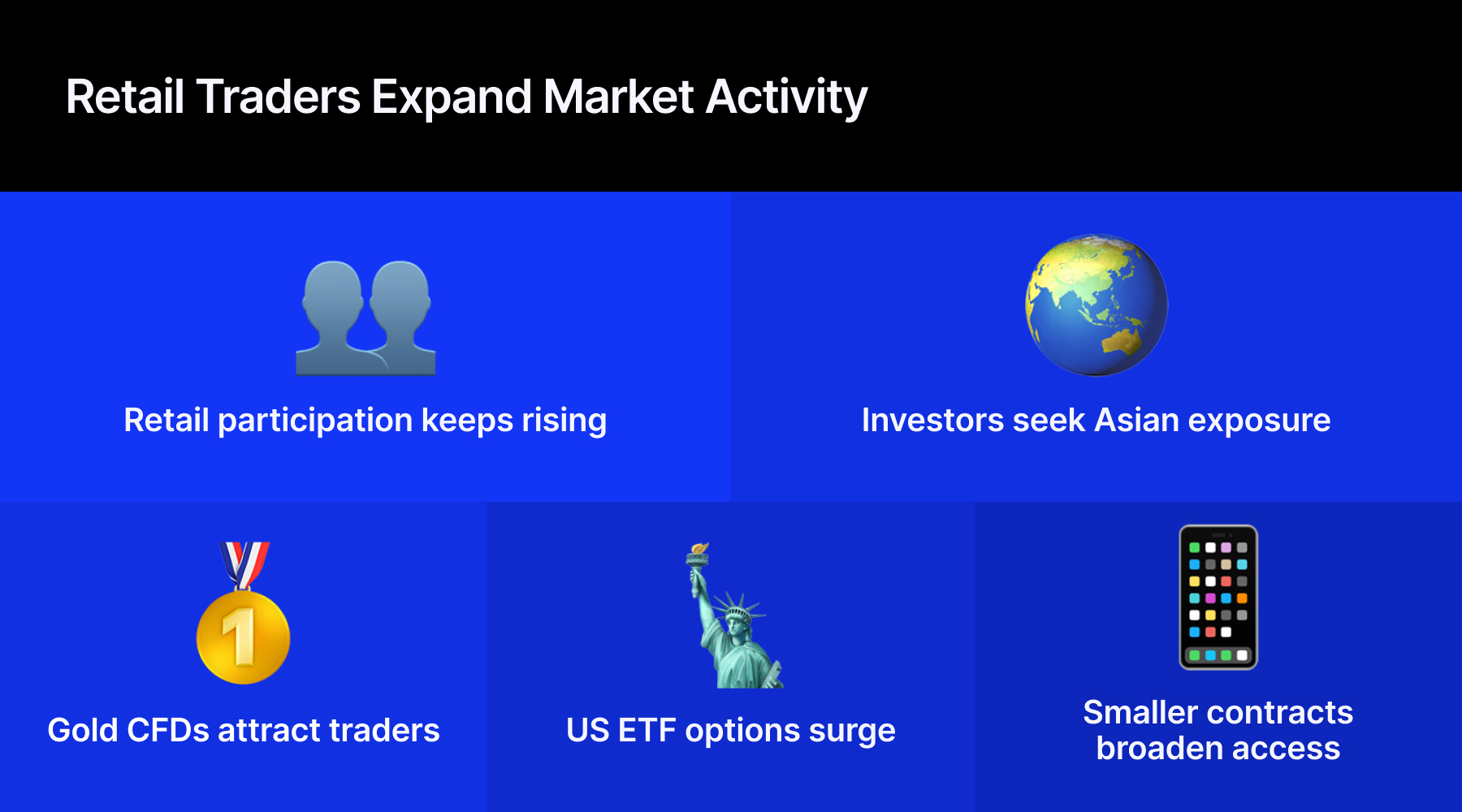
“We are also seeing
increased engagement in perpetual futures, particularly where investors are
looking for continuous exposure without the need to manage contract expiries,”
he adds. “Across all of these products, growth has been driven by a focus on transparent
pricing, resilient liquidity and reliable execution, reflecting a broader shift
towards more disciplined trading strategies.”
The surge in gold
price momentum has increased intra-day and intra-week price swings in an asset
class that has historically traded with relatively more stability, prompting
speculators to participate alongside safe-haven buyers and broadening the base
of retail participants trading gold CFDs, explains Jaycee Lai, head of client
services at IG Singapore.
“We also see growing
interest in the Dow Jones Industrial Average index,” he adds. “Unlike the
S&P 500, its composition carries greater weighting toward defensive and
cyclical sectors such as industrials, healthcare, consumer staples and energy.
This shows that retail investors are slowly rotating or seeking more
defensively-positioned index exposure, without fully exiting US market
exposure.”
Jonathan Man, CEO, Webull Securities, Singapore
In an environment
where macro uncertainty is high but US equities markets are inching higher,
this kind of nuanced positioning is exactly what derivatives products are
designed to facilitate.
US Market Exposure Fuels Demand
Retail investors now
have better and more accessible educational resources to use derivatives for
portfolio diversification and risk management, leading to increased
participation, observes Yaki Razmovich, managing director of eToro Singapore
and Asia.
“Many platforms now
offer intuitive, mobile-first experiences alongside AI-powered insights,
helping retail traders better identify and manage opportunities,” he says. “In
addition, more efficient trading infrastructure and lower capital requirements
have enabled investors to trade smaller positions, lowering the entry barriers
for a broader audience.”
Retail investors have
increased their participation in US markets and as trading activity extends
across time zones, demand naturally carries over into derivatives for managing
short-term risk and expressing market views, says Jonathan Man, CEO of Webull
Securities (Singapore).
“The strongest growth
this year has been in broad-market US ETF options, particularly SPY and QQQ,
which are often the first instruments investors use for liquid exposure and to
adjust portfolio beta around macro events,” he says.
Single stock options
remain active in names like TSLA and NVDA, where investors are focused on
AI-driven growth, earnings sensitivity and event-driven volatility. On the
futures side, the firm has seen strong momentum in commodities such as Micro
WTI Crude Oil, Micro Gold and Micro E-mini S&P 500. Smaller contract sizes
have been key, allowing investors to scale exposure more precisely.
Market volatility has
added impetus to derivatives trading in Singapore as new products expand the
investor base.
Data from SGX shows
that within equities, FTSE China A50 Index Futures remain the primary contract
for China risk management, with Q1 daily average volumes of 548,000 lots
(approximately $8 billion). FTSE Taiwan Index Futures reached a record Q1 daily
average volume of 74,000 lots ($9.7 billion), supported by strong liquidity and
diversified index construction.
Equity and FX Derivatives Drive Growth
Micro FTSE Taiwan
Index Futures continue to gain traction, recording daily average volumes of
8,400 lots ($90 million), particularly among retail and active traders in Asia.
India-related derivatives have also seen rising engagement, reflecting India’s
growing weight in global and emerging market portfolios.
In commodities, SGX
continues to see strong participation across iron ore, fuel oil and freight
derivatives, with sustained activity over February and March as market
participants managed price and shipping cost volatility.
Victor Chia, Head of client success (dealing), Orient Futures Singapore
Victor Chia, head of
client success (dealing) at Orient Futures Singapore, says it should come as no
surprise that FX, equity and commodity derivatives have all experienced strong
activity as these are natural asset classes that are directly and immediately
impacted by news flow and geopolitical developments.
While cautioning that
market conditions continue to evolve and what drove volumes in the past year
may not necessarily persist, he accepts that the current global environment has
reinforced rather than weakened the case for operating out of Singapore.
“Singapore has
continued to demonstrate resilience and consistency, even as parts of the
global landscape have been affected by recent geopolitical and economic
disruptions,” says Chia. “In periods of uncertainty, this stability is not
merely advantageous but highly valued by firms seeking a reliable operating
base.”
Carlos Lim, Group head of securities and leveraged products, CGS International Securities
Demand is driven by
leverage and efficient access to different assets and in Singapore, this is
reinforced by its position as a regional hedging hub for Asian exposures,
particularly for global investors.
“Recent periods of
uncertainty have also caused investors to reposition their portfolios to hedge
against the noise,” observes Carlos Lim, group head of securities and leveraged
products, CGS International Securities.
Singapore’s Role as a Regional Hedging
Hub
Derivatives have
become an essential tool for hedging positions, diversifying portfolios and
managing exposure across global markets. More broadly, Singapore's status as a
premier global financial centre - combined with SGX's international marketplace
for Asian derivatives - makes it a natural hub for global trading activity.
Yujun Lin, CEO, Interactive Brokers Singapore
“In the first quarter
of the year we reported an increase in futures and options volumes on our
platform,” says Yujun Lin, CEO of Interactive Brokers Singapore. “Global client
trading volume in futures and options grew 20% and 16% respectively compared to
the same period in 2025.”
Lian Tuck Lee, head of
listed derivatives (Asia) at StoneX, refers to sustained growth in derivatives
volumes across global exchanges as market participants seek risk management
tools to manage exposure during periods of heightened volatility.
“International
investors increasingly use Asian-listed contracts to access and hedge exposures
to major markets such as China and India, where onshore access is limited,” he
says. “Global investors are allocating more capital to Asian assets, creating a
corresponding need for efficient hedging and risk transfer mechanisms.”
Lian Tuck Lee, Head of listed derivatives, Asia, StoneX
Singapore benefits
directly from this dynamic, acting as a neutral and well-regulated platform
where international and regional flows converge. The introduction of new
derivatives contracts - including those tied to emerging markets and non-Asian
exposures - has widened the investor base and strengthened Singapore’s role in
global price discovery.
“FX derivatives such
as USD/CNH and INR/USD have shown the strongest growth this year, reflecting
heightened currency volatility and increased hedging of cross-border
exposures,” he says. “This mirrors global trends where FX markets remain highly
sensitive to interest rate divergence and increased capital flows into Asia.”
Andreas Wigström, Managing director, LMAX Global
In addition, commodity
derivatives such as iron ore/metal derivatives have registered record trading
volumes and open interest levels, supported by global supply chain disruptions
and China-driven demand cycles.
Retail Participation Expands
Andreas Wigström,
managing director of LMAX Global, references demand for CFDs from institutional
and professional participants using these instruments to manage short-term risk
and gain flexible exposure across markets.
Jaycee Lai, Head of client services, IG Singapore
“We are also seeing
increased engagement in perpetual futures, particularly where investors are
looking for continuous exposure without the need to manage contract expiries,”
he adds. “Across all of these products, growth has been driven by a focus on transparent
pricing, resilient liquidity and reliable execution, reflecting a broader shift
towards more disciplined trading strategies.”
The surge in gold
price momentum has increased intra-day and intra-week price swings in an asset
class that has historically traded with relatively more stability, prompting
speculators to participate alongside safe-haven buyers and broadening the base
of retail participants trading gold CFDs, explains Jaycee Lai, head of client
services at IG Singapore.
“We also see growing
interest in the Dow Jones Industrial Average index,” he adds. “Unlike the
S&P 500, its composition carries greater weighting toward defensive and
cyclical sectors such as industrials, healthcare, consumer staples and energy.
This shows that retail investors are slowly rotating or seeking more
defensively-positioned index exposure, without fully exiting US market
exposure.”
Jonathan Man, CEO, Webull Securities, Singapore
In an environment
where macro uncertainty is high but US equities markets are inching higher,
this kind of nuanced positioning is exactly what derivatives products are
designed to facilitate.
US Market Exposure Fuels Demand
Retail investors now
have better and more accessible educational resources to use derivatives for
portfolio diversification and risk management, leading to increased
participation, observes Yaki Razmovich, managing director of eToro Singapore
and Asia.
“Many platforms now
offer intuitive, mobile-first experiences alongside AI-powered insights,
helping retail traders better identify and manage opportunities,” he says. “In
addition, more efficient trading infrastructure and lower capital requirements
have enabled investors to trade smaller positions, lowering the entry barriers
for a broader audience.”
Retail investors have
increased their participation in US markets and as trading activity extends
across time zones, demand naturally carries over into derivatives for managing
short-term risk and expressing market views, says Jonathan Man, CEO of Webull
Securities (Singapore).
“The strongest growth
this year has been in broad-market US ETF options, particularly SPY and QQQ,
which are often the first instruments investors use for liquid exposure and to
adjust portfolio beta around macro events,” he says.
Single stock options
remain active in names like TSLA and NVDA, where investors are focused on
AI-driven growth, earnings sensitivity and event-driven volatility. On the
futures side, the firm has seen strong momentum in commodities such as Micro
WTI Crude Oil, Micro Gold and Micro E-mini S&P 500. Smaller contract sizes
have been key, allowing investors to scale exposure more precisely.
Paul Golden is an experienced freelance financial journalist with a strong institutional background. Over the past two decades, he has written for globally recognised financial publications, covering topics such as market structure, regulation, trading behaviour, and economic policy.
Cboe and NYSE Roll Out Pre-Market Trading for Key Stock Options
Featured Videos
FXOpen UK Applies to Cancel Licence; FCA Plans Staff Rule Changes
FXOpen UK Applies to Cancel Licence; FCA Plans Staff Rule Changes
FXOpen UK Applies to Cancel Licence; FCA Plans Staff Rule Changes
FXOpen UK Applies to Cancel Licence; FCA Plans Staff Rule Changes
Today’s financial news recap covers FXOpen UK closes client accounts, the FCA proposes changes to senior management rules, Webull extends options trading hours, and Match-Prime joins iSAM Securities Apex.
Finance Magnates Daily Recap brings you the latest news from forex and CFD brokers, fintech, payments, cryptocurrency, digital assets, trading platforms, financial regulation and global markets.
Get the key company news, executive moves, deals, regulatory updates and market developments of the day, in just a few minutes. New episodes published every weekday.
Read more: https://www.financemagnates.com
#FinanceMagnates #ForexNews #FintechNews
Today’s financial news recap covers FXOpen UK closes client accounts, the FCA proposes changes to senior management rules, Webull extends options trading hours, and Match-Prime joins iSAM Securities Apex.
Finance Magnates Daily Recap brings you the latest news from forex and CFD brokers, fintech, payments, cryptocurrency, digital assets, trading platforms, financial regulation and global markets.
Get the key company news, executive moves, deals, regulatory updates and market developments of the day, in just a few minutes. New episodes published every weekday.
Read more: https://www.financemagnates.com
#FinanceMagnates #ForexNews #FintechNews
Today’s financial news recap covers FXOpen UK closes client accounts, the FCA proposes changes to senior management rules, Webull extends options trading hours, and Match-Prime joins iSAM Securities Apex.
Finance Magnates Daily Recap brings you the latest news from forex and CFD brokers, fintech, payments, cryptocurrency, digital assets, trading platforms, financial regulation and global markets.
Get the key company news, executive moves, deals, regulatory updates and market developments of the day, in just a few minutes. New episodes published every weekday.
Read more: https://www.financemagnates.com
#FinanceMagnates #ForexNews #FintechNews
Today’s financial news recap covers FXOpen UK closes client accounts, the FCA proposes changes to senior management rules, Webull extends options trading hours, and Match-Prime joins iSAM Securities Apex.
Finance Magnates Daily Recap brings you the latest news from forex and CFD brokers, fintech, payments, cryptocurrency, digital assets, trading platforms, financial regulation and global markets.
Get the key company news, executive moves, deals, regulatory updates and market developments of the day, in just a few minutes. New episodes published every weekday.
Read more: https://www.financemagnates.com
#FinanceMagnates #ForexNews #FintechNews
IG Seeks UK Gambling Licence; OANDA Japan Holds Withdrawals
IG Seeks UK Gambling Licence; OANDA Japan Holds Withdrawals
IG Seeks UK Gambling Licence; OANDA Japan Holds Withdrawals
IG Seeks UK Gambling Licence; OANDA Japan Holds Withdrawals
IG Seeks UK Gambling Licence; OANDA Japan Holds Withdrawals
IG Seeks UK Gambling Licence; OANDA Japan Holds Withdrawals
Today’s financial news recap covers IG's plans to enter prediction markets, OANDA Japan's withdrawal suspension after a server hack, a NAGA's falling earnings amid rising marketing costs
Finance Magnates Daily Recap brings you the latest news from forex and CFD brokers, fintech, payments, cryptocurrency, digital assets, trading platforms, financial regulation and global markets.
Get the key company news, executive moves, deals, regulatory updates and market developments of the day, in just a few minutes. New episodes published every weekday.
Read more: https://www.financemagnates.com
#FinanceMagnates #ForexNews #FintechNews
Today’s financial news recap covers IG's plans to enter prediction markets, OANDA Japan's withdrawal suspension after a server hack, a NAGA's falling earnings amid rising marketing costs
Finance Magnates Daily Recap brings you the latest news from forex and CFD brokers, fintech, payments, cryptocurrency, digital assets, trading platforms, financial regulation and global markets.
Get the key company news, executive moves, deals, regulatory updates and market developments of the day, in just a few minutes. New episodes published every weekday.
Read more: https://www.financemagnates.com
#FinanceMagnates #ForexNews #FintechNews
Today’s financial news recap covers IG's plans to enter prediction markets, OANDA Japan's withdrawal suspension after a server hack, a NAGA's falling earnings amid rising marketing costs
Finance Magnates Daily Recap brings you the latest news from forex and CFD brokers, fintech, payments, cryptocurrency, digital assets, trading platforms, financial regulation and global markets.
Get the key company news, executive moves, deals, regulatory updates and market developments of the day, in just a few minutes. New episodes published every weekday.
Read more: https://www.financemagnates.com
#FinanceMagnates #ForexNews #FintechNews
Today’s financial news recap covers IG's plans to enter prediction markets, OANDA Japan's withdrawal suspension after a server hack, a NAGA's falling earnings amid rising marketing costs
Finance Magnates Daily Recap brings you the latest news from forex and CFD brokers, fintech, payments, cryptocurrency, digital assets, trading platforms, financial regulation and global markets.
Get the key company news, executive moves, deals, regulatory updates and market developments of the day, in just a few minutes. New episodes published every weekday.
Read more: https://www.financemagnates.com
#FinanceMagnates #ForexNews #FintechNews
Today’s financial news recap covers IG's plans to enter prediction markets, OANDA Japan's withdrawal suspension after a server hack, a NAGA's falling earnings amid rising marketing costs
Finance Magnates Daily Recap brings you the latest news from forex and CFD brokers, fintech, payments, cryptocurrency, digital assets, trading platforms, financial regulation and global markets.
Get the key company news, executive moves, deals, regulatory updates and market developments of the day, in just a few minutes. New episodes published every weekday.
Read more: https://www.financemagnates.com
#FinanceMagnates #ForexNews #FintechNews
Today’s financial news recap covers IG's plans to enter prediction markets, OANDA Japan's withdrawal suspension after a server hack, a NAGA's falling earnings amid rising marketing costs
Finance Magnates Daily Recap brings you the latest news from forex and CFD brokers, fintech, payments, cryptocurrency, digital assets, trading platforms, financial regulation and global markets.
Get the key company news, executive moves, deals, regulatory updates and market developments of the day, in just a few minutes. New episodes published every weekday.
Read more: https://www.financemagnates.com
#FinanceMagnates #ForexNews #FintechNews
FMIQ: Get Verified Market Intelligence in Seconds | FM Intelligence
FMIQ: Get Verified Market Intelligence in Seconds | FM Intelligence
FMIQ: Get Verified Market Intelligence in Seconds | FM Intelligence
FMIQ: Get Verified Market Intelligence in Seconds | FM Intelligence
FMIQ: Get Verified Market Intelligence in Seconds | FM Intelligence
FMIQ: Get Verified Market Intelligence in Seconds | FM Intelligence
Meet FMIQ (FM Intelligence Quantitative), now available inside the FM Intelligence Portal.
Ask the market a question in plain language and get a sourced, verified answer in seconds. FMIQ gives you the figures, time periods, and sources you need to make informed decisions, without the need to work through dashboards, filters, or spreadsheet exports.
What makes FMIQ different?
✓ Ask questions in plain language, with no SQL or dashboard setup required.
✓ Get verified answers checked through an independent quality assurance step.
✓ Access sourced figures you can cite with confidence.
✓ Ask follow-up questions and build on the same conversation.
✓ Query seven datasets in one place, covering trading volumes, traffic, platforms, market movements, regulations, fines, and licences.
Built for professionals across the financial markets
- Editorial teams: Find reliable figures and support your reporting with clear sources.
- Commercial teams: Access the market data you need to prepare for client meetings and sales discussions.
- Research and analyst teams: Explore market trends and get answers to specific questions.
- Compliance teams: Access intelligence on regulations, fines, and licences.
Every query is run live, and answers go through an independent quality check. FMIQ is read-only, stays focused on your question, and does not alter the underlying data.
Built on Finance Magnates market intelligence, FMIQ helps professionals get the answers they need, when they need them.
Access FMIQ today: https://datalab.financemagnates.com/market?utm_source=youtube&utm_medium=video&utm_campaign=fmiq_phase1_mvp_launch
#FMIntelligence #FMIQ #MarketIntelligence #FinanceMagnates #FinancialMarkets #MarketResearch
Meet FMIQ (FM Intelligence Quantitative), now available inside the FM Intelligence Portal.
Ask the market a question in plain language and get a sourced, verified answer in seconds. FMIQ gives you the figures, time periods, and sources you need to make informed decisions, without the need to work through dashboards, filters, or spreadsheet exports.
What makes FMIQ different?
✓ Ask questions in plain language, with no SQL or dashboard setup required.
✓ Get verified answers checked through an independent quality assurance step.
✓ Access sourced figures you can cite with confidence.
✓ Ask follow-up questions and build on the same conversation.
✓ Query seven datasets in one place, covering trading volumes, traffic, platforms, market movements, regulations, fines, and licences.
Built for professionals across the financial markets
- Editorial teams: Find reliable figures and support your reporting with clear sources.
- Commercial teams: Access the market data you need to prepare for client meetings and sales discussions.
- Research and analyst teams: Explore market trends and get answers to specific questions.
- Compliance teams: Access intelligence on regulations, fines, and licences.
Every query is run live, and answers go through an independent quality check. FMIQ is read-only, stays focused on your question, and does not alter the underlying data.
Built on Finance Magnates market intelligence, FMIQ helps professionals get the answers they need, when they need them.
Access FMIQ today: https://datalab.financemagnates.com/market?utm_source=youtube&utm_medium=video&utm_campaign=fmiq_phase1_mvp_launch
#FMIntelligence #FMIQ #MarketIntelligence #FinanceMagnates #FinancialMarkets #MarketResearch
Meet FMIQ (FM Intelligence Quantitative), now available inside the FM Intelligence Portal.
Ask the market a question in plain language and get a sourced, verified answer in seconds. FMIQ gives you the figures, time periods, and sources you need to make informed decisions, without the need to work through dashboards, filters, or spreadsheet exports.
What makes FMIQ different?
✓ Ask questions in plain language, with no SQL or dashboard setup required.
✓ Get verified answers checked through an independent quality assurance step.
✓ Access sourced figures you can cite with confidence.
✓ Ask follow-up questions and build on the same conversation.
✓ Query seven datasets in one place, covering trading volumes, traffic, platforms, market movements, regulations, fines, and licences.
Built for professionals across the financial markets
- Editorial teams: Find reliable figures and support your reporting with clear sources.
- Commercial teams: Access the market data you need to prepare for client meetings and sales discussions.
- Research and analyst teams: Explore market trends and get answers to specific questions.
- Compliance teams: Access intelligence on regulations, fines, and licences.
Every query is run live, and answers go through an independent quality check. FMIQ is read-only, stays focused on your question, and does not alter the underlying data.
Built on Finance Magnates market intelligence, FMIQ helps professionals get the answers they need, when they need them.
Access FMIQ today: https://datalab.financemagnates.com/market?utm_source=youtube&utm_medium=video&utm_campaign=fmiq_phase1_mvp_launch
#FMIntelligence #FMIQ #MarketIntelligence #FinanceMagnates #FinancialMarkets #MarketResearch
Meet FMIQ (FM Intelligence Quantitative), now available inside the FM Intelligence Portal.
Ask the market a question in plain language and get a sourced, verified answer in seconds. FMIQ gives you the figures, time periods, and sources you need to make informed decisions, without the need to work through dashboards, filters, or spreadsheet exports.
What makes FMIQ different?
✓ Ask questions in plain language, with no SQL or dashboard setup required.
✓ Get verified answers checked through an independent quality assurance step.
✓ Access sourced figures you can cite with confidence.
✓ Ask follow-up questions and build on the same conversation.
✓ Query seven datasets in one place, covering trading volumes, traffic, platforms, market movements, regulations, fines, and licences.
Built for professionals across the financial markets
- Editorial teams: Find reliable figures and support your reporting with clear sources.
- Commercial teams: Access the market data you need to prepare for client meetings and sales discussions.
- Research and analyst teams: Explore market trends and get answers to specific questions.
- Compliance teams: Access intelligence on regulations, fines, and licences.
Every query is run live, and answers go through an independent quality check. FMIQ is read-only, stays focused on your question, and does not alter the underlying data.
Built on Finance Magnates market intelligence, FMIQ helps professionals get the answers they need, when they need them.
Access FMIQ today: https://datalab.financemagnates.com/market?utm_source=youtube&utm_medium=video&utm_campaign=fmiq_phase1_mvp_launch
#FMIntelligence #FMIQ #MarketIntelligence #FinanceMagnates #FinancialMarkets #MarketResearch
Meet FMIQ (FM Intelligence Quantitative), now available inside the FM Intelligence Portal.
Ask the market a question in plain language and get a sourced, verified answer in seconds. FMIQ gives you the figures, time periods, and sources you need to make informed decisions, without the need to work through dashboards, filters, or spreadsheet exports.
What makes FMIQ different?
✓ Ask questions in plain language, with no SQL or dashboard setup required.
✓ Get verified answers checked through an independent quality assurance step.
✓ Access sourced figures you can cite with confidence.
✓ Ask follow-up questions and build on the same conversation.
✓ Query seven datasets in one place, covering trading volumes, traffic, platforms, market movements, regulations, fines, and licences.
Built for professionals across the financial markets
- Editorial teams: Find reliable figures and support your reporting with clear sources.
- Commercial teams: Access the market data you need to prepare for client meetings and sales discussions.
- Research and analyst teams: Explore market trends and get answers to specific questions.
- Compliance teams: Access intelligence on regulations, fines, and licences.
Every query is run live, and answers go through an independent quality check. FMIQ is read-only, stays focused on your question, and does not alter the underlying data.
Built on Finance Magnates market intelligence, FMIQ helps professionals get the answers they need, when they need them.
Access FMIQ today: https://datalab.financemagnates.com/market?utm_source=youtube&utm_medium=video&utm_campaign=fmiq_phase1_mvp_launch
#FMIntelligence #FMIQ #MarketIntelligence #FinanceMagnates #FinancialMarkets #MarketResearch
Meet FMIQ (FM Intelligence Quantitative), now available inside the FM Intelligence Portal.
Ask the market a question in plain language and get a sourced, verified answer in seconds. FMIQ gives you the figures, time periods, and sources you need to make informed decisions, without the need to work through dashboards, filters, or spreadsheet exports.
What makes FMIQ different?
✓ Ask questions in plain language, with no SQL or dashboard setup required.
✓ Get verified answers checked through an independent quality assurance step.
✓ Access sourced figures you can cite with confidence.
✓ Ask follow-up questions and build on the same conversation.
✓ Query seven datasets in one place, covering trading volumes, traffic, platforms, market movements, regulations, fines, and licences.
Built for professionals across the financial markets
- Editorial teams: Find reliable figures and support your reporting with clear sources.
- Commercial teams: Access the market data you need to prepare for client meetings and sales discussions.
- Research and analyst teams: Explore market trends and get answers to specific questions.
- Compliance teams: Access intelligence on regulations, fines, and licences.
Every query is run live, and answers go through an independent quality check. FMIQ is read-only, stays focused on your question, and does not alter the underlying data.
Built on Finance Magnates market intelligence, FMIQ helps professionals get the answers they need, when they need them.
Access FMIQ today: https://datalab.financemagnates.com/market?utm_source=youtube&utm_medium=video&utm_campaign=fmiq_phase1_mvp_launch
#FMIntelligence #FMIQ #MarketIntelligence #FinanceMagnates #FinancialMarkets #MarketResearch
MyForexFunds Details No Conflict Model; UK Eyes iPhone Wallets
MyForexFunds Details No Conflict Model; UK Eyes iPhone Wallets
MyForexFunds Details No Conflict Model; UK Eyes iPhone Wallets
MyForexFunds Details No Conflict Model; UK Eyes iPhone Wallets
MyForexFunds Details No Conflict Model; UK Eyes iPhone Wallets
MyForexFunds Details No Conflict Model; UK Eyes iPhone Wallets
Today’s financial news recap covers MyForexFunds outlines its Evolution relaunch, UK brokers could get their own iPhone wallets, Goat Funded Trader reports $26 million in payouts, and Kalshi explains its pitch to brokers.
Finance Magnates Daily Recap brings you the latest news from forex and CFD brokers, fintech, payments, cryptocurrency, digital assets, trading platforms, financial regulation and global markets.
Get the key company news, executive moves, deals, regulatory updates and market developments of the day, in just a few minutes. New episodes published every weekday.
Read more: https://www.financemagnates.com
#FinanceMagnates #ForexNews #FintechNews
Today’s financial news recap covers MyForexFunds outlines its Evolution relaunch, UK brokers could get their own iPhone wallets, Goat Funded Trader reports $26 million in payouts, and Kalshi explains its pitch to brokers.
Finance Magnates Daily Recap brings you the latest news from forex and CFD brokers, fintech, payments, cryptocurrency, digital assets, trading platforms, financial regulation and global markets.
Get the key company news, executive moves, deals, regulatory updates and market developments of the day, in just a few minutes. New episodes published every weekday.
Read more: https://www.financemagnates.com
#FinanceMagnates #ForexNews #FintechNews
Today’s financial news recap covers MyForexFunds outlines its Evolution relaunch, UK brokers could get their own iPhone wallets, Goat Funded Trader reports $26 million in payouts, and Kalshi explains its pitch to brokers.
Finance Magnates Daily Recap brings you the latest news from forex and CFD brokers, fintech, payments, cryptocurrency, digital assets, trading platforms, financial regulation and global markets.
Get the key company news, executive moves, deals, regulatory updates and market developments of the day, in just a few minutes. New episodes published every weekday.
Read more: https://www.financemagnates.com
#FinanceMagnates #ForexNews #FintechNews
Today’s financial news recap covers MyForexFunds outlines its Evolution relaunch, UK brokers could get their own iPhone wallets, Goat Funded Trader reports $26 million in payouts, and Kalshi explains its pitch to brokers.
Finance Magnates Daily Recap brings you the latest news from forex and CFD brokers, fintech, payments, cryptocurrency, digital assets, trading platforms, financial regulation and global markets.
Get the key company news, executive moves, deals, regulatory updates and market developments of the day, in just a few minutes. New episodes published every weekday.
Read more: https://www.financemagnates.com
#FinanceMagnates #ForexNews #FintechNews
Today’s financial news recap covers MyForexFunds outlines its Evolution relaunch, UK brokers could get their own iPhone wallets, Goat Funded Trader reports $26 million in payouts, and Kalshi explains its pitch to brokers.
Finance Magnates Daily Recap brings you the latest news from forex and CFD brokers, fintech, payments, cryptocurrency, digital assets, trading platforms, financial regulation and global markets.
Get the key company news, executive moves, deals, regulatory updates and market developments of the day, in just a few minutes. New episodes published every weekday.
Read more: https://www.financemagnates.com
#FinanceMagnates #ForexNews #FintechNews
Today’s financial news recap covers MyForexFunds outlines its Evolution relaunch, UK brokers could get their own iPhone wallets, Goat Funded Trader reports $26 million in payouts, and Kalshi explains its pitch to brokers.
Finance Magnates Daily Recap brings you the latest news from forex and CFD brokers, fintech, payments, cryptocurrency, digital assets, trading platforms, financial regulation and global markets.
Get the key company news, executive moves, deals, regulatory updates and market developments of the day, in just a few minutes. New episodes published every weekday.
Read more: https://www.financemagnates.com
#FinanceMagnates #ForexNews #FintechNews
How Much Are CFD Industry Executives Making; Plus500 Buys Brazilian Broker
How Much Are CFD Industry Executives Making; Plus500 Buys Brazilian Broker
How Much Are CFD Industry Executives Making; Plus500 Buys Brazilian Broker
How Much Are CFD Industry Executives Making; Plus500 Buys Brazilian Broker
How Much Are CFD Industry Executives Making; Plus500 Buys Brazilian Broker
How Much Are CFD Industry Executives Making; Plus500 Buys Brazilian Broker
Today’s financial news recap covers FinTop Consulting shared its 2026 salary surveys for Dubai, London and Cyprus with Finance Magnates, Plus500 buys a Brazilian broker, and Google opens the door to CFD ads in Denmark and Chile.
Finance Magnates Daily Recap brings you the latest news from forex and CFD brokers, fintech, payments, cryptocurrency, digital assets, trading platforms, financial regulation and global markets.
Get the key company news, executive moves, deals, regulatory updates and market developments of the day, in just a few minutes. New episodes published every weekday.
Read more: https://www.financemagnates.com
#FinanceMagnates #ForexNews #FintechNews
Today’s financial news recap covers FinTop Consulting shared its 2026 salary surveys for Dubai, London and Cyprus with Finance Magnates, Plus500 buys a Brazilian broker, and Google opens the door to CFD ads in Denmark and Chile.
Finance Magnates Daily Recap brings you the latest news from forex and CFD brokers, fintech, payments, cryptocurrency, digital assets, trading platforms, financial regulation and global markets.
Get the key company news, executive moves, deals, regulatory updates and market developments of the day, in just a few minutes. New episodes published every weekday.
Read more: https://www.financemagnates.com
#FinanceMagnates #ForexNews #FintechNews
Today’s financial news recap covers FinTop Consulting shared its 2026 salary surveys for Dubai, London and Cyprus with Finance Magnates, Plus500 buys a Brazilian broker, and Google opens the door to CFD ads in Denmark and Chile.
Finance Magnates Daily Recap brings you the latest news from forex and CFD brokers, fintech, payments, cryptocurrency, digital assets, trading platforms, financial regulation and global markets.
Get the key company news, executive moves, deals, regulatory updates and market developments of the day, in just a few minutes. New episodes published every weekday.
Read more: https://www.financemagnates.com
#FinanceMagnates #ForexNews #FintechNews
Today’s financial news recap covers FinTop Consulting shared its 2026 salary surveys for Dubai, London and Cyprus with Finance Magnates, Plus500 buys a Brazilian broker, and Google opens the door to CFD ads in Denmark and Chile.
Finance Magnates Daily Recap brings you the latest news from forex and CFD brokers, fintech, payments, cryptocurrency, digital assets, trading platforms, financial regulation and global markets.
Get the key company news, executive moves, deals, regulatory updates and market developments of the day, in just a few minutes. New episodes published every weekday.
Read more: https://www.financemagnates.com
#FinanceMagnates #ForexNews #FintechNews
Today’s financial news recap covers FinTop Consulting shared its 2026 salary surveys for Dubai, London and Cyprus with Finance Magnates, Plus500 buys a Brazilian broker, and Google opens the door to CFD ads in Denmark and Chile.
Finance Magnates Daily Recap brings you the latest news from forex and CFD brokers, fintech, payments, cryptocurrency, digital assets, trading platforms, financial regulation and global markets.
Get the key company news, executive moves, deals, regulatory updates and market developments of the day, in just a few minutes. New episodes published every weekday.
Read more: https://www.financemagnates.com
#FinanceMagnates #ForexNews #FintechNews
Today’s financial news recap covers FinTop Consulting shared its 2026 salary surveys for Dubai, London and Cyprus with Finance Magnates, Plus500 buys a Brazilian broker, and Google opens the door to CFD ads in Denmark and Chile.
Finance Magnates Daily Recap brings you the latest news from forex and CFD brokers, fintech, payments, cryptocurrency, digital assets, trading platforms, financial regulation and global markets.
Get the key company news, executive moves, deals, regulatory updates and market developments of the day, in just a few minutes. New episodes published every weekday.
Read more: https://www.financemagnates.com
#FinanceMagnates #ForexNews #FintechNews