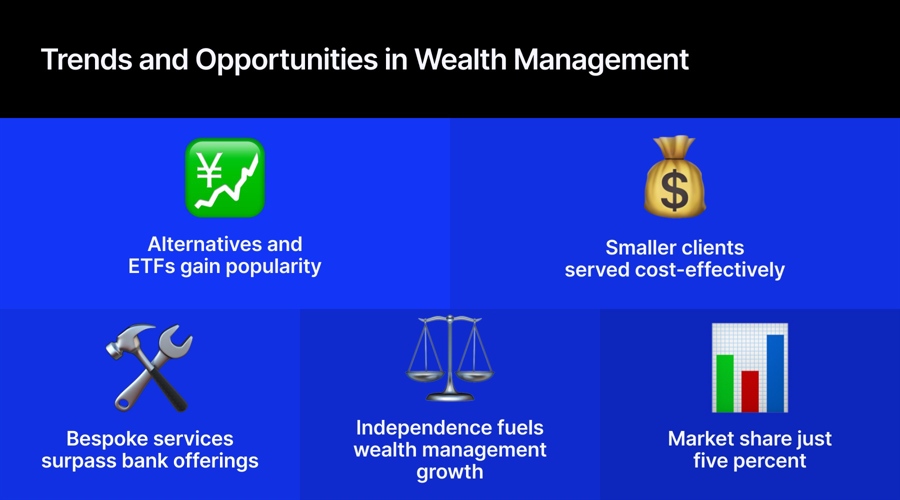
Fixed income, alternatives, and ETFs expected to see the highest growth in client demand.
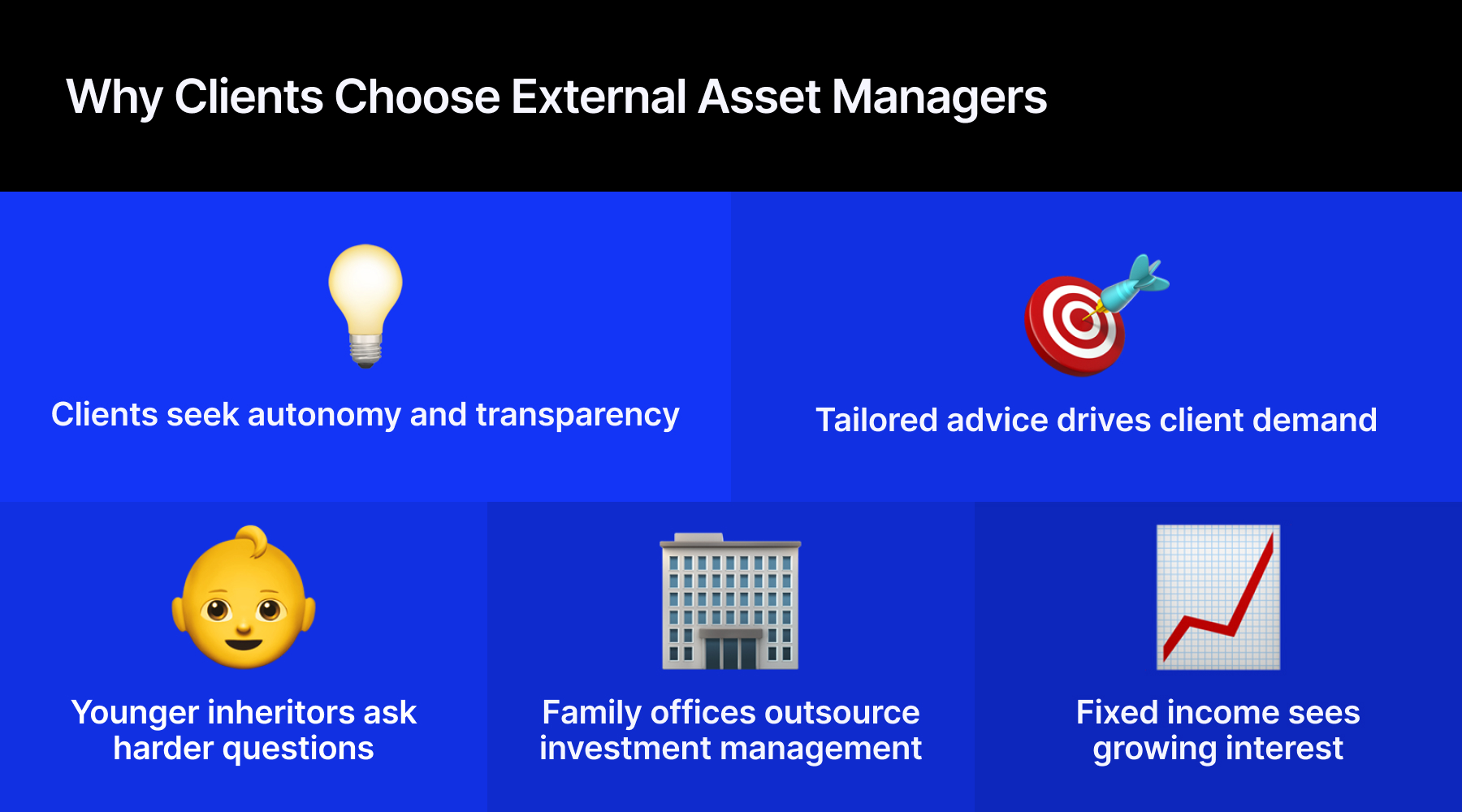
Younger inheritors seek independent advice, questioning how wealth is managed and whose interests advisers serve.
Singapore Wealth Management: Key Trends and Emerging Opportunities
The growth of external asset management is one of the most significant
wealth trends in Singapore, as high and ultra-high net worth individuals and
families look for more customised solutions.
According to new research from Bank of
Singapore, external asset managers are gaining traction, driven by a new
generation of clients who value autonomy, transparency, and tailored advice.
More than half of the managers surveyed in late 2025/early 2026 said they were
exploring new markets and forming strategic partnerships, with almost
two-thirds ranking improving customer experience and engagement as their top
priority.
One-third of respondents expected fixed income solutions to see the
biggest growth in demand among clients, reflecting a more defensive stance as
clients seek to lock in yields ahead of anticipated interest rate declines.
Other asset classes expected to see growth in demand include alternatives and
ETFs.
Challenges and Opportunities for External Managers
Lim Leong Guan, global head of financial
intermediaries, family office, and wealth advisory at Bank of Singapore, says
there is recognition of the twin challenges of helping clients shift their
portfolios amid the geopolitical environment and fast-changing investment
environment due to technology innovations and demographics, as well as the
necessity to build scale and diversification in their businesses.
Lim Leong Guan, Bank of Singapore
Unlike large financial institutions, external
asset managers need not be driven by short-term revenue targets, which enables
them to build stronger, longer, and more trusted relationships with clients and
develop genuinely customised approaches to wealth management.
Who Uses External Asset Management?
The core users of external asset management
services are high net worth and ultra-high net worth individuals and families
who prioritise independence, transparency, and a deeper advisory relationship
than they may get from traditional banks, explains Damian Hitchen, regional
head of APAC and MENA at Saxo Bank.
“We are also seeing more institutional
players—including insurance asset managers—turning to external portfolio
management specialists to complement their internal capabilities, particularly
as portfolios become more complex,” he adds.
Hitchen refers to a shift driven by second-
and third-generation wealth holders, who are more digitally engaged and prefer
advisers who can offer open architecture access and a personalised, tech‑enabled
service.
Serving Smaller Clients Cost-Effectively
Damian Hitchen, Regional Head of APAC and MENA at Saxo Bank
Multi-family offices and external asset
managers that have their own funds can accommodate smaller clients far more
cost-effectively than banks for relatively modest sums, suggests Simon Hopkins,
managing partner at East West Private Wealth.
At its broadest, the main users are clients
who have wealth they wish to grow or protect and who want a service that is
tailored specifically to them, rather than built around a standardised product.
Younger Professionals and Next-Generation Wealth Holders
That is the view of Stephen Davies, founder
and CEO of Javelin Wealth Management, where one of the fastest-growing segments
is young professionals who may not meet the minimum thresholds that private
banks prioritise but are looking to build meaningful wealth over time.
Simon Hopkins, Managing Partner at East West Private Wealth
“Wealth
in Asia is increasingly passing to the next generation, and younger inheritors
tend to ask harder questions about how their money is being managed and whose
interests their adviser is actually serving,” he says. “That shift in mindset
is expanding the pool of clients who seek out genuinely independent advice.”
Family Offices and Multi-Generational Wealth
Another important user group is family offices
seeking professionalised management for substantial private wealth and complex
multi-generational requirements, observes Nithi Genesan, country head – Singapore
at Waystone.
Genesan suggests that family offices are
increasingly choosing to outsource and delegate their investment
decision-making to trusted external asset managers, and that rather than
managing complex portfolios internally, these offices utilise external asset
managers to act as their outsourced chief investment officers, providing a
higher level of professionalised management and objective expertise.
Stephen Davies, Founder and CEO of Javelin Wealth Management
“Furthermore,
from a regulatory standpoint, they ensure high levels of transparency by
generally disclosing all fees in strict accordance with applicable
regulations,” she continues.
Drivers of Demand
According to Hopkins, demand for external
asset management has been accelerated by disaffection with the private banking
industry (which he says is seen as banal yet expensive), the desire of
relationship managers to work in a more flexible setup with true open
architecture, and a focus on the client rather than the bank’s targets.
“However, perhaps the biggest driver is the ability for the relationship
manager to be better paid than in the banks, which are all typically burdened
by very high cost-to-income ratios,” he adds.
Market Growth and Future Prospects
Nithi Genesan, Country Head, Singapore at Waystone
Custodian bank executives have described the
growth of this segment in Singapore as ‘staggering,’ with strong prospects for
further growth.
However, Polka Mishra, Javelin Wealth Management partner and
managing director, reckons demand has probably not grown as much as might have
been expected, noting that market penetration is estimated to be lower than in
more mature markets.
“There are two reasons for this,” she says. “Firstly, Asian
investors tend to be at a slightly earlier stage of their wealth management
needs, and secondly, there is still a strong focus on brand rather than
service.
Polka Mishra, Partner and Managing Director at Javelin Wealth Management
The major banks carry a natural advantage because of the existing
linkages between the banking services they provide to families and their
companies, and many clients have historically preferred to keep those
relationships together.”
Those linkages are now being questioned,
though, with the result that more clients are starting to separate their
banking relationship from their wealth management.
As second- and third-generation wealth holders
rise to prominence and transactional approaches give way to more fiduciary
models, high net worth and ultra-high net worth clients' desire for
conflict-free advice and independence is keeping the sector growing.
“With external asset manager-managed assets
accounting for less than 10% of Singapore’s market, there is significant room
for the independent wealth management model to grow,” says Mishra.
The growth of external asset management is one of the most significant
wealth trends in Singapore, as high and ultra-high net worth individuals and
families look for more customised solutions.
According to new research from Bank of
Singapore, external asset managers are gaining traction, driven by a new
generation of clients who value autonomy, transparency, and tailored advice.
More than half of the managers surveyed in late 2025/early 2026 said they were
exploring new markets and forming strategic partnerships, with almost
two-thirds ranking improving customer experience and engagement as their top
priority.
One-third of respondents expected fixed income solutions to see the
biggest growth in demand among clients, reflecting a more defensive stance as
clients seek to lock in yields ahead of anticipated interest rate declines.
Other asset classes expected to see growth in demand include alternatives and
ETFs.
Challenges and Opportunities for External Managers
Lim Leong Guan, global head of financial
intermediaries, family office, and wealth advisory at Bank of Singapore, says
there is recognition of the twin challenges of helping clients shift their
portfolios amid the geopolitical environment and fast-changing investment
environment due to technology innovations and demographics, as well as the
necessity to build scale and diversification in their businesses.
Lim Leong Guan, Bank of Singapore
Unlike large financial institutions, external
asset managers need not be driven by short-term revenue targets, which enables
them to build stronger, longer, and more trusted relationships with clients and
develop genuinely customised approaches to wealth management.
Who Uses External Asset Management?
The core users of external asset management
services are high net worth and ultra-high net worth individuals and families
who prioritise independence, transparency, and a deeper advisory relationship
than they may get from traditional banks, explains Damian Hitchen, regional
head of APAC and MENA at Saxo Bank.
“We are also seeing more institutional
players—including insurance asset managers—turning to external portfolio
management specialists to complement their internal capabilities, particularly
as portfolios become more complex,” he adds.
Hitchen refers to a shift driven by second-
and third-generation wealth holders, who are more digitally engaged and prefer
advisers who can offer open architecture access and a personalised, tech‑enabled
service.
Serving Smaller Clients Cost-Effectively
Damian Hitchen, Regional Head of APAC and MENA at Saxo Bank
Multi-family offices and external asset
managers that have their own funds can accommodate smaller clients far more
cost-effectively than banks for relatively modest sums, suggests Simon Hopkins,
managing partner at East West Private Wealth.
At its broadest, the main users are clients
who have wealth they wish to grow or protect and who want a service that is
tailored specifically to them, rather than built around a standardised product.
Younger Professionals and Next-Generation Wealth Holders
That is the view of Stephen Davies, founder
and CEO of Javelin Wealth Management, where one of the fastest-growing segments
is young professionals who may not meet the minimum thresholds that private
banks prioritise but are looking to build meaningful wealth over time.
Simon Hopkins, Managing Partner at East West Private Wealth
“Wealth
in Asia is increasingly passing to the next generation, and younger inheritors
tend to ask harder questions about how their money is being managed and whose
interests their adviser is actually serving,” he says. “That shift in mindset
is expanding the pool of clients who seek out genuinely independent advice.”
Family Offices and Multi-Generational Wealth
Another important user group is family offices
seeking professionalised management for substantial private wealth and complex
multi-generational requirements, observes Nithi Genesan, country head – Singapore
at Waystone.
Genesan suggests that family offices are
increasingly choosing to outsource and delegate their investment
decision-making to trusted external asset managers, and that rather than
managing complex portfolios internally, these offices utilise external asset
managers to act as their outsourced chief investment officers, providing a
higher level of professionalised management and objective expertise.
Stephen Davies, Founder and CEO of Javelin Wealth Management
“Furthermore,
from a regulatory standpoint, they ensure high levels of transparency by
generally disclosing all fees in strict accordance with applicable
regulations,” she continues.
Drivers of Demand
According to Hopkins, demand for external
asset management has been accelerated by disaffection with the private banking
industry (which he says is seen as banal yet expensive), the desire of
relationship managers to work in a more flexible setup with true open
architecture, and a focus on the client rather than the bank’s targets.
“However, perhaps the biggest driver is the ability for the relationship
manager to be better paid than in the banks, which are all typically burdened
by very high cost-to-income ratios,” he adds.
Market Growth and Future Prospects
Nithi Genesan, Country Head, Singapore at Waystone
Custodian bank executives have described the
growth of this segment in Singapore as ‘staggering,’ with strong prospects for
further growth.
However, Polka Mishra, Javelin Wealth Management partner and
managing director, reckons demand has probably not grown as much as might have
been expected, noting that market penetration is estimated to be lower than in
more mature markets.
“There are two reasons for this,” she says. “Firstly, Asian
investors tend to be at a slightly earlier stage of their wealth management
needs, and secondly, there is still a strong focus on brand rather than
service.
Polka Mishra, Partner and Managing Director at Javelin Wealth Management
The major banks carry a natural advantage because of the existing
linkages between the banking services they provide to families and their
companies, and many clients have historically preferred to keep those
relationships together.”
Those linkages are now being questioned,
though, with the result that more clients are starting to separate their
banking relationship from their wealth management.
As second- and third-generation wealth holders
rise to prominence and transactional approaches give way to more fiduciary
models, high net worth and ultra-high net worth clients' desire for
conflict-free advice and independence is keeping the sector growing.
“With external asset manager-managed assets
accounting for less than 10% of Singapore’s market, there is significant room
for the independent wealth management model to grow,” says Mishra.
Paul Golden is an experienced freelance financial journalist with a strong institutional background. Over the past two decades, he has written for globally recognised financial publications, covering topics such as market structure, regulation, trading behaviour, and economic policy.
Capitolis Raises $220 Million to Support $200 Million eSecLending Deal
Featured Videos
AvaTrade to Acquire Most of FXCM; NAGA Raises $8M
AvaTrade to Acquire Most of FXCM; NAGA Raises $8M
AvaTrade to Acquire Most of FXCM; NAGA Raises $8M
AvaTrade to Acquire Most of FXCM; NAGA Raises $8M
Today’s financial news recap covers AvaTrade agrees to acquire most of FXCM, NAGA secures eight million dollars in new financing, and Wise seeks a tax settlement in the UK.
Finance Magnates Daily Recap brings you the latest news from forex and CFD brokers, fintech, payments, cryptocurrency, digital assets, trading platforms, financial regulation and global markets.
Get the key company news, executive moves, deals, regulatory updates and market developments of the day, in just a few minutes. New episodes published every weekday.
Read more: https://www.financemagnates.com
#FinanceMagnates #ForexNews #FintechNews
Today’s financial news recap covers AvaTrade agrees to acquire most of FXCM, NAGA secures eight million dollars in new financing, and Wise seeks a tax settlement in the UK.
Finance Magnates Daily Recap brings you the latest news from forex and CFD brokers, fintech, payments, cryptocurrency, digital assets, trading platforms, financial regulation and global markets.
Get the key company news, executive moves, deals, regulatory updates and market developments of the day, in just a few minutes. New episodes published every weekday.
Read more: https://www.financemagnates.com
#FinanceMagnates #ForexNews #FintechNews
Today’s financial news recap covers AvaTrade agrees to acquire most of FXCM, NAGA secures eight million dollars in new financing, and Wise seeks a tax settlement in the UK.
Finance Magnates Daily Recap brings you the latest news from forex and CFD brokers, fintech, payments, cryptocurrency, digital assets, trading platforms, financial regulation and global markets.
Get the key company news, executive moves, deals, regulatory updates and market developments of the day, in just a few minutes. New episodes published every weekday.
Read more: https://www.financemagnates.com
#FinanceMagnates #ForexNews #FintechNews
Today’s financial news recap covers AvaTrade agrees to acquire most of FXCM, NAGA secures eight million dollars in new financing, and Wise seeks a tax settlement in the UK.
Finance Magnates Daily Recap brings you the latest news from forex and CFD brokers, fintech, payments, cryptocurrency, digital assets, trading platforms, financial regulation and global markets.
Get the key company news, executive moves, deals, regulatory updates and market developments of the day, in just a few minutes. New episodes published every weekday.
Read more: https://www.financemagnates.com
#FinanceMagnates #ForexNews #FintechNews
XTB Adds Overnight US Stock Trading; Nasdaq Ventures Invests in One Trading
XTB Adds Overnight US Stock Trading; Nasdaq Ventures Invests in One Trading
XTB Adds Overnight US Stock Trading; Nasdaq Ventures Invests in One Trading
XTB Adds Overnight US Stock Trading; Nasdaq Ventures Invests in One Trading
XTB Adds Overnight US Stock Trading; Nasdaq Ventures Invests in One Trading
XTB Adds Overnight US Stock Trading; Nasdaq Ventures Invests in One Trading
Today’s financial news recap covers XTB expands overnight US stock trading, Fortrade reports higher revenue, Nasdaq backs One Trading, and Vest Labs raises 13 million dollars.
Finance Magnates Daily Recap brings you the latest news from forex and CFD brokers, fintech, payments, cryptocurrency, digital assets, trading platforms, financial regulation and global markets.
Get the key company news, executive moves, deals, regulatory updates and market developments of the day, in just a few minutes. New episodes published every weekday.
Read more: https://www.financemagnates.com
#FinanceMagnates #ForexNews #FintechNews
Today’s financial news recap covers XTB expands overnight US stock trading, Fortrade reports higher revenue, Nasdaq backs One Trading, and Vest Labs raises 13 million dollars.
Finance Magnates Daily Recap brings you the latest news from forex and CFD brokers, fintech, payments, cryptocurrency, digital assets, trading platforms, financial regulation and global markets.
Get the key company news, executive moves, deals, regulatory updates and market developments of the day, in just a few minutes. New episodes published every weekday.
Read more: https://www.financemagnates.com
#FinanceMagnates #ForexNews #FintechNews
Today’s financial news recap covers XTB expands overnight US stock trading, Fortrade reports higher revenue, Nasdaq backs One Trading, and Vest Labs raises 13 million dollars.
Finance Magnates Daily Recap brings you the latest news from forex and CFD brokers, fintech, payments, cryptocurrency, digital assets, trading platforms, financial regulation and global markets.
Get the key company news, executive moves, deals, regulatory updates and market developments of the day, in just a few minutes. New episodes published every weekday.
Read more: https://www.financemagnates.com
#FinanceMagnates #ForexNews #FintechNews
Today’s financial news recap covers XTB expands overnight US stock trading, Fortrade reports higher revenue, Nasdaq backs One Trading, and Vest Labs raises 13 million dollars.
Finance Magnates Daily Recap brings you the latest news from forex and CFD brokers, fintech, payments, cryptocurrency, digital assets, trading platforms, financial regulation and global markets.
Get the key company news, executive moves, deals, regulatory updates and market developments of the day, in just a few minutes. New episodes published every weekday.
Read more: https://www.financemagnates.com
#FinanceMagnates #ForexNews #FintechNews
Today’s financial news recap covers XTB expands overnight US stock trading, Fortrade reports higher revenue, Nasdaq backs One Trading, and Vest Labs raises 13 million dollars.
Finance Magnates Daily Recap brings you the latest news from forex and CFD brokers, fintech, payments, cryptocurrency, digital assets, trading platforms, financial regulation and global markets.
Get the key company news, executive moves, deals, regulatory updates and market developments of the day, in just a few minutes. New episodes published every weekday.
Read more: https://www.financemagnates.com
#FinanceMagnates #ForexNews #FintechNews
Today’s financial news recap covers XTB expands overnight US stock trading, Fortrade reports higher revenue, Nasdaq backs One Trading, and Vest Labs raises 13 million dollars.
Finance Magnates Daily Recap brings you the latest news from forex and CFD brokers, fintech, payments, cryptocurrency, digital assets, trading platforms, financial regulation and global markets.
Get the key company news, executive moves, deals, regulatory updates and market developments of the day, in just a few minutes. New episodes published every weekday.
Read more: https://www.financemagnates.com
#FinanceMagnates #ForexNews #FintechNews
CMC Founder Downplays Volatility Hit; Devexperts Names CEO
CMC Founder Downplays Volatility Hit; Devexperts Names CEO
CMC Founder Downplays Volatility Hit; Devexperts Names CEO
CMC Founder Downplays Volatility Hit; Devexperts Names CEO
CMC Founder Downplays Volatility Hit; Devexperts Names CEO
CMC Founder Downplays Volatility Hit; Devexperts Names CEO
Today’s financial news recap covers low volatility pressures brokers, Devexperts names a new CEO, Saxo cuts onboarding time, and OKX reaches a 25 billion dollar valuation.
Finance Magnates Daily Recap brings you the latest news from forex and CFD brokers, fintech, payments, cryptocurrency, digital assets, trading platforms, financial regulation and global markets.
Get the key company news, executive moves, deals, regulatory updates and market developments of the day, in just a few minutes. New episodes published every weekday.
Read more: https://www.financemagnates.com
#FinanceMagnates #ForexNews #FintechNews
Today’s financial news recap covers low volatility pressures brokers, Devexperts names a new CEO, Saxo cuts onboarding time, and OKX reaches a 25 billion dollar valuation.
Finance Magnates Daily Recap brings you the latest news from forex and CFD brokers, fintech, payments, cryptocurrency, digital assets, trading platforms, financial regulation and global markets.
Get the key company news, executive moves, deals, regulatory updates and market developments of the day, in just a few minutes. New episodes published every weekday.
Read more: https://www.financemagnates.com
#FinanceMagnates #ForexNews #FintechNews
Today’s financial news recap covers low volatility pressures brokers, Devexperts names a new CEO, Saxo cuts onboarding time, and OKX reaches a 25 billion dollar valuation.
Finance Magnates Daily Recap brings you the latest news from forex and CFD brokers, fintech, payments, cryptocurrency, digital assets, trading platforms, financial regulation and global markets.
Get the key company news, executive moves, deals, regulatory updates and market developments of the day, in just a few minutes. New episodes published every weekday.
Read more: https://www.financemagnates.com
#FinanceMagnates #ForexNews #FintechNews
Today’s financial news recap covers low volatility pressures brokers, Devexperts names a new CEO, Saxo cuts onboarding time, and OKX reaches a 25 billion dollar valuation.
Finance Magnates Daily Recap brings you the latest news from forex and CFD brokers, fintech, payments, cryptocurrency, digital assets, trading platforms, financial regulation and global markets.
Get the key company news, executive moves, deals, regulatory updates and market developments of the day, in just a few minutes. New episodes published every weekday.
Read more: https://www.financemagnates.com
#FinanceMagnates #ForexNews #FintechNews
Today’s financial news recap covers low volatility pressures brokers, Devexperts names a new CEO, Saxo cuts onboarding time, and OKX reaches a 25 billion dollar valuation.
Finance Magnates Daily Recap brings you the latest news from forex and CFD brokers, fintech, payments, cryptocurrency, digital assets, trading platforms, financial regulation and global markets.
Get the key company news, executive moves, deals, regulatory updates and market developments of the day, in just a few minutes. New episodes published every weekday.
Read more: https://www.financemagnates.com
#FinanceMagnates #ForexNews #FintechNews
Today’s financial news recap covers low volatility pressures brokers, Devexperts names a new CEO, Saxo cuts onboarding time, and OKX reaches a 25 billion dollar valuation.
Finance Magnates Daily Recap brings you the latest news from forex and CFD brokers, fintech, payments, cryptocurrency, digital assets, trading platforms, financial regulation and global markets.
Get the key company news, executive moves, deals, regulatory updates and market developments of the day, in just a few minutes. New episodes published every weekday.
Read more: https://www.financemagnates.com
#FinanceMagnates #ForexNews #FintechNews
Today’s financial news recap covers Trade Nation buys FXCM's UK client book, Trading 212 reports higher revenue, the CFTC's move to allow perpetual index futures.
Finance Magnates Daily Recap brings you the latest news from forex and CFD brokers, fintech, payments, cryptocurrency, digital assets, trading platforms, financial regulation and global markets.
Get the key company news, executive moves, deals, regulatory updates and market developments of the day, in just a few minutes. New episodes published every weekday.
Read more: https://www.financemagnates.com
#FinanceMagnates #ForexNews #FintechNews
Today’s financial news recap covers Trade Nation buys FXCM's UK client book, Trading 212 reports higher revenue, the CFTC's move to allow perpetual index futures.
Finance Magnates Daily Recap brings you the latest news from forex and CFD brokers, fintech, payments, cryptocurrency, digital assets, trading platforms, financial regulation and global markets.
Get the key company news, executive moves, deals, regulatory updates and market developments of the day, in just a few minutes. New episodes published every weekday.
Read more: https://www.financemagnates.com
#FinanceMagnates #ForexNews #FintechNews
Today’s financial news recap covers Trade Nation buys FXCM's UK client book, Trading 212 reports higher revenue, the CFTC's move to allow perpetual index futures.
Finance Magnates Daily Recap brings you the latest news from forex and CFD brokers, fintech, payments, cryptocurrency, digital assets, trading platforms, financial regulation and global markets.
Get the key company news, executive moves, deals, regulatory updates and market developments of the day, in just a few minutes. New episodes published every weekday.
Read more: https://www.financemagnates.com
#FinanceMagnates #ForexNews #FintechNews
Today’s financial news recap covers Trade Nation buys FXCM's UK client book, Trading 212 reports higher revenue, the CFTC's move to allow perpetual index futures.
Finance Magnates Daily Recap brings you the latest news from forex and CFD brokers, fintech, payments, cryptocurrency, digital assets, trading platforms, financial regulation and global markets.
Get the key company news, executive moves, deals, regulatory updates and market developments of the day, in just a few minutes. New episodes published every weekday.
Read more: https://www.financemagnates.com
#FinanceMagnates #ForexNews #FintechNews
Today’s financial news recap covers Trade Nation buys FXCM's UK client book, Trading 212 reports higher revenue, the CFTC's move to allow perpetual index futures.
Finance Magnates Daily Recap brings you the latest news from forex and CFD brokers, fintech, payments, cryptocurrency, digital assets, trading platforms, financial regulation and global markets.
Get the key company news, executive moves, deals, regulatory updates and market developments of the day, in just a few minutes. New episodes published every weekday.
Read more: https://www.financemagnates.com
#FinanceMagnates #ForexNews #FintechNews
Today’s financial news recap covers Trade Nation buys FXCM's UK client book, Trading 212 reports higher revenue, the CFTC's move to allow perpetual index futures.
Finance Magnates Daily Recap brings you the latest news from forex and CFD brokers, fintech, payments, cryptocurrency, digital assets, trading platforms, financial regulation and global markets.
Get the key company news, executive moves, deals, regulatory updates and market developments of the day, in just a few minutes. New episodes published every weekday.
Read more: https://www.financemagnates.com
#FinanceMagnates #ForexNews #FintechNews
Your career isn’t a linear path.
Your career isn’t a linear path.
Your career isn’t a linear path.
Your career isn’t a linear path.
Your career isn’t a linear path.
Your career isn’t a linear path.
Roles change. Career goals change. Sometimes you want a completely new challenge.
But the skills and knowledge you build along the way can stay with you and give you something to build on.
For Jeff Patterson, that continued growth is key to long-term career development.
You bring the skills. FM Academy helps you build the knowledge.
#FMAcademy #FinanceMagnates #FinanceCareers #ProfessionalDevelopment #Fintech
Roles change. Career goals change. Sometimes you want a completely new challenge.
But the skills and knowledge you build along the way can stay with you and give you something to build on.
For Jeff Patterson, that continued growth is key to long-term career development.
You bring the skills. FM Academy helps you build the knowledge.
#FMAcademy #FinanceMagnates #FinanceCareers #ProfessionalDevelopment #Fintech
Roles change. Career goals change. Sometimes you want a completely new challenge.
But the skills and knowledge you build along the way can stay with you and give you something to build on.
For Jeff Patterson, that continued growth is key to long-term career development.
You bring the skills. FM Academy helps you build the knowledge.
#FMAcademy #FinanceMagnates #FinanceCareers #ProfessionalDevelopment #Fintech
Roles change. Career goals change. Sometimes you want a completely new challenge.
But the skills and knowledge you build along the way can stay with you and give you something to build on.
For Jeff Patterson, that continued growth is key to long-term career development.
You bring the skills. FM Academy helps you build the knowledge.
#FMAcademy #FinanceMagnates #FinanceCareers #ProfessionalDevelopment #Fintech
Roles change. Career goals change. Sometimes you want a completely new challenge.
But the skills and knowledge you build along the way can stay with you and give you something to build on.
For Jeff Patterson, that continued growth is key to long-term career development.
You bring the skills. FM Academy helps you build the knowledge.
#FMAcademy #FinanceMagnates #FinanceCareers #ProfessionalDevelopment #Fintech
Roles change. Career goals change. Sometimes you want a completely new challenge.
But the skills and knowledge you build along the way can stay with you and give you something to build on.
For Jeff Patterson, that continued growth is key to long-term career development.
You bring the skills. FM Academy helps you build the knowledge.
#FMAcademy #FinanceMagnates #FinanceCareers #ProfessionalDevelopment #Fintech