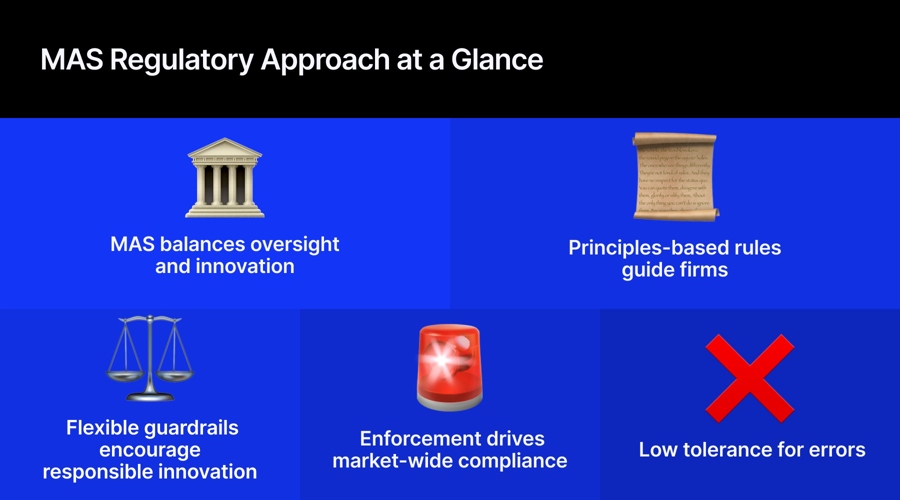
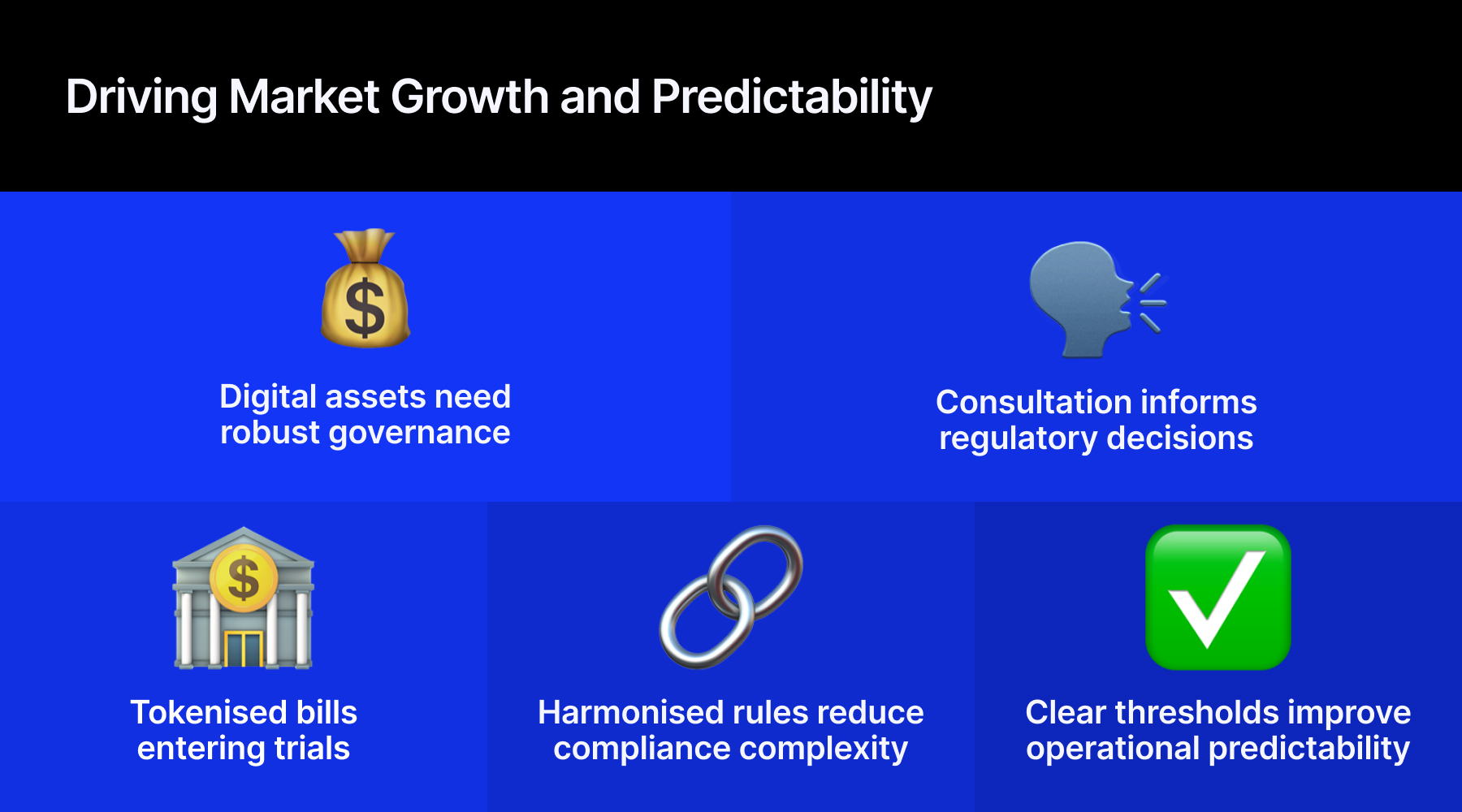
Industry seeks predictability: clear compliance thresholds, faster licensing, harmonised rules, and playbooks for emerging digital assets.
Consultation and stakeholder feedback “remain central” to MAS policy and rule implementation.
Strict but fair – that is how financial services companies
view the Monetary Authority of Singapore’s approach to regulation, which
includes regular consultation with current and prospective market entrants.
When it comes to assessing the merits of an industry
regulator, an obvious starting point is to ask whether it is ‘market-friendly’.
But that is an oversimplistic approach – the focus should instead be on how
these bodies balance robust oversight with fostering innovation and growth.
Principles-Based Regulation and Flexible Guardrails
The regulator practices what Cora Ang, head of legal &
compliance APAC at
AMINA Bank, describes as pragmatic, principles-based regulation, maintaining an
open door to participants willing to operate within its framework while
upholding a demanding framework.
Cora Ang, Head of Legal & Compliance APAC at AMINA Bank
“MAS explicitly emphasises responsible innovation within
what it calls ‘flexible guardrails’, taking a risk-based approach particularly
in evolving areas such as digital assets and AI,” she explains.
But this flexibility comes with high stakes. MAS has low
tolerance for firms falling short of expectations, and its enforcement strategy
amplifies individual penalties into market-wide behavioural shifts.
For example, when the regulator fined several institutions
for AML/CFT failures in
a 2023 money-laundering case, it simultaneously updated its supervisory
guidance so that every market participant faced heightened compliance
requirements and costs to meet the new baseline.
“So while MAS welcomes innovation and growth, it operates
with little margin for error and uses enforcement to move the entire market,
not just individual actors,” adds Ang.
Regulatory Maturity and Market Predictability
Sophisticated market participants look for regulatory
maturity and systemic predictability. The MAS is increasingly viewed as a
pragmatic architect that has successfully shifted the industry's focus from
speculative experimentation to institutional-grade commercialisation.
We were delighted to host central bank governors from across the region at the @sgfintechfest (SFF), where they witnessed firsthand the cutting-edge innovations shaping the future of finance.
That is the view of Rohit Apte, head of markets at regulated
institutional digital asset markets services provider Hex Trust, who notes that
for digital assets to achieve global scale, they must be underpinned by
interoperable, trust-minimised infrastructure that satisfies the fiduciary
requirements of the world’s largest asset managers.
Rohit Apte, Head of Markets at Hex Trust
“By prioritising market integrity and robust governance, the
MAS is effectively establishing international benchmarks for the next
generation of financial markets, attracting quality capital that prioritises
long-term stability over short-term volatility,” he says.
Consultative Approach and Stakeholder Engagement
Given that MAS actively consults stakeholders and related
professionals before implementing significant policy and regulatory changes,
the Securities Investors Association Singapore is of the
view that it is a consultative market regulator, which is “most laudable,”
according to the association’s head of regulatory, Robson Lee.
Simon Forster, global co-head of digital assets at TP ICAP,
says much of Singapore’s relevance in the digital asset space stems from the
work of the MAS since Project Orchid in 2021, which explored the viability of a
digital Singapore dollar, and more recently Project Bloom, which broadened that
scope to include stablecoins and tokenised commercial bank money.
In late 2025, the regulator announced plans to start testing
the issuance of tokenised bills to primary dealers, which will be settled
through a wholesale central bank digital currency.
Simon Forster, Global Co-Head of Digital Assets at TP ICAP
Of course, this is not to say that the regulatory
environment in Singapore could not be improved.
“As the global economy enters a more nuanced rhythm in 2026,
market participants are advocating for structural refinements that enhance
capital efficiency and cross-border mobility,” observes Apte.
“The industry is primarily seeking the global
standardisation of asset protocols – specifically for tokenised funds and bank
liabilities – to ensure seamless interoperability across international
platforms and jurisdictions.”
Furthermore, there is a clear mandate for modernised
post-trade infrastructure and enhanced multi-market connectivity, which would
allow custodians to better align with international practices and unlock deeper
liquidity pools.
“Finally, as institutional pilots for real-world assets
expand, the market is calling for an agile governance model that addresses
emerging technical risks without stifling the responsible innovation that
defines Singapore's macro strategy,” adds Apte.
Refining Existing Rules
When asked what rule changes market participants would like
to see in Singapore, Ang suggests that the real need isn't for new rules but
rather refinements to how existing rules are calibrated, applied and
operationalised in practice.
“The common wish list across banks, fund managers and
digital asset firms centres on operational predictability, specifically more
proportional requirements tied to actual business models and risk profiles,”
she says. “Right now, there is ambiguity around when simplified compliance
measures are acceptable versus when enhanced measures kick in. Clearer
thresholds would help firms design appropriate controls from the outset.”
#ICYMI: MAS has proposed Guidelines for AI Risk Management in the financial sector — including governance, risk management, life cycle controls, and capabilities. Submit your comments on the proposals by 31 Jan 2026.
There have also been calls for faster, more predictable
licensing and approval timelines amid concerns that some processes have become
so protracted that they have shifted from friction to a genuine deterrent for
market entry, especially for firms trying to assess whether Singapore is viable
for their business model.
Robson Lee, Head of Regulatory at Securities Investors Association Singapore
Ang calls for greater harmonisation across regulatory
frameworks on the basis that firms operating across multiple licence types or
business lines face overlapping but inconsistent requirements, creating
compliance complexity that doesn't always map to risk.
“Clearer playbooks for emerging sectors such as digital
assets would also be welcome,” she continues. “The current principles-based
approach creates flexibility but also uncertainty. Firms need enough regulatory
clarity to commit capital and build sustainable operations without risking
sudden supervisory expectation shifts.”
Continued Consultation and Transparency
The SIAS is in constant contact with the MAS as and when it
obtains significant feedback on regulatory policies and market conduct rules,
including when it receives credible information regarding market misconduct or
breaches.
“In this respect, we would like the MAS to continue with its
consultative approach towards proposed rules implementation and receptiveness
to market feedback regarding enforcement,” says Lee.
The bottom line is that participants want to play by the
rules – they just want to know what the rules look like in advance.
Strict but fair – that is how financial services companies
view the Monetary Authority of Singapore’s approach to regulation, which
includes regular consultation with current and prospective market entrants.
When it comes to assessing the merits of an industry
regulator, an obvious starting point is to ask whether it is ‘market-friendly’.
But that is an oversimplistic approach – the focus should instead be on how
these bodies balance robust oversight with fostering innovation and growth.
Principles-Based Regulation and Flexible Guardrails
The regulator practices what Cora Ang, head of legal &
compliance APAC at
AMINA Bank, describes as pragmatic, principles-based regulation, maintaining an
open door to participants willing to operate within its framework while
upholding a demanding framework.
Cora Ang, Head of Legal & Compliance APAC at AMINA Bank
“MAS explicitly emphasises responsible innovation within
what it calls ‘flexible guardrails’, taking a risk-based approach particularly
in evolving areas such as digital assets and AI,” she explains.
But this flexibility comes with high stakes. MAS has low
tolerance for firms falling short of expectations, and its enforcement strategy
amplifies individual penalties into market-wide behavioural shifts.
For example, when the regulator fined several institutions
for AML/CFT failures in
a 2023 money-laundering case, it simultaneously updated its supervisory
guidance so that every market participant faced heightened compliance
requirements and costs to meet the new baseline.
“So while MAS welcomes innovation and growth, it operates
with little margin for error and uses enforcement to move the entire market,
not just individual actors,” adds Ang.
Regulatory Maturity and Market Predictability
Sophisticated market participants look for regulatory
maturity and systemic predictability. The MAS is increasingly viewed as a
pragmatic architect that has successfully shifted the industry's focus from
speculative experimentation to institutional-grade commercialisation.
We were delighted to host central bank governors from across the region at the @sgfintechfest (SFF), where they witnessed firsthand the cutting-edge innovations shaping the future of finance.
That is the view of Rohit Apte, head of markets at regulated
institutional digital asset markets services provider Hex Trust, who notes that
for digital assets to achieve global scale, they must be underpinned by
interoperable, trust-minimised infrastructure that satisfies the fiduciary
requirements of the world’s largest asset managers.
Rohit Apte, Head of Markets at Hex Trust
“By prioritising market integrity and robust governance, the
MAS is effectively establishing international benchmarks for the next
generation of financial markets, attracting quality capital that prioritises
long-term stability over short-term volatility,” he says.
Consultative Approach and Stakeholder Engagement
Given that MAS actively consults stakeholders and related
professionals before implementing significant policy and regulatory changes,
the Securities Investors Association Singapore is of the
view that it is a consultative market regulator, which is “most laudable,”
according to the association’s head of regulatory, Robson Lee.
Simon Forster, global co-head of digital assets at TP ICAP,
says much of Singapore’s relevance in the digital asset space stems from the
work of the MAS since Project Orchid in 2021, which explored the viability of a
digital Singapore dollar, and more recently Project Bloom, which broadened that
scope to include stablecoins and tokenised commercial bank money.
In late 2025, the regulator announced plans to start testing
the issuance of tokenised bills to primary dealers, which will be settled
through a wholesale central bank digital currency.
Simon Forster, Global Co-Head of Digital Assets at TP ICAP
Of course, this is not to say that the regulatory
environment in Singapore could not be improved.
“As the global economy enters a more nuanced rhythm in 2026,
market participants are advocating for structural refinements that enhance
capital efficiency and cross-border mobility,” observes Apte.
“The industry is primarily seeking the global
standardisation of asset protocols – specifically for tokenised funds and bank
liabilities – to ensure seamless interoperability across international
platforms and jurisdictions.”
Furthermore, there is a clear mandate for modernised
post-trade infrastructure and enhanced multi-market connectivity, which would
allow custodians to better align with international practices and unlock deeper
liquidity pools.
“Finally, as institutional pilots for real-world assets
expand, the market is calling for an agile governance model that addresses
emerging technical risks without stifling the responsible innovation that
defines Singapore's macro strategy,” adds Apte.
Refining Existing Rules
When asked what rule changes market participants would like
to see in Singapore, Ang suggests that the real need isn't for new rules but
rather refinements to how existing rules are calibrated, applied and
operationalised in practice.
“The common wish list across banks, fund managers and
digital asset firms centres on operational predictability, specifically more
proportional requirements tied to actual business models and risk profiles,”
she says. “Right now, there is ambiguity around when simplified compliance
measures are acceptable versus when enhanced measures kick in. Clearer
thresholds would help firms design appropriate controls from the outset.”
#ICYMI: MAS has proposed Guidelines for AI Risk Management in the financial sector — including governance, risk management, life cycle controls, and capabilities. Submit your comments on the proposals by 31 Jan 2026.
There have also been calls for faster, more predictable
licensing and approval timelines amid concerns that some processes have become
so protracted that they have shifted from friction to a genuine deterrent for
market entry, especially for firms trying to assess whether Singapore is viable
for their business model.
Robson Lee, Head of Regulatory at Securities Investors Association Singapore
Ang calls for greater harmonisation across regulatory
frameworks on the basis that firms operating across multiple licence types or
business lines face overlapping but inconsistent requirements, creating
compliance complexity that doesn't always map to risk.
“Clearer playbooks for emerging sectors such as digital
assets would also be welcome,” she continues. “The current principles-based
approach creates flexibility but also uncertainty. Firms need enough regulatory
clarity to commit capital and build sustainable operations without risking
sudden supervisory expectation shifts.”
Continued Consultation and Transparency
The SIAS is in constant contact with the MAS as and when it
obtains significant feedback on regulatory policies and market conduct rules,
including when it receives credible information regarding market misconduct or
breaches.
“In this respect, we would like the MAS to continue with its
consultative approach towards proposed rules implementation and receptiveness
to market feedback regarding enforcement,” says Lee.
The bottom line is that participants want to play by the
rules – they just want to know what the rules look like in advance.
Paul Golden is an experienced freelance financial journalist with a strong institutional background. Over the past two decades, he has written for globally recognised financial publications, covering topics such as market structure, regulation, trading behaviour, and economic policy.
Swiss Banks, Brokers and Fintechs Must Prove Online Clients Are Real People
Featured Videos
AvaTrade to Acquire Most of FXCM; NAGA Raises $8M
AvaTrade to Acquire Most of FXCM; NAGA Raises $8M
AvaTrade to Acquire Most of FXCM; NAGA Raises $8M
AvaTrade to Acquire Most of FXCM; NAGA Raises $8M
Today’s financial news recap covers AvaTrade agrees to acquire most of FXCM, NAGA secures eight million dollars in new financing, and Wise seeks a tax settlement in the UK.
Finance Magnates Daily Recap brings you the latest news from forex and CFD brokers, fintech, payments, cryptocurrency, digital assets, trading platforms, financial regulation and global markets.
Get the key company news, executive moves, deals, regulatory updates and market developments of the day, in just a few minutes. New episodes published every weekday.
Read more: https://www.financemagnates.com
#FinanceMagnates #ForexNews #FintechNews
Today’s financial news recap covers AvaTrade agrees to acquire most of FXCM, NAGA secures eight million dollars in new financing, and Wise seeks a tax settlement in the UK.
Finance Magnates Daily Recap brings you the latest news from forex and CFD brokers, fintech, payments, cryptocurrency, digital assets, trading platforms, financial regulation and global markets.
Get the key company news, executive moves, deals, regulatory updates and market developments of the day, in just a few minutes. New episodes published every weekday.
Read more: https://www.financemagnates.com
#FinanceMagnates #ForexNews #FintechNews
Today’s financial news recap covers AvaTrade agrees to acquire most of FXCM, NAGA secures eight million dollars in new financing, and Wise seeks a tax settlement in the UK.
Finance Magnates Daily Recap brings you the latest news from forex and CFD brokers, fintech, payments, cryptocurrency, digital assets, trading platforms, financial regulation and global markets.
Get the key company news, executive moves, deals, regulatory updates and market developments of the day, in just a few minutes. New episodes published every weekday.
Read more: https://www.financemagnates.com
#FinanceMagnates #ForexNews #FintechNews
Today’s financial news recap covers AvaTrade agrees to acquire most of FXCM, NAGA secures eight million dollars in new financing, and Wise seeks a tax settlement in the UK.
Finance Magnates Daily Recap brings you the latest news from forex and CFD brokers, fintech, payments, cryptocurrency, digital assets, trading platforms, financial regulation and global markets.
Get the key company news, executive moves, deals, regulatory updates and market developments of the day, in just a few minutes. New episodes published every weekday.
Read more: https://www.financemagnates.com
#FinanceMagnates #ForexNews #FintechNews
XTB Adds Overnight US Stock Trading; Nasdaq Ventures Invests in One Trading
XTB Adds Overnight US Stock Trading; Nasdaq Ventures Invests in One Trading
XTB Adds Overnight US Stock Trading; Nasdaq Ventures Invests in One Trading
XTB Adds Overnight US Stock Trading; Nasdaq Ventures Invests in One Trading
XTB Adds Overnight US Stock Trading; Nasdaq Ventures Invests in One Trading
XTB Adds Overnight US Stock Trading; Nasdaq Ventures Invests in One Trading
Today’s financial news recap covers XTB expands overnight US stock trading, Fortrade reports higher revenue, Nasdaq backs One Trading, and Vest Labs raises 13 million dollars.
Finance Magnates Daily Recap brings you the latest news from forex and CFD brokers, fintech, payments, cryptocurrency, digital assets, trading platforms, financial regulation and global markets.
Get the key company news, executive moves, deals, regulatory updates and market developments of the day, in just a few minutes. New episodes published every weekday.
Read more: https://www.financemagnates.com
#FinanceMagnates #ForexNews #FintechNews
Today’s financial news recap covers XTB expands overnight US stock trading, Fortrade reports higher revenue, Nasdaq backs One Trading, and Vest Labs raises 13 million dollars.
Finance Magnates Daily Recap brings you the latest news from forex and CFD brokers, fintech, payments, cryptocurrency, digital assets, trading platforms, financial regulation and global markets.
Get the key company news, executive moves, deals, regulatory updates and market developments of the day, in just a few minutes. New episodes published every weekday.
Read more: https://www.financemagnates.com
#FinanceMagnates #ForexNews #FintechNews
Today’s financial news recap covers XTB expands overnight US stock trading, Fortrade reports higher revenue, Nasdaq backs One Trading, and Vest Labs raises 13 million dollars.
Finance Magnates Daily Recap brings you the latest news from forex and CFD brokers, fintech, payments, cryptocurrency, digital assets, trading platforms, financial regulation and global markets.
Get the key company news, executive moves, deals, regulatory updates and market developments of the day, in just a few minutes. New episodes published every weekday.
Read more: https://www.financemagnates.com
#FinanceMagnates #ForexNews #FintechNews
Today’s financial news recap covers XTB expands overnight US stock trading, Fortrade reports higher revenue, Nasdaq backs One Trading, and Vest Labs raises 13 million dollars.
Finance Magnates Daily Recap brings you the latest news from forex and CFD brokers, fintech, payments, cryptocurrency, digital assets, trading platforms, financial regulation and global markets.
Get the key company news, executive moves, deals, regulatory updates and market developments of the day, in just a few minutes. New episodes published every weekday.
Read more: https://www.financemagnates.com
#FinanceMagnates #ForexNews #FintechNews
Today’s financial news recap covers XTB expands overnight US stock trading, Fortrade reports higher revenue, Nasdaq backs One Trading, and Vest Labs raises 13 million dollars.
Finance Magnates Daily Recap brings you the latest news from forex and CFD brokers, fintech, payments, cryptocurrency, digital assets, trading platforms, financial regulation and global markets.
Get the key company news, executive moves, deals, regulatory updates and market developments of the day, in just a few minutes. New episodes published every weekday.
Read more: https://www.financemagnates.com
#FinanceMagnates #ForexNews #FintechNews
Today’s financial news recap covers XTB expands overnight US stock trading, Fortrade reports higher revenue, Nasdaq backs One Trading, and Vest Labs raises 13 million dollars.
Finance Magnates Daily Recap brings you the latest news from forex and CFD brokers, fintech, payments, cryptocurrency, digital assets, trading platforms, financial regulation and global markets.
Get the key company news, executive moves, deals, regulatory updates and market developments of the day, in just a few minutes. New episodes published every weekday.
Read more: https://www.financemagnates.com
#FinanceMagnates #ForexNews #FintechNews
CMC Founder Downplays Volatility Hit; Devexperts Names CEO
CMC Founder Downplays Volatility Hit; Devexperts Names CEO
CMC Founder Downplays Volatility Hit; Devexperts Names CEO
CMC Founder Downplays Volatility Hit; Devexperts Names CEO
CMC Founder Downplays Volatility Hit; Devexperts Names CEO
CMC Founder Downplays Volatility Hit; Devexperts Names CEO
Today’s financial news recap covers low volatility pressures brokers, Devexperts names a new CEO, Saxo cuts onboarding time, and OKX reaches a 25 billion dollar valuation.
Finance Magnates Daily Recap brings you the latest news from forex and CFD brokers, fintech, payments, cryptocurrency, digital assets, trading platforms, financial regulation and global markets.
Get the key company news, executive moves, deals, regulatory updates and market developments of the day, in just a few minutes. New episodes published every weekday.
Read more: https://www.financemagnates.com
#FinanceMagnates #ForexNews #FintechNews
Today’s financial news recap covers low volatility pressures brokers, Devexperts names a new CEO, Saxo cuts onboarding time, and OKX reaches a 25 billion dollar valuation.
Finance Magnates Daily Recap brings you the latest news from forex and CFD brokers, fintech, payments, cryptocurrency, digital assets, trading platforms, financial regulation and global markets.
Get the key company news, executive moves, deals, regulatory updates and market developments of the day, in just a few minutes. New episodes published every weekday.
Read more: https://www.financemagnates.com
#FinanceMagnates #ForexNews #FintechNews
Today’s financial news recap covers low volatility pressures brokers, Devexperts names a new CEO, Saxo cuts onboarding time, and OKX reaches a 25 billion dollar valuation.
Finance Magnates Daily Recap brings you the latest news from forex and CFD brokers, fintech, payments, cryptocurrency, digital assets, trading platforms, financial regulation and global markets.
Get the key company news, executive moves, deals, regulatory updates and market developments of the day, in just a few minutes. New episodes published every weekday.
Read more: https://www.financemagnates.com
#FinanceMagnates #ForexNews #FintechNews
Today’s financial news recap covers low volatility pressures brokers, Devexperts names a new CEO, Saxo cuts onboarding time, and OKX reaches a 25 billion dollar valuation.
Finance Magnates Daily Recap brings you the latest news from forex and CFD brokers, fintech, payments, cryptocurrency, digital assets, trading platforms, financial regulation and global markets.
Get the key company news, executive moves, deals, regulatory updates and market developments of the day, in just a few minutes. New episodes published every weekday.
Read more: https://www.financemagnates.com
#FinanceMagnates #ForexNews #FintechNews
Today’s financial news recap covers low volatility pressures brokers, Devexperts names a new CEO, Saxo cuts onboarding time, and OKX reaches a 25 billion dollar valuation.
Finance Magnates Daily Recap brings you the latest news from forex and CFD brokers, fintech, payments, cryptocurrency, digital assets, trading platforms, financial regulation and global markets.
Get the key company news, executive moves, deals, regulatory updates and market developments of the day, in just a few minutes. New episodes published every weekday.
Read more: https://www.financemagnates.com
#FinanceMagnates #ForexNews #FintechNews
Today’s financial news recap covers low volatility pressures brokers, Devexperts names a new CEO, Saxo cuts onboarding time, and OKX reaches a 25 billion dollar valuation.
Finance Magnates Daily Recap brings you the latest news from forex and CFD brokers, fintech, payments, cryptocurrency, digital assets, trading platforms, financial regulation and global markets.
Get the key company news, executive moves, deals, regulatory updates and market developments of the day, in just a few minutes. New episodes published every weekday.
Read more: https://www.financemagnates.com
#FinanceMagnates #ForexNews #FintechNews
Today’s financial news recap covers Trade Nation buys FXCM's UK client book, Trading 212 reports higher revenue, the CFTC's move to allow perpetual index futures.
Finance Magnates Daily Recap brings you the latest news from forex and CFD brokers, fintech, payments, cryptocurrency, digital assets, trading platforms, financial regulation and global markets.
Get the key company news, executive moves, deals, regulatory updates and market developments of the day, in just a few minutes. New episodes published every weekday.
Read more: https://www.financemagnates.com
#FinanceMagnates #ForexNews #FintechNews
Today’s financial news recap covers Trade Nation buys FXCM's UK client book, Trading 212 reports higher revenue, the CFTC's move to allow perpetual index futures.
Finance Magnates Daily Recap brings you the latest news from forex and CFD brokers, fintech, payments, cryptocurrency, digital assets, trading platforms, financial regulation and global markets.
Get the key company news, executive moves, deals, regulatory updates and market developments of the day, in just a few minutes. New episodes published every weekday.
Read more: https://www.financemagnates.com
#FinanceMagnates #ForexNews #FintechNews
Today’s financial news recap covers Trade Nation buys FXCM's UK client book, Trading 212 reports higher revenue, the CFTC's move to allow perpetual index futures.
Finance Magnates Daily Recap brings you the latest news from forex and CFD brokers, fintech, payments, cryptocurrency, digital assets, trading platforms, financial regulation and global markets.
Get the key company news, executive moves, deals, regulatory updates and market developments of the day, in just a few minutes. New episodes published every weekday.
Read more: https://www.financemagnates.com
#FinanceMagnates #ForexNews #FintechNews
Today’s financial news recap covers Trade Nation buys FXCM's UK client book, Trading 212 reports higher revenue, the CFTC's move to allow perpetual index futures.
Finance Magnates Daily Recap brings you the latest news from forex and CFD brokers, fintech, payments, cryptocurrency, digital assets, trading platforms, financial regulation and global markets.
Get the key company news, executive moves, deals, regulatory updates and market developments of the day, in just a few minutes. New episodes published every weekday.
Read more: https://www.financemagnates.com
#FinanceMagnates #ForexNews #FintechNews
Today’s financial news recap covers Trade Nation buys FXCM's UK client book, Trading 212 reports higher revenue, the CFTC's move to allow perpetual index futures.
Finance Magnates Daily Recap brings you the latest news from forex and CFD brokers, fintech, payments, cryptocurrency, digital assets, trading platforms, financial regulation and global markets.
Get the key company news, executive moves, deals, regulatory updates and market developments of the day, in just a few minutes. New episodes published every weekday.
Read more: https://www.financemagnates.com
#FinanceMagnates #ForexNews #FintechNews
Today’s financial news recap covers Trade Nation buys FXCM's UK client book, Trading 212 reports higher revenue, the CFTC's move to allow perpetual index futures.
Finance Magnates Daily Recap brings you the latest news from forex and CFD brokers, fintech, payments, cryptocurrency, digital assets, trading platforms, financial regulation and global markets.
Get the key company news, executive moves, deals, regulatory updates and market developments of the day, in just a few minutes. New episodes published every weekday.
Read more: https://www.financemagnates.com
#FinanceMagnates #ForexNews #FintechNews
Your career isn’t a linear path.
Your career isn’t a linear path.
Your career isn’t a linear path.
Your career isn’t a linear path.
Your career isn’t a linear path.
Your career isn’t a linear path.
Roles change. Career goals change. Sometimes you want a completely new challenge.
But the skills and knowledge you build along the way can stay with you and give you something to build on.
For Jeff Patterson, that continued growth is key to long-term career development.
You bring the skills. FM Academy helps you build the knowledge.
#FMAcademy #FinanceMagnates #FinanceCareers #ProfessionalDevelopment #Fintech
Roles change. Career goals change. Sometimes you want a completely new challenge.
But the skills and knowledge you build along the way can stay with you and give you something to build on.
For Jeff Patterson, that continued growth is key to long-term career development.
You bring the skills. FM Academy helps you build the knowledge.
#FMAcademy #FinanceMagnates #FinanceCareers #ProfessionalDevelopment #Fintech
Roles change. Career goals change. Sometimes you want a completely new challenge.
But the skills and knowledge you build along the way can stay with you and give you something to build on.
For Jeff Patterson, that continued growth is key to long-term career development.
You bring the skills. FM Academy helps you build the knowledge.
#FMAcademy #FinanceMagnates #FinanceCareers #ProfessionalDevelopment #Fintech
Roles change. Career goals change. Sometimes you want a completely new challenge.
But the skills and knowledge you build along the way can stay with you and give you something to build on.
For Jeff Patterson, that continued growth is key to long-term career development.
You bring the skills. FM Academy helps you build the knowledge.
#FMAcademy #FinanceMagnates #FinanceCareers #ProfessionalDevelopment #Fintech
Roles change. Career goals change. Sometimes you want a completely new challenge.
But the skills and knowledge you build along the way can stay with you and give you something to build on.
For Jeff Patterson, that continued growth is key to long-term career development.
You bring the skills. FM Academy helps you build the knowledge.
#FMAcademy #FinanceMagnates #FinanceCareers #ProfessionalDevelopment #Fintech
Roles change. Career goals change. Sometimes you want a completely new challenge.
But the skills and knowledge you build along the way can stay with you and give you something to build on.
For Jeff Patterson, that continued growth is key to long-term career development.
You bring the skills. FM Academy helps you build the knowledge.
#FMAcademy #FinanceMagnates #FinanceCareers #ProfessionalDevelopment #Fintech