European Market Infrastructure Regulations (EMIR) reporting goes into effect, and Forex Magnates brings feedback from firms that are now obliged to submit trade data to an authorized Trade Repository (TR),
Any Open trade positions under the applicable asset classes, including Forex and related derivatives will from today need to be reported on a back-dated basis from August 2012 to the present, with tomorrow being the next reporting day on a T+1 basis which will include trade data for February 12, 2014’s trading, and a process that will ensue on a daily basis going forward.
Below we can look at the important updates and feedback from regulators, brokers, technology and service providers involved with EMIR, as a sample update on the current development.
The information is expected to be submitted by 5pm GMT each day, for the prior day's positions, and can be submitted to any of the approved TRs that handle FX, either directly or via 3rd party provider facilitating the connection.
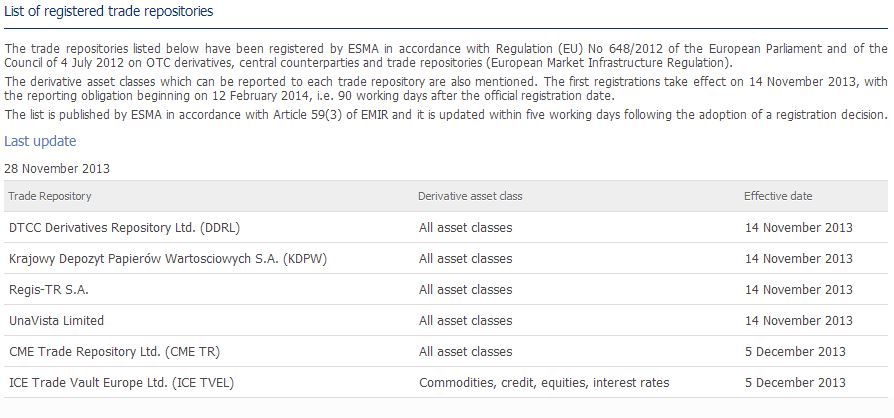
6 Approved Trade Repositories Currently Can Handle Submissions
ESMA's list of registered Trade Respositories (TRs), as can be seen on the ESMA website:
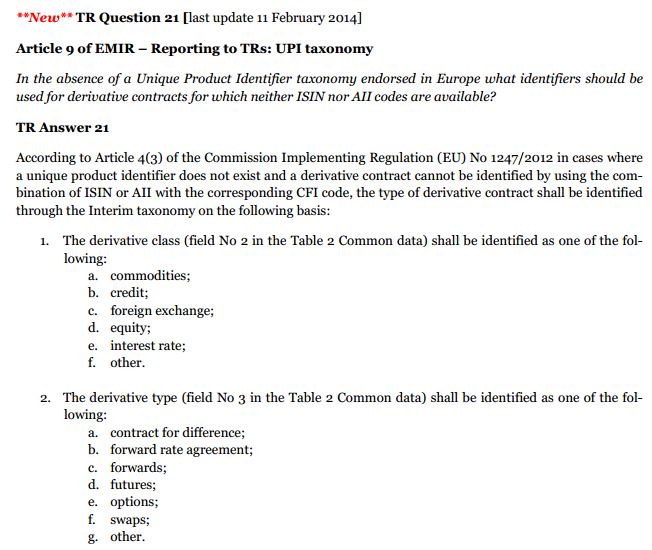
ESMA also updated just yesterday certain frequently asked questions in one of its previously published guidelines on EMIR, available as a PDF on its website. Forex Magnate's reporters were unable to reach a company spokesperson around time of publication for comments. An excerpt of the updated document shows a question that talks about applicable asset classes, including Foreign Exchange:
Sample Excerpt of Question Updated February 11, 2014 from ESMA report
FCA: "Everybody recognizes that reporting will not be perfect on February 12."
Chris Hamilton, a press officer with the Financial Conduct Authority (FCA) of the U.K, said in an official statement issued by the FCA that, “Everybody recognizes that reporting will not be perfect on February 12. There have been a number of challenges encountered, but in general, people are busy preparing. We recognize these challenges and will be proportionate in our response to any instances of non-compliance. Our initial focus will be solving any reporting problems and helping the industry meet the new standards. Firms should however recognize that non-compliance could lead to enforcement action.”
Indeed, there have been a number of media outlets that wrote about confusion or mixed views about EMIR's applicability and related compliance obligations, leading up to today, as interpreted by firms in Europe.
While the view from the FCA is only representative of one financial markets regulator within the EU, it's safe to say the other regulators may be lenient as well, however, non-compliance as noted above might not be taken lightly as noted by the FCA, in Forex Magnates' opinion. In addition, action could be taken from ESMA itself, just as the European Commission (EC) has recently flexed its arm in wake of the benchmark rigging investigations, as the EU authorities exercise their power.
Regulated Brokers Operating Within Europe, Including under MiFID
Forex Magnates' reporters reached out to a number of brokers operating within the EU, including technology service providers, legal experts and some of the authorized TRs, in an effort to compile a sample of feedback on how firms are faring with the new effective date.
During the feedback received, Forex Magnates' reporters spoke with Charalambos Psimolophitis, CEO at FxPro, who shared the following opinion on the news, "FxPro welcomes the initiative ESMA has undertaken to increase investor confidence in the derivatives market and can confirm that all structural implementation regarding the EMIR regulatory reporting obligations have been finalized with all concerned parties. Official Legal Entity Identifiers have been obtained for both reporting entities in light of the reporting commencement date of February 12th, and we have additionally taken the initiative to service our premium corporate clients who fall under the scope of EMIR by offering the delegation of reporting obligations to the Firm should they desire.”
In addition, several brokers have sent customers notice with regards to changes under EMIR, including brokers from the UK, as seen in email transcripts reviewed by Forex Magnates.
Mixed Views on EMIR as it Applies to FX, CFDs and Binary Options
Another firm said, as told to Forex Magnates during a survey, that a new template had to be developed internally to meet the reporting requirements, and how an LEI application had been filed, and that the firm chose UnaVista as its TR.
Also noted by feedback provided during the survey was how the process was thought by one firm to be more burdensome than not, due to a lack of information and poor understanding of the new rules applicability as it pertains to Forex, CFD and binary options brokers.
In addition, a number of other services providers, including financial services and legal advisory, have launched EMIR reporting solutions, such as MAP S.Platis who developed the map-ers.com EMIR solution.
In addition, members of Forex Magnates research team asked Windors Brokers, the Cyprus-based online broker that just celebrated its 25th anniversary, regarding whether the firm is reporting directly to a TR or through a 3rd party reporting providers (that connects to TRs) and a company spokesperson answered as follows:
“It is important to note that whether an investment firm chooses to report directly or via a third party, the final liability for reporting lies on each financial investment firm. We have therefore decided to handle reporting obligations ourselves, directly to the TR, at least for now. We already have our internal reporting and legal framework in place therefore we believe we are able to fulfill this obligation without the need of a third party at the moment. Should the reporting requirements change or if at some point, we believe that a third party is necessary for more efficiency or time related issues, we will decide accordingly when the time comes."
Forex Magnates expects a number of firms to issue press releases today with regards to EMIR, as an update on their respective statuses may be made to assure participants of where they stand.
Any Open trade positions under the applicable asset classes, including Forex and related derivatives will from today need to be reported on a back-dated basis from August 2012 to the present, with tomorrow being the next reporting day on a T+1 basis which will include trade data for February 12, 2014’s trading, and a process that will ensue on a daily basis going forward.
Below we can look at the important updates and feedback from regulators, brokers, technology and service providers involved with EMIR, as a sample update on the current development.
The information is expected to be submitted by 5pm GMT each day, for the prior day's positions, and can be submitted to any of the approved TRs that handle FX, either directly or via 3rd party provider facilitating the connection.
6 Approved Trade Repositories Currently Can Handle Submissions
ESMA's list of registered Trade Respositories (TRs), as can be seen on the ESMA website:
ESMA also updated just yesterday certain frequently asked questions in one of its previously published guidelines on EMIR, available as a PDF on its website. Forex Magnate's reporters were unable to reach a company spokesperson around time of publication for comments. An excerpt of the updated document shows a question that talks about applicable asset classes, including Foreign Exchange:
Sample Excerpt of Question Updated February 11, 2014 from ESMA report
FCA: "Everybody recognizes that reporting will not be perfect on February 12."
Chris Hamilton, a press officer with the Financial Conduct Authority (FCA) of the U.K, said in an official statement issued by the FCA that, “Everybody recognizes that reporting will not be perfect on February 12. There have been a number of challenges encountered, but in general, people are busy preparing. We recognize these challenges and will be proportionate in our response to any instances of non-compliance. Our initial focus will be solving any reporting problems and helping the industry meet the new standards. Firms should however recognize that non-compliance could lead to enforcement action.”
Indeed, there have been a number of media outlets that wrote about confusion or mixed views about EMIR's applicability and related compliance obligations, leading up to today, as interpreted by firms in Europe.
While the view from the FCA is only representative of one financial markets regulator within the EU, it's safe to say the other regulators may be lenient as well, however, non-compliance as noted above might not be taken lightly as noted by the FCA, in Forex Magnates' opinion. In addition, action could be taken from ESMA itself, just as the European Commission (EC) has recently flexed its arm in wake of the benchmark rigging investigations, as the EU authorities exercise their power.
Regulated Brokers Operating Within Europe, Including under MiFID
Forex Magnates' reporters reached out to a number of brokers operating within the EU, including technology service providers, legal experts and some of the authorized TRs, in an effort to compile a sample of feedback on how firms are faring with the new effective date.
During the feedback received, Forex Magnates' reporters spoke with Charalambos Psimolophitis, CEO at FxPro, who shared the following opinion on the news, "FxPro welcomes the initiative ESMA has undertaken to increase investor confidence in the derivatives market and can confirm that all structural implementation regarding the EMIR regulatory reporting obligations have been finalized with all concerned parties. Official Legal Entity Identifiers have been obtained for both reporting entities in light of the reporting commencement date of February 12th, and we have additionally taken the initiative to service our premium corporate clients who fall under the scope of EMIR by offering the delegation of reporting obligations to the Firm should they desire.”
In addition, several brokers have sent customers notice with regards to changes under EMIR, including brokers from the UK, as seen in email transcripts reviewed by Forex Magnates.
Mixed Views on EMIR as it Applies to FX, CFDs and Binary Options
Another firm said, as told to Forex Magnates during a survey, that a new template had to be developed internally to meet the reporting requirements, and how an LEI application had been filed, and that the firm chose UnaVista as its TR.
Also noted by feedback provided during the survey was how the process was thought by one firm to be more burdensome than not, due to a lack of information and poor understanding of the new rules applicability as it pertains to Forex, CFD and binary options brokers.
In addition, a number of other services providers, including financial services and legal advisory, have launched EMIR reporting solutions, such as MAP S.Platis who developed the map-ers.com EMIR solution.
In addition, members of Forex Magnates research team asked Windors Brokers, the Cyprus-based online broker that just celebrated its 25th anniversary, regarding whether the firm is reporting directly to a TR or through a 3rd party reporting providers (that connects to TRs) and a company spokesperson answered as follows:
“It is important to note that whether an investment firm chooses to report directly or via a third party, the final liability for reporting lies on each financial investment firm. We have therefore decided to handle reporting obligations ourselves, directly to the TR, at least for now. We already have our internal reporting and legal framework in place therefore we believe we are able to fulfill this obligation without the need of a third party at the moment. Should the reporting requirements change or if at some point, we believe that a third party is necessary for more efficiency or time related issues, we will decide accordingly when the time comes."
Forex Magnates expects a number of firms to issue press releases today with regards to EMIR, as an update on their respective statuses may be made to assure participants of where they stand.
XTB Catches Up on Overnight US Stock Trading, Adds Hungarian Tax Account
Featured Videos
XTB Adds Overnight US Stock Trading; Nasdaq Ventures Invests in One Trading
XTB Adds Overnight US Stock Trading; Nasdaq Ventures Invests in One Trading
XTB Adds Overnight US Stock Trading; Nasdaq Ventures Invests in One Trading
XTB Adds Overnight US Stock Trading; Nasdaq Ventures Invests in One Trading
Today’s financial news recap covers XTB expands overnight US stock trading, Fortrade reports higher revenue, Nasdaq backs One Trading, and Vest Labs raises 13 million dollars.
Finance Magnates Daily Recap brings you the latest news from forex and CFD brokers, fintech, payments, cryptocurrency, digital assets, trading platforms, financial regulation and global markets.
Get the key company news, executive moves, deals, regulatory updates and market developments of the day, in just a few minutes. New episodes published every weekday.
Read more: https://www.financemagnates.com
#FinanceMagnates #ForexNews #FintechNews
Today’s financial news recap covers XTB expands overnight US stock trading, Fortrade reports higher revenue, Nasdaq backs One Trading, and Vest Labs raises 13 million dollars.
Finance Magnates Daily Recap brings you the latest news from forex and CFD brokers, fintech, payments, cryptocurrency, digital assets, trading platforms, financial regulation and global markets.
Get the key company news, executive moves, deals, regulatory updates and market developments of the day, in just a few minutes. New episodes published every weekday.
Read more: https://www.financemagnates.com
#FinanceMagnates #ForexNews #FintechNews
Today’s financial news recap covers XTB expands overnight US stock trading, Fortrade reports higher revenue, Nasdaq backs One Trading, and Vest Labs raises 13 million dollars.
Finance Magnates Daily Recap brings you the latest news from forex and CFD brokers, fintech, payments, cryptocurrency, digital assets, trading platforms, financial regulation and global markets.
Get the key company news, executive moves, deals, regulatory updates and market developments of the day, in just a few minutes. New episodes published every weekday.
Read more: https://www.financemagnates.com
#FinanceMagnates #ForexNews #FintechNews
Today’s financial news recap covers XTB expands overnight US stock trading, Fortrade reports higher revenue, Nasdaq backs One Trading, and Vest Labs raises 13 million dollars.
Finance Magnates Daily Recap brings you the latest news from forex and CFD brokers, fintech, payments, cryptocurrency, digital assets, trading platforms, financial regulation and global markets.
Get the key company news, executive moves, deals, regulatory updates and market developments of the day, in just a few minutes. New episodes published every weekday.
Read more: https://www.financemagnates.com
#FinanceMagnates #ForexNews #FintechNews
CMC Founder Downplays Volatility Hit; Devexperts Names CEO
CMC Founder Downplays Volatility Hit; Devexperts Names CEO
CMC Founder Downplays Volatility Hit; Devexperts Names CEO
CMC Founder Downplays Volatility Hit; Devexperts Names CEO
CMC Founder Downplays Volatility Hit; Devexperts Names CEO
CMC Founder Downplays Volatility Hit; Devexperts Names CEO
Today’s financial news recap covers low volatility pressures brokers, Devexperts names a new CEO, Saxo cuts onboarding time, and OKX reaches a 25 billion dollar valuation.
Finance Magnates Daily Recap brings you the latest news from forex and CFD brokers, fintech, payments, cryptocurrency, digital assets, trading platforms, financial regulation and global markets.
Get the key company news, executive moves, deals, regulatory updates and market developments of the day, in just a few minutes. New episodes published every weekday.
Read more: https://www.financemagnates.com
#FinanceMagnates #ForexNews #FintechNews
Today’s financial news recap covers low volatility pressures brokers, Devexperts names a new CEO, Saxo cuts onboarding time, and OKX reaches a 25 billion dollar valuation.
Finance Magnates Daily Recap brings you the latest news from forex and CFD brokers, fintech, payments, cryptocurrency, digital assets, trading platforms, financial regulation and global markets.
Get the key company news, executive moves, deals, regulatory updates and market developments of the day, in just a few minutes. New episodes published every weekday.
Read more: https://www.financemagnates.com
#FinanceMagnates #ForexNews #FintechNews
Today’s financial news recap covers low volatility pressures brokers, Devexperts names a new CEO, Saxo cuts onboarding time, and OKX reaches a 25 billion dollar valuation.
Finance Magnates Daily Recap brings you the latest news from forex and CFD brokers, fintech, payments, cryptocurrency, digital assets, trading platforms, financial regulation and global markets.
Get the key company news, executive moves, deals, regulatory updates and market developments of the day, in just a few minutes. New episodes published every weekday.
Read more: https://www.financemagnates.com
#FinanceMagnates #ForexNews #FintechNews
Today’s financial news recap covers low volatility pressures brokers, Devexperts names a new CEO, Saxo cuts onboarding time, and OKX reaches a 25 billion dollar valuation.
Finance Magnates Daily Recap brings you the latest news from forex and CFD brokers, fintech, payments, cryptocurrency, digital assets, trading platforms, financial regulation and global markets.
Get the key company news, executive moves, deals, regulatory updates and market developments of the day, in just a few minutes. New episodes published every weekday.
Read more: https://www.financemagnates.com
#FinanceMagnates #ForexNews #FintechNews
Today’s financial news recap covers low volatility pressures brokers, Devexperts names a new CEO, Saxo cuts onboarding time, and OKX reaches a 25 billion dollar valuation.
Finance Magnates Daily Recap brings you the latest news from forex and CFD brokers, fintech, payments, cryptocurrency, digital assets, trading platforms, financial regulation and global markets.
Get the key company news, executive moves, deals, regulatory updates and market developments of the day, in just a few minutes. New episodes published every weekday.
Read more: https://www.financemagnates.com
#FinanceMagnates #ForexNews #FintechNews
Today’s financial news recap covers low volatility pressures brokers, Devexperts names a new CEO, Saxo cuts onboarding time, and OKX reaches a 25 billion dollar valuation.
Finance Magnates Daily Recap brings you the latest news from forex and CFD brokers, fintech, payments, cryptocurrency, digital assets, trading platforms, financial regulation and global markets.
Get the key company news, executive moves, deals, regulatory updates and market developments of the day, in just a few minutes. New episodes published every weekday.
Read more: https://www.financemagnates.com
#FinanceMagnates #ForexNews #FintechNews
Today’s financial news recap covers Trade Nation buys FXCM's UK client book, Trading 212 reports higher revenue, the CFTC's move to allow perpetual index futures.
Finance Magnates Daily Recap brings you the latest news from forex and CFD brokers, fintech, payments, cryptocurrency, digital assets, trading platforms, financial regulation and global markets.
Get the key company news, executive moves, deals, regulatory updates and market developments of the day, in just a few minutes. New episodes published every weekday.
Read more: https://www.financemagnates.com
#FinanceMagnates #ForexNews #FintechNews
Today’s financial news recap covers Trade Nation buys FXCM's UK client book, Trading 212 reports higher revenue, the CFTC's move to allow perpetual index futures.
Finance Magnates Daily Recap brings you the latest news from forex and CFD brokers, fintech, payments, cryptocurrency, digital assets, trading platforms, financial regulation and global markets.
Get the key company news, executive moves, deals, regulatory updates and market developments of the day, in just a few minutes. New episodes published every weekday.
Read more: https://www.financemagnates.com
#FinanceMagnates #ForexNews #FintechNews
Today’s financial news recap covers Trade Nation buys FXCM's UK client book, Trading 212 reports higher revenue, the CFTC's move to allow perpetual index futures.
Finance Magnates Daily Recap brings you the latest news from forex and CFD brokers, fintech, payments, cryptocurrency, digital assets, trading platforms, financial regulation and global markets.
Get the key company news, executive moves, deals, regulatory updates and market developments of the day, in just a few minutes. New episodes published every weekday.
Read more: https://www.financemagnates.com
#FinanceMagnates #ForexNews #FintechNews
Today’s financial news recap covers Trade Nation buys FXCM's UK client book, Trading 212 reports higher revenue, the CFTC's move to allow perpetual index futures.
Finance Magnates Daily Recap brings you the latest news from forex and CFD brokers, fintech, payments, cryptocurrency, digital assets, trading platforms, financial regulation and global markets.
Get the key company news, executive moves, deals, regulatory updates and market developments of the day, in just a few minutes. New episodes published every weekday.
Read more: https://www.financemagnates.com
#FinanceMagnates #ForexNews #FintechNews
Today’s financial news recap covers Trade Nation buys FXCM's UK client book, Trading 212 reports higher revenue, the CFTC's move to allow perpetual index futures.
Finance Magnates Daily Recap brings you the latest news from forex and CFD brokers, fintech, payments, cryptocurrency, digital assets, trading platforms, financial regulation and global markets.
Get the key company news, executive moves, deals, regulatory updates and market developments of the day, in just a few minutes. New episodes published every weekday.
Read more: https://www.financemagnates.com
#FinanceMagnates #ForexNews #FintechNews
Today’s financial news recap covers Trade Nation buys FXCM's UK client book, Trading 212 reports higher revenue, the CFTC's move to allow perpetual index futures.
Finance Magnates Daily Recap brings you the latest news from forex and CFD brokers, fintech, payments, cryptocurrency, digital assets, trading platforms, financial regulation and global markets.
Get the key company news, executive moves, deals, regulatory updates and market developments of the day, in just a few minutes. New episodes published every weekday.
Read more: https://www.financemagnates.com
#FinanceMagnates #ForexNews #FintechNews
Your career isn’t a linear path.
Your career isn’t a linear path.
Your career isn’t a linear path.
Your career isn’t a linear path.
Your career isn’t a linear path.
Your career isn’t a linear path.
Roles change. Career goals change. Sometimes you want a completely new challenge.
But the skills and knowledge you build along the way can stay with you and give you something to build on.
For Jeff Patterson, that continued growth is key to long-term career development.
You bring the skills. FM Academy helps you build the knowledge.
#FMAcademy #FinanceMagnates #FinanceCareers #ProfessionalDevelopment #Fintech
Roles change. Career goals change. Sometimes you want a completely new challenge.
But the skills and knowledge you build along the way can stay with you and give you something to build on.
For Jeff Patterson, that continued growth is key to long-term career development.
You bring the skills. FM Academy helps you build the knowledge.
#FMAcademy #FinanceMagnates #FinanceCareers #ProfessionalDevelopment #Fintech
Roles change. Career goals change. Sometimes you want a completely new challenge.
But the skills and knowledge you build along the way can stay with you and give you something to build on.
For Jeff Patterson, that continued growth is key to long-term career development.
You bring the skills. FM Academy helps you build the knowledge.
#FMAcademy #FinanceMagnates #FinanceCareers #ProfessionalDevelopment #Fintech
Roles change. Career goals change. Sometimes you want a completely new challenge.
But the skills and knowledge you build along the way can stay with you and give you something to build on.
For Jeff Patterson, that continued growth is key to long-term career development.
You bring the skills. FM Academy helps you build the knowledge.
#FMAcademy #FinanceMagnates #FinanceCareers #ProfessionalDevelopment #Fintech
Roles change. Career goals change. Sometimes you want a completely new challenge.
But the skills and knowledge you build along the way can stay with you and give you something to build on.
For Jeff Patterson, that continued growth is key to long-term career development.
You bring the skills. FM Academy helps you build the knowledge.
#FMAcademy #FinanceMagnates #FinanceCareers #ProfessionalDevelopment #Fintech
Roles change. Career goals change. Sometimes you want a completely new challenge.
But the skills and knowledge you build along the way can stay with you and give you something to build on.
For Jeff Patterson, that continued growth is key to long-term career development.
You bring the skills. FM Academy helps you build the knowledge.
#FMAcademy #FinanceMagnates #FinanceCareers #ProfessionalDevelopment #Fintech
IG Group Tech Chiefs Exit; Pepperstone Revenue Grows
IG Group Tech Chiefs Exit; Pepperstone Revenue Grows
IG Group Tech Chiefs Exit; Pepperstone Revenue Grows
IG Group Tech Chiefs Exit; Pepperstone Revenue Grows
IG Group Tech Chiefs Exit; Pepperstone Revenue Grows
IG Group Tech Chiefs Exit; Pepperstone Revenue Grows
Today’s financial news recap covers IG Group loses two technology chiefs, Pepperstone reports double-digit growth, and eToro backs a euro stablecoin.
Finance Magnates Daily Recap brings you the latest news from forex and CFD brokers, fintech, payments, cryptocurrency, digital assets, trading platforms, financial regulation and global markets.
Get the key company news, executive moves, deals, regulatory updates and market developments of the day, in just a few minutes. New episodes published every weekday.
Read more: https://www.financemagnates.com
#FinanceMagnates #ForexNews #FintechNews
Today’s financial news recap covers IG Group loses two technology chiefs, Pepperstone reports double-digit growth, and eToro backs a euro stablecoin.
Finance Magnates Daily Recap brings you the latest news from forex and CFD brokers, fintech, payments, cryptocurrency, digital assets, trading platforms, financial regulation and global markets.
Get the key company news, executive moves, deals, regulatory updates and market developments of the day, in just a few minutes. New episodes published every weekday.
Read more: https://www.financemagnates.com
#FinanceMagnates #ForexNews #FintechNews
Today’s financial news recap covers IG Group loses two technology chiefs, Pepperstone reports double-digit growth, and eToro backs a euro stablecoin.
Finance Magnates Daily Recap brings you the latest news from forex and CFD brokers, fintech, payments, cryptocurrency, digital assets, trading platforms, financial regulation and global markets.
Get the key company news, executive moves, deals, regulatory updates and market developments of the day, in just a few minutes. New episodes published every weekday.
Read more: https://www.financemagnates.com
#FinanceMagnates #ForexNews #FintechNews
Today’s financial news recap covers IG Group loses two technology chiefs, Pepperstone reports double-digit growth, and eToro backs a euro stablecoin.
Finance Magnates Daily Recap brings you the latest news from forex and CFD brokers, fintech, payments, cryptocurrency, digital assets, trading platforms, financial regulation and global markets.
Get the key company news, executive moves, deals, regulatory updates and market developments of the day, in just a few minutes. New episodes published every weekday.
Read more: https://www.financemagnates.com
#FinanceMagnates #ForexNews #FintechNews
Today’s financial news recap covers IG Group loses two technology chiefs, Pepperstone reports double-digit growth, and eToro backs a euro stablecoin.
Finance Magnates Daily Recap brings you the latest news from forex and CFD brokers, fintech, payments, cryptocurrency, digital assets, trading platforms, financial regulation and global markets.
Get the key company news, executive moves, deals, regulatory updates and market developments of the day, in just a few minutes. New episodes published every weekday.
Read more: https://www.financemagnates.com
#FinanceMagnates #ForexNews #FintechNews
Today’s financial news recap covers IG Group loses two technology chiefs, Pepperstone reports double-digit growth, and eToro backs a euro stablecoin.
Finance Magnates Daily Recap brings you the latest news from forex and CFD brokers, fintech, payments, cryptocurrency, digital assets, trading platforms, financial regulation and global markets.
Get the key company news, executive moves, deals, regulatory updates and market developments of the day, in just a few minutes. New episodes published every weekday.
Read more: https://www.financemagnates.com
#FinanceMagnates #ForexNews #FintechNews