Sporttrade Exits Sports Betting to Rebuild Around Prediction Markets Under CFTC Oversight

Tuesday, 19/05/2026 | 15:00 GMT by Tanya Chepkova
  • Sporttrade is replacing its state sportsbook model with a federally regulated event-trading structure tied to the CFTC.
  • DraftKings and FanDuel are also expanding into event contracts, but Sporttrade is one of the few firms leaving the sportsbook model behind entirely.
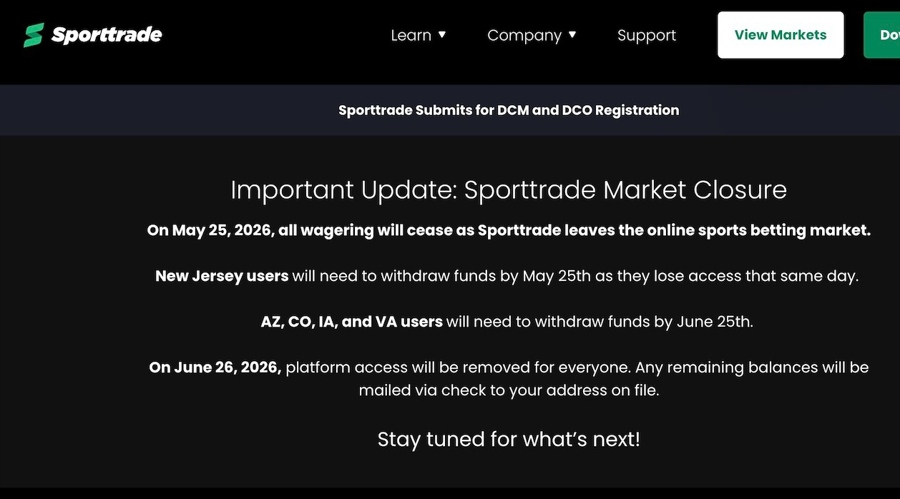
Sporttrade announcement. Screenshot from the official webiste

Sporttrade is shutting down its sportsbook operations in five U.S. states and applying for registration with the Commodity Futures Trading Commission as a derivatives exchange and clearinghouse.

Sports wagering in New Jersey, Arizona, Colorado, Iowa, and Virginia ends on May 25, 2026. Customers have until late June to withdraw their funds.

The company filed applications with the CFTC to become both a Designated Contract Market (DCM) and Derivatives Clearing Organization (DCO) in February 2026. Instead of operating under state betting licenses, Sporttrade wants to move into the federal framework used for derivatives and event contracts.

The economics behind that decision are fairly simple. State-by-state licensing is expensive, fragmented, and tied to gambling regulation. Under CFTC oversight, similar products can instead be structured as event contracts or swaps.

“The CFTC’s market-based regulatory framework enables Sporttrade to provide market participants an elevated level of efficiency, transparency, and consumer protection relative to what we’ve been able to offer to date,” founder and CEO Alex Kane said when the company submitted its applications.

From Sportsbook Operator to Exchange Model

Sporttrade originally tried to differentiate itself from traditional sportsbooks by using exchange-style mechanics. Users could buy and sell positions during events rather than place fixed-odds wagers and wait for settlement.

But competing directly against FanDuel and DraftKings in the state-regulated sportsbook market remained difficult. Both companies are now also moving into prediction markets and event contracts through CFTC-linked structures. DraftKings launched DraftKings Predictions in December 2025; around the same time FanDuel partnered with CME Group to launch FanDuel Predicts.

Sporttrade is taking a more direct approach by attempting to leave the sportsbook category entirely and operate under financial market regulation instead. That transition is still subject to regulatory approval.

The CFTC recently opened a broader review of event contracts, while some state regulators and lawmakers continue pushing for restrictions on sports-related prediction markets.

What Brokers and Exchanges May Take from This

Sporttrade decision highlights the practical trade-offs: federal derivatives regulation offers unified market access, while state gaming licenses mean fragmented compliance across 30+ jurisdictions.

Building a regulated exchange and clearinghouse is expensive and time-consuming. DCM and DCO approvals can take months or years, depending on the application and regulatory environment.

At the same time, companies operating under the federal framework avoid the complexity of maintaining licenses across dozens of states. They also gain access to a regulatory structure that looks closer to financial markets than traditional sports betting.

Sporttrade's willingness to shut down revenue-generating operations for regulatory repositioning signals confidence that CFTC approval is more valuable than state-by-state expansion.

Sporttrade is shutting down its sportsbook operations in five U.S. states and applying for registration with the Commodity Futures Trading Commission as a derivatives exchange and clearinghouse.

Sports wagering in New Jersey, Arizona, Colorado, Iowa, and Virginia ends on May 25, 2026. Customers have until late June to withdraw their funds.

The company filed applications with the CFTC to become both a Designated Contract Market (DCM) and Derivatives Clearing Organization (DCO) in February 2026. Instead of operating under state betting licenses, Sporttrade wants to move into the federal framework used for derivatives and event contracts.

The economics behind that decision are fairly simple. State-by-state licensing is expensive, fragmented, and tied to gambling regulation. Under CFTC oversight, similar products can instead be structured as event contracts or swaps.

“The CFTC’s market-based regulatory framework enables Sporttrade to provide market participants an elevated level of efficiency, transparency, and consumer protection relative to what we’ve been able to offer to date,” founder and CEO Alex Kane said when the company submitted its applications.

From Sportsbook Operator to Exchange Model

Sporttrade originally tried to differentiate itself from traditional sportsbooks by using exchange-style mechanics. Users could buy and sell positions during events rather than place fixed-odds wagers and wait for settlement.

But competing directly against FanDuel and DraftKings in the state-regulated sportsbook market remained difficult. Both companies are now also moving into prediction markets and event contracts through CFTC-linked structures. DraftKings launched DraftKings Predictions in December 2025; around the same time FanDuel partnered with CME Group to launch FanDuel Predicts.

Sporttrade is taking a more direct approach by attempting to leave the sportsbook category entirely and operate under financial market regulation instead. That transition is still subject to regulatory approval.

The CFTC recently opened a broader review of event contracts, while some state regulators and lawmakers continue pushing for restrictions on sports-related prediction markets.

What Brokers and Exchanges May Take from This

Sporttrade decision highlights the practical trade-offs: federal derivatives regulation offers unified market access, while state gaming licenses mean fragmented compliance across 30+ jurisdictions.

Building a regulated exchange and clearinghouse is expensive and time-consuming. DCM and DCO approvals can take months or years, depending on the application and regulatory environment.

At the same time, companies operating under the federal framework avoid the complexity of maintaining licenses across dozens of states. They also gain access to a regulatory structure that looks closer to financial markets than traditional sports betting.

Sporttrade's willingness to shut down revenue-generating operations for regulatory repositioning signals confidence that CFTC approval is more valuable than state-by-state expansion.

About the Author: Tanya Chepkova
Tanya Chepkova
  • 207 Articles
About the Author: Tanya Chepkova
Tanya Chepkova is a News Editor at Finance Magnates with more than 16 years of experience in financial journalism, covering forex, crypto, and digital asset markets. Her work spans daily industry reporting and data-driven, long-form explainers focused on market structure, trading models, and regulatory shifts. Before joining Finance Magnates, she led the editorial team of a cryptocurrency-focused media outlet for six years. Her reporting combines analytical depth with clear storytelling, with particular attention to how structural changes in trading, stablecoin infrastructure, and emerging products such as prediction markets reshape the broader financial ecosystem. She covers global developments and provides additional insight into CIS markets. Areas of Coverage: Crypto and digital asset markets Prediction markets Stablecoins and cross-border payments Industry analysis and long-form explainers
  • 207 Articles

More from the Author

Retail FX

!"#$%&'()*+,-./0123456789:;<=>?@ABCDEFGHIJKLMNOPQRSTUVWXYZ[\]^_`abcdefghijklmnopqrstuvwxyz{|} !"#$%&'()*+,-./0123456789:;<=>?@ABCDEFGHIJKLMNOPQRSTUVWXYZ[\]^_`abcdefghijklmnopqrstuvwxyz{|}