At the Vision Stage, panelists described the current phase as “industrial rewiring,” with infrastructure being built to support institutional participation at scale.
Adoption in APAC is still growing, though regulatory fragmentation across jurisdictions continues to hinder seamless expansion.
Watch the full video below.
Digital assets are no longer stuck in a “crypto winter” so
much as a period of industrial rewiring, according to panelists at the FM
Singapore Summit 2026, who said the sector is increasingly being shaped by
banks, custodians and institutional allocators rather than the speculative
traders who dominated earlier cycles.
The discussion painted a picture of a market that is still
fragmented and cautious, but also more regulated, more connected and more
useful to mainstream finance than it was even a few years ago.
Market Winter, Not Market Death
The panel, titled “Buying the Deep: Digital Asset Adoption
in APAC and Beyond,” centered on whether the latest downturn has stalled
adoption or merely changed its form.
It brought together David Jenkins, the Chief
Product and Technology Officer at Openmarkets Group, Chris Knight, the Managing
Director of LMAX Digital, Andrew Leelarthaepin the Head of Business Product Maybank
Investment Banking Group, Luke Boland, the Head of Fintech at Standard Chartered, Karl Mohan, the EVP for
Financial Services and Crypto.com, and Zann
Kwan, the Managing Partner and Chief Investment Officer of REVO.
Knight argued that the industry is not in hibernation at all, but undergoing
a hard rewiring as banks and market infrastructure providers build the
plumbing needed for institutional participation.
Leelarthaepin of Maybank Investment Banking said
digital asset adoption in Asia-Pacific is still growing, but warned that the
region’s many regulatory regimes remain a practical obstacle. Karl Mohan of
Crypto.com framed the shift more bluntly: in his view, the old “cowboys” and
arbitrage-heavy business models that flourished in the 2021 bull market have
largely disappeared, replaced by a more serious, institution-led market.
What Institutions Want
A recurring theme was that the next phase of adoption will
depend less on hype and more on operational efficiency. Panelists repeatedly
highlighted custody, connectivity, settlement and collateral management as the
real bottlenecks holding the market back.
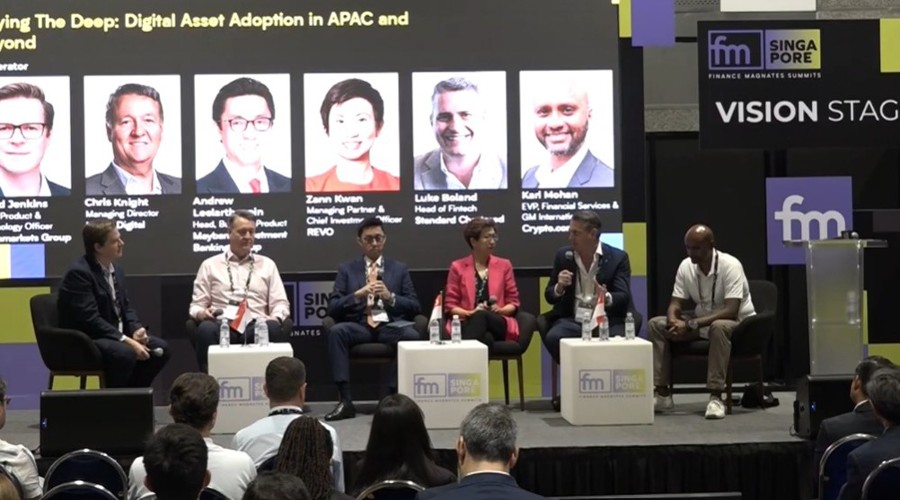
From left: David Jenkins, Chris Knight, Andrew Leelarthaepin, Zann Kwan, Luke Boland, and Karl Mohan
Knight said credit risk remains one of the biggest
unresolved issues, adding that large institutions still need clearer central
clearing and stronger counterparty structures before they can participate at
scale.
Boland said the industry is already seeing practical use
cases move into production, including collateral mirroring with tokenized money
market funds in the UAE, which he said the bank plans to roll out in other
custody markets.
He also argued that stablecoins have become an important
settlement layer because they make money movement faster and more flexible,
particularly in a 24/7 market.
Stablecoins as Capital Tools
If one message cut through the discussion, it was that
stablecoins are no longer just a payment story. Mohan said their real value
lies in “capital efficiency,” allowing traders and funds to move collateral
quickly and stay active over weekends and outside traditional banking hours.
Knight used a vivid comparison, saying stablecoins are like
sending an email while fiat still feels like mailing a letter and waiting for
the post office to open.
Zann Kwan, managing partner and chief investment officer at
REVO, said many allocators had reduced risk exposure after a difficult year,
but still held stablecoins and could redeploy capital with “a click of a
button” when conditions improved.
She said the market had shifted from broad exposure across
dozens of tokens to a narrower focus on top assets, even as pockets of activity
continued in derivatives, tokenized products and M&A.
Regulation and Regional Momentum
The panel was notably upbeat about regulatory progress in
Asia-Pacific and the Middle East, even while acknowledging the patchwork nature
of local rules. Mohan said the days of setting up in offshore jurisdictions and
servicing the world from there are over, because major markets now have some
form of regulatory framework.
He argued that once the US fully settles its own rules,
other markets will be forced to follow because capital tends to move toward the
largest and most liquid venues.
Leelarthaepin said regional regulators have been
progressively more open to innovation, citing Singapore, Hong Kong, Japan and
the Philippines as examples of jurisdictions that have built workable paths for
digital assets. Still, he said fragmentation remains a challenge for large
institutions operating across multiple markets, with compliance requirements
often varying from one jurisdiction to another.
Human Stories and Anecdotes
The panel also offered several personal moments that
underscored how far the industry has come. Kwan recalled that, a decade ago,
even her daughter’s bank account had been shut down because of her family’s
involvement in crypto, making it difficult to handle even basic expenses such
as school fees. She said the fact that banking access is now far less hostile
marks an important form of progress for the industry.
The discussion suggested that digital assets are entering a
more mature phase in which infrastructure, compliance and utility matter more
than pure speculation.
Banks and institutions are increasingly treating the asset
class as part of a broader financial toolkit, whether for investment exposure,
treasury management or faster collateral deployment. That does not mean the
market has solved its structural problems, but it does suggest the industry is
moving from experimentation to integration.
For APAC in particular, the panel’s message was that the
region has a real chance to remain at the forefront if regulators and market
participants continue building practical rails for institutional use. The next
cycle, they implied, may not be about whether digital assets survive. It will
be about which firms can make them work in everyday finance.
Digital assets are no longer stuck in a “crypto winter” so
much as a period of industrial rewiring, according to panelists at the FM
Singapore Summit 2026, who said the sector is increasingly being shaped by
banks, custodians and institutional allocators rather than the speculative
traders who dominated earlier cycles.
The discussion painted a picture of a market that is still
fragmented and cautious, but also more regulated, more connected and more
useful to mainstream finance than it was even a few years ago.
Market Winter, Not Market Death
The panel, titled “Buying the Deep: Digital Asset Adoption
in APAC and Beyond,” centered on whether the latest downturn has stalled
adoption or merely changed its form.
It brought together David Jenkins, the Chief
Product and Technology Officer at Openmarkets Group, Chris Knight, the Managing
Director of LMAX Digital, Andrew Leelarthaepin the Head of Business Product Maybank
Investment Banking Group, Luke Boland, the Head of Fintech at Standard Chartered, Karl Mohan, the EVP for
Financial Services and Crypto.com, and Zann
Kwan, the Managing Partner and Chief Investment Officer of REVO.
Knight argued that the industry is not in hibernation at all, but undergoing
a hard rewiring as banks and market infrastructure providers build the
plumbing needed for institutional participation.
Leelarthaepin of Maybank Investment Banking said
digital asset adoption in Asia-Pacific is still growing, but warned that the
region’s many regulatory regimes remain a practical obstacle. Karl Mohan of
Crypto.com framed the shift more bluntly: in his view, the old “cowboys” and
arbitrage-heavy business models that flourished in the 2021 bull market have
largely disappeared, replaced by a more serious, institution-led market.
What Institutions Want
A recurring theme was that the next phase of adoption will
depend less on hype and more on operational efficiency. Panelists repeatedly
highlighted custody, connectivity, settlement and collateral management as the
real bottlenecks holding the market back.
From left: David Jenkins, Chris Knight, Andrew Leelarthaepin, Zann Kwan, Luke Boland, and Karl Mohan
Knight said credit risk remains one of the biggest
unresolved issues, adding that large institutions still need clearer central
clearing and stronger counterparty structures before they can participate at
scale.
Boland said the industry is already seeing practical use
cases move into production, including collateral mirroring with tokenized money
market funds in the UAE, which he said the bank plans to roll out in other
custody markets.
He also argued that stablecoins have become an important
settlement layer because they make money movement faster and more flexible,
particularly in a 24/7 market.
Stablecoins as Capital Tools
If one message cut through the discussion, it was that
stablecoins are no longer just a payment story. Mohan said their real value
lies in “capital efficiency,” allowing traders and funds to move collateral
quickly and stay active over weekends and outside traditional banking hours.
Knight used a vivid comparison, saying stablecoins are like
sending an email while fiat still feels like mailing a letter and waiting for
the post office to open.
Zann Kwan, managing partner and chief investment officer at
REVO, said many allocators had reduced risk exposure after a difficult year,
but still held stablecoins and could redeploy capital with “a click of a
button” when conditions improved.
She said the market had shifted from broad exposure across
dozens of tokens to a narrower focus on top assets, even as pockets of activity
continued in derivatives, tokenized products and M&A.
Regulation and Regional Momentum
The panel was notably upbeat about regulatory progress in
Asia-Pacific and the Middle East, even while acknowledging the patchwork nature
of local rules. Mohan said the days of setting up in offshore jurisdictions and
servicing the world from there are over, because major markets now have some
form of regulatory framework.
He argued that once the US fully settles its own rules,
other markets will be forced to follow because capital tends to move toward the
largest and most liquid venues.
Leelarthaepin said regional regulators have been
progressively more open to innovation, citing Singapore, Hong Kong, Japan and
the Philippines as examples of jurisdictions that have built workable paths for
digital assets. Still, he said fragmentation remains a challenge for large
institutions operating across multiple markets, with compliance requirements
often varying from one jurisdiction to another.
Human Stories and Anecdotes
The panel also offered several personal moments that
underscored how far the industry has come. Kwan recalled that, a decade ago,
even her daughter’s bank account had been shut down because of her family’s
involvement in crypto, making it difficult to handle even basic expenses such
as school fees. She said the fact that banking access is now far less hostile
marks an important form of progress for the industry.
The discussion suggested that digital assets are entering a
more mature phase in which infrastructure, compliance and utility matter more
than pure speculation.
Banks and institutions are increasingly treating the asset
class as part of a broader financial toolkit, whether for investment exposure,
treasury management or faster collateral deployment. That does not mean the
market has solved its structural problems, but it does suggest the industry is
moving from experimentation to integration.
For APAC in particular, the panel’s message was that the
region has a real chance to remain at the forefront if regulators and market
participants continue building practical rails for institutional use. The next
cycle, they implied, may not be about whether digital assets survive. It will
be about which firms can make them work in everyday finance.
Jared Kirui is an Editor at Finance Magnates with more than five years of experience in financial journalism. He covers online trading, fintech, payments, and crypto industries with a focus on companies, regulation and compliance, executive moves, trading technology, and market analysis.
His work has been featured in other media outlets, including Benzinga, ZyCrypto, The Distributed, and The Daily Hodl.
Education:
Bachelor of Commerce degree (Finance option), University of Nairobi
Cyprus Digital Marketing Summit 2026: Global Brands, CMOs and Innovators Meet in Larnaca
Featured Videos
FM Daily Brief – 23 June 2026
Today’s Tuesday, the 23rd of June 2026, and these are our main stories: Capital.com enters South Africa with dual local licences, CMC Markets launches a native AI engine for investors, and Plus500 joins the race for 24/5 trading.
Today’s Monday, the 22nd of June 2026, and these are our main stories: The operator of FXCM is likely facing a bidding war, Dukascopy’s new all-in-one mobile banking and trading app, and Bitget’s launch of real US stock ownership through its Stock plus feature.
FM Daily Brief – 19 June 2026
Today’s Friday, the 19th of June 2026, and these are our main stories: Australia’s ASIC scam losses and whitelist push, Singapore adding Bybit to its alert list, and Cyprus broker executives arrested in Moscow.
FM Daily Brief – 18 June 2026
Today is Thursday, the eighteenth of June 2026, and these are our main stories: CME Group is taking the CFTC to court over crypto perpetual futures, the Polish retail trading market is cooling, and Coinbase doubles down on global asset expansion.
FM Daily Brief – 17 June 2026
Today’s Wednesday, the 17th of June 2026 and these are our main stories: Robinhood cuts around two hundred ninety jobs while still hiring, Binance against the clock in Europe, and Australia's whitelist against scam clones.