“Prop Firms Are Becoming Brokers, Brokers Are Becoming Prop Firms”: What FM Singapore Summit 2026 Revealed

Friday, 03/07/2026 | 16:35 GMT by Jared Kirui
  • APAC now accounts for over 30% of global prop trading activity, but much of the growth comes from high-volume.
  • In markets where CFDs are banned, like India, prop firms act as a workaround.
  • Watch the full video below.

The rapid rise of proprietary trading firms in Asia-Pacific is masking a more uneven reality beneath headline growth, as operators grapple with low-value retail flows, regulatory ambiguity, and a fragmented regional landscape.

That was the central message from a panel at the Finance Magnates Singapore Summit 2026, where industry executives debated whether APAC’s prop trading boom reflects sustainable expansion or a regulatory grey zone ripe for disruption.

Growth Without Depth

APAC now accounts for a significant share of glof1qbal prop trading activity—more than 30%, according to Lubomir Marasi, Commercial Director at Axcera, but much of that growth is concentrated in high-volume, low-value markets.

“India dominates the flow,” Marasi said, noting that while user numbers are large, “the average client… spends around $150 per challenge.” By contrast, traders in more developed markets such as Singapore or Taiwan spend closer to $700, highlighting a stark divide between participation and monetization.

Jakub Roz, CEO of For Traders, framed this as a structural challenge. “For us as an operator, it’s fundamentally a different business to run high volume, low value versus low volume, high value,” he said, pointing to higher support, infrastructure, and acquisition costs tied to mass-market segments.

Continue reading: “The Mistake Is Treating Loyalty as a Reward Layer When It Should Be a Growth Engine”: FM Singapore Summit 2026 Focus

The disparity underscores a key theme of the discussion: headline signup growth in APAC does not necessarily translate into meaningful funded trader activity or sustainable revenue.

Regulation Lags Innovation

Despite its growth, prop trading remains largely unregulated globally, a point both speakers emphasized. Roz described the model as “pure demo trading… more like a trading simulator than real trading,” which allows firms to operate across jurisdictions more freely than traditional brokers.
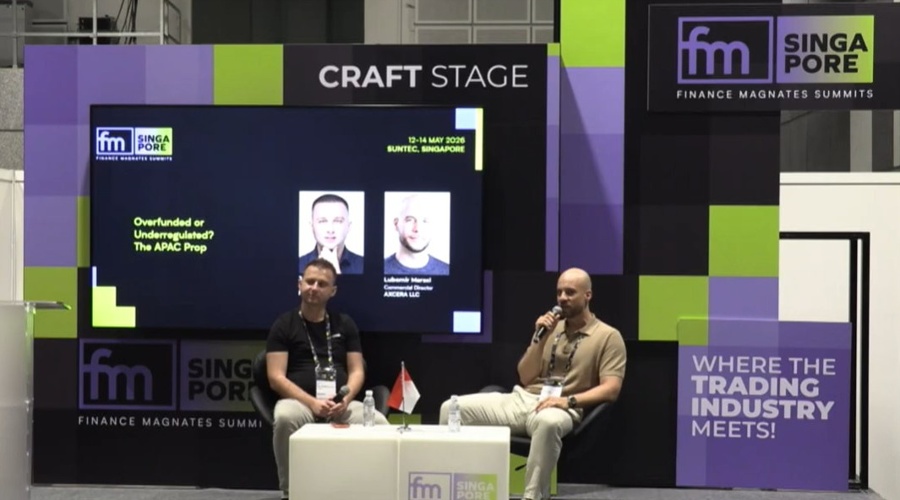
From left: Jakub Roz, the CEO of For Traders, Lubomir Marasi, the Commercial Director at Axcera LLC

This regulatory gap has created opportunities—particularly in markets where leveraged trading is restricted. In India, where CFDs are banned, prop firms have effectively stepped in as an alternative route to market exposure.

“No local regulators are chasing prop firms as of now,” Marasi observed, adding that this dynamic has enabled firms to “bridge the gap” left by regulatory constraints.

However, the workaround extends beyond market access into payments infrastructure. In stricter jurisdictions, crypto has become the dominant payout rail. “The majority of payouts are withdrawn by crypto rails,” Marasi said, reflecting both regulatory limitations and the region’s broader digital asset adoption.

A Fragmented, Mobile-First Market

Panelists highlighted the operational complexity of scaling across APAC, where language barriers, cultural differences, and uneven financial literacy complicate expansion.

“The APAC region… doesn’t know and doesn’t understand prop trading,” Marasi said, stressing the need for significant user education. Roz echoed this, noting that in markets such as Vietnam, language isolation limits exposure to global platforms and comparison tools.

Customer acquisition strategies also diverge sharply from Western markets. With restrictions on financial advertising in countries like India, firms rely more heavily on community-driven and organic channels rather than paid media.

At the same time, trading behavior differs markedly. According to Roz, “74% of traders from APAC… are trading just gold,” with limited engagement in US indices—a staple in Western markets. Crypto, however, is gaining traction, driven by regional demand and the entry of exchanges into the prop space.

Blurring Lines Between Brokers and Prop Firms

One of the more notable shifts discussed was the convergence between prop firms and traditional brokers.

“We are seeing that prop firms are now becoming brokers, and brokers are entering the prop firm space,” Marasi said, attributing this partly to infrastructure needs such as access to platforms like MetaTrader.

Both speakers suggested the distinction may eventually disappear altogether. Prop firms are increasingly viewed as acquisition funnels for younger traders, particularly those aged 18 to 25, who may later transition into fully funded brokerage clients.

“It could be a great lead generation tool,” Marasi said, describing how firms can build early relationships with traders before they accumulate significant capital.

Continue reading: “The Question Is No Longer If You Hold Gold, but How and Where You Hold It”: Topics from FM Singapore Summit 2026

Roz outlined a similar lifecycle strategy, from free trading tournaments to paid challenges and eventually live trading accounts. His firm runs monthly competitions with more than 50,000 participants, using gamification as both an onboarding and retention mechanism.

Saturation, or Untapped Opportunity?

While the global prop trading market is often described as crowded—with more than 500 firms in operation—panelists disagreed on whether APAC fits that narrative.

Roz argued the industry is “extremely saturated,” with many firms failing to meet operational standards. Marasi countered that saturation is largely confined to mature markets such as the US and Europe. “I think APAC is a gold mine,” he said. “Once there’s a group who can do the business right… this could be huge.”

Yet unlocking that potential will require local expertise. Both speakers emphasized that firms headquartered in Europe or the Middle East often lack the cultural and linguistic understanding needed to succeed in Asia.

“The future is having a local presence,” Marasi said, predicting that regional specialization—long a hallmark of brokerage expansion, will become essential in prop trading as well.

An Industry at a Crossroads

The discussion ultimately pointed to an industry in transition. Rapid growth, driven by regulatory arbitrage and retail demand, is colliding with rising expectations around transparency, sustainability, and user protection.

“There has been a lot of drama… a lot of prop firms… closed the shop,” Marasi noted, referencing past failures and “rug pulls” that have dented trust in the sector.

In the absence of formal oversight, larger firms and technology providers are increasingly taking it upon themselves to impose standards. “We need to regulate the business, even though it’s unregulated,” he said.

Whether APAC becomes the next engine of prop trading growth—or exposes the fragility of its current model—will depend on how effectively the industry navigates that tension between scale and structure.

The rapid rise of proprietary trading firms in Asia-Pacific is masking a more uneven reality beneath headline growth, as operators grapple with low-value retail flows, regulatory ambiguity, and a fragmented regional landscape.

That was the central message from a panel at the Finance Magnates Singapore Summit 2026, where industry executives debated whether APAC’s prop trading boom reflects sustainable expansion or a regulatory grey zone ripe for disruption.

Growth Without Depth

APAC now accounts for a significant share of glof1qbal prop trading activity—more than 30%, according to Lubomir Marasi, Commercial Director at Axcera, but much of that growth is concentrated in high-volume, low-value markets.

“India dominates the flow,” Marasi said, noting that while user numbers are large, “the average client… spends around $150 per challenge.” By contrast, traders in more developed markets such as Singapore or Taiwan spend closer to $700, highlighting a stark divide between participation and monetization.

Jakub Roz, CEO of For Traders, framed this as a structural challenge. “For us as an operator, it’s fundamentally a different business to run high volume, low value versus low volume, high value,” he said, pointing to higher support, infrastructure, and acquisition costs tied to mass-market segments.

Continue reading: “The Mistake Is Treating Loyalty as a Reward Layer When It Should Be a Growth Engine”: FM Singapore Summit 2026 Focus

The disparity underscores a key theme of the discussion: headline signup growth in APAC does not necessarily translate into meaningful funded trader activity or sustainable revenue.

Regulation Lags Innovation

Despite its growth, prop trading remains largely unregulated globally, a point both speakers emphasized. Roz described the model as “pure demo trading… more like a trading simulator than real trading,” which allows firms to operate across jurisdictions more freely than traditional brokers.

From left: Jakub Roz, the CEO of For Traders, Lubomir Marasi, the Commercial Director at Axcera LLC

This regulatory gap has created opportunities—particularly in markets where leveraged trading is restricted. In India, where CFDs are banned, prop firms have effectively stepped in as an alternative route to market exposure.

“No local regulators are chasing prop firms as of now,” Marasi observed, adding that this dynamic has enabled firms to “bridge the gap” left by regulatory constraints.

However, the workaround extends beyond market access into payments infrastructure. In stricter jurisdictions, crypto has become the dominant payout rail. “The majority of payouts are withdrawn by crypto rails,” Marasi said, reflecting both regulatory limitations and the region’s broader digital asset adoption.

A Fragmented, Mobile-First Market

Panelists highlighted the operational complexity of scaling across APAC, where language barriers, cultural differences, and uneven financial literacy complicate expansion.

“The APAC region… doesn’t know and doesn’t understand prop trading,” Marasi said, stressing the need for significant user education. Roz echoed this, noting that in markets such as Vietnam, language isolation limits exposure to global platforms and comparison tools.

Customer acquisition strategies also diverge sharply from Western markets. With restrictions on financial advertising in countries like India, firms rely more heavily on community-driven and organic channels rather than paid media.

At the same time, trading behavior differs markedly. According to Roz, “74% of traders from APAC… are trading just gold,” with limited engagement in US indices—a staple in Western markets. Crypto, however, is gaining traction, driven by regional demand and the entry of exchanges into the prop space.

Blurring Lines Between Brokers and Prop Firms

One of the more notable shifts discussed was the convergence between prop firms and traditional brokers.

“We are seeing that prop firms are now becoming brokers, and brokers are entering the prop firm space,” Marasi said, attributing this partly to infrastructure needs such as access to platforms like MetaTrader.

Both speakers suggested the distinction may eventually disappear altogether. Prop firms are increasingly viewed as acquisition funnels for younger traders, particularly those aged 18 to 25, who may later transition into fully funded brokerage clients.

“It could be a great lead generation tool,” Marasi said, describing how firms can build early relationships with traders before they accumulate significant capital.

Continue reading: “The Question Is No Longer If You Hold Gold, but How and Where You Hold It”: Topics from FM Singapore Summit 2026

Roz outlined a similar lifecycle strategy, from free trading tournaments to paid challenges and eventually live trading accounts. His firm runs monthly competitions with more than 50,000 participants, using gamification as both an onboarding and retention mechanism.

Saturation, or Untapped Opportunity?

While the global prop trading market is often described as crowded—with more than 500 firms in operation—panelists disagreed on whether APAC fits that narrative.

Roz argued the industry is “extremely saturated,” with many firms failing to meet operational standards. Marasi countered that saturation is largely confined to mature markets such as the US and Europe. “I think APAC is a gold mine,” he said. “Once there’s a group who can do the business right… this could be huge.”

Yet unlocking that potential will require local expertise. Both speakers emphasized that firms headquartered in Europe or the Middle East often lack the cultural and linguistic understanding needed to succeed in Asia.

“The future is having a local presence,” Marasi said, predicting that regional specialization—long a hallmark of brokerage expansion, will become essential in prop trading as well.

An Industry at a Crossroads

The discussion ultimately pointed to an industry in transition. Rapid growth, driven by regulatory arbitrage and retail demand, is colliding with rising expectations around transparency, sustainability, and user protection.

“There has been a lot of drama… a lot of prop firms… closed the shop,” Marasi noted, referencing past failures and “rug pulls” that have dented trust in the sector.

In the absence of formal oversight, larger firms and technology providers are increasingly taking it upon themselves to impose standards. “We need to regulate the business, even though it’s unregulated,” he said.

Whether APAC becomes the next engine of prop trading growth—or exposes the fragility of its current model—will depend on how effectively the industry navigates that tension between scale and structure.

About the Author: Jared Kirui
Jared Kirui
  • 2874 Articles
  • 55 Followers
About the Author: Jared Kirui
Jared Kirui is an Editor at Finance Magnates with more than five years of experience in financial journalism. He covers online trading, fintech, payments, and crypto industries with a focus on companies, regulation and compliance, executive moves, trading technology, and market analysis. His work has been featured in other media outlets, including Benzinga, ZyCrypto, The Distributed, and The Daily Hodl. Education: Bachelor of Commerce degree (Finance option), University of Nairobi
  • 2874 Articles
  • 55 Followers

More from the Author

FM-Events

!"#$%&'()*+,-./0123456789:;<=>?@ABCDEFGHIJKLMNOPQRSTUVWXYZ[\]^_`abcdefghijklmnopqrstuvwxyz{|} !"#$%&'()*+,-./0123456789:;<=>?@ABCDEFGHIJKLMNOPQRSTUVWXYZ[\]^_`abcdefghijklmnopqrstuvwxyz{|}