“If You Have a Limited Acquisition Budget in APAC, Start by Finding Synergies”: FM Singapore Summit 2026 Insights

Monday, 06/07/2026 | 17:43 GMT by Jared Kirui
  • Market fragmentation across languages, payment rails and media ecosystems makes simple translation inadequate.
  • IB networks still dominate acquisition in much of Southeast Asia, helped by regulatory fragmentation that lets large brokers keep distance.
  • Watch the full video below.

Tony Cross, a veteran PR strategist who has advised brokers across Europe and Asia since the early 2000s, told a packed room at the FM Singapore Summit 2026 that the Asian-Pacific (APAC) retail trading market is simultaneously the largest opportunity and one of the toughest to crack.

In a wide-ranging conversation on July 6 titled “Beyond Reach? Retail Investor Acquisition Across APAC,” Cross argued that fragmentation, misplaced reliance on short-term performance marketing and a collapsing attention economy have made customer acquisition harder, not easier, despite better technology.

Continue reading: “Prop Firms Are Becoming Brokers, Brokers Are Becoming Prop Firms”: What FM Singapore Summit 2026 Revealed

Localization and IBs Win in APAC.

“Trust was so much easier to build” when clients visited physical offices, Cross said, describing an era when personal relationships and visible counterparty presence reduced friction in acquisition. Today, he warned, “everyone is a publisher” and the exponential growth of content has made discoverability and credibility scarcer commodities. “If everyone can generate infinite content at almost zero cost, does trust become the real scarce asset at the moment? Absolutely,” he said.
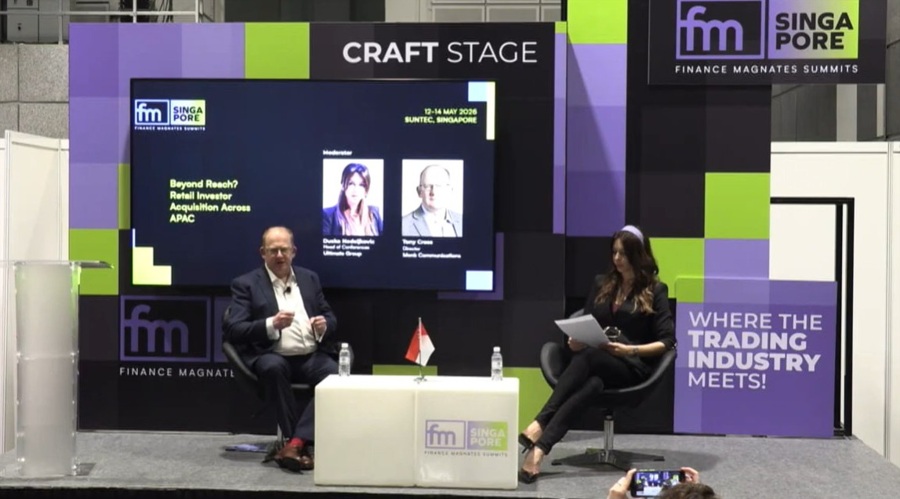
From left: Tony Cross, Duska Nedeljkovic

Fragmentation and localization: Cross emphasized the complexity of APAC markets where language, payment rails and media ecosystems vary widely. Simple translation is insufficient: “There are so many nuances — what lot size they want, what base currency they want to use,” he said. Local partners, notably introducing brokers (IBs), remain vital because they understand on-the-ground trading habits and local nuances.

IBs Bridge Fragmented Markets

The continuing pull of IB networks: Despite regulatory and reputational risks, IBs still dominate acquisition in much of Southeast Asia. Cross suggested that regulatory fragmentation is paradoxically part of their success: it permits large brokers to maintain an “arm’s length relationship into the territory” while IBs build tight communities and serve as the interface with small but valuable retail clients.

The limits of performance marketing: A recurring critique was the industry’s fixation on traceable, short-term customer-acquisition metrics. “They feel quite annoyed that we can’t drill back to the same level of detail to say that has cost X and given a CPA of Y,” Cross said, advocating longer‑term investment in brand, PR and education to build durable trust.

Keep reading: “The Mistake Is Treating Loyalty as a Reward Layer When It Should Be a Growth Engine”: FM Singapore Summit 2026 Focus

Content, AI and the discoverability problem: With content volumes surging, Cross noted that advances in large language models (LLMs) and search are reshaping what surfaces to users. He argued LLMs increasingly favour uniquely authored, trustworthy content over mass-produced AI output. “If you haven’t got the trust in the LLM, or the LLM hasn’t got trust in your brand, you’re never going to be able to populate,” Cross warned.

Notable Moments and Practical Advice

Cross urged brokers to “look bigger” than product features when trying to win local trust. That could mean CSR initiatives, financial education programs, or media-friendly campaigns that build profile without triggering regulatory sensitivities in controlled media markets. “If you do that… they’re not talking about your product. So you move away from the regulation issue,” he said.

On Gen Z, Cross struck a nuanced tone: younger investors arrive earlier and are more willing to adopt challenger brands, but they are also exposed to low-quality “Fintalk” content on short-form platforms. “They see the potential,” he said, but added that the information quality is uneven and carries risk.

For a founder with a limited acquisition budget, Cross’s first-dollar recommendation was pragmatic: hire expertise, and look for consolidation opportunities. With markets crowded, “more than 100 brokers in Thailand working with IB networks”, he suggested acquisition or merging as a route to sensible scale and differentiation.

Broader Implications for the Industry

Cross’s diagnosis points to a market at an inflection point. Technology has lowered barriers to publishing and distribution, but that has intensified competition for attention and heightened the premium on credibility. Regulators and evolving AI search layers will both complicate and potentially help restore trust, he said: “As things move more onto the blockchain, you’re going to get that security. It’s about trust.”

That creates strategic choices for brokers: continue optimizing short-term CPAs through performance channels and IB networks, or invest in slower-burning reputation building — financial education, community projects and distinctive PR stunts — that could yield loyalty when markets wobble. Cross’s bottom line: in APAC’s fractured media and regulatory landscape, trust, not clicks, may determine the winners.

Tony Cross, a veteran PR strategist who has advised brokers across Europe and Asia since the early 2000s, told a packed room at the FM Singapore Summit 2026 that the Asian-Pacific (APAC) retail trading market is simultaneously the largest opportunity and one of the toughest to crack.

In a wide-ranging conversation on July 6 titled “Beyond Reach? Retail Investor Acquisition Across APAC,” Cross argued that fragmentation, misplaced reliance on short-term performance marketing and a collapsing attention economy have made customer acquisition harder, not easier, despite better technology.

Continue reading: “Prop Firms Are Becoming Brokers, Brokers Are Becoming Prop Firms”: What FM Singapore Summit 2026 Revealed

Localization and IBs Win in APAC.

“Trust was so much easier to build” when clients visited physical offices, Cross said, describing an era when personal relationships and visible counterparty presence reduced friction in acquisition. Today, he warned, “everyone is a publisher” and the exponential growth of content has made discoverability and credibility scarcer commodities. “If everyone can generate infinite content at almost zero cost, does trust become the real scarce asset at the moment? Absolutely,” he said.

From left: Tony Cross, Duska Nedeljkovic

Fragmentation and localization: Cross emphasized the complexity of APAC markets where language, payment rails and media ecosystems vary widely. Simple translation is insufficient: “There are so many nuances — what lot size they want, what base currency they want to use,” he said. Local partners, notably introducing brokers (IBs), remain vital because they understand on-the-ground trading habits and local nuances.

IBs Bridge Fragmented Markets

The continuing pull of IB networks: Despite regulatory and reputational risks, IBs still dominate acquisition in much of Southeast Asia. Cross suggested that regulatory fragmentation is paradoxically part of their success: it permits large brokers to maintain an “arm’s length relationship into the territory” while IBs build tight communities and serve as the interface with small but valuable retail clients.

The limits of performance marketing: A recurring critique was the industry’s fixation on traceable, short-term customer-acquisition metrics. “They feel quite annoyed that we can’t drill back to the same level of detail to say that has cost X and given a CPA of Y,” Cross said, advocating longer‑term investment in brand, PR and education to build durable trust.

Keep reading: “The Mistake Is Treating Loyalty as a Reward Layer When It Should Be a Growth Engine”: FM Singapore Summit 2026 Focus

Content, AI and the discoverability problem: With content volumes surging, Cross noted that advances in large language models (LLMs) and search are reshaping what surfaces to users. He argued LLMs increasingly favour uniquely authored, trustworthy content over mass-produced AI output. “If you haven’t got the trust in the LLM, or the LLM hasn’t got trust in your brand, you’re never going to be able to populate,” Cross warned.

Notable Moments and Practical Advice

Cross urged brokers to “look bigger” than product features when trying to win local trust. That could mean CSR initiatives, financial education programs, or media-friendly campaigns that build profile without triggering regulatory sensitivities in controlled media markets. “If you do that… they’re not talking about your product. So you move away from the regulation issue,” he said.

On Gen Z, Cross struck a nuanced tone: younger investors arrive earlier and are more willing to adopt challenger brands, but they are also exposed to low-quality “Fintalk” content on short-form platforms. “They see the potential,” he said, but added that the information quality is uneven and carries risk.

For a founder with a limited acquisition budget, Cross’s first-dollar recommendation was pragmatic: hire expertise, and look for consolidation opportunities. With markets crowded, “more than 100 brokers in Thailand working with IB networks”, he suggested acquisition or merging as a route to sensible scale and differentiation.

Broader Implications for the Industry

Cross’s diagnosis points to a market at an inflection point. Technology has lowered barriers to publishing and distribution, but that has intensified competition for attention and heightened the premium on credibility. Regulators and evolving AI search layers will both complicate and potentially help restore trust, he said: “As things move more onto the blockchain, you’re going to get that security. It’s about trust.”

That creates strategic choices for brokers: continue optimizing short-term CPAs through performance channels and IB networks, or invest in slower-burning reputation building — financial education, community projects and distinctive PR stunts — that could yield loyalty when markets wobble. Cross’s bottom line: in APAC’s fractured media and regulatory landscape, trust, not clicks, may determine the winners.

About the Author: Jared Kirui
Jared Kirui
  • 2876 Articles
  • 55 Followers
About the Author: Jared Kirui
Jared Kirui is an Editor at Finance Magnates with more than five years of experience in financial journalism. He covers online trading, fintech, payments, and crypto industries with a focus on companies, regulation and compliance, executive moves, trading technology, and market analysis. His work has been featured in other media outlets, including Benzinga, ZyCrypto, The Distributed, and The Daily Hodl. Education: Bachelor of Commerce degree (Finance option), University of Nairobi
  • 2876 Articles
  • 55 Followers

More from the Author

FM-Events

!"#$%&'()*+,-./0123456789:;<=>?@ABCDEFGHIJKLMNOPQRSTUVWXYZ[\]^_`abcdefghijklmnopqrstuvwxyz{|} !"#$%&'()*+,-./0123456789:;<=>?@ABCDEFGHIJKLMNOPQRSTUVWXYZ[\]^_`abcdefghijklmnopqrstuvwxyz{|}