
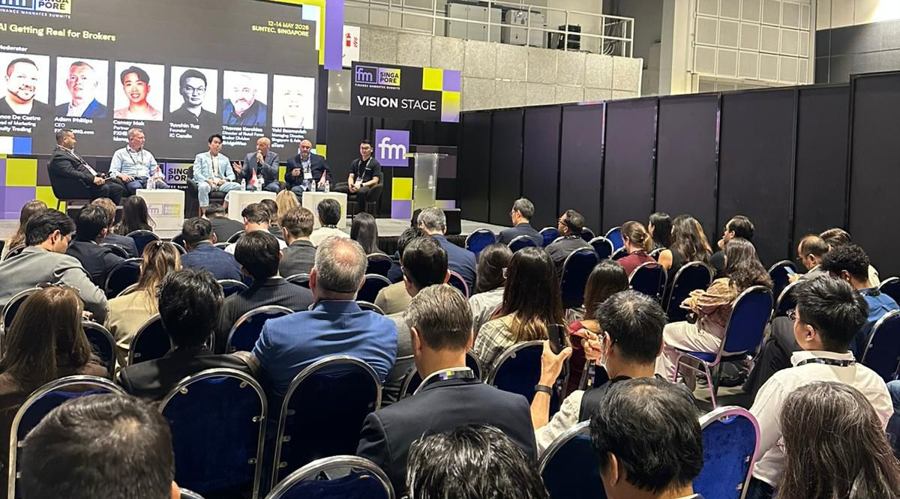
Day one of the FM Singapore Summit 2026 set a clear tone: market structure, not marketing slogans, is now at the center of the conversation in APAC finance. At Suntec Singapore, brokers, banks, fintech builders and liquidity specialists spent the opening day unpacking how trading is changing from the ground up.
Singapore Summit: Meet the largest APAC brokers you know (and those you still don't!).
On the expo floor, the rise of proprietary trading firms was impossible to miss. A sizeable portion of exhibitors focused on evaluation systems, risk controls and technology stacks designed specifically for prop models, signaling how “trade-as-a-service” has become a mature business line.
Among the many insights shared: Judy Goh from Integral led an insightful discussion on APAC bullion markets, emphasizing a key takeaway: bullion should not be treated as just another CFD product.
Related: “Our Job Is to Educate, Not Dictate”: FM Singapore Summit 2026 Begins Sessions
The panel, featuring Alexander Fergusson (Woodside), John Murillo (B2Broker), Alex Ho (CMC Markets), and Kway Guan Tan (World Gold Council), explored the practical realities of operating in modern physical metals markets.
Why Physical Metals Demand a Different Approach Than CFDs
Unlike CFDs, which are purely speculative instruments allowing traders to bet on price movements without ever taking possession of the underlying asset, physical bullion trading involves real-world complexities such as storage, insurance, transportation, delivery logistics, and varying purity standards across different markets.
In the APAC region specifically, these operational realities become even more critical as cultural preferences for physical gold ownership, regulatory frameworks around precious metals, and the infrastructure for vault storage and settlement differ significantly from Western markets.
A Cross-Cultural Journey in Global Markets
Spencer Campbell, Director at SE Asia Consulting, described his move from London to Singapore during the open outcry trading era, where clerks worked longer hours than traders and used physical trading cards—blue for buy orders and red for sell orders—similar to today’s electronic systems.
He also shared how his London trading symbol “F.U.N.” couldn’t be used in Singapore because it had an unintended meaning in Chinese, illustrating how small cultural differences can impact global trading environments.
𝗚𝗿𝗲𝗮𝘁 𝗖𝗼𝗻𝘃𝗲𝗿𝘀𝗮𝘁𝗶𝗼𝗻𝘀 𝗛𝗲𝗿𝗲 𝗮𝘁 𝗙𝗠 𝗦𝘂𝗺𝗺𝗶𝘁𝘀 𝗦𝗶𝗻𝗴𝗮𝗽𝗼𝗿𝗲
— BridgeWise (@BridgeWiseAI) May 13, 2026
Here at Finance Magnates Summit, we've had the opportunity to meet leaders from across the investment and trading ecosystem to discuss how BridgeWise and AI are shaping the future of… pic.twitter.com/M0aXaN2d9I
“I made the transition from London to Singapore 28 years ago because it was still open outcry and as a young junior clerk our days were much longer than the traders. They traded for the time that they were in the pit, they handed over.”
“What I brought with me today were our trading cards and as you can see here the front side is blue and the other side is red. Blue being our buy order, red being our sell order which you'll look familiar with the electronic trading screens today. But when I tried to come to Singapore and get the same trading symbol it wasn't allowed because in Chinese it means rice. It's the little things. It's the little things, yeah.”
At the Vision Stage, Luke Boland, Global Head of Fintech at Standard Chartered Singapore, joined a panel of industry experts titled “Buying the Deep: Digital Asset Adoption in APAC and Beyond,” where they explored how current market dynamics are influencing long-term strategies and highlighted opportunities emerging ahead of the next market cycle. He also shared insights on the evolving digital assets landscape.
"As more traditional assets transition onto blockchain, digital assets are transforming business processes and financial flows, with banks playing a crucial role in supporting this shift. A major opportunity is emerging at the crossroads of infrastructure, connectivity, and trust as financial services continue to adapt to the growing digitization of money."
The Finance Magnates Singapore Summit 2026, running from May 12-14 at Suntec Singapore, launched on Tuesday with an opening networking session at Paulaner Brauhaus, bringing together retail and prime brokers, liquidity providers, banks, hedge funds, wealth managers, and fintech firms from across the Asia-Pacific region.
Finance Magnates Singapore Summit 2026是Finance Magnates(知名金融B2B活动主办方,首届新加坡峰会),也算是亚太版的高端金融 + 支付 + 数字资产 + Trading 基础设施闭门商务大会,来聊聊合作 pic.twitter.com/c0W5xCeYWM
— Andy Wang (@JustWhaleIt) May 13, 2026
The three-day event features panel discussions and sessions on topics including APAC liquidity landscapes, AI implementation for brokers, tokenization, and premium client strategies, alongside an exhibition showcasing trading technologies and fintech solutions.
Looking Ahead: Payments, Prop Trading, and Platform Innovation
The last day of the FM Singapore Summit features eight panel discussions spanning digital assets, regulatory frameworks, and broker innovation. Sessions kick off at 11:30 AM with a discussion on stablecoins, followed immediately by a critical examination of APAC's prop trading landscape, among other topics.
Great talk at the @financemagnates Singapore Summit today!
— For Traders (@fortraderscom) May 13, 2026
Our @jakub_ceo just moderated an excellent panel on “Outrageous Predictions? Retail Brokers & Event Contracts” — super insightful discussions on the super-cycle in volumes, how brokers are approaching prediction/event… pic.twitter.com/OFVjCTLvvG
The afternoon agenda shifts focus to infrastructure and growth strategies, beginning at 2:00 PM with a session on payments infrastructure for financial superapps, alongside a panel exploring whether brokers and banks should buy or build their trading technology.
The day wraps up with two concurrent sessions starting at 3:10 PM: one examining the necessity of multi-asset offerings as part of modern brokerage strategy, and another analyzing retail investor acquisition challenges across the Asia-Pacific region.


