“When AI Is a Black Box, Traders Either Distrust It Completely or Trust It Far Too Much”: Insights from FM Singapore Summit 2026

Monday, 22/06/2026 | 16:37 GMT by Jared Kirui
  • At the event's Vision Stage, panelist agreed that brokers should focus on AI implementation, not experimentation.
  • Brokers that use AI only as a marketing label will struggle long term.
  • Watch the full video from FM Singapore Summit 2026 below.

AI is rapidly shifting from experimental add-on to core infrastructure in the retail trading industry, but brokers face a growing challenge: how to harness its power without eroding trust or encouraging overreliance.

That tension framed a panel discussion at the Finance Magnates Singapore Summit 2026, where executives from eToro, FXTrading.com, Bridgewise, and AI-focused firms debated how artificial intelligence is reshaping trading behavior, product design, and competitive dynamics across brokerage platforms.

The panel brought together, Vince De Castro, the Head of Marketing at Acuity Trading, Adam Phillips, the CEO of FXTRADING.com, Carney Mak, Partner at FXHB Asset Management, Tuvshin Tug, the Founder at iC Candle, Thomas Kareklas, the Director of Retail Forex Broker Division at BridgeWise, and Yaki Razmovich, the MD for Singapore and Asia at eToro.

From Feature to Foundation

Across the panel, there was broad agreement that AI is no longer a peripheral tool. “It’s not a top layer,” said Kareklas. “It’s built within the core of all of our products.”

That view was echoed by Phillips who described AI as part of the engine room of his brokerage after acquiring an in-house development team to control its technology stack and data inputs. “It's not just a bolt-on, it's a core part of the engine room of our company that helps traders assess risk and trade effectively.”

Similarly, Rasmovich said the platform has become “AI-first,” embedding machine learning across the user journey, from onboarding and trade selection to risk management.

More from the event: “AI Very Useful for Fraud Detection, Monitoring”: FM Singapore Summit 2026 Enters Final Day

The shift reflects a wider industry transition: AI is now central to how brokers structure client experience, generate insights, and ultimately drive trading activity.

Better Decisions, or Just More Trades?

A key point of debate was whether AI genuinely improves decision-making or simply increases engagement. Panelists largely argued that AI enhances traders’ analytical capabilities. By processing vast datasets, from macroeconomic indicators to earnings reports, AI tools can surface insights faster than manual analysis. “It does the legwork,” said Rasmovich, noting that personalized AI agents can deliver real-time, tailored market intelligence based on a user’s portfolio and behavior.
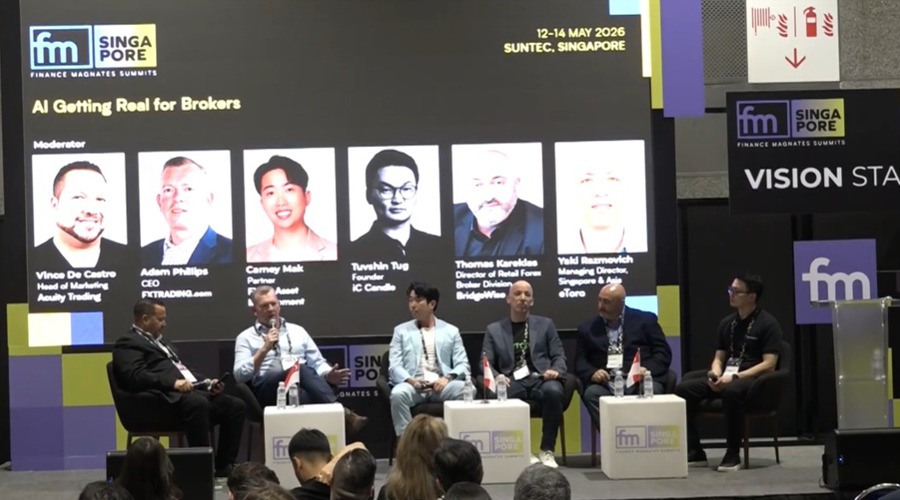
From left: Vince Castro, Adam Phillips, Carney Mak, Tuvshin Tug, Thomas Kareklas, and Yaki Razmovich

Mak framed AI as the mechanism that turns raw data into actionable signals. “Data is now quantifiable based on AI metrics… it not only complements analysis but confirms it,” he said.

“Data is now quantifiable based on AI matrix they discover they develop the AI and they give you solutions or suggestions to the AI and that is the core the analytic core of AI. So, you know we can have all the information that CNBC or even Bloomberg shares on the CPI numbers and stuff but who analyze them?”

“Back then it was us with our own power knowledge and our own education but now with AI, it not only complements that but they also confirm that. So, you have a double confirmation and gives you a stronger motivation to put on a trade or more importantly put it on investment bet.”

Yet there was also caution. Rasmovich warned that AI models remain rooted in historical data and may fail under unprecedented market conditions. “Traders need to combine AI with their own judgment and due diligence,” he said.

Behavioral Shift: From Reactive to Structured

Panelists agreed that AI is already changing how traders operate. Tug said AI is helping shift traders from reactive behavior toward more disciplined strategies. Automated scanning and pattern recognition allow users to define criteria and let algorithms identify opportunities, reducing time spent on manual chart analysis.

Related: AI Takes Center Stage in Brokers’ Layoff Narratives

At the same time, AI is helping filter “noise”—a recurring theme throughout the discussion. Bridgewise’s Thomas noted that curated, AI-driven insights can expand traders’ knowledge while simplifying decision-making, provided the data is reliable and regulated.

“AI itself, especially what we're doing here at Bridgewise, is it helps clear the noise. And there is a lot of noise out there. As long as you are using a regulated and clean AI, then that's going to actually help you in the future. So, it's very it's a very positive change to the trading environment.”

However, this behavioral shift raises new risks. Faster insights and easier execution can encourage overtrading if not paired with proper safeguards.

The Trust Problem

As AI becomes more embedded, trust, and transparency, emerged as a central concern. The goal shouldn’t be to trust AI blindly, said Razmovich. Instead, it should be to understand what AI is telling you and then decide.

“The goal is shouldn't be trust the AI or etc. It should be instead understood what AI is telling and then you decide kind of. So that's the where trust is built the right way without creating the over reliance on it.”

Panelists emphasized the importance of explainability and data integrity. Thomas drew a distinction between generic AI tools and purpose-built financial systems, arguing that only the latter can provide “clean, audited” outputs suitable for trading decisions.

Phillips highlighted another risk: AI systems designed to “please” users may generate misleading outputs, a known issue with large language models. For brokers, this makes control over data sources and model behavior critical.

What Won’t Last

There was clear consensus on what approaches are unlikely to endure. Using AI primarily as a marketing label drew sharp criticism. “If brokers are using AI purely as a marketing tool, that won’t last,” Phillips said, warning that superficial implementations will quickly lose credibility.

Carney added that overloading platforms with multiple AI tools can backfire, creating confusion rather than clarity. “If five different AI tools give different suggestions, the trade will not be made,” he said. Panelists also pointed to earlier misuse of AI to drive client churn and short-term volume, an approach increasingly at odds with regulatory expectations and long-term client retention.

Differentiation in an AI-Saturated Market

With AI adoption becoming ubiquitous, competitive advantage is shifting elsewhere. “It’s no longer a good-to-have, it’s a must,” said Rasmovich. Differentiation, he argued, will depend on the quality of algorithms, personalization, user experience, and integration across the trading lifecycle.

Others pointed to control over infrastructure. Owning or deeply understanding AI systems allows brokers to tailor outputs, incorporate user feedback, and ensure consistency, advantages not easily replicated with off-the-shelf tools.

Localization also surfaced as a key factor. Carney noted that trader preferences vary significantly across Asian markets, meaning AI deployment must align with local trading cultures and behaviors rather than follow a one-size-fits-all model.

A Tool, Not a Decision-Maker

In a closing exchange with the audience, the limits of AI became clear. Asked whether AI can determine a stock’s intrinsic value, Phillips offered a blunt assessment: “A stock’s value is where buyers and sellers meet… I haven’t met an AI yet that is effective at picking share price movements over the next two weeks.”

The remark underscored a broader theme running through the session: while AI can enhance analysis, streamline workflows, and improve access to information, it does not replace human judgment.

For brokers, the challenge now is not adoption but execution—embedding AI in ways that improve outcomes without undermining trust. For traders, the message was equally direct: AI may sharpen decisions, but responsibility for those decisions remains firmly human.

AI is rapidly shifting from experimental add-on to core infrastructure in the retail trading industry, but brokers face a growing challenge: how to harness its power without eroding trust or encouraging overreliance.

That tension framed a panel discussion at the Finance Magnates Singapore Summit 2026, where executives from eToro, FXTrading.com, Bridgewise, and AI-focused firms debated how artificial intelligence is reshaping trading behavior, product design, and competitive dynamics across brokerage platforms.

The panel brought together, Vince De Castro, the Head of Marketing at Acuity Trading, Adam Phillips, the CEO of FXTRADING.com, Carney Mak, Partner at FXHB Asset Management, Tuvshin Tug, the Founder at iC Candle, Thomas Kareklas, the Director of Retail Forex Broker Division at BridgeWise, and Yaki Razmovich, the MD for Singapore and Asia at eToro.

From Feature to Foundation

Across the panel, there was broad agreement that AI is no longer a peripheral tool. “It’s not a top layer,” said Kareklas. “It’s built within the core of all of our products.”

That view was echoed by Phillips who described AI as part of the engine room of his brokerage after acquiring an in-house development team to control its technology stack and data inputs. “It's not just a bolt-on, it's a core part of the engine room of our company that helps traders assess risk and trade effectively.”

Similarly, Rasmovich said the platform has become “AI-first,” embedding machine learning across the user journey, from onboarding and trade selection to risk management.

More from the event: “AI Very Useful for Fraud Detection, Monitoring”: FM Singapore Summit 2026 Enters Final Day

The shift reflects a wider industry transition: AI is now central to how brokers structure client experience, generate insights, and ultimately drive trading activity.

Better Decisions, or Just More Trades?

A key point of debate was whether AI genuinely improves decision-making or simply increases engagement. Panelists largely argued that AI enhances traders’ analytical capabilities. By processing vast datasets, from macroeconomic indicators to earnings reports, AI tools can surface insights faster than manual analysis. “It does the legwork,” said Rasmovich, noting that personalized AI agents can deliver real-time, tailored market intelligence based on a user’s portfolio and behavior.

From left: Vince Castro, Adam Phillips, Carney Mak, Tuvshin Tug, Thomas Kareklas, and Yaki Razmovich

Mak framed AI as the mechanism that turns raw data into actionable signals. “Data is now quantifiable based on AI metrics… it not only complements analysis but confirms it,” he said.

“Data is now quantifiable based on AI matrix they discover they develop the AI and they give you solutions or suggestions to the AI and that is the core the analytic core of AI. So, you know we can have all the information that CNBC or even Bloomberg shares on the CPI numbers and stuff but who analyze them?”

“Back then it was us with our own power knowledge and our own education but now with AI, it not only complements that but they also confirm that. So, you have a double confirmation and gives you a stronger motivation to put on a trade or more importantly put it on investment bet.”

Yet there was also caution. Rasmovich warned that AI models remain rooted in historical data and may fail under unprecedented market conditions. “Traders need to combine AI with their own judgment and due diligence,” he said.

Behavioral Shift: From Reactive to Structured

Panelists agreed that AI is already changing how traders operate. Tug said AI is helping shift traders from reactive behavior toward more disciplined strategies. Automated scanning and pattern recognition allow users to define criteria and let algorithms identify opportunities, reducing time spent on manual chart analysis.

Related: AI Takes Center Stage in Brokers’ Layoff Narratives

At the same time, AI is helping filter “noise”—a recurring theme throughout the discussion. Bridgewise’s Thomas noted that curated, AI-driven insights can expand traders’ knowledge while simplifying decision-making, provided the data is reliable and regulated.

“AI itself, especially what we're doing here at Bridgewise, is it helps clear the noise. And there is a lot of noise out there. As long as you are using a regulated and clean AI, then that's going to actually help you in the future. So, it's very it's a very positive change to the trading environment.”

However, this behavioral shift raises new risks. Faster insights and easier execution can encourage overtrading if not paired with proper safeguards.

The Trust Problem

As AI becomes more embedded, trust, and transparency, emerged as a central concern. The goal shouldn’t be to trust AI blindly, said Razmovich. Instead, it should be to understand what AI is telling you and then decide.

“The goal is shouldn't be trust the AI or etc. It should be instead understood what AI is telling and then you decide kind of. So that's the where trust is built the right way without creating the over reliance on it.”

Panelists emphasized the importance of explainability and data integrity. Thomas drew a distinction between generic AI tools and purpose-built financial systems, arguing that only the latter can provide “clean, audited” outputs suitable for trading decisions.

Phillips highlighted another risk: AI systems designed to “please” users may generate misleading outputs, a known issue with large language models. For brokers, this makes control over data sources and model behavior critical.

What Won’t Last

There was clear consensus on what approaches are unlikely to endure. Using AI primarily as a marketing label drew sharp criticism. “If brokers are using AI purely as a marketing tool, that won’t last,” Phillips said, warning that superficial implementations will quickly lose credibility.

Carney added that overloading platforms with multiple AI tools can backfire, creating confusion rather than clarity. “If five different AI tools give different suggestions, the trade will not be made,” he said. Panelists also pointed to earlier misuse of AI to drive client churn and short-term volume, an approach increasingly at odds with regulatory expectations and long-term client retention.

Differentiation in an AI-Saturated Market

With AI adoption becoming ubiquitous, competitive advantage is shifting elsewhere. “It’s no longer a good-to-have, it’s a must,” said Rasmovich. Differentiation, he argued, will depend on the quality of algorithms, personalization, user experience, and integration across the trading lifecycle.

Others pointed to control over infrastructure. Owning or deeply understanding AI systems allows brokers to tailor outputs, incorporate user feedback, and ensure consistency, advantages not easily replicated with off-the-shelf tools.

Localization also surfaced as a key factor. Carney noted that trader preferences vary significantly across Asian markets, meaning AI deployment must align with local trading cultures and behaviors rather than follow a one-size-fits-all model.

A Tool, Not a Decision-Maker

In a closing exchange with the audience, the limits of AI became clear. Asked whether AI can determine a stock’s intrinsic value, Phillips offered a blunt assessment: “A stock’s value is where buyers and sellers meet… I haven’t met an AI yet that is effective at picking share price movements over the next two weeks.”

The remark underscored a broader theme running through the session: while AI can enhance analysis, streamline workflows, and improve access to information, it does not replace human judgment.

For brokers, the challenge now is not adoption but execution—embedding AI in ways that improve outcomes without undermining trust. For traders, the message was equally direct: AI may sharpen decisions, but responsibility for those decisions remains firmly human.

About the Author: Jared Kirui
Jared Kirui
  • 2855 Articles
  • 54 Followers
About the Author: Jared Kirui
Jared Kirui is an Editor at Finance Magnates with more than five years of experience in financial journalism. He covers online trading, fintech, payments, and crypto industries with a focus on companies, regulation and compliance, executive moves, trading technology, and market analysis. His work has been featured in other media outlets, including Benzinga, ZyCrypto, The Distributed, and The Daily Hodl. Education: Bachelor of Commerce degree (Finance option), University of Nairobi
  • 2855 Articles
  • 54 Followers

More from the Author

FM-Events

!"#$%&'()*+,-./0123456789:;<=>?@ABCDEFGHIJKLMNOPQRSTUVWXYZ[\]^_`abcdefghijklmnopqrstuvwxyz{|} !"#$%&'()*+,-./0123456789:;<=>?@ABCDEFGHIJKLMNOPQRSTUVWXYZ[\]^_`abcdefghijklmnopqrstuvwxyz{|}