“For Southeast Asia, You Definitely Need IB”: FM Singapore Summit 2026 Lessons

Monday, 29/06/2026 | 18:13 GMT by Jared Kirui
  • At the Craft Stage, the panel argued that expanding into Thailand and Vietnam is primarily a test of local trust, hiring quality and risk management.
  • Brokers must learn to operate within opaque rules, local languages and relationship-based networks.
  • Watch the full video below.

Brokers eyeing Thailand and Vietnam may talk about expansion as a map exercise, but operators at FM Singapore Summit 2026 argued it is really a test of local trust, hiring discipline and risk controls in markets that remain attractive, crowded and highly relationship-driven.

At FM Singapore Summit 2026, a panel on Thailand and Vietnam offered a practical message for brokers chasing Southeast Asia growth: entering the two markets is less about opening a local outpost than learning how to operate inside opaque rules, local languages and trust-based networks.

Local Talent and ‘Yes’ Culture

Jonathan Fine, moderating the discussion, framed the issue as a gap between market interest and real operating knowledge, arguing that Thailand and Vietnam are often discussed but poorly understood by firms trying to expand in the region.

You may also like: “What Differentiates Brokers Now Is Connectivity and User Experience”: Inside FM Singapore Summit 2026

That gap showed up quickly in the panellists’ remarks, with Won Tien Ching, CEO of ACCM, saying local talent can make or break an operation because “once you hire a wrong guy, you will create… so many freaking problems for you and the company,” while Janis Baltalksnis, Regional Director for Thailand and Laos at Versus Trade, warned that the Thai market is full of “noise” and unclear commitments.

Small Tickets, IB-Heavy Models

On unit economics, both speakers described smaller ticket sizes than in Europe or China, but still meaningful value if the model is built for scale. Ching said ACCM sees average first-time deposits in Vietnam ranging from $50 to $1,000 and client lifetime value of $2,000 to $5,000, while Baltalksnis said Thai clients often begin with $50 or $100 to test withdrawals, onboarding friction and customer support before committing more capital.
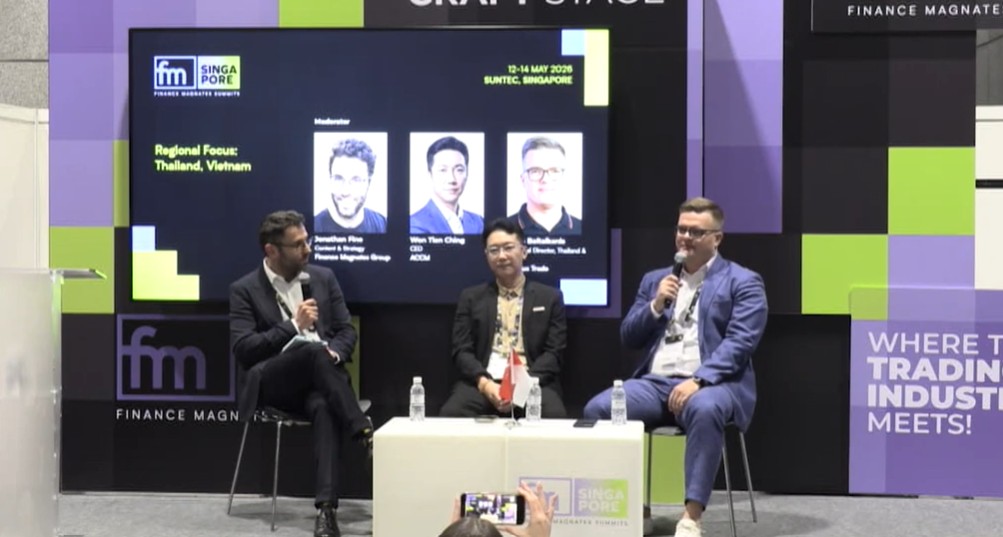
From left: Jonathan Fine, Won Tien Ching, and Janis Baltalksnis

Both executives agreed that Thailand and Vietnam remain IB-led markets, where local teams are not optional. Baltalksnis said it is “close to impossible” to succeed without local staff in Thailand, adding that partners and employees have ample broker choice in a saturated market. Ching, however, argued that local presence alone is not enough, saying a visible foreign executive can also strengthen credibility because IBs want proof they are dealing with a real regional firm rather than “some kind of sketchy local project.”

Abuse Risk and Bonus Headaches

Risk management emerged as another fault line. Baltalksnis said newcomers quickly become targets for abusive trading behavior and should build controls around corner cases, particularly for swap-free accounts and aggressive bonus structures. “Don’t go crazy and follow the players that are offering 100% deposit bonuses for up to $10,000,” he said. “That’s a potential killer for your company.”

More from the event: “In Asia, Loyalty Is Earned in WhatsApp Groups and Golf Invitations”: FM Singapore Summit 2026 Insights

On regulation, neither speaker described Thailand or Vietnam as straightforward onshore licensing stories. Ching said there is still no clear local CFD or forex licensing regime in Vietnam, adding that brokers often enter through offshore entities backed by recognised licences elsewhere, while Baltalksnis said offshore regulation can work as a credibility bridge, though trust still rests heavily on local relationships.

The panel ended on a softer note, but one that reinforced its core argument: these are human markets before they are growth markets. For firms trying to build in Bangkok or Vietnam, the message was clear — trust, language and local reputation may matter more than the initial deposit size.

Brokers eyeing Thailand and Vietnam may talk about expansion as a map exercise, but operators at FM Singapore Summit 2026 argued it is really a test of local trust, hiring discipline and risk controls in markets that remain attractive, crowded and highly relationship-driven.

At FM Singapore Summit 2026, a panel on Thailand and Vietnam offered a practical message for brokers chasing Southeast Asia growth: entering the two markets is less about opening a local outpost than learning how to operate inside opaque rules, local languages and trust-based networks.

Local Talent and ‘Yes’ Culture

Jonathan Fine, moderating the discussion, framed the issue as a gap between market interest and real operating knowledge, arguing that Thailand and Vietnam are often discussed but poorly understood by firms trying to expand in the region.

You may also like: “What Differentiates Brokers Now Is Connectivity and User Experience”: Inside FM Singapore Summit 2026

That gap showed up quickly in the panellists’ remarks, with Won Tien Ching, CEO of ACCM, saying local talent can make or break an operation because “once you hire a wrong guy, you will create… so many freaking problems for you and the company,” while Janis Baltalksnis, Regional Director for Thailand and Laos at Versus Trade, warned that the Thai market is full of “noise” and unclear commitments.

Small Tickets, IB-Heavy Models

On unit economics, both speakers described smaller ticket sizes than in Europe or China, but still meaningful value if the model is built for scale. Ching said ACCM sees average first-time deposits in Vietnam ranging from $50 to $1,000 and client lifetime value of $2,000 to $5,000, while Baltalksnis said Thai clients often begin with $50 or $100 to test withdrawals, onboarding friction and customer support before committing more capital.

From left: Jonathan Fine, Won Tien Ching, and Janis Baltalksnis

Both executives agreed that Thailand and Vietnam remain IB-led markets, where local teams are not optional. Baltalksnis said it is “close to impossible” to succeed without local staff in Thailand, adding that partners and employees have ample broker choice in a saturated market. Ching, however, argued that local presence alone is not enough, saying a visible foreign executive can also strengthen credibility because IBs want proof they are dealing with a real regional firm rather than “some kind of sketchy local project.”

Abuse Risk and Bonus Headaches

Risk management emerged as another fault line. Baltalksnis said newcomers quickly become targets for abusive trading behavior and should build controls around corner cases, particularly for swap-free accounts and aggressive bonus structures. “Don’t go crazy and follow the players that are offering 100% deposit bonuses for up to $10,000,” he said. “That’s a potential killer for your company.”

More from the event: “In Asia, Loyalty Is Earned in WhatsApp Groups and Golf Invitations”: FM Singapore Summit 2026 Insights

On regulation, neither speaker described Thailand or Vietnam as straightforward onshore licensing stories. Ching said there is still no clear local CFD or forex licensing regime in Vietnam, adding that brokers often enter through offshore entities backed by recognised licences elsewhere, while Baltalksnis said offshore regulation can work as a credibility bridge, though trust still rests heavily on local relationships.

The panel ended on a softer note, but one that reinforced its core argument: these are human markets before they are growth markets. For firms trying to build in Bangkok or Vietnam, the message was clear — trust, language and local reputation may matter more than the initial deposit size.

About the Author: Jared Kirui
Jared Kirui
  • 2867 Articles
  • 55 Followers
About the Author: Jared Kirui
Jared Kirui is an Editor at Finance Magnates with more than five years of experience in financial journalism. He covers online trading, fintech, payments, and crypto industries with a focus on companies, regulation and compliance, executive moves, trading technology, and market analysis. His work has been featured in other media outlets, including Benzinga, ZyCrypto, The Distributed, and The Daily Hodl. Education: Bachelor of Commerce degree (Finance option), University of Nairobi
  • 2867 Articles
  • 55 Followers

More from the Author

FM-Events

!"#$%&'()*+,-./0123456789:;<=>?@ABCDEFGHIJKLMNOPQRSTUVWXYZ[\]^_`abcdefghijklmnopqrstuvwxyz{|} !"#$%&'()*+,-./0123456789:;<=>?@ABCDEFGHIJKLMNOPQRSTUVWXYZ[\]^_`abcdefghijklmnopqrstuvwxyz{|}