
Why Gold Price Is Going Down? XAU/USD Price Prediction Based on Death Cross Targets $3,400

Monday, 22/06/2026 | 10:58 GMT by Damian Chmiel
  • Gold traded near $4,185 per ounce on Monday, June 22, 2026, still below its 200-day moving average after a third straight weekly decline.
  • My chart shows the 50-day and 200-day moving averages converging toward a death cross, a strong new bearish signal for the XAU/USD trend.
  • Only the $4,000 to $4,100 support stands between spot and my $3,440 Fibonacci target, a fall of nearly 20% from current gold levels.
A gold bar with the red chart downward line showing gold price falls
How low can gold price go and what are the newest XAU/USD predictions?

Gold (XAU/USD) traded at $4,185 per ounce on Monday, June 22, 2026, rebounding intraday on progress in US-Iran talks but still below its 200-day moving average after a third straight weekly decline.

The bounce changes nothing on my chart, and nothing in my bearish gold price prediction. Since my recent gold analysis nearly two weeks ago, the setup is identical: price under the 200-day average, the $4,300 zone capping rallies, and a Fibonacci extension pointing to $3,440.

What has sharpened is the moving-average picture, with the 50-day and 200-day lines converging toward a death cross.

This week's catalysts are June PMI data, the third estimate of US first-quarter GDP, the University of Michigan inflation reading, and the next headline from the US-Iran talks.

Follow me on X for real-time market analysis: @ChmielDk.

Gold Technical Analysis: A Death Cross Nears as $4,000 Becomes the Last Line

My chart shows gold still trapped below the 200-day moving average, the same structure I flagged when the metal first lost its 200 EMA near $4,300. The trend reads lower while price holds beneath that band.

The new development is the death cross. The 50-day moving average has fallen toward the 200-day, and the two are converging near the $4,300 to $4,400 region.

A confirmed cross, with the 50-day slipping below the 200-day, would harden the medium-term sell signal rather than create it. The trend is already down, and the cross would underline it.

Death crosses are not destiny. The mid-2022 version preceded a deep slide, while the 2023 cross reversed within weeks. What tips the odds bearish now is that price already sits below both averages instead of testing them from above.

In 15-plus years charting metals, I rarely see a zone as well defended as $4,300 give way and then cap every bounce the way it has this month. You can follow my prior gold calls on my analyst page. That broken band, built by the 200 EMA and the October 2025 highs, now invalidates the bearish case only on a daily close back above it.

Below spot, one support matters. The $4,000 to $4,100 zone, set by the March 2026 lows and retested in June, is the last defense before my downside target. The signal I watch is the retest, since each rejection at $4,300 from below strengthens the case for the next leg down.

Silver is sending the same signal, trading below its own 200 EMA after breaking a multi-month range, which tightens the risk-off read across precious metals.

Lose $4,000 on a daily close, and the path opens toward $3,440, the 100% Fibonacci extension of the 2025 advance and roughly the lowest level since August 2025.
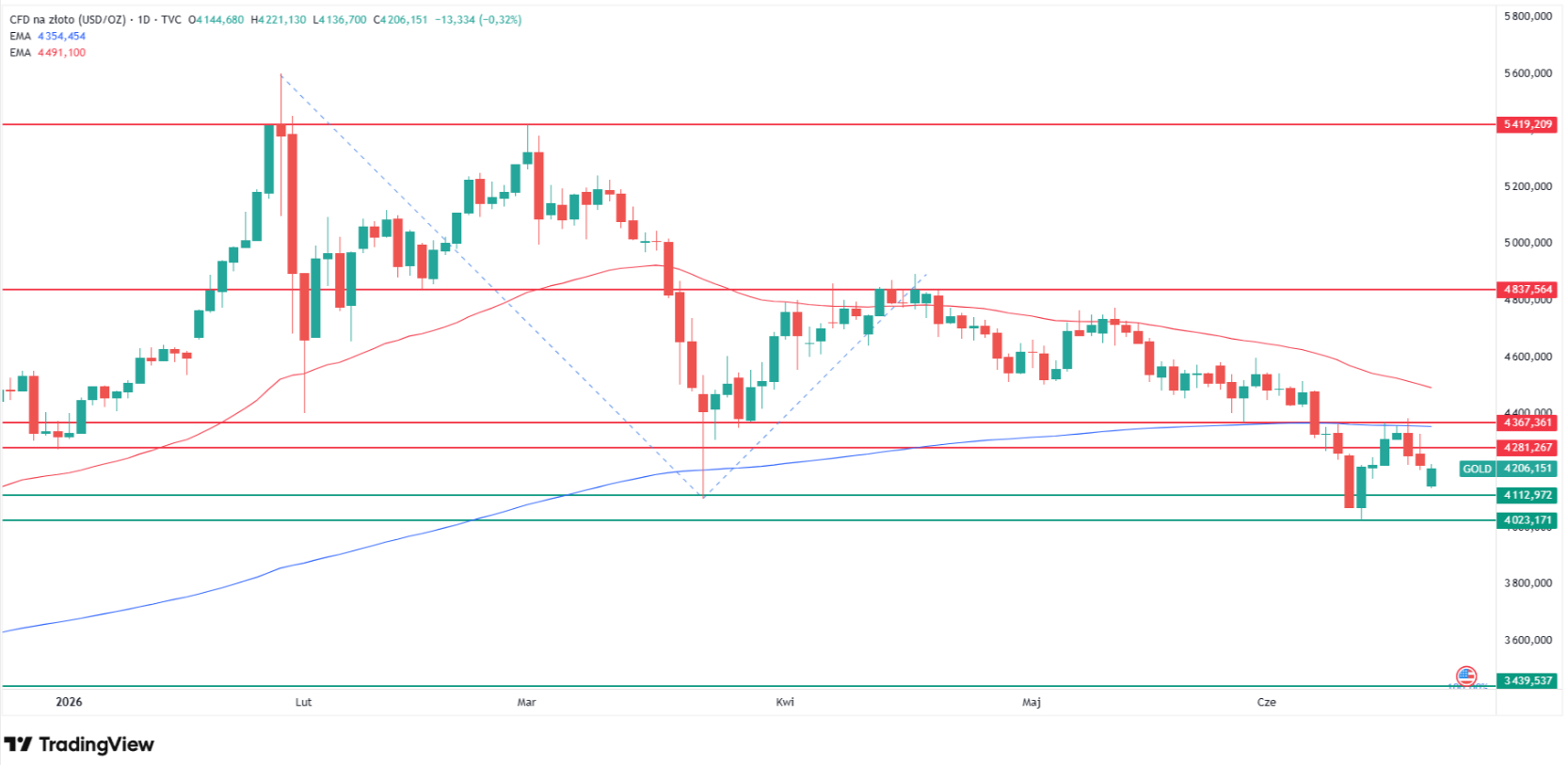
Gold price prediction: can $4,000 hold before the death cross? Source: Tradingview.com

That target sits about 20% under the $4,000 floor and close to 40% below January's $5,602 record. A reclaim of $4,300 to $4,400 would neutralize the setup and return gold to the consolidation that framed 2026, capped by the $5,400 to $5,600 record zone. Nothing on my chart points that way yet.

Level

Type

Notes

$5,400–$5,600

Resistance

January record zone, top of the 2026 consolidation

$4,300–$4,400

Resistance

200 EMA and October 2025 highs, invalidation zone, death-cross convergence

$4,185

Spot

Monday, June 22 intraday

$4,000–$4,100

Support

March 2026 lows, retested in June, last defense

$3,440

Target

100% Fibonacci extension of the 2025 advance

Why Is Gold Falling?

Gold is falling because the Federal Reserve turned more hawkish. At its June meeting the Fed left rates unchanged, but nine of its 19 policymakers now expect at least one hike this year, and markets price roughly a 70% chance of an increase by September. Higher-for-longer policy lifts real Treasury yields, the main headwind for a non-yielding asset.

The dollar has followed, climbing to a one-year high and adding pressure on bullion priced in the currency. The data week reinforces the bias, since soft June PMIs or a hot University of Michigan inflation print would each harden the higher-for-longer case.

Institutional conviction is cooling at the margin. Goldman Sachs cut its year-end gold target to $4,900 from $5,400, a level I tracked in my Goldman Sachs gold analysis. The forecast still sits above spot, but the direction of the revision matters.

Geopolitics now cuts the other way. Progress in the US-Iran talks, the driver of Monday's bounce, also thins the safe-haven premium that carried gold through 2025.

The drivers behind the slide:

  • Hawkish June Fed hold, with hike odds near 70% by September
  • Real Treasury yields rising as the dollar hits a one-year high
  • Goldman Sachs trimming its year-end target to $4,900 from $5,400
  • US-Iran de-escalation reducing safe-haven demand

How Low Can Gold Go? Gold Price Predictions

My base case stays bearish while gold holds below $4,300, and my primary target is $3,440. The forecast aligns with the World Gold Council's reflation scenario, which models a 5% to 20% drop into the $3,360 to $3,440 zone if a stronger dollar and firmer yields persist.

Two independent methods landing on the same area raises my confidence in it. What would flip my base case is a daily close back above $4,300 to $4,400, which would void the death-cross setup before it confirms.

The bull case has not disappeared. Goldman Sachs still targets $4,900, and the Reuters poll median of 30 analysts sits at $4,746, both above spot. My read is that these consensus figures have lagged the 2026 reversal all year and assume a Fed pivot that has not arrived.

The extreme upside belongs to Wells Fargo at $6,100 to $6,300. That projection needs a dovish turn and renewed ETF demand, neither visible on my chart today. I track it as a ceiling, not a near-term path.

Source

Target

My view

Damian Chmiel (TA)

$3,440

My base case while price holds below $4,300, about 20% under the $4,000 floor.

World Gold Council

$3,360–$3,440

The reflation-crash scenario overlaps exactly with my Fibonacci target.

Reuters poll (median)

$4,746

Still about 14% above spot, but the poll has trailed every leg of the 2026 drop.

Goldman Sachs

$4,900

Even after the cut it implies a rebound, so the structural bull case survives.

Wells Fargo

$6,100–$6,300

A genuine ceiling that needs a dovish Fed pivot I do not yet see.

FAQ: Gold Price Prediction

Why is gold falling right now?

Gold is falling because the Federal Reserve held rates in June but signaled a hawkish bias, with markets pricing roughly 70% odds of a hike by September. That lifted real Treasury yields and pushed the dollar to a one-year high, both negative for non-yielding bullion. On the chart, gold also trades below its 200-day moving average, which invites technical selling.

What is a gold death cross and does it matter?

A death cross forms when the 50-day moving average falls below the 200-day, a signal traders read as a shift to a bearish medium-term trend. On my gold chart the two lines are converging near $4,300. The cross would not create the downtrend, since price already sits below both averages, but it would reinforce the existing sell signal.

How low can gold go in 2026?

My primary target is $3,440, the 100% Fibonacci extension of the 2025 advance, roughly the lowest level since August 2025 and about 20% below the $4,000 support. The World Gold Council's reflation scenario models a similar $3,360 to $3,440 zone. The $4,000 to $4,100 band is the first checkpoint and the last defense before that target.

What happens if gold breaks $4,000?

A daily close below $4,000 would remove the last support before my $3,440 target and confirm the breakdown from the March 2026 lows. It would likely accelerate technical selling toward the 2025 peak cluster near $3,440. A failure there would also pressure silver, which has already broken its own 200 EMA and multi-month range, as I argued in my silver breakdown analysis.

Is the gold bull market over?

Not necessarily. Central banks bought 244 net tonnes in the first quarter of 2026, and institutional year-end targets from Goldman Sachs and Wells Fargo still sit above spot. The current move looks like a deep correction inside a longer cycle. A daily close back above $4,300 to $4,400 would reopen the upside toward the $5,400 record zone.

Gold (XAU/USD) traded at $4,185 per ounce on Monday, June 22, 2026, rebounding intraday on progress in US-Iran talks but still below its 200-day moving average after a third straight weekly decline.

The bounce changes nothing on my chart, and nothing in my bearish gold price prediction. Since my recent gold analysis nearly two weeks ago, the setup is identical: price under the 200-day average, the $4,300 zone capping rallies, and a Fibonacci extension pointing to $3,440.

What has sharpened is the moving-average picture, with the 50-day and 200-day lines converging toward a death cross.

This week's catalysts are June PMI data, the third estimate of US first-quarter GDP, the University of Michigan inflation reading, and the next headline from the US-Iran talks.

Follow me on X for real-time market analysis: @ChmielDk.

Gold Technical Analysis: A Death Cross Nears as $4,000 Becomes the Last Line

My chart shows gold still trapped below the 200-day moving average, the same structure I flagged when the metal first lost its 200 EMA near $4,300. The trend reads lower while price holds beneath that band.

The new development is the death cross. The 50-day moving average has fallen toward the 200-day, and the two are converging near the $4,300 to $4,400 region.

A confirmed cross, with the 50-day slipping below the 200-day, would harden the medium-term sell signal rather than create it. The trend is already down, and the cross would underline it.

Death crosses are not destiny. The mid-2022 version preceded a deep slide, while the 2023 cross reversed within weeks. What tips the odds bearish now is that price already sits below both averages instead of testing them from above.

In 15-plus years charting metals, I rarely see a zone as well defended as $4,300 give way and then cap every bounce the way it has this month. You can follow my prior gold calls on my analyst page. That broken band, built by the 200 EMA and the October 2025 highs, now invalidates the bearish case only on a daily close back above it.

Below spot, one support matters. The $4,000 to $4,100 zone, set by the March 2026 lows and retested in June, is the last defense before my downside target. The signal I watch is the retest, since each rejection at $4,300 from below strengthens the case for the next leg down.

Silver is sending the same signal, trading below its own 200 EMA after breaking a multi-month range, which tightens the risk-off read across precious metals.

Lose $4,000 on a daily close, and the path opens toward $3,440, the 100% Fibonacci extension of the 2025 advance and roughly the lowest level since August 2025.

Gold price prediction: can $4,000 hold before the death cross? Source: Tradingview.com

That target sits about 20% under the $4,000 floor and close to 40% below January's $5,602 record. A reclaim of $4,300 to $4,400 would neutralize the setup and return gold to the consolidation that framed 2026, capped by the $5,400 to $5,600 record zone. Nothing on my chart points that way yet.

Level

Type

Notes

$5,400–$5,600

Resistance

January record zone, top of the 2026 consolidation

$4,300–$4,400

Resistance

200 EMA and October 2025 highs, invalidation zone, death-cross convergence

$4,185

Spot

Monday, June 22 intraday

$4,000–$4,100

Support

March 2026 lows, retested in June, last defense

$3,440

Target

100% Fibonacci extension of the 2025 advance

Why Is Gold Falling?

Gold is falling because the Federal Reserve turned more hawkish. At its June meeting the Fed left rates unchanged, but nine of its 19 policymakers now expect at least one hike this year, and markets price roughly a 70% chance of an increase by September. Higher-for-longer policy lifts real Treasury yields, the main headwind for a non-yielding asset.

The dollar has followed, climbing to a one-year high and adding pressure on bullion priced in the currency. The data week reinforces the bias, since soft June PMIs or a hot University of Michigan inflation print would each harden the higher-for-longer case.

Institutional conviction is cooling at the margin. Goldman Sachs cut its year-end gold target to $4,900 from $5,400, a level I tracked in my Goldman Sachs gold analysis. The forecast still sits above spot, but the direction of the revision matters.

Geopolitics now cuts the other way. Progress in the US-Iran talks, the driver of Monday's bounce, also thins the safe-haven premium that carried gold through 2025.

The drivers behind the slide:

  • Hawkish June Fed hold, with hike odds near 70% by September
  • Real Treasury yields rising as the dollar hits a one-year high
  • Goldman Sachs trimming its year-end target to $4,900 from $5,400
  • US-Iran de-escalation reducing safe-haven demand

How Low Can Gold Go? Gold Price Predictions

My base case stays bearish while gold holds below $4,300, and my primary target is $3,440. The forecast aligns with the World Gold Council's reflation scenario, which models a 5% to 20% drop into the $3,360 to $3,440 zone if a stronger dollar and firmer yields persist.

Two independent methods landing on the same area raises my confidence in it. What would flip my base case is a daily close back above $4,300 to $4,400, which would void the death-cross setup before it confirms.

The bull case has not disappeared. Goldman Sachs still targets $4,900, and the Reuters poll median of 30 analysts sits at $4,746, both above spot. My read is that these consensus figures have lagged the 2026 reversal all year and assume a Fed pivot that has not arrived.

The extreme upside belongs to Wells Fargo at $6,100 to $6,300. That projection needs a dovish turn and renewed ETF demand, neither visible on my chart today. I track it as a ceiling, not a near-term path.

Source

Target

My view

Damian Chmiel (TA)

$3,440

My base case while price holds below $4,300, about 20% under the $4,000 floor.

World Gold Council

$3,360–$3,440

The reflation-crash scenario overlaps exactly with my Fibonacci target.

Reuters poll (median)

$4,746

Still about 14% above spot, but the poll has trailed every leg of the 2026 drop.

Goldman Sachs

$4,900

Even after the cut it implies a rebound, so the structural bull case survives.

Wells Fargo

$6,100–$6,300

A genuine ceiling that needs a dovish Fed pivot I do not yet see.

FAQ: Gold Price Prediction

Why is gold falling right now?

Gold is falling because the Federal Reserve held rates in June but signaled a hawkish bias, with markets pricing roughly 70% odds of a hike by September. That lifted real Treasury yields and pushed the dollar to a one-year high, both negative for non-yielding bullion. On the chart, gold also trades below its 200-day moving average, which invites technical selling.

What is a gold death cross and does it matter?

A death cross forms when the 50-day moving average falls below the 200-day, a signal traders read as a shift to a bearish medium-term trend. On my gold chart the two lines are converging near $4,300. The cross would not create the downtrend, since price already sits below both averages, but it would reinforce the existing sell signal.

How low can gold go in 2026?

My primary target is $3,440, the 100% Fibonacci extension of the 2025 advance, roughly the lowest level since August 2025 and about 20% below the $4,000 support. The World Gold Council's reflation scenario models a similar $3,360 to $3,440 zone. The $4,000 to $4,100 band is the first checkpoint and the last defense before that target.

What happens if gold breaks $4,000?

A daily close below $4,000 would remove the last support before my $3,440 target and confirm the breakdown from the March 2026 lows. It would likely accelerate technical selling toward the 2025 peak cluster near $3,440. A failure there would also pressure silver, which has already broken its own 200 EMA and multi-month range, as I argued in my silver breakdown analysis.

Is the gold bull market over?

Not necessarily. Central banks bought 244 net tonnes in the first quarter of 2026, and institutional year-end targets from Goldman Sachs and Wells Fargo still sit above spot. The current move looks like a deep correction inside a longer cycle. A daily close back above $4,300 to $4,400 would reopen the upside toward the $5,400 record zone.

About the Author: Damian Chmiel
Damian Chmiel
  • 3666 Articles
  • 113 Followers
About the Author: Damian Chmiel
Damian Chmiel is a Senior Analyst & Editor at Finance Magnates with more than 15 years of experience in the CFD and online trading industry. Active as both a trader and journalist since 2010, he focuses on broker coverage, fintech innovation, and regulatory developments across Europe, the Middle East, and Asia. His work includes interviews with C-level leaders at major brokerages and fintech platforms, as well as co-authoring Finance Magnates’ quarterly industry benchmarking reports. Damian’s reporting is data-driven, market-aware, and grounded in direct industry engagement. His analysis and commentary have also been cited by external media outlets, including Investing.com, Binance, The Asset, Stockhead, and Dispatch. Education: MA in Finance and Accounting, Cracow University of Economics
  • 3666 Articles
  • 113 Followers

More from the Author

Trending

!"#$%&'()*+,-./0123456789:;<=>?@ABCDEFGHIJKLMNOPQRSTUVWXYZ[\]^_`abcdefghijklmnopqrstuvwxyz{|} !"#$%&'()*+,-./0123456789:;<=>?@ABCDEFGHIJKLMNOPQRSTUVWXYZ[\]^_`abcdefghijklmnopqrstuvwxyz{|}