Bitcoin plunges to $95,828, down 24% from October's $126,296 ATH as Fed rate cut odds collapse from 97% to 52%.
Analysts warn of a 30% crash to $70K as $1.3B in liquidations hit and Bitcoin breaks critical $100K support on a 6-month low.
BTC faces key $94-92K support test; breakdown risks deeper fall to April's $74K lows amid massive $870M ETF outflows.
Why Bitcoin price is going down today?
Bitcoin (BTC) price crashed
to $95,722 on Friday, November 14, 2025, marking a six-month low and
representing a 24% decline from its October all-time high of $126,296. The
sharp selloff accelerated as optimism from the U.S. government reopening faded
and December Federal Reserve rate cut odds collapsed from 97% to just 52%,
triggering over $1.3 billion in forced liquidations across cryptocurrency
markets.
In this article, I answer the question why Bitcoin is
falling, how low can BTC price go and why the newest Bitcoin price prediction
suggests that we may witness another 30% collapse.
Why Bitcoin Is Going Down?
Government Relief Fades as Rate Cut Hopes Crumble
Bitcoin's descent
accelerated after Tuesday's brief rally above $107,000 failed to hold, with the
cryptocurrency now down nearly 9% week-to-date despite momentarily reclaiming
that level earlier this week. The broader decline mirrors weakness across
growth-sensitive assets as traders reassess the macroeconomic landscape
following diminished expectations for monetary easing.
Samer Hasn
"Bitcoin's
sharp decline accelerated as relief from the U.S. government reopening faded
and the odds of a December rate cut fell sharply," explains Samer Hasn,
Senior Market Analyst at XS.com. "The token is effectively mirroring the
drawdown in stock market and other growth-sensitive assets, with deleveraging
pushing long liquidations higher and reducing buyers' willingness to defend key
levels."
The
psychological $100,000 level has proven critical in determining near-term
market direction. Arkadiusz Jóżwiak, Editor-in-Chief at Comparic.pl, warns that the
breakdown below this threshold sends a clear message about shifting market
dynamics.
Arkadiusz Jóżwiak, Editor-in-Chief at Comparic.pl
“Breaking below $100,000 is a clear signal that bears
are taking control, at least in the short term. At this point we have support
ahead at $94-92K, and if this gets broken, then there's a risk of further, much
deeper depreciation toward April lows around $74,000,” Jóźwiak predicted. “In
the long term, however, I remain a bull and assume that even if Bitcoin drops
that low, or lower, it will ultimately bounce back and return to ATH and higher.”
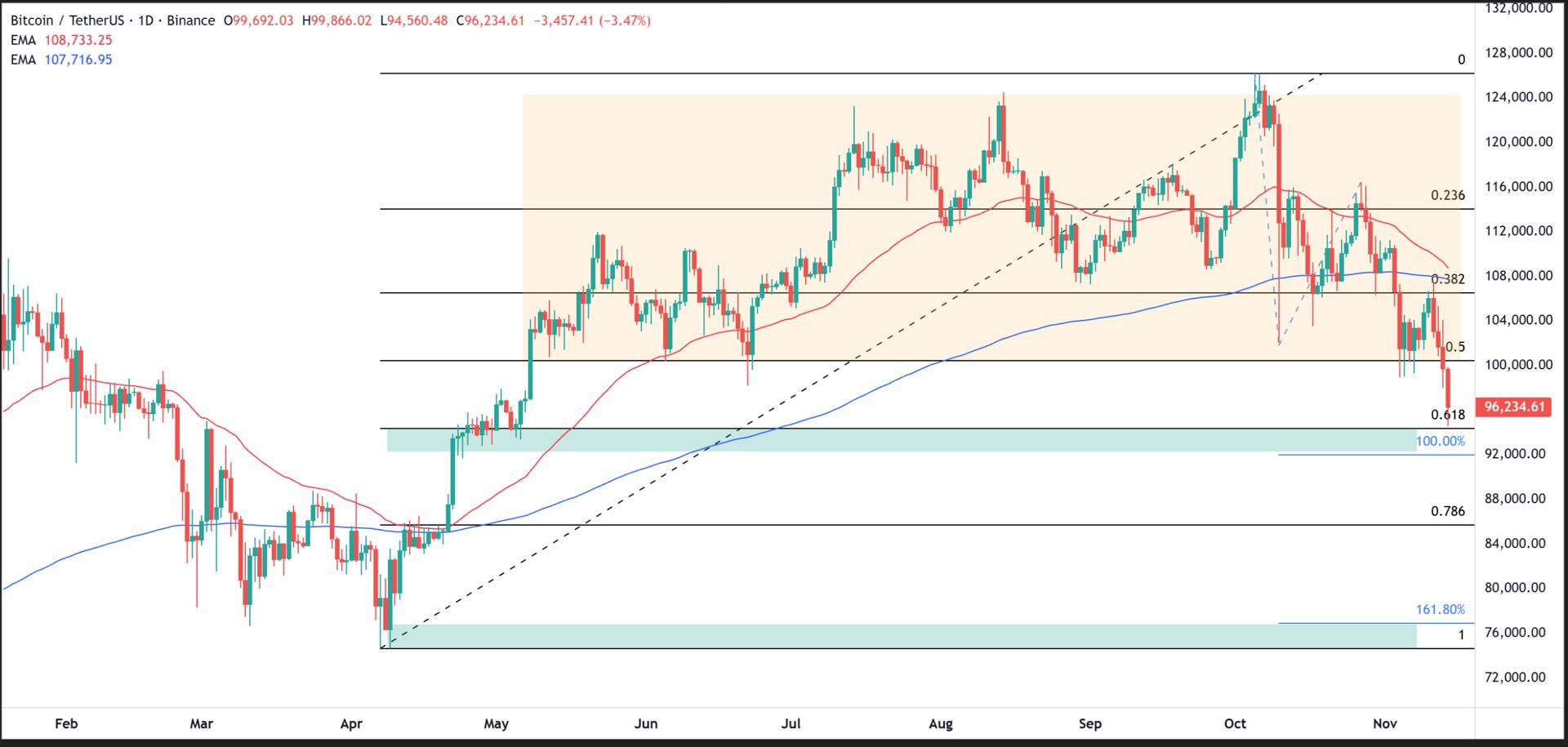
The $94,000-$92,000
support zone represents the next critical battleground for Bitcoin
bulls. If this level fails to hold, technical analysts warn of significantly
deeper depreciation toward April's lows around $74,000, a scenario that would
represent roughly a 50% correction from recent peaks. It
also coincides with my own previous Bitcoin price analysis based on the
Fibonacci extensions.
Market data
reveals Bitcoin's 50-week exponential moving average currently intersects at
$101,285, a level the cryptocurrency must reclaim with a weekly close to
preserve its bullish market structure. Trading at $95,722, Bitcoin would need
to surge over 6.8% just to regain this technical threshold.
Why Bitcoin price is going down today? Source: Tradingview.com
Bitcoin Price Prediction: 30%
Crash Warning from Technical Analyst
TraderJonesy,
a technical analyst from X, has issued a stark warning about Bitcoin's
trajectory, predicting a 30% crash that "nobody sees coming". His
SuperTrend indicator flipped red near $117,000 in mid-August, successfully
calling the entire decline and avoiding the massive drawdown that followed.
"Bitcoin
is about to crash 30% and nobody sees it," TraderJonesy declared, pointing
to a structure of lower highs and lower lows that's
"about to flush below $100K". His system identifies the next major
buy zone near the 200-week moving average around $70,000, suggesting
significant downside remains before accumulation opportunities emerge.
#Bitcoin is about to crash 30% and nobody sees it.
I’ve been bearish on Bitcoin since August 16th, when my SuperTrend flipped red near $117,000. Structure remains the same with lower highs, lower lows and a setup that’s about to flush below $100K.
The analyst
dismisses optimism surrounding government stimulus or traditional four-year
cycles as false hope. "The Moonboys still think the government reopening
or stimulus talk is going to save crypto. They think the four-year cycle is
magically different this time. It's not," he stated. His trend signals
remain bearish, with tools that have been red since $117,000 now pointing
toward the $70,000 region as the ultimate target.
Critical BTC Support
Levels to Watch
Technical
analysis reveals several key price zones that will determine whether Bitcoin
stabilizes or continues its descent toward deeper support levels:
Support
levels: $94,000-$92,000
(immediate critical support), $88,772 (mid-term technical floor), $74,000
(April 2025 lows), $70,000 (200-week MA and TraderJonesy's ultimate target)
Analyst
Rekt Capital notes that Bitcoin has formed clusters of lower lows at
the 50-week EMA region over the past six weeks following its rejection above
$126,000 in October. While this pattern has historically preceded notable
Bitcoin price gains—similar formations between June-September 2024 eventually
led to moves from $51,000 to above $107,000—the near-term technical picture
remains decidedly bearish.
Market Outlook and
Recovery Scenarios
Despite the
carnage, Bitcoin remains up approximately 4-5% year-to-date and has surged
28.6% over the past 12 months from $74,421—though these gains pale compared to
the recent 24% collapse from all-time highs. The cryptocurrency's year-low sits
at $74,421, a level that now represents major downside risk if current support
zones fail.
The path
forward depends heavily on several factors: whether the Federal Reserve
delivers a December rate cut, how quickly Bitcoin can reclaim the psychological
$100,000 level, and whether institutional buyers return after the recent $870
million in ETF outflows. Arkadiusz Jóżwiak maintains a long-term bullish stance
despite near-term bearishness, suggesting that even a drop to $74,000 or lower
would ultimately reverse with Bitcoin returning to all-time highs and beyond.
However, in
the immediate term, momentum clearly favors sellers. Bitcoin needs to establish
higher lows and reclaim key moving averages to shift sentiment, while failure
at current levels opens the door to TraderJonesy's $70,000 target, a scenario
that would inflict devastating losses on leveraged long positions and test the
resolve of even long-term holders.
Bitcoin Price Analysis,
FAQ
Why is BTC price down
today?
Bitcoin
crashed to $95,722 on November 14, 2025, down 3.9% on the day and nearly 9%
week-to-date, as optimism from the U.S. government reopening faded and December
Fed rate cut odds collapsed from 97% to 52%.
Can Bitcoin drop below
$90K?
Yes. Bitcoin
dropping below $90,000 is a realistic possibility if current support at
$94,000-$92,000 fails to hold. Technical analysts warn that breakdown below
this zone opens the door to much deeper declines toward April's lows around
$74,000, with TraderJonesy's SuperTrend system targeting the 200-week moving
average near $70,000.
Is this the start of a
Bitcoin crash?
Yes. Bitcoin
has already experienced a significant crash, plunging 24% from its October
all-time high of $126,296 to $95,722, a six-month low. Technical analyst
TraderJonesy warns of an additional 30% decline to $70,000, stating
"Bitcoin is about to crash 30% and nobody sees it" based on his
SuperTrend indicator that flipped red at $117,000 in August.
What's the BTC price
forecast for 2025?
Bitcoin
price forecasts for 2025 vary dramatically based on near-term technical
outcomes. In the short term, analysts identify critical support at
$94,000-$92,000, with breakdown scenarios targeting $88,772, then $74,000
(April lows), and ultimately $70,000 according to TraderJonesy's 200-week MA
projection. For recovery scenarios, Bitcoin must reclaim $100,000-$101,285 (the
50-week EMA) to preserve bullish market structure and potentially challenge the
October all-time high of $126,296.
Bitcoin (BTC) price crashed
to $95,722 on Friday, November 14, 2025, marking a six-month low and
representing a 24% decline from its October all-time high of $126,296. The
sharp selloff accelerated as optimism from the U.S. government reopening faded
and December Federal Reserve rate cut odds collapsed from 97% to just 52%,
triggering over $1.3 billion in forced liquidations across cryptocurrency
markets.
In this article, I answer the question why Bitcoin is
falling, how low can BTC price go and why the newest Bitcoin price prediction
suggests that we may witness another 30% collapse.
Why Bitcoin Is Going Down?
Government Relief Fades as Rate Cut Hopes Crumble
Bitcoin's descent
accelerated after Tuesday's brief rally above $107,000 failed to hold, with the
cryptocurrency now down nearly 9% week-to-date despite momentarily reclaiming
that level earlier this week. The broader decline mirrors weakness across
growth-sensitive assets as traders reassess the macroeconomic landscape
following diminished expectations for monetary easing.
Samer Hasn
"Bitcoin's
sharp decline accelerated as relief from the U.S. government reopening faded
and the odds of a December rate cut fell sharply," explains Samer Hasn,
Senior Market Analyst at XS.com. "The token is effectively mirroring the
drawdown in stock market and other growth-sensitive assets, with deleveraging
pushing long liquidations higher and reducing buyers' willingness to defend key
levels."
The
psychological $100,000 level has proven critical in determining near-term
market direction. Arkadiusz Jóżwiak, Editor-in-Chief at Comparic.pl, warns that the
breakdown below this threshold sends a clear message about shifting market
dynamics.
Arkadiusz Jóżwiak, Editor-in-Chief at Comparic.pl
“Breaking below $100,000 is a clear signal that bears
are taking control, at least in the short term. At this point we have support
ahead at $94-92K, and if this gets broken, then there's a risk of further, much
deeper depreciation toward April lows around $74,000,” Jóźwiak predicted. “In
the long term, however, I remain a bull and assume that even if Bitcoin drops
that low, or lower, it will ultimately bounce back and return to ATH and higher.”
The $94,000-$92,000
support zone represents the next critical battleground for Bitcoin
bulls. If this level fails to hold, technical analysts warn of significantly
deeper depreciation toward April's lows around $74,000, a scenario that would
represent roughly a 50% correction from recent peaks. It
also coincides with my own previous Bitcoin price analysis based on the
Fibonacci extensions.
Market data
reveals Bitcoin's 50-week exponential moving average currently intersects at
$101,285, a level the cryptocurrency must reclaim with a weekly close to
preserve its bullish market structure. Trading at $95,722, Bitcoin would need
to surge over 6.8% just to regain this technical threshold.
Why Bitcoin price is going down today? Source: Tradingview.com
Bitcoin Price Prediction: 30%
Crash Warning from Technical Analyst
TraderJonesy,
a technical analyst from X, has issued a stark warning about Bitcoin's
trajectory, predicting a 30% crash that "nobody sees coming". His
SuperTrend indicator flipped red near $117,000 in mid-August, successfully
calling the entire decline and avoiding the massive drawdown that followed.
"Bitcoin
is about to crash 30% and nobody sees it," TraderJonesy declared, pointing
to a structure of lower highs and lower lows that's
"about to flush below $100K". His system identifies the next major
buy zone near the 200-week moving average around $70,000, suggesting
significant downside remains before accumulation opportunities emerge.
#Bitcoin is about to crash 30% and nobody sees it.
I’ve been bearish on Bitcoin since August 16th, when my SuperTrend flipped red near $117,000. Structure remains the same with lower highs, lower lows and a setup that’s about to flush below $100K.
The analyst
dismisses optimism surrounding government stimulus or traditional four-year
cycles as false hope. "The Moonboys still think the government reopening
or stimulus talk is going to save crypto. They think the four-year cycle is
magically different this time. It's not," he stated. His trend signals
remain bearish, with tools that have been red since $117,000 now pointing
toward the $70,000 region as the ultimate target.
Critical BTC Support
Levels to Watch
Technical
analysis reveals several key price zones that will determine whether Bitcoin
stabilizes or continues its descent toward deeper support levels:
Support
levels: $94,000-$92,000
(immediate critical support), $88,772 (mid-term technical floor), $74,000
(April 2025 lows), $70,000 (200-week MA and TraderJonesy's ultimate target)
Analyst
Rekt Capital notes that Bitcoin has formed clusters of lower lows at
the 50-week EMA region over the past six weeks following its rejection above
$126,000 in October. While this pattern has historically preceded notable
Bitcoin price gains—similar formations between June-September 2024 eventually
led to moves from $51,000 to above $107,000—the near-term technical picture
remains decidedly bearish.
Market Outlook and
Recovery Scenarios
Despite the
carnage, Bitcoin remains up approximately 4-5% year-to-date and has surged
28.6% over the past 12 months from $74,421—though these gains pale compared to
the recent 24% collapse from all-time highs. The cryptocurrency's year-low sits
at $74,421, a level that now represents major downside risk if current support
zones fail.
The path
forward depends heavily on several factors: whether the Federal Reserve
delivers a December rate cut, how quickly Bitcoin can reclaim the psychological
$100,000 level, and whether institutional buyers return after the recent $870
million in ETF outflows. Arkadiusz Jóżwiak maintains a long-term bullish stance
despite near-term bearishness, suggesting that even a drop to $74,000 or lower
would ultimately reverse with Bitcoin returning to all-time highs and beyond.
However, in
the immediate term, momentum clearly favors sellers. Bitcoin needs to establish
higher lows and reclaim key moving averages to shift sentiment, while failure
at current levels opens the door to TraderJonesy's $70,000 target, a scenario
that would inflict devastating losses on leveraged long positions and test the
resolve of even long-term holders.
Bitcoin Price Analysis,
FAQ
Why is BTC price down
today?
Bitcoin
crashed to $95,722 on November 14, 2025, down 3.9% on the day and nearly 9%
week-to-date, as optimism from the U.S. government reopening faded and December
Fed rate cut odds collapsed from 97% to 52%.
Can Bitcoin drop below
$90K?
Yes. Bitcoin
dropping below $90,000 is a realistic possibility if current support at
$94,000-$92,000 fails to hold. Technical analysts warn that breakdown below
this zone opens the door to much deeper declines toward April's lows around
$74,000, with TraderJonesy's SuperTrend system targeting the 200-week moving
average near $70,000.
Is this the start of a
Bitcoin crash?
Yes. Bitcoin
has already experienced a significant crash, plunging 24% from its October
all-time high of $126,296 to $95,722, a six-month low. Technical analyst
TraderJonesy warns of an additional 30% decline to $70,000, stating
"Bitcoin is about to crash 30% and nobody sees it" based on his
SuperTrend indicator that flipped red at $117,000 in August.
What's the BTC price
forecast for 2025?
Bitcoin
price forecasts for 2025 vary dramatically based on near-term technical
outcomes. In the short term, analysts identify critical support at
$94,000-$92,000, with breakdown scenarios targeting $88,772, then $74,000
(April lows), and ultimately $70,000 according to TraderJonesy's 200-week MA
projection. For recovery scenarios, Bitcoin must reclaim $100,000-$101,285 (the
50-week EMA) to preserve bullish market structure and potentially challenge the
October all-time high of $126,296.
Damian Chmiel is a Senior Analyst & Editor at Finance Magnates with more than 15 years of experience in the CFD and online trading industry. Active as both a trader and journalist since 2010, he focuses on broker coverage, fintech innovation, and regulatory developments across Europe, the Middle East, and Asia.
His work includes interviews with C-level leaders at major brokerages and fintech platforms, as well as co-authoring Finance Magnates’ quarterly industry benchmarking reports. Damian’s reporting is data-driven, market-aware, and grounded in direct industry engagement. His analysis and commentary have also been cited by external media outlets, including Investing.com, Binance, The Asset, Stockhead, and Dispatch.
Education:
MA in Finance and Accounting, Cracow University of Economics
Why Is Dogecoin Going Up Today? DOGE Price Prediction Shows 25% Upside Potential
Featured Videos
AvaTrade to Acquire Most of FXCM; NAGA Raises $8M
AvaTrade to Acquire Most of FXCM; NAGA Raises $8M
AvaTrade to Acquire Most of FXCM; NAGA Raises $8M
AvaTrade to Acquire Most of FXCM; NAGA Raises $8M
Today’s financial news recap covers AvaTrade agrees to acquire most of FXCM, NAGA secures eight million dollars in new financing, and Wise seeks a tax settlement in the UK.
Finance Magnates Daily Recap brings you the latest news from forex and CFD brokers, fintech, payments, cryptocurrency, digital assets, trading platforms, financial regulation and global markets.
Get the key company news, executive moves, deals, regulatory updates and market developments of the day, in just a few minutes. New episodes published every weekday.
Read more: https://www.financemagnates.com
#FinanceMagnates #ForexNews #FintechNews
Today’s financial news recap covers AvaTrade agrees to acquire most of FXCM, NAGA secures eight million dollars in new financing, and Wise seeks a tax settlement in the UK.
Finance Magnates Daily Recap brings you the latest news from forex and CFD brokers, fintech, payments, cryptocurrency, digital assets, trading platforms, financial regulation and global markets.
Get the key company news, executive moves, deals, regulatory updates and market developments of the day, in just a few minutes. New episodes published every weekday.
Read more: https://www.financemagnates.com
#FinanceMagnates #ForexNews #FintechNews
Today’s financial news recap covers AvaTrade agrees to acquire most of FXCM, NAGA secures eight million dollars in new financing, and Wise seeks a tax settlement in the UK.
Finance Magnates Daily Recap brings you the latest news from forex and CFD brokers, fintech, payments, cryptocurrency, digital assets, trading platforms, financial regulation and global markets.
Get the key company news, executive moves, deals, regulatory updates and market developments of the day, in just a few minutes. New episodes published every weekday.
Read more: https://www.financemagnates.com
#FinanceMagnates #ForexNews #FintechNews
Today’s financial news recap covers AvaTrade agrees to acquire most of FXCM, NAGA secures eight million dollars in new financing, and Wise seeks a tax settlement in the UK.
Finance Magnates Daily Recap brings you the latest news from forex and CFD brokers, fintech, payments, cryptocurrency, digital assets, trading platforms, financial regulation and global markets.
Get the key company news, executive moves, deals, regulatory updates and market developments of the day, in just a few minutes. New episodes published every weekday.
Read more: https://www.financemagnates.com
#FinanceMagnates #ForexNews #FintechNews
XTB Adds Overnight US Stock Trading; Nasdaq Ventures Invests in One Trading
XTB Adds Overnight US Stock Trading; Nasdaq Ventures Invests in One Trading
XTB Adds Overnight US Stock Trading; Nasdaq Ventures Invests in One Trading
XTB Adds Overnight US Stock Trading; Nasdaq Ventures Invests in One Trading
XTB Adds Overnight US Stock Trading; Nasdaq Ventures Invests in One Trading
XTB Adds Overnight US Stock Trading; Nasdaq Ventures Invests in One Trading
Today’s financial news recap covers XTB expands overnight US stock trading, Fortrade reports higher revenue, Nasdaq backs One Trading, and Vest Labs raises 13 million dollars.
Finance Magnates Daily Recap brings you the latest news from forex and CFD brokers, fintech, payments, cryptocurrency, digital assets, trading platforms, financial regulation and global markets.
Get the key company news, executive moves, deals, regulatory updates and market developments of the day, in just a few minutes. New episodes published every weekday.
Read more: https://www.financemagnates.com
#FinanceMagnates #ForexNews #FintechNews
Today’s financial news recap covers XTB expands overnight US stock trading, Fortrade reports higher revenue, Nasdaq backs One Trading, and Vest Labs raises 13 million dollars.
Finance Magnates Daily Recap brings you the latest news from forex and CFD brokers, fintech, payments, cryptocurrency, digital assets, trading platforms, financial regulation and global markets.
Get the key company news, executive moves, deals, regulatory updates and market developments of the day, in just a few minutes. New episodes published every weekday.
Read more: https://www.financemagnates.com
#FinanceMagnates #ForexNews #FintechNews
Today’s financial news recap covers XTB expands overnight US stock trading, Fortrade reports higher revenue, Nasdaq backs One Trading, and Vest Labs raises 13 million dollars.
Finance Magnates Daily Recap brings you the latest news from forex and CFD brokers, fintech, payments, cryptocurrency, digital assets, trading platforms, financial regulation and global markets.
Get the key company news, executive moves, deals, regulatory updates and market developments of the day, in just a few minutes. New episodes published every weekday.
Read more: https://www.financemagnates.com
#FinanceMagnates #ForexNews #FintechNews
Today’s financial news recap covers XTB expands overnight US stock trading, Fortrade reports higher revenue, Nasdaq backs One Trading, and Vest Labs raises 13 million dollars.
Finance Magnates Daily Recap brings you the latest news from forex and CFD brokers, fintech, payments, cryptocurrency, digital assets, trading platforms, financial regulation and global markets.
Get the key company news, executive moves, deals, regulatory updates and market developments of the day, in just a few minutes. New episodes published every weekday.
Read more: https://www.financemagnates.com
#FinanceMagnates #ForexNews #FintechNews
Today’s financial news recap covers XTB expands overnight US stock trading, Fortrade reports higher revenue, Nasdaq backs One Trading, and Vest Labs raises 13 million dollars.
Finance Magnates Daily Recap brings you the latest news from forex and CFD brokers, fintech, payments, cryptocurrency, digital assets, trading platforms, financial regulation and global markets.
Get the key company news, executive moves, deals, regulatory updates and market developments of the day, in just a few minutes. New episodes published every weekday.
Read more: https://www.financemagnates.com
#FinanceMagnates #ForexNews #FintechNews
Today’s financial news recap covers XTB expands overnight US stock trading, Fortrade reports higher revenue, Nasdaq backs One Trading, and Vest Labs raises 13 million dollars.
Finance Magnates Daily Recap brings you the latest news from forex and CFD brokers, fintech, payments, cryptocurrency, digital assets, trading platforms, financial regulation and global markets.
Get the key company news, executive moves, deals, regulatory updates and market developments of the day, in just a few minutes. New episodes published every weekday.
Read more: https://www.financemagnates.com
#FinanceMagnates #ForexNews #FintechNews
CMC Founder Downplays Volatility Hit; Devexperts Names CEO
CMC Founder Downplays Volatility Hit; Devexperts Names CEO
CMC Founder Downplays Volatility Hit; Devexperts Names CEO
CMC Founder Downplays Volatility Hit; Devexperts Names CEO
CMC Founder Downplays Volatility Hit; Devexperts Names CEO
CMC Founder Downplays Volatility Hit; Devexperts Names CEO
Today’s financial news recap covers low volatility pressures brokers, Devexperts names a new CEO, Saxo cuts onboarding time, and OKX reaches a 25 billion dollar valuation.
Finance Magnates Daily Recap brings you the latest news from forex and CFD brokers, fintech, payments, cryptocurrency, digital assets, trading platforms, financial regulation and global markets.
Get the key company news, executive moves, deals, regulatory updates and market developments of the day, in just a few minutes. New episodes published every weekday.
Read more: https://www.financemagnates.com
#FinanceMagnates #ForexNews #FintechNews
Today’s financial news recap covers low volatility pressures brokers, Devexperts names a new CEO, Saxo cuts onboarding time, and OKX reaches a 25 billion dollar valuation.
Finance Magnates Daily Recap brings you the latest news from forex and CFD brokers, fintech, payments, cryptocurrency, digital assets, trading platforms, financial regulation and global markets.
Get the key company news, executive moves, deals, regulatory updates and market developments of the day, in just a few minutes. New episodes published every weekday.
Read more: https://www.financemagnates.com
#FinanceMagnates #ForexNews #FintechNews
Today’s financial news recap covers low volatility pressures brokers, Devexperts names a new CEO, Saxo cuts onboarding time, and OKX reaches a 25 billion dollar valuation.
Finance Magnates Daily Recap brings you the latest news from forex and CFD brokers, fintech, payments, cryptocurrency, digital assets, trading platforms, financial regulation and global markets.
Get the key company news, executive moves, deals, regulatory updates and market developments of the day, in just a few minutes. New episodes published every weekday.
Read more: https://www.financemagnates.com
#FinanceMagnates #ForexNews #FintechNews
Today’s financial news recap covers low volatility pressures brokers, Devexperts names a new CEO, Saxo cuts onboarding time, and OKX reaches a 25 billion dollar valuation.
Finance Magnates Daily Recap brings you the latest news from forex and CFD brokers, fintech, payments, cryptocurrency, digital assets, trading platforms, financial regulation and global markets.
Get the key company news, executive moves, deals, regulatory updates and market developments of the day, in just a few minutes. New episodes published every weekday.
Read more: https://www.financemagnates.com
#FinanceMagnates #ForexNews #FintechNews
Today’s financial news recap covers low volatility pressures brokers, Devexperts names a new CEO, Saxo cuts onboarding time, and OKX reaches a 25 billion dollar valuation.
Finance Magnates Daily Recap brings you the latest news from forex and CFD brokers, fintech, payments, cryptocurrency, digital assets, trading platforms, financial regulation and global markets.
Get the key company news, executive moves, deals, regulatory updates and market developments of the day, in just a few minutes. New episodes published every weekday.
Read more: https://www.financemagnates.com
#FinanceMagnates #ForexNews #FintechNews
Today’s financial news recap covers low volatility pressures brokers, Devexperts names a new CEO, Saxo cuts onboarding time, and OKX reaches a 25 billion dollar valuation.
Finance Magnates Daily Recap brings you the latest news from forex and CFD brokers, fintech, payments, cryptocurrency, digital assets, trading platforms, financial regulation and global markets.
Get the key company news, executive moves, deals, regulatory updates and market developments of the day, in just a few minutes. New episodes published every weekday.
Read more: https://www.financemagnates.com
#FinanceMagnates #ForexNews #FintechNews
Today’s financial news recap covers Trade Nation buys FXCM's UK client book, Trading 212 reports higher revenue, the CFTC's move to allow perpetual index futures.
Finance Magnates Daily Recap brings you the latest news from forex and CFD brokers, fintech, payments, cryptocurrency, digital assets, trading platforms, financial regulation and global markets.
Get the key company news, executive moves, deals, regulatory updates and market developments of the day, in just a few minutes. New episodes published every weekday.
Read more: https://www.financemagnates.com
#FinanceMagnates #ForexNews #FintechNews
Today’s financial news recap covers Trade Nation buys FXCM's UK client book, Trading 212 reports higher revenue, the CFTC's move to allow perpetual index futures.
Finance Magnates Daily Recap brings you the latest news from forex and CFD brokers, fintech, payments, cryptocurrency, digital assets, trading platforms, financial regulation and global markets.
Get the key company news, executive moves, deals, regulatory updates and market developments of the day, in just a few minutes. New episodes published every weekday.
Read more: https://www.financemagnates.com
#FinanceMagnates #ForexNews #FintechNews
Today’s financial news recap covers Trade Nation buys FXCM's UK client book, Trading 212 reports higher revenue, the CFTC's move to allow perpetual index futures.
Finance Magnates Daily Recap brings you the latest news from forex and CFD brokers, fintech, payments, cryptocurrency, digital assets, trading platforms, financial regulation and global markets.
Get the key company news, executive moves, deals, regulatory updates and market developments of the day, in just a few minutes. New episodes published every weekday.
Read more: https://www.financemagnates.com
#FinanceMagnates #ForexNews #FintechNews
Today’s financial news recap covers Trade Nation buys FXCM's UK client book, Trading 212 reports higher revenue, the CFTC's move to allow perpetual index futures.
Finance Magnates Daily Recap brings you the latest news from forex and CFD brokers, fintech, payments, cryptocurrency, digital assets, trading platforms, financial regulation and global markets.
Get the key company news, executive moves, deals, regulatory updates and market developments of the day, in just a few minutes. New episodes published every weekday.
Read more: https://www.financemagnates.com
#FinanceMagnates #ForexNews #FintechNews
Today’s financial news recap covers Trade Nation buys FXCM's UK client book, Trading 212 reports higher revenue, the CFTC's move to allow perpetual index futures.
Finance Magnates Daily Recap brings you the latest news from forex and CFD brokers, fintech, payments, cryptocurrency, digital assets, trading platforms, financial regulation and global markets.
Get the key company news, executive moves, deals, regulatory updates and market developments of the day, in just a few minutes. New episodes published every weekday.
Read more: https://www.financemagnates.com
#FinanceMagnates #ForexNews #FintechNews
Today’s financial news recap covers Trade Nation buys FXCM's UK client book, Trading 212 reports higher revenue, the CFTC's move to allow perpetual index futures.
Finance Magnates Daily Recap brings you the latest news from forex and CFD brokers, fintech, payments, cryptocurrency, digital assets, trading platforms, financial regulation and global markets.
Get the key company news, executive moves, deals, regulatory updates and market developments of the day, in just a few minutes. New episodes published every weekday.
Read more: https://www.financemagnates.com
#FinanceMagnates #ForexNews #FintechNews
Your career isn’t a linear path.
Your career isn’t a linear path.
Your career isn’t a linear path.
Your career isn’t a linear path.
Your career isn’t a linear path.
Your career isn’t a linear path.
Roles change. Career goals change. Sometimes you want a completely new challenge.
But the skills and knowledge you build along the way can stay with you and give you something to build on.
For Jeff Patterson, that continued growth is key to long-term career development.
You bring the skills. FM Academy helps you build the knowledge.
#FMAcademy #FinanceMagnates #FinanceCareers #ProfessionalDevelopment #Fintech
Roles change. Career goals change. Sometimes you want a completely new challenge.
But the skills and knowledge you build along the way can stay with you and give you something to build on.
For Jeff Patterson, that continued growth is key to long-term career development.
You bring the skills. FM Academy helps you build the knowledge.
#FMAcademy #FinanceMagnates #FinanceCareers #ProfessionalDevelopment #Fintech
Roles change. Career goals change. Sometimes you want a completely new challenge.
But the skills and knowledge you build along the way can stay with you and give you something to build on.
For Jeff Patterson, that continued growth is key to long-term career development.
You bring the skills. FM Academy helps you build the knowledge.
#FMAcademy #FinanceMagnates #FinanceCareers #ProfessionalDevelopment #Fintech
Roles change. Career goals change. Sometimes you want a completely new challenge.
But the skills and knowledge you build along the way can stay with you and give you something to build on.
For Jeff Patterson, that continued growth is key to long-term career development.
You bring the skills. FM Academy helps you build the knowledge.
#FMAcademy #FinanceMagnates #FinanceCareers #ProfessionalDevelopment #Fintech
Roles change. Career goals change. Sometimes you want a completely new challenge.
But the skills and knowledge you build along the way can stay with you and give you something to build on.
For Jeff Patterson, that continued growth is key to long-term career development.
You bring the skills. FM Academy helps you build the knowledge.
#FMAcademy #FinanceMagnates #FinanceCareers #ProfessionalDevelopment #Fintech
Roles change. Career goals change. Sometimes you want a completely new challenge.
But the skills and knowledge you build along the way can stay with you and give you something to build on.
For Jeff Patterson, that continued growth is key to long-term career development.
You bring the skills. FM Academy helps you build the knowledge.
#FMAcademy #FinanceMagnates #FinanceCareers #ProfessionalDevelopment #Fintech