
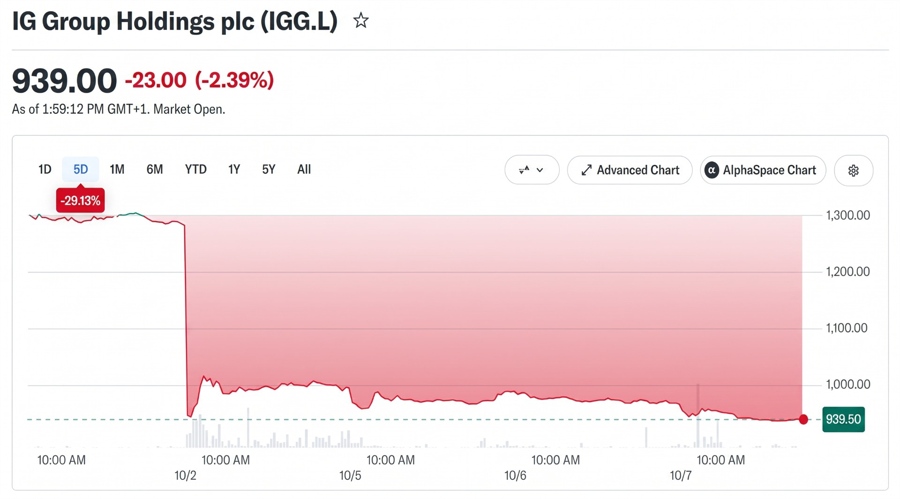
Friday, 2 October, was a bad morning for IG Group shareholders. The stock plunged as much as 27% in early trading after management slashed its revenue outlook, marking its worst trading session for nearly a decade.
Rivals immediately felt the squeeze and by Monday, they had all found a way to explain why IG's numbers were not theirs.
“Peers responded quickly. I read these as positive signals. None of them, however, addressed what actually hurt IG,” Maksymilian Bączkowski, Senior Quantitative Analyst at AI Investments Ltd, says to Finance Magnates.
London's trading industry is coming home!
What Actually Happened to IG
What actually hurt IG was not a sudden collapse in retail trading appetite, but its own risk management.
In its core over-the-counter (OTC) derivatives business, IG retained just 70% of client trading incoming during Q3, a sharp drop from its historical average of 80%. The decline stems from an internal shift in the second half of 2025 in how it priced and hedged client flow.
As a consequence, IG now expects Q3 revenue to fall 14% year-on-year to £240 million. Because of this severe quarterly shortfall, management was forced to dial back its broader outlook, forecasting mid-single-digit revenue growth for 2026, a steep downgrade from the 10-15% target touted just last May.
"Lower Q3 revenue reflected reduced OTC revenue retention in less supportive market conditions," CEO Breon Corcoran stated, though he maintained confidence in the firm’s medium-term trajectory.

Analysts did not share in the optimism.
Peel Hunt warned of a high-teens cut to consensus EBITDA due to lower revenue and margin guidance. Similarly, Panmure Liberum cut its price target to 1,500 pence from 2,000 pence and reduced its 2026 EBITDA forecast by 18.3%, noting the hedging shift renders IG’s core earnings less predictable.
By Monday, the shares had shed an additional 2.5%.
Adding to this instability, IG is currently navigating a quiet tech exodus. Group CTO David Perry and UK and Ireland CTO Qaiser Mazhar have both left after about a year, Finance Magnates reported, having worked on moving IG's legacy architecture to AI-enabled infrastructure.
IG has not confirmed the departures, and it is unclear whether they are linked to the restructuring of its consumer business, which would involve hundreds of job cuts.
A Disproportionate Reaction
The initial market reflex was a sector-wide contagion: Rivals CMC Markets and Plus500 saw their stock dropping down by as much as 9% and 14%, respectively.
However, IG's underlying customer metrics actually held firm: organic first trades jumped 25%, and active customers rose 17%. Furthermore, Underdog, the US prediction market IG is acquiring for $1.3 billion, doubled its quarterly revenue to $105 million.
Analysts quickly characterized the shortfall as a self-inflicted wound rather than industry-wide decay, with UBS dismissing the broader sector sell-off as a massive overreaction.
That sentiment is shared among analysts who view the market's punishment as disproportionate to the actual earnings miss.

“Was the sell-off fair? Partly,” Bączkowski says. “The stock closed 22.6% lower, more than the earnings reset alone would explain, so investors added a discount for uncertainty. Some of that discount is earned.”
He noted that while IG's recent market-making changes made retention swing more from quarter to quarter, the sell-off ignores the underlying fundamentals. “Treating one quarter at 70% retention as the new normal looks overdone, while customer growth is still in double digits.”
Bączkowski stressed that the trust test will be IG’s upcoming 22 October Q3 update: “If management shows retention can move back toward 80% over time, part of the discount could unwind.”
Plus500 and CMC Rush to Reassure
Rivals wasted no time telling the market that IG’s bleeding was isolated.
By midday on Friday, Plus500 said that it "continues to trade in-line with current market expectations for FY 2026 and maintains a strong cash position".
Crucially, management pointed to a risk management framework that "has been through various market cycles over the years and has demonstrated an established and robust track record over time." One could interpret this as a thinly veiled contrast to IG’s hedging misstep.
The intervention worked, with shares recovering just 6% lower.
- IG Group Tech Chiefs Exit as Brokers Hunt for AI Talent Intesifies
- IG's OTC Retention Slips, Pushing Q3 Revenue Expectation at 14% Lower
- Five Things to Know About IG's New All-in-One App
CMC Markets responded differently. As the news broke, Lord Peter Cruddas, the company's founder, CEO and majority shareholder, bought 23,011 shares at around £6.04 and said he would buy up to £5 million in total. The announcement saw the stock paring its losses.
"Since our IPO a decade ago in 2016, I have not sold a single CMC share," Cruddas said earlier this week, adding that he has "no intention of selling any shares".
In July, CMC Markets raised its net operating income guidance for the 2027 fiscal year to at least £550 million, from £460-480 million, crediting the scale of its B2B platforms – the shares rose 20% that day.

The firm says it is about to broaden its B2B suite with new prime, gold and pricing products. As Cruddas added today, it is also a hedge against market conditions.
While IG's growth since 2021 has largely been bought – tastytrade for $1 billion, Freetrade, and now Underdog – CMC takes pride in its tech and institutional offering, and argues the mix keeps earnings steadier when retail activity dips.
"The VIX hovering at historically low levels [is] causing a tougher operating backdrop for some of our industry peers," Lord Cruddas said in a fresh announcement published today. "However, that macro headwind is not reflected in CMC's performance."
Another executive we spoke with at CMC Markets pointed to the firm’s strategy as a differentiator: marketing is run locally in each region, leadership is coming from investment banks and trading, and hiring is on the rise. "When you call, we pick up the phone, not push you to the platform," he said.
“For now the market treats this as an IG problem: peers fell far less, and CMC has already recovered its initial losses. Market conditions and client P&L affect the whole industry, though, so the question stays open until peers report their own numbers,” Bączkowski says.
Meanwhile, Nasdaq-listed eToro barely registered the shockwave. With its Q2 funded accounts up 18%, eToro’s valuation remains tethered to a separate set of challenges, namely, a sharp drop in retail crypto activity and its ongoing US expansion efforts via the TradeZero acquisition.
For eToro, CFD retention is a secondary storyline.
Pepperstone: Not Listed, Still Talking
The blast radius even reached the private markets. Pepperstone has no shareholders to reassure and does not publish mid-year results. Its CEO, Tamas Szabo, published some anyway, citing "mixed results and plenty of focus on broker performance in the market recently."
In the first quarter of its financial year, July to September, Pepperstone says volumes rose more than 30%, with double-digit growth in new clients and revenue, and new client first trades 40% ahead of last year. The figures are self-reported and unaudited.
Szabo also pointed to the February launch of Pepperstone Crypto in Australia, with a gradual global rollout planned, and to new CTO Nigel Fernandes, hired from Xero to invest in "the technology we own".
That a private firm felt the need to say anything at all shows how far the IG news travelled.
Existential Threats Still Loom
So, one bad Friday and three ways of saying business as usual. Still, none of those answers deal with the looming structural threats the industry faces.
Customer acquisition costs are soaring – IG increased its Premier League advertising spend by 51% this season – just as deep-pocketed outsiders encroach on the retail trading space.
Revolut, armed with a new UK banking license and 68 million users, already possesses a CFD trading base in 29 countries that traditional brokers spend fortunes to acquire.
Simultaneously, prediction markets are siphoning younger, risk-tolerant demographics who rarely open CFD accounts. Kalshi raised $1 billion at a $22 billion valuation this year, and Polymarket is in talks at above $20 billion.
On top of that, traditional crypto venues like Coinbase are securing CFTC approval to offer perpetual futures in the US.
For B2B providers, the threat from outside comes with an opening: CMC's UK head has told Finance Magnates that neobanks want trading, and that CMC is the partner to deliver it.
Meanwhile, brokers are responding in different ways, especially to the prediction markets threat: IG is buying Underdog, while Plus500 has distributed Kalshi's contracts through its US futures business since February. The legal position surrounding prediction markets, though, is still unsettled, with several US states winning injunctions against Kalshi.
The market will soon see whether the Q3 turbulence was truly an IG anomaly or a symptom of a shifting landscape.


