Bitcoin traded at $74,300 on Thursday, April 16, 2026, testing the $75,000 consolidation ceiling that has capped rallies since February.
BTC/USD chart shows the 38.2% Fibonacci retracement and $75K resistance must break before the $84K-$85K confluence zone comes into play
eToro CEO Yoni Assia targets $250K BTC at Paris Blockchain Week; Wincent's Paul Howard projects $100K by Q4 2026.
Yoni Assia at the eToro IPO launch event at Nasdaq (Photo: Wikimedia)
Bitcoin
traded at $74,300 on Thursday, April 16, 2026, sitting 41% below the $126,198
all-time high set on October 6, 2025, as the market retests resistance at the
top of a consolidation range that has defined the chart since early February.
Tuesday's session briefly cleared $76,000 before reversing into a bearish pin
bar, the same pattern that my previous analysis flagged as the dominant technical
signal this week.
The bitcoin
price prediction debate is being shaped by two competing forces: $411 million
in single-day ETF inflows on April 15 after Goldman Sachs filed for a new
Bitcoin ETF, and the mechanical reality that every rally attempt toward $75,000
has been sold since the consolidation began. Charles Schwab announced its spot
Bitcoin and Ethereum trading platform rollout this week, adding another
institutional on-ramp.
"Bitcoin
is on the path eventually to $250,000, $500,000 and beyond," Assia said
during a fireside chat. He expects the current slowdown to last one more
quarter before an accumulation phase pushes BTC to new highs.
The
conviction carries weight given eToro's exposure. The platform reported total
revenue and income of $13.8 billion in 2025, of which $12.98 billion came from
crypto assets, making crypto roughly 94% of its business. That revenue mix
explains why eToro is spending $70 million to bring Zengo's self-custody wallet
technology in-house and expanding into tokenized assets, prediction markets,
and yield products.
Paul
Howard, Senior Director at crypto market maker Wincent, frames the trajectory
as more measured. "We are seeing steady growth in institutional and
high-net-worth interest, which acts as a consistent catalyst for BTC,
particularly through larger OTC trades and increased engagement from
sophisticated counterparties," Howard said. He projects BTC could reach
$100,000 by Q4 2026, though not necessarily setting a new all-time high within
the year.
Key
drivers shaping the bitcoin price prediction:
ETF-driven institutional demand absorbed $1.1 billion in
weekly inflows, the strongest since January
Fed rate stance at 3.50-3.75% providing a
floor for risk assets while keeping monetary conditions restrictive
Iran ceasefire removed the geopolitical
premium from oil, loosening the BTC-Nasdaq correlation trade
eToro's Zengo acquisition and Goldman Sachs ETF filing
signal deepening institutional commitment to crypto infrastructure
Tax-season selling mechanically pressuring prices
into mid-April, expected to clear by month-end
Weekly
inflows hit $1.1 billion for the week ending April 11, the largest weekly
intake since January. IBIT captured $871 million of that total. Year-to-date
flows have turned positive at $2.3 billion, and total ETF AUM reached $96.5
billion, the highest since mid-March.
Adam
Haeems, Head of Asset Management at Tesseract Group, identified three
short-term drivers. "The Fed holding at 3.50-3.75% keeps the floor under
risk assets generally. The Iran ceasefire took some of the geopolitical premium
out of oil, which loosened the correlation trade that was pinning BTC to the
Nasdaq through March. And tax-season liquidations are adding noise this week,
that's mechanical, not directional," Haeems said.
Haeems also
flagged what he considers the most underappreciated structural shift. "A
growing share of the $8 billion-plus in wrapped Bitcoin sitting in DeFi
protocols is being actively managed rather than parked as idle collateral. That
changes the holding cost calculation, which feeds back into price," he
said. When allocators can generate yield on a BTC position rather than giving
up the risk-free rate, they size larger and hold longer.
BlackRock IBIT: $505M inflows over April
14-15, five consecutive days of positive flows
Goldman Sachs: filed for new Bitcoin ETF,
joining the institutional race
Morgan Stanley MSBT: $100M+ inflows in first six
trading days since launch
YTD flows: positive at $2.3B after
digging out of a Q1 outflow hole
Total spot ETF AUM: $96.5B, approaching the
January high-water mark
As I noted
in my April analysis, Q1 absorbed $18.7 billion in net
ETF inflows despite a 23% price decline, suggesting institutional conviction
moved to lower price levels rather than disappearing.
Bitcoin is
currently pressing against the upper boundary of the consolidation range it has
occupied since early February, and this range sits at the lowest price levels
since November 2024. Based on my over 15 years of experience as an analyst and
trader, the structure is clear.
The upper
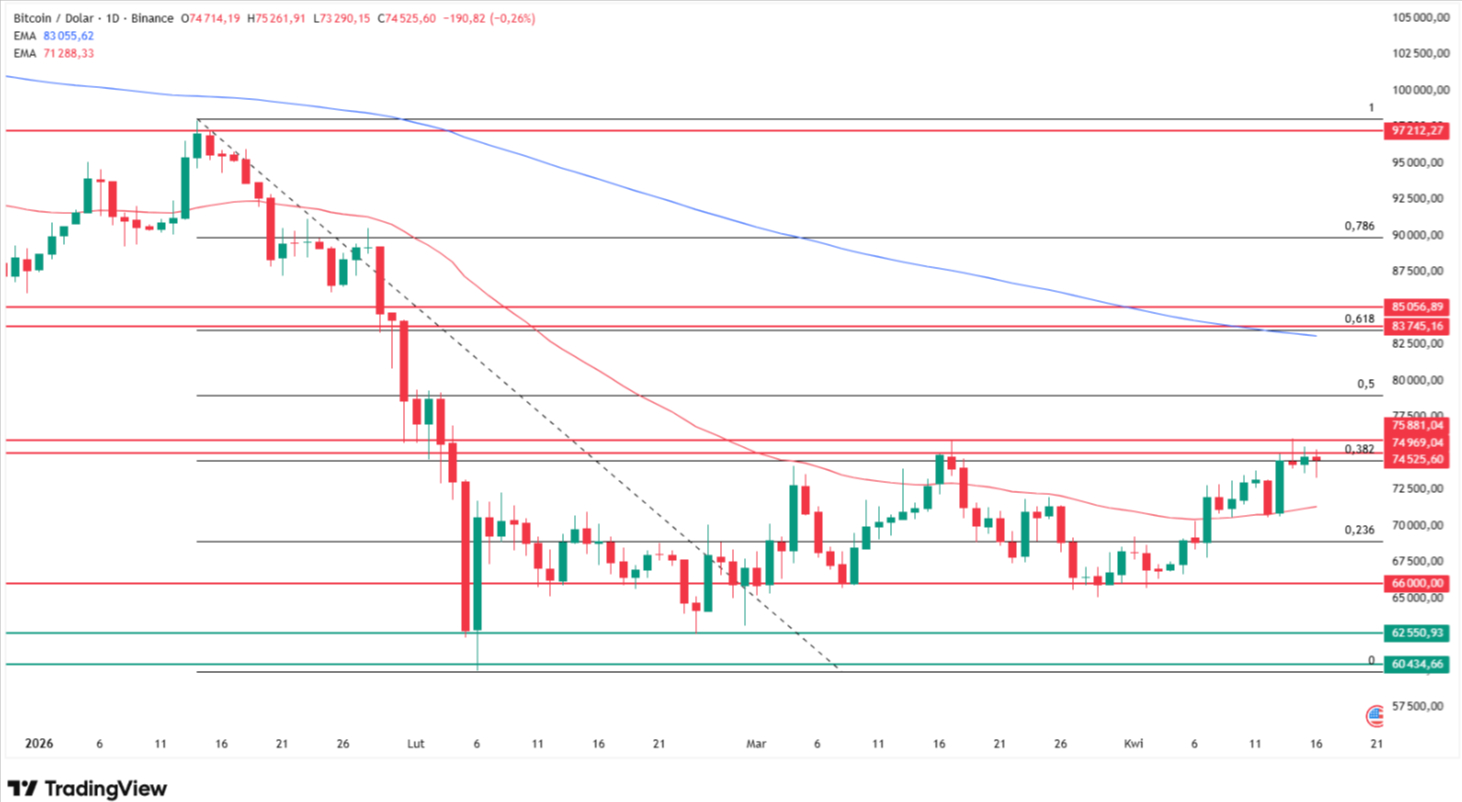
boundary is defined by the $75,000 area, which coincides with the 38.2%
Fibonacci retracement of the decline from the October 2025 ATH. This level
carries additional significance because it aligns with important swing lows
from April 2025 that previously acted as support.
The lower
boundary sits at the early February lows in the $60,400-$62,500 zone, with a
local support shelf near $66,000. The 50 EMA runs at approximately $72,000, and
price has reclaimed it, a necessary but insufficient condition for any bullish
continuation.
How high can Bitcoin go? BTC/USDT price prediction. Source: Tradingview.com
My chart
shows that even if Bitcoin breaks above this consolidation to the upside,
supply pressure does not disappear. The 200 EMA and the 61.8% Fibonacci
retracement converge in the $84,000-$85,000 zone, building a strong confluence
resistance that has defined the bearish trend boundary since late 2025.
As I
detailed in my March analysis, the 200 EMA remains the line
separating corrective rallies from genuine trend reversals. Only a daily close
above the $84,000-$85,000 confluence would remove the bearish pressure from
Bitcoin's chart.
Level
Type
Notes
$84,000-$85,000
Resistance (confluence)
200 EMA +
61.8% Fibonacci retracement, major trend separator
$75,000
Resistance
Upper
consolidation boundary + 38.2% Fib, April 2025 swing lows
$72,000
Support (dynamic)
50 EMA, currently reclaimed
$66,000
Support
Local
shelf, mid-range level
$60,400-$62,500
Support
Lower
consolidation boundary, February 2026 lows
How High Can Bitcoin Go?
Price Predictions for 2026
Assia is
not alone in targeting $250,000. BitMEX co-founder Arthur Hayes and "Rich
Dad Poor Dad" author Robert Kiyosaki have both issued similar calls, as the FinanceMagnates.com report from
February detailed
alongside even more aggressive targets. A $250,000 BTC price would imply a $5
trillion market capitalization, making Bitcoin the world's second-largest asset
after gold.
Howard's
$100,000 Q4 target at Wincent is built on two pillars: geopolitical
de-escalation and potential monetary easing in H2 2026. "I maintain my
previous 2025 outlook that 2026 will be characterised by a steady uptrend for
BTC, potentially reaching $100K by Q4, though not necessarily setting a new
all-time high within the year," Howard said.
Haeems
approaches the question from a structural angle rather than a price target.
"Bitcoin has been range-bound between $64,000 support and $74,000
resistance for weeks now. That range has absorbed the Hormuz shock, the March
correlation squeeze, and tax-season selling without breaking in either
direction," he said.
He noted
roughly $6 billion in short liquidation is clustered above the current range,
meaning any sustained break through $74,000 gets accelerated mechanically. On
the bearish side, Galaxy Digital described the year ahead as "too chaotic
to predict," as the FinanceMagnates.com report noted.
Source
Target
Notes
Yoni Assia, CEO, eToro
$250,000+
Eventually,
after one more quarter of slowdown
Paul Howard, Wincent
$100,000
Q4 2026,
no new ATH this year
Arthur Hayes, BitMEX
$250,000
Long-term cycle target
Robert Kiyosaki
$250,000
Macro debasement thesis
Galaxy Digital
No target
"Too
chaotic to predict," urges caution
My Fibonacci extension
$84,000-$85,000 first test
Confluence
resistance, must clear for bull trend
FAQ, Bitcoin Price
Prediction
How high can Bitcoin go in
2026?
eToro CEO
Yoni Assia targets $250,000, which would imply a $5 trillion market cap, making
BTC the world's second-largest asset after gold. Wincent's Paul Howard projects
$100,000 by Q4 2026 based on steady institutional growth, while Tesseract's
Adam Haeems notes $6 billion in clustered shorts above $74,000 that could
accelerate a breakout.
What is the Bitcoin price
prediction for April 2026?
Bitcoin
trades at $74,300 as of April 16, 2026, testing the $75,000 upper boundary of a
consolidation range that has held since February. The failed breakout above
$76,000 on April 14 produced a bearish pin bar. The lower boundary sits at
$60,400-$62,500. My technical analysis identifies $84,000-$85,000 as the next
major resistance.
Why is Bitcoin stuck below
$75,000?
The $75,000
level coincides with the 38.2% Fibonacci retracement of the decline from the
October 2025 ATH of $126,198. This zone also aligns with April 2025 swing lows.
Sellers have defended this level on every test since February, creating a
ceiling that requires significant volume and catalyst convergence to break.
Are Bitcoin ETF inflows
bullish for BTC price?
Spot
Bitcoin ETFs absorbed $1.1 billion in weekly inflows ending April 11, the
strongest since January. Total AUM reached $96.5 billion. Goldman Sachs filed
for a new BTC ETF, and Morgan Stanley's MSBT attracted $100M+ in its first six
trading days. These flows provide structural demand, but BTC remains
range-bound, suggesting inflows are being absorbed without triggering a
breakout.
Will Bitcoin reach
$100,000 again in 2026?
Wincent's
Paul Howard projects BTC could reach $100,000 by Q4 2026 but likely will not
set a new ATH this year. My chart shows the 200 EMA at $84,000-$85,000 must
clear first, a 14% move from current levels. Prediction markets price
$100K by December 31 at roughly 38%.
Bitcoin
traded at $74,300 on Thursday, April 16, 2026, sitting 41% below the $126,198
all-time high set on October 6, 2025, as the market retests resistance at the
top of a consolidation range that has defined the chart since early February.
Tuesday's session briefly cleared $76,000 before reversing into a bearish pin
bar, the same pattern that my previous analysis flagged as the dominant technical
signal this week.
The bitcoin
price prediction debate is being shaped by two competing forces: $411 million
in single-day ETF inflows on April 15 after Goldman Sachs filed for a new
Bitcoin ETF, and the mechanical reality that every rally attempt toward $75,000
has been sold since the consolidation began. Charles Schwab announced its spot
Bitcoin and Ethereum trading platform rollout this week, adding another
institutional on-ramp.
"Bitcoin
is on the path eventually to $250,000, $500,000 and beyond," Assia said
during a fireside chat. He expects the current slowdown to last one more
quarter before an accumulation phase pushes BTC to new highs.
The
conviction carries weight given eToro's exposure. The platform reported total
revenue and income of $13.8 billion in 2025, of which $12.98 billion came from
crypto assets, making crypto roughly 94% of its business. That revenue mix
explains why eToro is spending $70 million to bring Zengo's self-custody wallet
technology in-house and expanding into tokenized assets, prediction markets,
and yield products.
Paul
Howard, Senior Director at crypto market maker Wincent, frames the trajectory
as more measured. "We are seeing steady growth in institutional and
high-net-worth interest, which acts as a consistent catalyst for BTC,
particularly through larger OTC trades and increased engagement from
sophisticated counterparties," Howard said. He projects BTC could reach
$100,000 by Q4 2026, though not necessarily setting a new all-time high within
the year.
Key
drivers shaping the bitcoin price prediction:
ETF-driven institutional demand absorbed $1.1 billion in
weekly inflows, the strongest since January
Fed rate stance at 3.50-3.75% providing a
floor for risk assets while keeping monetary conditions restrictive
Iran ceasefire removed the geopolitical
premium from oil, loosening the BTC-Nasdaq correlation trade
eToro's Zengo acquisition and Goldman Sachs ETF filing
signal deepening institutional commitment to crypto infrastructure
Tax-season selling mechanically pressuring prices
into mid-April, expected to clear by month-end
Weekly
inflows hit $1.1 billion for the week ending April 11, the largest weekly
intake since January. IBIT captured $871 million of that total. Year-to-date
flows have turned positive at $2.3 billion, and total ETF AUM reached $96.5
billion, the highest since mid-March.
Adam
Haeems, Head of Asset Management at Tesseract Group, identified three
short-term drivers. "The Fed holding at 3.50-3.75% keeps the floor under
risk assets generally. The Iran ceasefire took some of the geopolitical premium
out of oil, which loosened the correlation trade that was pinning BTC to the
Nasdaq through March. And tax-season liquidations are adding noise this week,
that's mechanical, not directional," Haeems said.
Haeems also
flagged what he considers the most underappreciated structural shift. "A
growing share of the $8 billion-plus in wrapped Bitcoin sitting in DeFi
protocols is being actively managed rather than parked as idle collateral. That
changes the holding cost calculation, which feeds back into price," he
said. When allocators can generate yield on a BTC position rather than giving
up the risk-free rate, they size larger and hold longer.
BlackRock IBIT: $505M inflows over April
14-15, five consecutive days of positive flows
Goldman Sachs: filed for new Bitcoin ETF,
joining the institutional race
Morgan Stanley MSBT: $100M+ inflows in first six
trading days since launch
YTD flows: positive at $2.3B after
digging out of a Q1 outflow hole
Total spot ETF AUM: $96.5B, approaching the
January high-water mark
As I noted
in my April analysis, Q1 absorbed $18.7 billion in net
ETF inflows despite a 23% price decline, suggesting institutional conviction
moved to lower price levels rather than disappearing.
Bitcoin is
currently pressing against the upper boundary of the consolidation range it has
occupied since early February, and this range sits at the lowest price levels
since November 2024. Based on my over 15 years of experience as an analyst and
trader, the structure is clear.
The upper
boundary is defined by the $75,000 area, which coincides with the 38.2%
Fibonacci retracement of the decline from the October 2025 ATH. This level
carries additional significance because it aligns with important swing lows
from April 2025 that previously acted as support.
The lower
boundary sits at the early February lows in the $60,400-$62,500 zone, with a
local support shelf near $66,000. The 50 EMA runs at approximately $72,000, and
price has reclaimed it, a necessary but insufficient condition for any bullish
continuation.
How high can Bitcoin go? BTC/USDT price prediction. Source: Tradingview.com
My chart
shows that even if Bitcoin breaks above this consolidation to the upside,
supply pressure does not disappear. The 200 EMA and the 61.8% Fibonacci
retracement converge in the $84,000-$85,000 zone, building a strong confluence
resistance that has defined the bearish trend boundary since late 2025.
As I
detailed in my March analysis, the 200 EMA remains the line
separating corrective rallies from genuine trend reversals. Only a daily close
above the $84,000-$85,000 confluence would remove the bearish pressure from
Bitcoin's chart.
Level
Type
Notes
$84,000-$85,000
Resistance (confluence)
200 EMA +
61.8% Fibonacci retracement, major trend separator
$75,000
Resistance
Upper
consolidation boundary + 38.2% Fib, April 2025 swing lows
$72,000
Support (dynamic)
50 EMA, currently reclaimed
$66,000
Support
Local
shelf, mid-range level
$60,400-$62,500
Support
Lower
consolidation boundary, February 2026 lows
How High Can Bitcoin Go?
Price Predictions for 2026
Assia is
not alone in targeting $250,000. BitMEX co-founder Arthur Hayes and "Rich
Dad Poor Dad" author Robert Kiyosaki have both issued similar calls, as the FinanceMagnates.com report from
February detailed
alongside even more aggressive targets. A $250,000 BTC price would imply a $5
trillion market capitalization, making Bitcoin the world's second-largest asset
after gold.
Howard's
$100,000 Q4 target at Wincent is built on two pillars: geopolitical
de-escalation and potential monetary easing in H2 2026. "I maintain my
previous 2025 outlook that 2026 will be characterised by a steady uptrend for
BTC, potentially reaching $100K by Q4, though not necessarily setting a new
all-time high within the year," Howard said.
Haeems
approaches the question from a structural angle rather than a price target.
"Bitcoin has been range-bound between $64,000 support and $74,000
resistance for weeks now. That range has absorbed the Hormuz shock, the March
correlation squeeze, and tax-season selling without breaking in either
direction," he said.
He noted
roughly $6 billion in short liquidation is clustered above the current range,
meaning any sustained break through $74,000 gets accelerated mechanically. On
the bearish side, Galaxy Digital described the year ahead as "too chaotic
to predict," as the FinanceMagnates.com report noted.
Source
Target
Notes
Yoni Assia, CEO, eToro
$250,000+
Eventually,
after one more quarter of slowdown
Paul Howard, Wincent
$100,000
Q4 2026,
no new ATH this year
Arthur Hayes, BitMEX
$250,000
Long-term cycle target
Robert Kiyosaki
$250,000
Macro debasement thesis
Galaxy Digital
No target
"Too
chaotic to predict," urges caution
My Fibonacci extension
$84,000-$85,000 first test
Confluence
resistance, must clear for bull trend
FAQ, Bitcoin Price
Prediction
How high can Bitcoin go in
2026?
eToro CEO
Yoni Assia targets $250,000, which would imply a $5 trillion market cap, making
BTC the world's second-largest asset after gold. Wincent's Paul Howard projects
$100,000 by Q4 2026 based on steady institutional growth, while Tesseract's
Adam Haeems notes $6 billion in clustered shorts above $74,000 that could
accelerate a breakout.
What is the Bitcoin price
prediction for April 2026?
Bitcoin
trades at $74,300 as of April 16, 2026, testing the $75,000 upper boundary of a
consolidation range that has held since February. The failed breakout above
$76,000 on April 14 produced a bearish pin bar. The lower boundary sits at
$60,400-$62,500. My technical analysis identifies $84,000-$85,000 as the next
major resistance.
Why is Bitcoin stuck below
$75,000?
The $75,000
level coincides with the 38.2% Fibonacci retracement of the decline from the
October 2025 ATH of $126,198. This zone also aligns with April 2025 swing lows.
Sellers have defended this level on every test since February, creating a
ceiling that requires significant volume and catalyst convergence to break.
Are Bitcoin ETF inflows
bullish for BTC price?
Spot
Bitcoin ETFs absorbed $1.1 billion in weekly inflows ending April 11, the
strongest since January. Total AUM reached $96.5 billion. Goldman Sachs filed
for a new BTC ETF, and Morgan Stanley's MSBT attracted $100M+ in its first six
trading days. These flows provide structural demand, but BTC remains
range-bound, suggesting inflows are being absorbed without triggering a
breakout.
Will Bitcoin reach
$100,000 again in 2026?
Wincent's
Paul Howard projects BTC could reach $100,000 by Q4 2026 but likely will not
set a new ATH this year. My chart shows the 200 EMA at $84,000-$85,000 must
clear first, a 14% move from current levels. Prediction markets price
$100K by December 31 at roughly 38%.
Damian Chmiel is a Senior Analyst & Editor at Finance Magnates with more than 15 years of experience in the CFD and online trading industry. Active as both a trader and journalist since 2010, he focuses on broker coverage, fintech innovation, and regulatory developments across Europe, the Middle East, and Asia.
His work includes interviews with C-level leaders at major brokerages and fintech platforms, as well as co-authoring Finance Magnates’ quarterly industry benchmarking reports. Damian’s reporting is data-driven, market-aware, and grounded in direct industry engagement. His analysis and commentary have also been cited by external media outlets, including Investing.com, Binance, The Asset, Stockhead, and Dispatch.
Education:
MA in Finance and Accounting, Cracow University of Economics
Why Is Crypto Going Down Today? Bitcoin Slips Toward $82,600, XRP Falls 7%
Featured Videos
How Much Are CFD Industry Executives Making; Plus500 Buys Brazilian Broker
How Much Are CFD Industry Executives Making; Plus500 Buys Brazilian Broker
How Much Are CFD Industry Executives Making; Plus500 Buys Brazilian Broker
How Much Are CFD Industry Executives Making; Plus500 Buys Brazilian Broker
Today’s financial news recap covers FinTop Consulting shared its 2026 salary surveys for Dubai, London and Cyprus with Finance Magnates, Plus500 buys a Brazilian broker, and Google opens the door to CFD ads in Denmark and Chile.
Finance Magnates Daily Recap brings you the latest news from forex and CFD brokers, fintech, payments, cryptocurrency, digital assets, trading platforms, financial regulation and global markets.
Get the key company news, executive moves, deals, regulatory updates and market developments of the day, in just a few minutes. New episodes published every weekday.
Read more: https://www.financemagnates.com
#FinanceMagnates #ForexNews #FintechNews
Today’s financial news recap covers FinTop Consulting shared its 2026 salary surveys for Dubai, London and Cyprus with Finance Magnates, Plus500 buys a Brazilian broker, and Google opens the door to CFD ads in Denmark and Chile.
Finance Magnates Daily Recap brings you the latest news from forex and CFD brokers, fintech, payments, cryptocurrency, digital assets, trading platforms, financial regulation and global markets.
Get the key company news, executive moves, deals, regulatory updates and market developments of the day, in just a few minutes. New episodes published every weekday.
Read more: https://www.financemagnates.com
#FinanceMagnates #ForexNews #FintechNews
Today’s financial news recap covers FinTop Consulting shared its 2026 salary surveys for Dubai, London and Cyprus with Finance Magnates, Plus500 buys a Brazilian broker, and Google opens the door to CFD ads in Denmark and Chile.
Finance Magnates Daily Recap brings you the latest news from forex and CFD brokers, fintech, payments, cryptocurrency, digital assets, trading platforms, financial regulation and global markets.
Get the key company news, executive moves, deals, regulatory updates and market developments of the day, in just a few minutes. New episodes published every weekday.
Read more: https://www.financemagnates.com
#FinanceMagnates #ForexNews #FintechNews
Today’s financial news recap covers FinTop Consulting shared its 2026 salary surveys for Dubai, London and Cyprus with Finance Magnates, Plus500 buys a Brazilian broker, and Google opens the door to CFD ads in Denmark and Chile.
Finance Magnates Daily Recap brings you the latest news from forex and CFD brokers, fintech, payments, cryptocurrency, digital assets, trading platforms, financial regulation and global markets.
Get the key company news, executive moves, deals, regulatory updates and market developments of the day, in just a few minutes. New episodes published every weekday.
Read more: https://www.financemagnates.com
#FinanceMagnates #ForexNews #FintechNews
Capital.com UAE Clients Trade $1T in H1; Saxo Signs Nine Athletes
Capital.com UAE Clients Trade $1T in H1; Saxo Signs Nine Athletes
Capital.com UAE Clients Trade $1T in H1; Saxo Signs Nine Athletes
Capital.com UAE Clients Trade $1T in H1; Saxo Signs Nine Athletes
Capital.com UAE Clients Trade $1T in H1; Saxo Signs Nine Athletes
Capital.com UAE Clients Trade $1T in H1; Saxo Signs Nine Athletes
Today’s financial news recap covers Capital.com’s trading data, Saxo Bank’s athlete campaign, Revolut’s Gibraltar crypto licence, and eToro’s new desktop terminal.
Finance Magnates Daily Recap brings you the latest news from forex and CFD brokers, fintech, payments, cryptocurrency, digital assets, trading platforms, financial regulation and global markets.
Get the key company news, executive moves, deals, regulatory updates and market developments of the day, in just a few minutes. New episodes published every weekday.
Read more: https://www.financemagnates.com
#FinanceMagnates #ForexNews #FintechNews
Today’s financial news recap covers Capital.com’s trading data, Saxo Bank’s athlete campaign, Revolut’s Gibraltar crypto licence, and eToro’s new desktop terminal.
Finance Magnates Daily Recap brings you the latest news from forex and CFD brokers, fintech, payments, cryptocurrency, digital assets, trading platforms, financial regulation and global markets.
Get the key company news, executive moves, deals, regulatory updates and market developments of the day, in just a few minutes. New episodes published every weekday.
Read more: https://www.financemagnates.com
#FinanceMagnates #ForexNews #FintechNews
Today’s financial news recap covers Capital.com’s trading data, Saxo Bank’s athlete campaign, Revolut’s Gibraltar crypto licence, and eToro’s new desktop terminal.
Finance Magnates Daily Recap brings you the latest news from forex and CFD brokers, fintech, payments, cryptocurrency, digital assets, trading platforms, financial regulation and global markets.
Get the key company news, executive moves, deals, regulatory updates and market developments of the day, in just a few minutes. New episodes published every weekday.
Read more: https://www.financemagnates.com
#FinanceMagnates #ForexNews #FintechNews
Today’s financial news recap covers Capital.com’s trading data, Saxo Bank’s athlete campaign, Revolut’s Gibraltar crypto licence, and eToro’s new desktop terminal.
Finance Magnates Daily Recap brings you the latest news from forex and CFD brokers, fintech, payments, cryptocurrency, digital assets, trading platforms, financial regulation and global markets.
Get the key company news, executive moves, deals, regulatory updates and market developments of the day, in just a few minutes. New episodes published every weekday.
Read more: https://www.financemagnates.com
#FinanceMagnates #ForexNews #FintechNews
Today’s financial news recap covers Capital.com’s trading data, Saxo Bank’s athlete campaign, Revolut’s Gibraltar crypto licence, and eToro’s new desktop terminal.
Finance Magnates Daily Recap brings you the latest news from forex and CFD brokers, fintech, payments, cryptocurrency, digital assets, trading platforms, financial regulation and global markets.
Get the key company news, executive moves, deals, regulatory updates and market developments of the day, in just a few minutes. New episodes published every weekday.
Read more: https://www.financemagnates.com
#FinanceMagnates #ForexNews #FintechNews
Today’s financial news recap covers Capital.com’s trading data, Saxo Bank’s athlete campaign, Revolut’s Gibraltar crypto licence, and eToro’s new desktop terminal.
Finance Magnates Daily Recap brings you the latest news from forex and CFD brokers, fintech, payments, cryptocurrency, digital assets, trading platforms, financial regulation and global markets.
Get the key company news, executive moves, deals, regulatory updates and market developments of the day, in just a few minutes. New episodes published every weekday.
Read more: https://www.financemagnates.com
#FinanceMagnates #ForexNews #FintechNews
CXM Group to Buy TD Markets; Interactive Brokers Raises Dividend
CXM Group to Buy TD Markets; Interactive Brokers Raises Dividend
CXM Group to Buy TD Markets; Interactive Brokers Raises Dividend
CXM Group to Buy TD Markets; Interactive Brokers Raises Dividend
CXM Group to Buy TD Markets; Interactive Brokers Raises Dividend
CXM Group to Buy TD Markets; Interactive Brokers Raises Dividend
Today’s financial news recap covers CXM Group agrees to acquire TD Markets, Interactive Brokers raises its dividend, Your Bourse and 4XPORTAL formalise a technology partnership, and IC completes its rebranding from IC Markets.
Finance Magnates Daily Recap brings you the latest news from forex and CFD brokers, fintech, payments, cryptocurrency, digital assets, trading platforms, financial regulation and global markets.
Get the key company news, executive moves, deals, regulatory updates and market developments of the day, in just a few minutes. New episodes published every weekday.
Read more: https://www.financemagnates.com
#FinanceMagnates #ForexNews #FintechNews
Today’s financial news recap covers CXM Group agrees to acquire TD Markets, Interactive Brokers raises its dividend, Your Bourse and 4XPORTAL formalise a technology partnership, and IC completes its rebranding from IC Markets.
Finance Magnates Daily Recap brings you the latest news from forex and CFD brokers, fintech, payments, cryptocurrency, digital assets, trading platforms, financial regulation and global markets.
Get the key company news, executive moves, deals, regulatory updates and market developments of the day, in just a few minutes. New episodes published every weekday.
Read more: https://www.financemagnates.com
#FinanceMagnates #ForexNews #FintechNews
Today’s financial news recap covers CXM Group agrees to acquire TD Markets, Interactive Brokers raises its dividend, Your Bourse and 4XPORTAL formalise a technology partnership, and IC completes its rebranding from IC Markets.
Finance Magnates Daily Recap brings you the latest news from forex and CFD brokers, fintech, payments, cryptocurrency, digital assets, trading platforms, financial regulation and global markets.
Get the key company news, executive moves, deals, regulatory updates and market developments of the day, in just a few minutes. New episodes published every weekday.
Read more: https://www.financemagnates.com
#FinanceMagnates #ForexNews #FintechNews
Today’s financial news recap covers CXM Group agrees to acquire TD Markets, Interactive Brokers raises its dividend, Your Bourse and 4XPORTAL formalise a technology partnership, and IC completes its rebranding from IC Markets.
Finance Magnates Daily Recap brings you the latest news from forex and CFD brokers, fintech, payments, cryptocurrency, digital assets, trading platforms, financial regulation and global markets.
Get the key company news, executive moves, deals, regulatory updates and market developments of the day, in just a few minutes. New episodes published every weekday.
Read more: https://www.financemagnates.com
#FinanceMagnates #ForexNews #FintechNews
Today’s financial news recap covers CXM Group agrees to acquire TD Markets, Interactive Brokers raises its dividend, Your Bourse and 4XPORTAL formalise a technology partnership, and IC completes its rebranding from IC Markets.
Finance Magnates Daily Recap brings you the latest news from forex and CFD brokers, fintech, payments, cryptocurrency, digital assets, trading platforms, financial regulation and global markets.
Get the key company news, executive moves, deals, regulatory updates and market developments of the day, in just a few minutes. New episodes published every weekday.
Read more: https://www.financemagnates.com
#FinanceMagnates #ForexNews #FintechNews
Today’s financial news recap covers CXM Group agrees to acquire TD Markets, Interactive Brokers raises its dividend, Your Bourse and 4XPORTAL formalise a technology partnership, and IC completes its rebranding from IC Markets.
Finance Magnates Daily Recap brings you the latest news from forex and CFD brokers, fintech, payments, cryptocurrency, digital assets, trading platforms, financial regulation and global markets.
Get the key company news, executive moves, deals, regulatory updates and market developments of the day, in just a few minutes. New episodes published every weekday.
Read more: https://www.financemagnates.com
#FinanceMagnates #ForexNews #FintechNews
Trade Nation Enters Poland; FCA Finds Gaps at Seven Brokers
Trade Nation Enters Poland; FCA Finds Gaps at Seven Brokers
Trade Nation Enters Poland; FCA Finds Gaps at Seven Brokers
Trade Nation Enters Poland; FCA Finds Gaps at Seven Brokers
Trade Nation Enters Poland; FCA Finds Gaps at Seven Brokers
Trade Nation Enters Poland; FCA Finds Gaps at Seven Brokers
Today’s financial news recap covers Trade Nation expands into Poland, the FCA finds surveillance gaps at seven UK retail brokers, perpetual futures on US stocks could launch within weeks, and Australia's crypto platforms face a new regulatory deadline.
Finance Magnates Daily Recap brings you the latest news from forex and CFD brokers, fintech, payments, cryptocurrency, digital assets, trading platforms, financial regulation and global markets.
Get the key company news, executive moves, deals, regulatory updates and market developments of the day, in just a few minutes. New episodes published every weekday.
Read more: https://www.financemagnates.com
#FinanceMagnates #ForexNews #FintechNews
Today’s financial news recap covers Trade Nation expands into Poland, the FCA finds surveillance gaps at seven UK retail brokers, perpetual futures on US stocks could launch within weeks, and Australia's crypto platforms face a new regulatory deadline.
Finance Magnates Daily Recap brings you the latest news from forex and CFD brokers, fintech, payments, cryptocurrency, digital assets, trading platforms, financial regulation and global markets.
Get the key company news, executive moves, deals, regulatory updates and market developments of the day, in just a few minutes. New episodes published every weekday.
Read more: https://www.financemagnates.com
#FinanceMagnates #ForexNews #FintechNews
Today’s financial news recap covers Trade Nation expands into Poland, the FCA finds surveillance gaps at seven UK retail brokers, perpetual futures on US stocks could launch within weeks, and Australia's crypto platforms face a new regulatory deadline.
Finance Magnates Daily Recap brings you the latest news from forex and CFD brokers, fintech, payments, cryptocurrency, digital assets, trading platforms, financial regulation and global markets.
Get the key company news, executive moves, deals, regulatory updates and market developments of the day, in just a few minutes. New episodes published every weekday.
Read more: https://www.financemagnates.com
#FinanceMagnates #ForexNews #FintechNews
Today’s financial news recap covers Trade Nation expands into Poland, the FCA finds surveillance gaps at seven UK retail brokers, perpetual futures on US stocks could launch within weeks, and Australia's crypto platforms face a new regulatory deadline.
Finance Magnates Daily Recap brings you the latest news from forex and CFD brokers, fintech, payments, cryptocurrency, digital assets, trading platforms, financial regulation and global markets.
Get the key company news, executive moves, deals, regulatory updates and market developments of the day, in just a few minutes. New episodes published every weekday.
Read more: https://www.financemagnates.com
#FinanceMagnates #ForexNews #FintechNews
Today’s financial news recap covers Trade Nation expands into Poland, the FCA finds surveillance gaps at seven UK retail brokers, perpetual futures on US stocks could launch within weeks, and Australia's crypto platforms face a new regulatory deadline.
Finance Magnates Daily Recap brings you the latest news from forex and CFD brokers, fintech, payments, cryptocurrency, digital assets, trading platforms, financial regulation and global markets.
Get the key company news, executive moves, deals, regulatory updates and market developments of the day, in just a few minutes. New episodes published every weekday.
Read more: https://www.financemagnates.com
#FinanceMagnates #ForexNews #FintechNews
Today’s financial news recap covers Trade Nation expands into Poland, the FCA finds surveillance gaps at seven UK retail brokers, perpetual futures on US stocks could launch within weeks, and Australia's crypto platforms face a new regulatory deadline.
Finance Magnates Daily Recap brings you the latest news from forex and CFD brokers, fintech, payments, cryptocurrency, digital assets, trading platforms, financial regulation and global markets.
Get the key company news, executive moves, deals, regulatory updates and market developments of the day, in just a few minutes. New episodes published every weekday.
Read more: https://www.financemagnates.com
#FinanceMagnates #ForexNews #FintechNews
FxPro Sells EU Clients to Capital.com; NAGA H1 Profit Revised
FxPro Sells EU Clients to Capital.com; NAGA H1 Profit Revised
FxPro Sells EU Clients to Capital.com; NAGA H1 Profit Revised
FxPro Sells EU Clients to Capital.com; NAGA H1 Profit Revised
FxPro Sells EU Clients to Capital.com; NAGA H1 Profit Revised
FxPro Sells EU Clients to Capital.com; NAGA H1 Profit Revised
Today’s financial news recap covers FxPro agrees to sell its European client book to Capital.com, NAGA raises its first-half profit estimate, Trade Republic prepares a fee-free pension account, and Interactive Brokers introduces Ether staking.
Finance Magnates Daily Recap brings you the latest news from forex and CFD brokers, fintech, payments, cryptocurrency, digital assets, trading platforms, financial regulation and global markets.
Get the key company news, executive moves, deals, regulatory updates and market developments of the day, in just a few minutes. New episodes published every weekday.
Read more: https://www.financemagnates.com
#FinanceMagnates #ForexNews #FintechNews
Today’s financial news recap covers FxPro agrees to sell its European client book to Capital.com, NAGA raises its first-half profit estimate, Trade Republic prepares a fee-free pension account, and Interactive Brokers introduces Ether staking.
Finance Magnates Daily Recap brings you the latest news from forex and CFD brokers, fintech, payments, cryptocurrency, digital assets, trading platforms, financial regulation and global markets.
Get the key company news, executive moves, deals, regulatory updates and market developments of the day, in just a few minutes. New episodes published every weekday.
Read more: https://www.financemagnates.com
#FinanceMagnates #ForexNews #FintechNews
Today’s financial news recap covers FxPro agrees to sell its European client book to Capital.com, NAGA raises its first-half profit estimate, Trade Republic prepares a fee-free pension account, and Interactive Brokers introduces Ether staking.
Finance Magnates Daily Recap brings you the latest news from forex and CFD brokers, fintech, payments, cryptocurrency, digital assets, trading platforms, financial regulation and global markets.
Get the key company news, executive moves, deals, regulatory updates and market developments of the day, in just a few minutes. New episodes published every weekday.
Read more: https://www.financemagnates.com
#FinanceMagnates #ForexNews #FintechNews
Today’s financial news recap covers FxPro agrees to sell its European client book to Capital.com, NAGA raises its first-half profit estimate, Trade Republic prepares a fee-free pension account, and Interactive Brokers introduces Ether staking.
Finance Magnates Daily Recap brings you the latest news from forex and CFD brokers, fintech, payments, cryptocurrency, digital assets, trading platforms, financial regulation and global markets.
Get the key company news, executive moves, deals, regulatory updates and market developments of the day, in just a few minutes. New episodes published every weekday.
Read more: https://www.financemagnates.com
#FinanceMagnates #ForexNews #FintechNews
Today’s financial news recap covers FxPro agrees to sell its European client book to Capital.com, NAGA raises its first-half profit estimate, Trade Republic prepares a fee-free pension account, and Interactive Brokers introduces Ether staking.
Finance Magnates Daily Recap brings you the latest news from forex and CFD brokers, fintech, payments, cryptocurrency, digital assets, trading platforms, financial regulation and global markets.
Get the key company news, executive moves, deals, regulatory updates and market developments of the day, in just a few minutes. New episodes published every weekday.
Read more: https://www.financemagnates.com
#FinanceMagnates #ForexNews #FintechNews
Today’s financial news recap covers FxPro agrees to sell its European client book to Capital.com, NAGA raises its first-half profit estimate, Trade Republic prepares a fee-free pension account, and Interactive Brokers introduces Ether staking.
Finance Magnates Daily Recap brings you the latest news from forex and CFD brokers, fintech, payments, cryptocurrency, digital assets, trading platforms, financial regulation and global markets.
Get the key company news, executive moves, deals, regulatory updates and market developments of the day, in just a few minutes. New episodes published every weekday.
Read more: https://www.financemagnates.com
#FinanceMagnates #ForexNews #FintechNews