The original cryptocurrency gained over 2% in Monday's session, with wider crypto markets showing renewed signs of life after weeks of consolidation.
The price of XRP is also rising, posting its strongest session in ten days.
Funding rates reached their highest level since mid-October as traders returned to leveraged positions, though open interest remains below recent peaks.
Why is crypto going up today? Let's check current Bitcoin, Ethereum, XRP and Dogecoin prices
Bitcoin (BTC)
price broke above $90,000 early Monday, 29 December 2025, picking up momentum
as traders positioned for a potential new year rally after the cryptocurrency
sat out Wall Street's recent record-setting run.
The largest
digital asset by market value rose as much as 3.1% to $90,200 in Singapore
trading before pulling back slightly to $89,615, according to Bloomberg data.
Other major cryptocurrencies followed suit, with Ethereum climbing 4% past
$3,000, while XRP and Solana each gained 3% or more.
Bitcoin
largely ignored the S&P 500's push to record highs in the days before
Christmas, still nursing wounds from a brutal October selloff that wiped out
$19 billion in leveraged positions. That liquidation event left traders
gun-shy, with few willing to rebuild significant positions. Until now.
In this
article, I examine why Bitcoin and XRP are rising and provide a technical
analysis of the XRP/USDT and BTC/USDT charts, drawing on my more than a decade
of experience as an analyst and investor.
Why Bitcoin Is Going Up
Today?
Funding Rates Signal
Shifting Sentiment
Monday's
move "appears somewhat driven by short term retail traders taking on
growing positions in futures," said Sebastian Bea, Chief Investment
Officer at ReserveOne Inc., a crypto treasury firm.
Joel
Kruger, crypto strategist at LMAX, suggested the quiet conditions may be
deceptive. "Bitcoin, in particular, has already repriced meaningfully
higher this year and may now be absorbing supply as longer-term holders remain
patient," he said. "The market's ability to hold elevated levels
despite quiet conditions arguably reinforces the view that the marginal buyer
remains intact, even if currently inactive."
Please also check my previous cryptocurrency analyses:
The crypto
rally coincided with rising oil prices as hopes for a Russia-Ukraine peace deal
dimmed. West Texas Intermediate crude jumped 1% to $57.24 per barrel, while
Brent crude rose 0.80% to $60.81.
Russia
attacked Ukraine's Kherson Combined Heat and Power Plant on Sunday, causing
significant damage to infrastructure that provides heating for tens of
thousands of residents. Ukraine responded by striking the Syzran oil refinery
in Russia's Samara region, damaging the facility's only primary processing
unit.
The attacks
complicated diplomatic progress, even as President Donald Trump and Ukrainian
President Volodymyr Zelensky indicated headway on a 20-point peace plan. The
nearly four-year conflict has contributed to persistent global inflation
pressures.
Bitcoin And XRP Price
Technical Analysis
Bitcoin Under Pressure
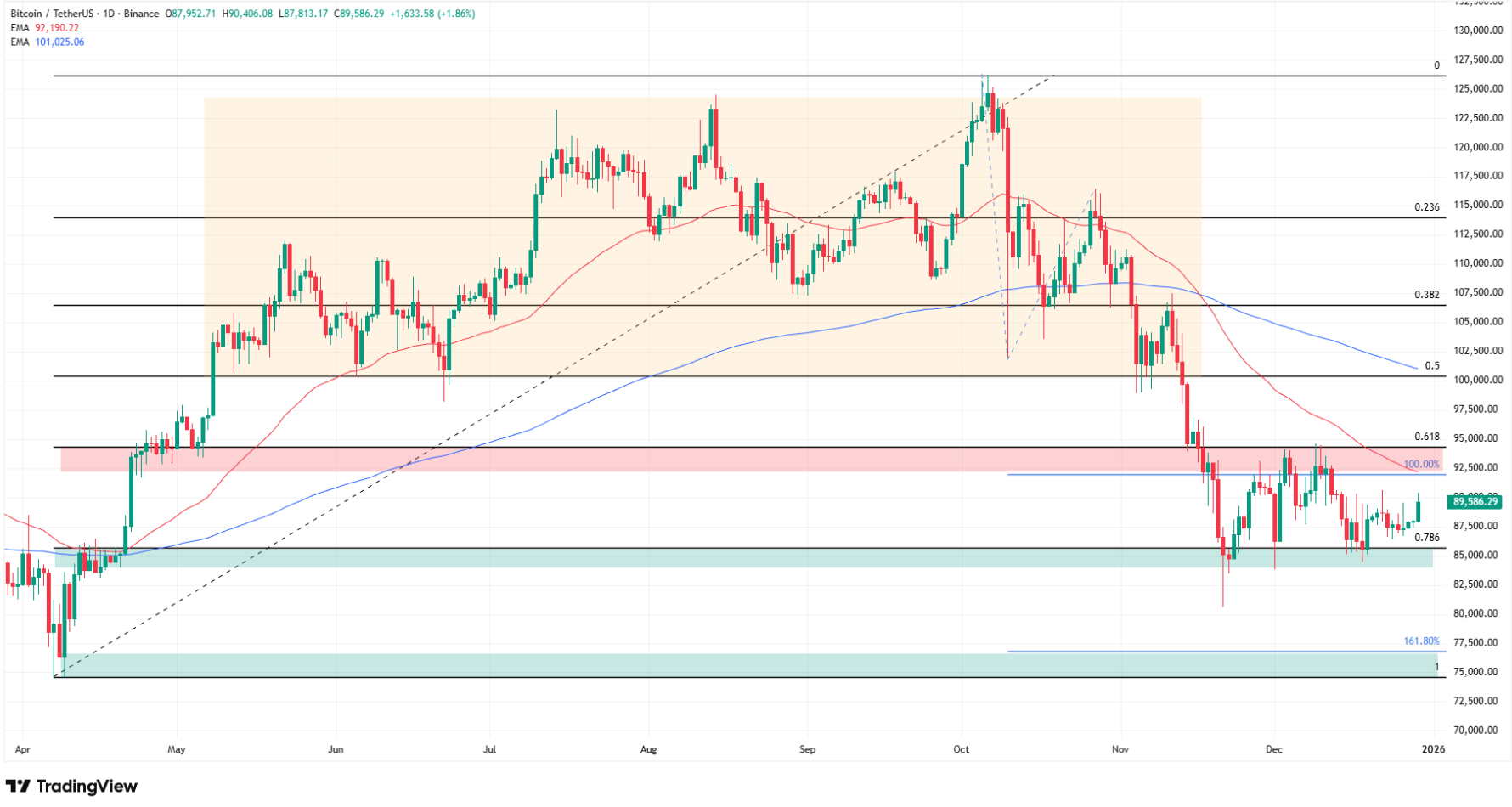
According
to my technical analysis, Bitcoin is consolidating within a range last seen in
April. The upper boundary sits between $90,000 and $92,000, reinforced by the
50-day exponential moving average and a 110% Fibonacci extension. The lower
limit rests at the 78.6% Fibonacci retracement and a $86,000-$84,000 zone
that's been actively tested since late November.
Why Bitcoin price is going up today? Source: Tradingview.com
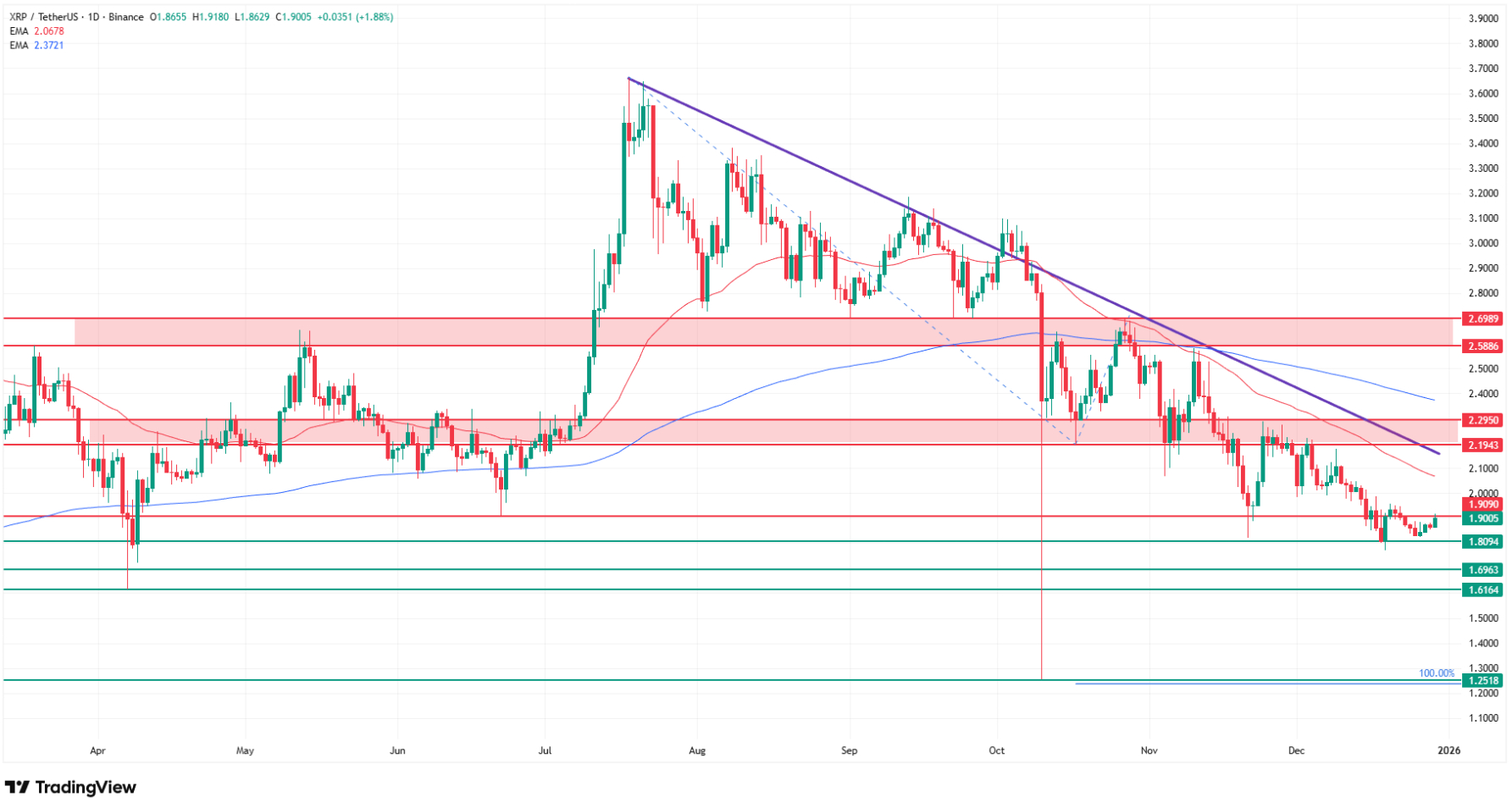
XRP In Bearish Trend
For XRP,
the picture looks similarly challenging. While the token tested $1.92 on Monday
before settling around $1.90, it faces resistance at a local level marked by
June lows and retested in November. The bearish moving average setup –
particularly the 50-200 EMA death cross that formed in early November –
suggests further downside. Initial support sits at $1.80, then $1.70-$1.61,
with an ultimate target around $1.25.
The chart
shows a network of significant resistance levels ahead, including the current
local zone being tested. I expect further depreciation, potentially before
year-end. Initial support sits at $1.80, representing this month's lows,
followed by the $1.70-$1.61 zone marked by April's lows. My ultimate target
sits around $1.25 – the flash crash lows from October 10 – which would
represent a decline of several dozen percentage points from current levels.
The price
currently trades below both key moving averages, which reinforces the bearish
outlook in the medium term.
Why XRP price is going up today? Source: Tradingview.com
Waiting for January
Catalysts?
Despite
growing institutional adoption and policy wins under the pro-crypto Trump
administration, Bitcoin has slipped roughly 4% in 2025. Many traders now look
to January for fresh catalysts as liquidity returns to markets.
"Looking
ahead, crypto's calm may prove temporary once liquidity returns and macro
narratives reassert themselves in the new year," Kruger said. "Should
easing expectations firm or risk appetite broaden further, Bitcoin and Ethereum
could re-engage from a position of relative balance rather than excess. In that
sense, the more subdued tone may be laying the groundwork for a more durable
[move] into the new year."
Asian
equity markets traded quietly on Monday, with thin year-end volumes keeping
activity muted. South Korea's KOSPI index provided an exception, rallying 1.7%
on gains in chipmaker stocks.
Crypto Price Analysis FAQ
Why did Bitcoin go up
today?
Bitcoin
rose over 2% on Monday as funding rates reached their highest level since
October 18, signaling renewed demand for bullish positions in perpetual futures
markets. The move appears driven by short-term retail traders rebuilding
leveraged positions after October's $19 billion liquidation event. Rising
geopolitical tensions from renewed Russia-Ukraine attacks also pushed investors
toward alternative assets.
Will Bitcoin go up in
2025?
Bitcoin has
declined roughly 4% in 2025 despite hitting an all-time high of $126,251 in
October. Analysts surveyed by CNBC predict prices could reach $150,000 to
$200,000 by year-end, driven by institutional adoption, favorable regulations
under the Trump administration, and growing corporate treasury strategies.
However, technical analysis suggests near-term consolidation with potential
downside to $74,000 before a sustained rally materializes.
Is Bitcoin a good
investment now?
Bitcoin
faces mixed signals in late 2025. While institutional inflows continue and 61
major US firms have adopted Bitcoin treasury strategies, the cryptocurrency
trades in a bearish technical pattern with resistance at $90,000-$92,000.
Volatility remains high, with historical corrections of 70-80% from peaks.
Long-term investors betting on continued institutional adoption may find
current levels attractive, but near-term traders should expect extended
sideways movement through early 2026.
What factors affect
Bitcoin's price?
Bitcoin's
price responds primarily to three forces: global liquidity measured by money
supply (M2), which explains over half of price variance; leverage in the
futures and derivatives markets; and on-chain fundamentals like mining
difficulty and holder behavior. Additional factors include institutional ETF
inflows, regulatory developments, geopolitical tensions affecting risk
appetite, and supply constraints from the halving cycle.
Bitcoin (BTC)
price broke above $90,000 early Monday, 29 December 2025, picking up momentum
as traders positioned for a potential new year rally after the cryptocurrency
sat out Wall Street's recent record-setting run.
The largest
digital asset by market value rose as much as 3.1% to $90,200 in Singapore
trading before pulling back slightly to $89,615, according to Bloomberg data.
Other major cryptocurrencies followed suit, with Ethereum climbing 4% past
$3,000, while XRP and Solana each gained 3% or more.
Bitcoin
largely ignored the S&P 500's push to record highs in the days before
Christmas, still nursing wounds from a brutal October selloff that wiped out
$19 billion in leveraged positions. That liquidation event left traders
gun-shy, with few willing to rebuild significant positions. Until now.
In this
article, I examine why Bitcoin and XRP are rising and provide a technical
analysis of the XRP/USDT and BTC/USDT charts, drawing on my more than a decade
of experience as an analyst and investor.
Why Bitcoin Is Going Up
Today?
Funding Rates Signal
Shifting Sentiment
Monday's
move "appears somewhat driven by short term retail traders taking on
growing positions in futures," said Sebastian Bea, Chief Investment
Officer at ReserveOne Inc., a crypto treasury firm.
Joel
Kruger, crypto strategist at LMAX, suggested the quiet conditions may be
deceptive. "Bitcoin, in particular, has already repriced meaningfully
higher this year and may now be absorbing supply as longer-term holders remain
patient," he said. "The market's ability to hold elevated levels
despite quiet conditions arguably reinforces the view that the marginal buyer
remains intact, even if currently inactive."
Please also check my previous cryptocurrency analyses:
The crypto
rally coincided with rising oil prices as hopes for a Russia-Ukraine peace deal
dimmed. West Texas Intermediate crude jumped 1% to $57.24 per barrel, while
Brent crude rose 0.80% to $60.81.
Russia
attacked Ukraine's Kherson Combined Heat and Power Plant on Sunday, causing
significant damage to infrastructure that provides heating for tens of
thousands of residents. Ukraine responded by striking the Syzran oil refinery
in Russia's Samara region, damaging the facility's only primary processing
unit.
The attacks
complicated diplomatic progress, even as President Donald Trump and Ukrainian
President Volodymyr Zelensky indicated headway on a 20-point peace plan. The
nearly four-year conflict has contributed to persistent global inflation
pressures.
Bitcoin And XRP Price
Technical Analysis
Bitcoin Under Pressure
According
to my technical analysis, Bitcoin is consolidating within a range last seen in
April. The upper boundary sits between $90,000 and $92,000, reinforced by the
50-day exponential moving average and a 110% Fibonacci extension. The lower
limit rests at the 78.6% Fibonacci retracement and a $86,000-$84,000 zone
that's been actively tested since late November.
Why Bitcoin price is going up today? Source: Tradingview.com
XRP In Bearish Trend
For XRP,
the picture looks similarly challenging. While the token tested $1.92 on Monday
before settling around $1.90, it faces resistance at a local level marked by
June lows and retested in November. The bearish moving average setup –
particularly the 50-200 EMA death cross that formed in early November –
suggests further downside. Initial support sits at $1.80, then $1.70-$1.61,
with an ultimate target around $1.25.
The chart
shows a network of significant resistance levels ahead, including the current
local zone being tested. I expect further depreciation, potentially before
year-end. Initial support sits at $1.80, representing this month's lows,
followed by the $1.70-$1.61 zone marked by April's lows. My ultimate target
sits around $1.25 – the flash crash lows from October 10 – which would
represent a decline of several dozen percentage points from current levels.
The price
currently trades below both key moving averages, which reinforces the bearish
outlook in the medium term.
Why XRP price is going up today? Source: Tradingview.com
Waiting for January
Catalysts?
Despite
growing institutional adoption and policy wins under the pro-crypto Trump
administration, Bitcoin has slipped roughly 4% in 2025. Many traders now look
to January for fresh catalysts as liquidity returns to markets.
"Looking
ahead, crypto's calm may prove temporary once liquidity returns and macro
narratives reassert themselves in the new year," Kruger said. "Should
easing expectations firm or risk appetite broaden further, Bitcoin and Ethereum
could re-engage from a position of relative balance rather than excess. In that
sense, the more subdued tone may be laying the groundwork for a more durable
[move] into the new year."
Asian
equity markets traded quietly on Monday, with thin year-end volumes keeping
activity muted. South Korea's KOSPI index provided an exception, rallying 1.7%
on gains in chipmaker stocks.
Crypto Price Analysis FAQ
Why did Bitcoin go up
today?
Bitcoin
rose over 2% on Monday as funding rates reached their highest level since
October 18, signaling renewed demand for bullish positions in perpetual futures
markets. The move appears driven by short-term retail traders rebuilding
leveraged positions after October's $19 billion liquidation event. Rising
geopolitical tensions from renewed Russia-Ukraine attacks also pushed investors
toward alternative assets.
Will Bitcoin go up in
2025?
Bitcoin has
declined roughly 4% in 2025 despite hitting an all-time high of $126,251 in
October. Analysts surveyed by CNBC predict prices could reach $150,000 to
$200,000 by year-end, driven by institutional adoption, favorable regulations
under the Trump administration, and growing corporate treasury strategies.
However, technical analysis suggests near-term consolidation with potential
downside to $74,000 before a sustained rally materializes.
Is Bitcoin a good
investment now?
Bitcoin
faces mixed signals in late 2025. While institutional inflows continue and 61
major US firms have adopted Bitcoin treasury strategies, the cryptocurrency
trades in a bearish technical pattern with resistance at $90,000-$92,000.
Volatility remains high, with historical corrections of 70-80% from peaks.
Long-term investors betting on continued institutional adoption may find
current levels attractive, but near-term traders should expect extended
sideways movement through early 2026.
What factors affect
Bitcoin's price?
Bitcoin's
price responds primarily to three forces: global liquidity measured by money
supply (M2), which explains over half of price variance; leverage in the
futures and derivatives markets; and on-chain fundamentals like mining
difficulty and holder behavior. Additional factors include institutional ETF
inflows, regulatory developments, geopolitical tensions affecting risk
appetite, and supply constraints from the halving cycle.
Damian Chmiel is a Senior Analyst & Editor at Finance Magnates with more than 15 years of experience in the CFD and online trading industry. Active as both a trader and journalist since 2010, he focuses on broker coverage, fintech innovation, and regulatory developments across Europe, the Middle East, and Asia.
His work includes interviews with C-level leaders at major brokerages and fintech platforms, as well as co-authoring Finance Magnates’ quarterly industry benchmarking reports. Damian’s reporting is data-driven, market-aware, and grounded in direct industry engagement. His analysis and commentary have also been cited by external media outlets, including Investing.com, Binance, The Asset, Stockhead, and Dispatch.
Education:
MA in Finance and Accounting, Cracow University of Economics
Why Is Dogecoin Going Up Today? DOGE Price Prediction Shows 25% Upside Potential
Featured Videos
AvaTrade to Acquire Most of FXCM; NAGA Raises $8M
AvaTrade to Acquire Most of FXCM; NAGA Raises $8M
AvaTrade to Acquire Most of FXCM; NAGA Raises $8M
AvaTrade to Acquire Most of FXCM; NAGA Raises $8M
Today’s financial news recap covers AvaTrade agrees to acquire most of FXCM, NAGA secures eight million dollars in new financing, and Wise seeks a tax settlement in the UK.
Finance Magnates Daily Recap brings you the latest news from forex and CFD brokers, fintech, payments, cryptocurrency, digital assets, trading platforms, financial regulation and global markets.
Get the key company news, executive moves, deals, regulatory updates and market developments of the day, in just a few minutes. New episodes published every weekday.
Read more: https://www.financemagnates.com
#FinanceMagnates #ForexNews #FintechNews
Today’s financial news recap covers AvaTrade agrees to acquire most of FXCM, NAGA secures eight million dollars in new financing, and Wise seeks a tax settlement in the UK.
Finance Magnates Daily Recap brings you the latest news from forex and CFD brokers, fintech, payments, cryptocurrency, digital assets, trading platforms, financial regulation and global markets.
Get the key company news, executive moves, deals, regulatory updates and market developments of the day, in just a few minutes. New episodes published every weekday.
Read more: https://www.financemagnates.com
#FinanceMagnates #ForexNews #FintechNews
Today’s financial news recap covers AvaTrade agrees to acquire most of FXCM, NAGA secures eight million dollars in new financing, and Wise seeks a tax settlement in the UK.
Finance Magnates Daily Recap brings you the latest news from forex and CFD brokers, fintech, payments, cryptocurrency, digital assets, trading platforms, financial regulation and global markets.
Get the key company news, executive moves, deals, regulatory updates and market developments of the day, in just a few minutes. New episodes published every weekday.
Read more: https://www.financemagnates.com
#FinanceMagnates #ForexNews #FintechNews
Today’s financial news recap covers AvaTrade agrees to acquire most of FXCM, NAGA secures eight million dollars in new financing, and Wise seeks a tax settlement in the UK.
Finance Magnates Daily Recap brings you the latest news from forex and CFD brokers, fintech, payments, cryptocurrency, digital assets, trading platforms, financial regulation and global markets.
Get the key company news, executive moves, deals, regulatory updates and market developments of the day, in just a few minutes. New episodes published every weekday.
Read more: https://www.financemagnates.com
#FinanceMagnates #ForexNews #FintechNews
XTB Adds Overnight US Stock Trading; Nasdaq Ventures Invests in One Trading
XTB Adds Overnight US Stock Trading; Nasdaq Ventures Invests in One Trading
XTB Adds Overnight US Stock Trading; Nasdaq Ventures Invests in One Trading
XTB Adds Overnight US Stock Trading; Nasdaq Ventures Invests in One Trading
XTB Adds Overnight US Stock Trading; Nasdaq Ventures Invests in One Trading
XTB Adds Overnight US Stock Trading; Nasdaq Ventures Invests in One Trading
Today’s financial news recap covers XTB expands overnight US stock trading, Fortrade reports higher revenue, Nasdaq backs One Trading, and Vest Labs raises 13 million dollars.
Finance Magnates Daily Recap brings you the latest news from forex and CFD brokers, fintech, payments, cryptocurrency, digital assets, trading platforms, financial regulation and global markets.
Get the key company news, executive moves, deals, regulatory updates and market developments of the day, in just a few minutes. New episodes published every weekday.
Read more: https://www.financemagnates.com
#FinanceMagnates #ForexNews #FintechNews
Today’s financial news recap covers XTB expands overnight US stock trading, Fortrade reports higher revenue, Nasdaq backs One Trading, and Vest Labs raises 13 million dollars.
Finance Magnates Daily Recap brings you the latest news from forex and CFD brokers, fintech, payments, cryptocurrency, digital assets, trading platforms, financial regulation and global markets.
Get the key company news, executive moves, deals, regulatory updates and market developments of the day, in just a few minutes. New episodes published every weekday.
Read more: https://www.financemagnates.com
#FinanceMagnates #ForexNews #FintechNews
Today’s financial news recap covers XTB expands overnight US stock trading, Fortrade reports higher revenue, Nasdaq backs One Trading, and Vest Labs raises 13 million dollars.
Finance Magnates Daily Recap brings you the latest news from forex and CFD brokers, fintech, payments, cryptocurrency, digital assets, trading platforms, financial regulation and global markets.
Get the key company news, executive moves, deals, regulatory updates and market developments of the day, in just a few minutes. New episodes published every weekday.
Read more: https://www.financemagnates.com
#FinanceMagnates #ForexNews #FintechNews
Today’s financial news recap covers XTB expands overnight US stock trading, Fortrade reports higher revenue, Nasdaq backs One Trading, and Vest Labs raises 13 million dollars.
Finance Magnates Daily Recap brings you the latest news from forex and CFD brokers, fintech, payments, cryptocurrency, digital assets, trading platforms, financial regulation and global markets.
Get the key company news, executive moves, deals, regulatory updates and market developments of the day, in just a few minutes. New episodes published every weekday.
Read more: https://www.financemagnates.com
#FinanceMagnates #ForexNews #FintechNews
Today’s financial news recap covers XTB expands overnight US stock trading, Fortrade reports higher revenue, Nasdaq backs One Trading, and Vest Labs raises 13 million dollars.
Finance Magnates Daily Recap brings you the latest news from forex and CFD brokers, fintech, payments, cryptocurrency, digital assets, trading platforms, financial regulation and global markets.
Get the key company news, executive moves, deals, regulatory updates and market developments of the day, in just a few minutes. New episodes published every weekday.
Read more: https://www.financemagnates.com
#FinanceMagnates #ForexNews #FintechNews
Today’s financial news recap covers XTB expands overnight US stock trading, Fortrade reports higher revenue, Nasdaq backs One Trading, and Vest Labs raises 13 million dollars.
Finance Magnates Daily Recap brings you the latest news from forex and CFD brokers, fintech, payments, cryptocurrency, digital assets, trading platforms, financial regulation and global markets.
Get the key company news, executive moves, deals, regulatory updates and market developments of the day, in just a few minutes. New episodes published every weekday.
Read more: https://www.financemagnates.com
#FinanceMagnates #ForexNews #FintechNews
CMC Founder Downplays Volatility Hit; Devexperts Names CEO
CMC Founder Downplays Volatility Hit; Devexperts Names CEO
CMC Founder Downplays Volatility Hit; Devexperts Names CEO
CMC Founder Downplays Volatility Hit; Devexperts Names CEO
CMC Founder Downplays Volatility Hit; Devexperts Names CEO
CMC Founder Downplays Volatility Hit; Devexperts Names CEO
Today’s financial news recap covers low volatility pressures brokers, Devexperts names a new CEO, Saxo cuts onboarding time, and OKX reaches a 25 billion dollar valuation.
Finance Magnates Daily Recap brings you the latest news from forex and CFD brokers, fintech, payments, cryptocurrency, digital assets, trading platforms, financial regulation and global markets.
Get the key company news, executive moves, deals, regulatory updates and market developments of the day, in just a few minutes. New episodes published every weekday.
Read more: https://www.financemagnates.com
#FinanceMagnates #ForexNews #FintechNews
Today’s financial news recap covers low volatility pressures brokers, Devexperts names a new CEO, Saxo cuts onboarding time, and OKX reaches a 25 billion dollar valuation.
Finance Magnates Daily Recap brings you the latest news from forex and CFD brokers, fintech, payments, cryptocurrency, digital assets, trading platforms, financial regulation and global markets.
Get the key company news, executive moves, deals, regulatory updates and market developments of the day, in just a few minutes. New episodes published every weekday.
Read more: https://www.financemagnates.com
#FinanceMagnates #ForexNews #FintechNews
Today’s financial news recap covers low volatility pressures brokers, Devexperts names a new CEO, Saxo cuts onboarding time, and OKX reaches a 25 billion dollar valuation.
Finance Magnates Daily Recap brings you the latest news from forex and CFD brokers, fintech, payments, cryptocurrency, digital assets, trading platforms, financial regulation and global markets.
Get the key company news, executive moves, deals, regulatory updates and market developments of the day, in just a few minutes. New episodes published every weekday.
Read more: https://www.financemagnates.com
#FinanceMagnates #ForexNews #FintechNews
Today’s financial news recap covers low volatility pressures brokers, Devexperts names a new CEO, Saxo cuts onboarding time, and OKX reaches a 25 billion dollar valuation.
Finance Magnates Daily Recap brings you the latest news from forex and CFD brokers, fintech, payments, cryptocurrency, digital assets, trading platforms, financial regulation and global markets.
Get the key company news, executive moves, deals, regulatory updates and market developments of the day, in just a few minutes. New episodes published every weekday.
Read more: https://www.financemagnates.com
#FinanceMagnates #ForexNews #FintechNews
Today’s financial news recap covers low volatility pressures brokers, Devexperts names a new CEO, Saxo cuts onboarding time, and OKX reaches a 25 billion dollar valuation.
Finance Magnates Daily Recap brings you the latest news from forex and CFD brokers, fintech, payments, cryptocurrency, digital assets, trading platforms, financial regulation and global markets.
Get the key company news, executive moves, deals, regulatory updates and market developments of the day, in just a few minutes. New episodes published every weekday.
Read more: https://www.financemagnates.com
#FinanceMagnates #ForexNews #FintechNews
Today’s financial news recap covers low volatility pressures brokers, Devexperts names a new CEO, Saxo cuts onboarding time, and OKX reaches a 25 billion dollar valuation.
Finance Magnates Daily Recap brings you the latest news from forex and CFD brokers, fintech, payments, cryptocurrency, digital assets, trading platforms, financial regulation and global markets.
Get the key company news, executive moves, deals, regulatory updates and market developments of the day, in just a few minutes. New episodes published every weekday.
Read more: https://www.financemagnates.com
#FinanceMagnates #ForexNews #FintechNews
Today’s financial news recap covers Trade Nation buys FXCM's UK client book, Trading 212 reports higher revenue, the CFTC's move to allow perpetual index futures.
Finance Magnates Daily Recap brings you the latest news from forex and CFD brokers, fintech, payments, cryptocurrency, digital assets, trading platforms, financial regulation and global markets.
Get the key company news, executive moves, deals, regulatory updates and market developments of the day, in just a few minutes. New episodes published every weekday.
Read more: https://www.financemagnates.com
#FinanceMagnates #ForexNews #FintechNews
Today’s financial news recap covers Trade Nation buys FXCM's UK client book, Trading 212 reports higher revenue, the CFTC's move to allow perpetual index futures.
Finance Magnates Daily Recap brings you the latest news from forex and CFD brokers, fintech, payments, cryptocurrency, digital assets, trading platforms, financial regulation and global markets.
Get the key company news, executive moves, deals, regulatory updates and market developments of the day, in just a few minutes. New episodes published every weekday.
Read more: https://www.financemagnates.com
#FinanceMagnates #ForexNews #FintechNews
Today’s financial news recap covers Trade Nation buys FXCM's UK client book, Trading 212 reports higher revenue, the CFTC's move to allow perpetual index futures.
Finance Magnates Daily Recap brings you the latest news from forex and CFD brokers, fintech, payments, cryptocurrency, digital assets, trading platforms, financial regulation and global markets.
Get the key company news, executive moves, deals, regulatory updates and market developments of the day, in just a few minutes. New episodes published every weekday.
Read more: https://www.financemagnates.com
#FinanceMagnates #ForexNews #FintechNews
Today’s financial news recap covers Trade Nation buys FXCM's UK client book, Trading 212 reports higher revenue, the CFTC's move to allow perpetual index futures.
Finance Magnates Daily Recap brings you the latest news from forex and CFD brokers, fintech, payments, cryptocurrency, digital assets, trading platforms, financial regulation and global markets.
Get the key company news, executive moves, deals, regulatory updates and market developments of the day, in just a few minutes. New episodes published every weekday.
Read more: https://www.financemagnates.com
#FinanceMagnates #ForexNews #FintechNews
Today’s financial news recap covers Trade Nation buys FXCM's UK client book, Trading 212 reports higher revenue, the CFTC's move to allow perpetual index futures.
Finance Magnates Daily Recap brings you the latest news from forex and CFD brokers, fintech, payments, cryptocurrency, digital assets, trading platforms, financial regulation and global markets.
Get the key company news, executive moves, deals, regulatory updates and market developments of the day, in just a few minutes. New episodes published every weekday.
Read more: https://www.financemagnates.com
#FinanceMagnates #ForexNews #FintechNews
Today’s financial news recap covers Trade Nation buys FXCM's UK client book, Trading 212 reports higher revenue, the CFTC's move to allow perpetual index futures.
Finance Magnates Daily Recap brings you the latest news from forex and CFD brokers, fintech, payments, cryptocurrency, digital assets, trading platforms, financial regulation and global markets.
Get the key company news, executive moves, deals, regulatory updates and market developments of the day, in just a few minutes. New episodes published every weekday.
Read more: https://www.financemagnates.com
#FinanceMagnates #ForexNews #FintechNews
Your career isn’t a linear path.
Your career isn’t a linear path.
Your career isn’t a linear path.
Your career isn’t a linear path.
Your career isn’t a linear path.
Your career isn’t a linear path.
Roles change. Career goals change. Sometimes you want a completely new challenge.
But the skills and knowledge you build along the way can stay with you and give you something to build on.
For Jeff Patterson, that continued growth is key to long-term career development.
You bring the skills. FM Academy helps you build the knowledge.
#FMAcademy #FinanceMagnates #FinanceCareers #ProfessionalDevelopment #Fintech
Roles change. Career goals change. Sometimes you want a completely new challenge.
But the skills and knowledge you build along the way can stay with you and give you something to build on.
For Jeff Patterson, that continued growth is key to long-term career development.
You bring the skills. FM Academy helps you build the knowledge.
#FMAcademy #FinanceMagnates #FinanceCareers #ProfessionalDevelopment #Fintech
Roles change. Career goals change. Sometimes you want a completely new challenge.
But the skills and knowledge you build along the way can stay with you and give you something to build on.
For Jeff Patterson, that continued growth is key to long-term career development.
You bring the skills. FM Academy helps you build the knowledge.
#FMAcademy #FinanceMagnates #FinanceCareers #ProfessionalDevelopment #Fintech
Roles change. Career goals change. Sometimes you want a completely new challenge.
But the skills and knowledge you build along the way can stay with you and give you something to build on.
For Jeff Patterson, that continued growth is key to long-term career development.
You bring the skills. FM Academy helps you build the knowledge.
#FMAcademy #FinanceMagnates #FinanceCareers #ProfessionalDevelopment #Fintech
Roles change. Career goals change. Sometimes you want a completely new challenge.
But the skills and knowledge you build along the way can stay with you and give you something to build on.
For Jeff Patterson, that continued growth is key to long-term career development.
You bring the skills. FM Academy helps you build the knowledge.
#FMAcademy #FinanceMagnates #FinanceCareers #ProfessionalDevelopment #Fintech
Roles change. Career goals change. Sometimes you want a completely new challenge.
But the skills and knowledge you build along the way can stay with you and give you something to build on.
For Jeff Patterson, that continued growth is key to long-term career development.
You bring the skills. FM Academy helps you build the knowledge.
#FMAcademy #FinanceMagnates #FinanceCareers #ProfessionalDevelopment #Fintech