US Futures Watchdog Posts Record $22.5 Million Surplus as It Halves Trading Fee

Wednesday, 25/11/2026 | 14:40 GMT by Damian Chmiel
  • The self-regulator lives mostly off a per-contract charge customers pay, and contract volume kept growing.
  • The cut returns the charge to its pre-2018 level until mid-2027, while swap dealers face higher annual dues.
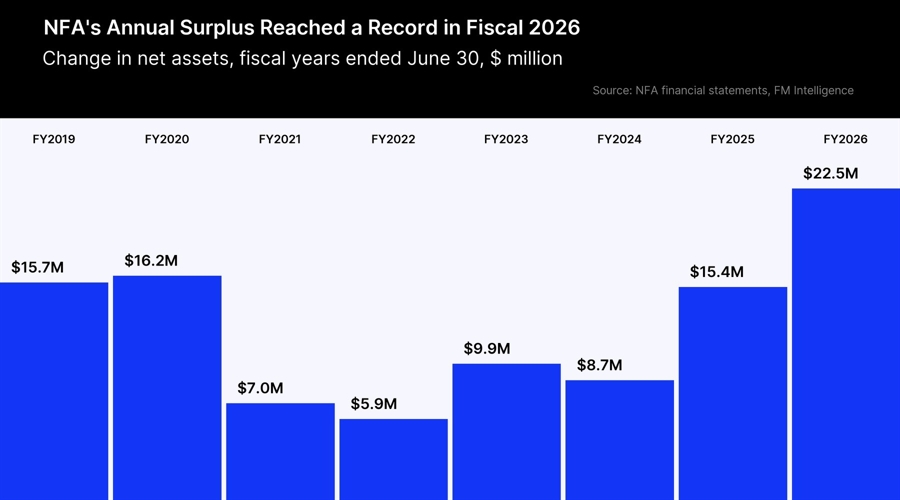
Bar chart of NFA's annual surplus, fiscal 2019-2026, at a record $22.5 million in fiscal 2026

The National Futures Association (NFA), the self-regulatory body of the US futures industry, ended its last fiscal year with a record $22.5 million surplus. It got there with fewer member firms than in any year of the past decade, FM Intelligence analysis published today (Wednesday) shows.

Most of that money comes from a fee charged on every futures trade, which brokers pass on to customers as a separate line on their statements. Contract volume kept rising, and fee income grew for a fifth straight year in fiscal 2026.

In May, NFA's Board voted to cut the fee from 2 cents to 1 cent per side for 12 months from July 1, 2026, FM Intelligence's analysis of the association's fiscal 2026 accounts shows.

That takes the fee back to where it stood before NFA doubled it in January 2018, citing the need to fund its operations and keep adequate reserves. It was only the fourth increase in the association's history.

Who Pays the Fee

For a customer trading through a US broker, the charge on a round turn, the opening and closing of one contract, falls from 4 cents to 2 cents until June 30, 2027. Options on futures are charged per trade, and that rate also halves to 1 cent.

The fee covers more than traditional futures. Event contracts listed as futures and carried by a futures commission merchant (FCM) are assessable, which brings part of the prediction-market business into NFA's funding base.

That business is moving inside the NFA perimeter. Prediction-market apps have been registering as introducing brokers under existing FCMs, and Polymarket's affiliate received NFA approval to operate as an FCM in November.

The Commodity Futures Trading Commission (CFTC ), which oversees NFA, is writing a framework for event contracts, the product line behind several of NFA's newest registrations.

Swap Dealers Pay More

Not every member shares in the cut. Swap dealers, whose part of NFA's budget sits below the floor of the association's own reserve policy, face higher annual dues from July 2026 and again from July 2027.

The increase is not spread evenly. The lowest-paying of the three swap dealer tiers rises the most, by FM Intelligence's calculation.

NFA also budgets for a cash deficit in fiscal 2027, according to its May filing with the CFTC. How far fee income falls in the year of the cut depends on contract volume, which the association does not set.

The full FM Intelligence analysis puts a range on fiscal 2027 fee income, sets NFA's cushion against its reserve target and shows what each swap dealer tier pays through 2028.

The fee is scheduled to return to 2 cents per side on July 1, 2027.

About the Author: Damian Chmiel
Damian Chmiel
  • 4236 Articles
  • 120 Followers
About the Author: Damian Chmiel
Damian Chmiel is a Senior Analyst & Editor at Finance Magnates with more than 15 years of experience in the CFD and online trading industry. Active as both a trader and journalist since 2010, he focuses on broker coverage, fintech innovation, and regulatory developments across Europe, the Middle East, and Asia. His work includes interviews with C-level leaders at major brokerages and fintech platforms, as well as co-authoring Finance Magnates’ quarterly industry benchmarking reports. Damian’s reporting is data-driven, market-aware, and grounded in direct industry engagement. His analysis and commentary have also been cited by external media outlets, including Investing.com, Binance, The Asset, Stockhead, and Dispatch. Education: MA in Finance and Accounting, Cracow University of Economics
  • 4236 Articles
  • 120 Followers

More from the Author

Institutional FX

!"#$%&'()*+,-./0123456789:;<=>?@ABCDEFGHIJKLMNOPQRSTUVWXYZ[\]^_`abcdefghijklmnopqrstuvwxyz{|} !"#$%&'()*+,-./0123456789:;<=>?@ABCDEFGHIJKLMNOPQRSTUVWXYZ[\]^_`abcdefghijklmnopqrstuvwxyz{|}