
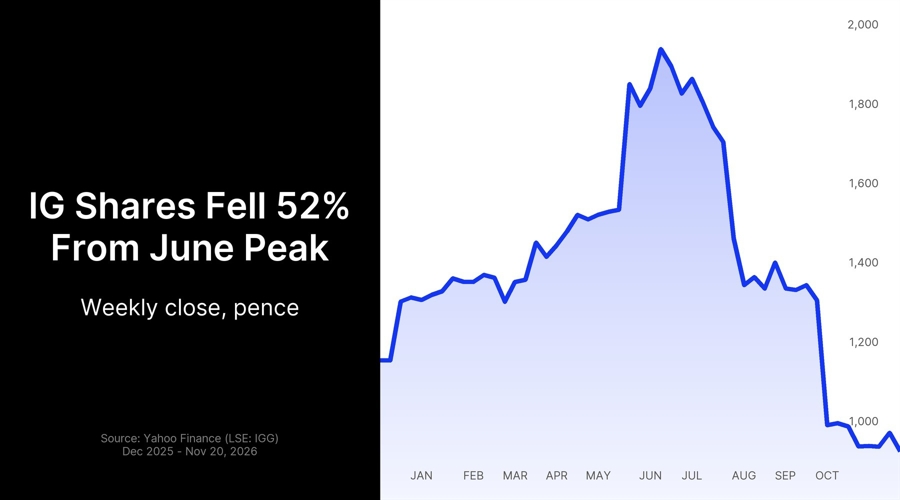
IG Group is set to leave London's FTSE 100 index after FTSE Russell named the online trading firm yesterday (Tuesday) as the only indicative deletion in its quarterly review. IG would move down to the FTSE 250.
One company is lined up to take the seat. The indicative addition is Airtel Mobile Commerce, the mobile-money business of Airtel Africa that trades as Airtel Money. FTSE Russell said it expects the stock to meet the index's 10% minimum free float once its IPO lock-ups expire within 12 months.
The demotion tracks a halving of IG's share price since the summer. The stock closed at 924 pence on Friday, November 20, the date the indicative list is based on, 52% below its record close of 1,938 pence on June 12, by FinanceMagnates.com's calculation from exchange data.
London's trading industry is coming home!
That price also sits 35% below the 1,423 pence at which IG ended its first day in the index on March 23, after FTSE Russell flagged it for promotion in February alongside the possible removal of easyJet.
Two Sessions Did Most of the Damage
Most of the fall came on two days. The shares dropped 14% on July 31, the session after IG reported half-year results and announced its planned acquisition of US prediction markets operator Underdog.
- IG Cancels 24.5 Million Treasury Shares After £32.9 Million Buyback
- IG Wants to Be Your Broker and Your Bookie
- IG Chief Questions What Kalshi and Polymarket Volume Records Are Worth
The bigger blow landed on October 2, when the stock closed 22.6% lower after IG cut its 2026 revenue growth outlook to mid-single digits. That reversed a May upgrade to growth of 10% to 15%, which had lifted the shares to a record.
IG blamed OTC revenue retention that slipped to 70% in the third quarter from an average of about 80%, and said quarterly revenue would fall about 14% to £240 million.
The selloff spread to other London-listed brokers on the same morning. CMC Markets and Plus500 fell as much as 9% and 14%. Plus500 later recovered to trade about 6% lower, less than a third of IG's 22.6% fall at the close.
The problem IG described was how much of its clients' trading it kept as revenue, not how much they traded. Its average monthly trading volume rose 11% in the third quarter from the second, according to estimates in FM Intelligence's Broker Volumes tracker.
Management Bought, the Price Kept Falling
IG's own executives have bought into the decline, so far at a paper loss.
Chief Executive Breon Corcoran and Chief Financial Officer Clifford Abrahams bought 80,000 shares between them in late October, with Corcoran paying £9.45 to £9.46 a share. The stock closed at 910 pence on Monday, below both purchase prices.
IG is reshaping its structure at the same time. A court approved its move to a Jersey holding company this month, part of about £30 million in non-recurring costs IG expects this year.
Its reorganization also includes closing offices in France, Spain and Italy, according to a report earlier this month.
IG's place will be settled on closing prices on Tuesday, December 1, with FTSE Russell confirming the changes after the market closes on Wednesday, December 2.


