High-Speed Trader Graviton Now Earns More in Singapore Than in India

Monday, 16/11/2026 | 08:26 GMT by Damian Chmiel
  • Its global unit's profit rose 166% to $142.4 million in the year to March, as the home business earned 25% less.
  • The jump made the co-founders billionaires, Bloomberg reported, as the firm hires for Europe and the US.
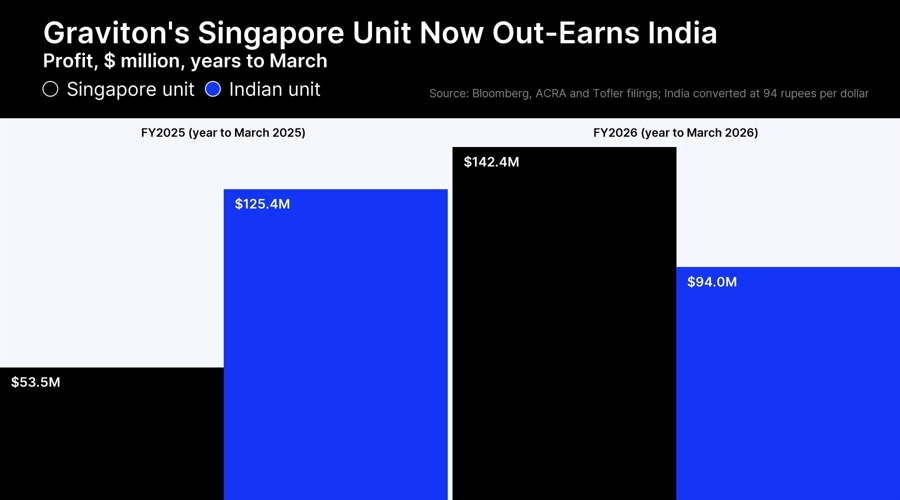
Graviton profit: Singapore unit $142.4M vs Indian unit $94.0M in FY2026

Graviton Research Capital's Singapore unit nearly tripled its annual profit to $142.4 million, Bloomberg reported today (Monday). The 166% rise in the year to March 2026 came as the Indian high-frequency trading firm earned 25% less at home.

That left Singapore ahead of India. The Indian unit's profit of 8.84 billion rupees is about $94 million at current exchange rates, by FinanceMagnates.com's calculation. A year earlier it was more than twice the Singapore figure.

Graviton became India's first billion-dollar quantitative trading venture, Bloomberg says. Proprietary traders made about 440 billion rupees in gross trading profit there last financial year, data from the Securities and Exchange Board of India (SEBI) show.

Algorithmic firms took 99% of the profit earned by proprietary traders and foreign investors in that period.

London's trading industry is coming home!

Singapore Now Carries Most of the Profit

The Singapore entity, which Graviton says represents its global business, more than doubled revenue to $239.4 million, a rise of 112%, Graviton told Bloomberg. Profit came to about 59% of that revenue.

"Our Singapore entity's growth reflects the strong momentum in our global business," a Graviton spokesperson said in an email to Bloomberg.

Larger market makers reported slower growth or declines in their latest results. Virtu Financial's net income rose 89.6% to $282.5 million in the third quarter, while Citadel Securities' UK market-making arm reported 2025 profit down 38.3% at $29.2 million.

The result helped lift the Gurugram-based firm's valuation by a third from $1.46 billion, the figure based on both entities' accounts for the year to March 2025. That puts co-founders Nishil Gupta and Ankit Gupta, both 39, at about $1 billion each, according to the Bloomberg Billionaires Index.

The two hold equal stakes, are not related and founded Graviton in 2014 after meeting at the Indian Institute of Technology in New Delhi. Nishil Gupta, a former vice president at WorldQuant, works on model design and risk, while Ankit Gupta runs technology and systems, Bloomberg reported.

Graviton is hiring in Singapore, Amsterdam and India. It has advertised for quantitative researchers graduating in 2027 to work in Singapore, London, Amsterdam or New York.

Two months ago it named Adam Celentano chief operating officer in the US, with a remit to build the business there, Bloomberg reported.

Home Market Turns Harder

In India, revenue at Graviton's local unit fell 11% to 22.8 billion rupees, according to a filing made available by data provider Tofler. Personnel expenses rose 21% to 11.6 billion rupees, or about half of that revenue.

The spokesperson put the declines down to "headwinds" in the Indian trading environment. Both entities also changed their accounting for the latest and prior year, so revenue is now shown net of trading expenses.

Bloomberg tied the tougher environment to regulation and competition. India reined in its options market after retail losses mounted, and SEBI found that nearly 91% of individual futures and options traders lost money in the year to March 2025.

Jane Street, Citadel Securities and Hudson River Trading have meanwhile expanded in India. The government also raised the securities transaction tax on futures and options from April 1, 2026, the first day of Graviton's current financial year.

Retail interest has cooled beyond the exchanges too. Organic traffic from India to retail broker websites fell 47.1% quarter on quarter in Q3 2026, FM Intelligence's FX/CFD heat map shows.

About the Author: Damian Chmiel
Damian Chmiel
  • 4188 Articles
  • 120 Followers
About the Author: Damian Chmiel
Damian Chmiel is a Senior Analyst & Editor at Finance Magnates with more than 15 years of experience in the CFD and online trading industry. Active as both a trader and journalist since 2010, he focuses on broker coverage, fintech innovation, and regulatory developments across Europe, the Middle East, and Asia. His work includes interviews with C-level leaders at major brokerages and fintech platforms, as well as co-authoring Finance Magnates’ quarterly industry benchmarking reports. Damian’s reporting is data-driven, market-aware, and grounded in direct industry engagement. His analysis and commentary have also been cited by external media outlets, including Investing.com, Binance, The Asset, Stockhead, and Dispatch. Education: MA in Finance and Accounting, Cracow University of Economics
  • 4188 Articles
  • 120 Followers

More from the Author

Institutional FX

!"#$%&'()*+,-./0123456789:;<=>?@ABCDEFGHIJKLMNOPQRSTUVWXYZ[\]^_`abcdefghijklmnopqrstuvwxyz{|} !"#$%&'()*+,-./0123456789:;<=>?@ABCDEFGHIJKLMNOPQRSTUVWXYZ[\]^_`abcdefghijklmnopqrstuvwxyz{|}